
June 3, 2026
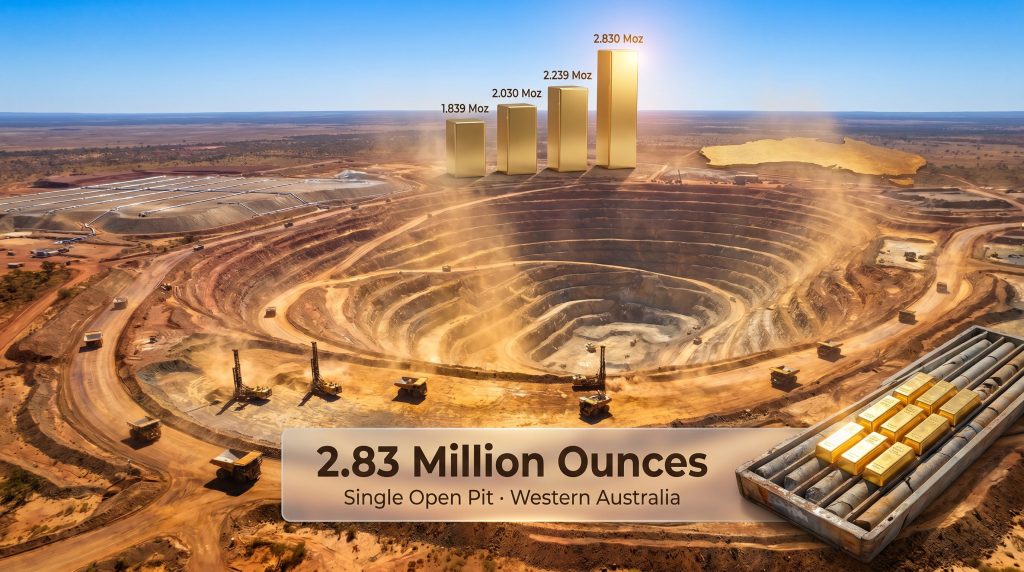
The Economics of Scale: Why Bulk-Mining Geometry Is Reshaping How Investors Value Undeveloped Gold
In gold exploration, the difference between a promising discovery and a genuinely fundable development project often comes down to geometry. Not just how many ounces sit in the ground, but how they are arranged, how confidently they can be defined, and whether a single, contiguous pit shell can capture the bulk of that value in one efficient sweep. These structural qualities determine capital intensity, financing appetite, and ultimately whether a project ever gets built.
Against that backdrop, the Saturn Metals Apollo Hill gold resource increase to 2.83 million ounces marks a meaningful inflection point, not merely in raw ounce count, but in the convergence of scale, confidence, and development-readiness that sophisticated investors and project lenders pay close attention to.
When big ASX news breaks, our subscribers know first
Apollo Hill Within Australia's Undeveloped Gold Landscape
Western Australia's Eastern Goldfields sits atop one of the world's most consistently productive gold-bearing geological corridors, a region defined by greenstone belts, shear-hosted lode systems, and the kind of geological repetition that rewards systematic exploration over time. The region has produced world-class operating mines for decades and continues to yield significant undeveloped inventories.
Within that context, reaching 2.83 million ounces within a single optimised open-pit shell places Apollo Hill in genuinely rare company among pre-production Australian gold assets. Most undeveloped gold inventories of comparable size are either fragmented across multiple pits, partially or predominantly underground, or carry elevated geological uncertainty in their resource classification. Apollo Hill's geometry avoids all three of those structural complications.
What a Single Whittle Pit Shell Actually Means
The term Whittle pit shell refers to a computerised optimisation process that calculates the theoretical economic boundary of an open-pit mine by integrating gold price assumptions, mining cost inputs, processing recoveries, and slope stability parameters. The output is the largest pit that remains economically positive under those assumptions.
The critical insight here is what it means when an entire 2.83-million-ounce resource sits entirely within one such shell. It implies:
- A single, consolidated infrastructure footprint rather than distributed processing or multiple mining fronts
- A low strip ratio, meaning the ratio of waste rock removed to ore processed remains manageable across the mine life
- Simplified mine scheduling, with ore progression through a single operating envelope
- Significantly reduced pre-production capital requirements compared to underground or multi-pit configurations
For investors, this translates into a cleaner capital efficiency story: more ounces, lower complexity, and a more predictable pathway to cashflow once development commences.
Eight Consecutive Resource Upgrades: A Quantitative Track Record
Consistent resource growth is genuinely uncommon in the pre-production gold space. Many projects deliver one or two upgrades before grade dilution, geological complexity, or funding constraints interrupt momentum. Apollo Hill has now delivered eight consecutive mineral resource estimate upgrades, each expanding both total contained ounces and resource confidence.
The trajectory over recent years tells a clear story:
| Resource Period | Tonnage (Mt) | Grade (g/t Au) | Contained Gold (Moz) | Growth vs. Prior |
|---|---|---|---|---|
| June 2023 | 105.0 | 0.54 | 1.839 | +370,000 oz (~25%) |
| 2024 Update | 118.7 | 0.53 | 2.030 | +190,000 oz |
| July 2025 Update | 137.1 | 0.51 | 2.239 | +209,000 oz |
| June 2026 Update | ~155+ | ~0.51 | 2.830 | +590,000 oz (+26%) |
Two observations stand out from this progression. First, the rate of ounce addition has actually accelerated in the most recent update, with 590,000 ounces added in the latest upgrade compared to incremental additions in prior rounds. Furthermore, these resource upgrade signals are precisely the kind of consistent, accelerating growth that institutional investors monitor when assessing pre-production gold assets.
Second, the average grade has moved from 0.54 g/t Au in 2023 to approximately 0.51 g/t Au in the current estimate, a modest dilution that reflects the deliberate inclusion of lower-grade bulk-mineable material consistent with a heap-leach processing model.
Why Gradual Grade Dilution Is Not a Red Flag Here
In conventional high-grade underground mining, declining average grades are a serious concern. In the context of a large-scale open-pit heap-leach operation, however, the calculus is entirely different. Heap-leach processing is economically optimised for volume throughput at lower grades, with operating costs per tonne substantially below those of conventional milling.
Adding lower-grade material to a heap-leach resource envelope expands the mineable inventory without fundamentally altering the processing economics, provided that material remains within the optimised pit shell. The grade maintenance at approximately 0.51 g/t Au across a growing tonnage base is therefore a positive indicator of geological consistency, not a warning sign.
The Drilling Campaign: Efficiency Metrics That Stand Out
The latest resource upgrade was underpinned by 367 reverse circulation and diamond drill holes totalling 62,385 metres, a program initiated in July 2025 and delivered with notable efficiency. When interpreting gold drill results of this scale, context is everything.
The standout productivity figure is the average return of 9.46 ounces of gold per metre drilled across the program. To contextualise this metric:
- Industry-wide exploration drilling in Australian gold projects routinely returns figures well below 5 oz/m at pre-resource stages
- Returning nearly double that average across a 62,000-metre program reflects both strong geological continuity and effective drill targeting
- This level of drilling efficiency reduces per-ounce discovery costs, a metric that institutional investors and project financiers use to benchmark capital deployment quality
The program combined infill drilling (increasing data density to convert inferred material into the higher-confidence measured and indicated categories) with extensional drilling targeting open mineralisation boundaries. This dual approach simultaneously grew the total resource and shifted its quality distribution toward more bankable classifications.
What 77% Measured and Indicated Means for Project Financing
Under the JORC Code (2012), which governs mineral resource reporting for ASX-listed companies, resources are classified into three tiers based on geological data density and confidence:
- Inferred resources carry the lowest confidence and are based on limited drilling data with assumed but not verified geological continuity
- Indicated resources reflect sufficient data density to support reasonable assumptions about grade and tonnage continuity
- Measured resources carry the highest confidence, with detailed sampling confirming grades and geological characteristics to a high degree
The current Apollo Hill resource breakdown, as detailed in the July 2025 resource update, is as follows:
- Measured + Indicated: approximately 2.19 million ounces (77% of total MRE)
- Inferred: approximately 640,000 ounces (23% of total MRE)
A 77% measured and indicated proportion significantly exceeds the typical 50–70% range observed across comparable pre-DFS Australian gold projects, positioning Apollo Hill above the confidence threshold that most project lenders and institutional equity investors require before committing capital.
The addition of 350,000 ounces specifically to the measured and indicated categories in the most recent upgrade is arguably more significant than the total ounce growth figure. Raw resource size attracts attention; high-confidence classification converts that attention into financing conversations.
Ore reserve declarations under JORC 2012 can only be derived from measured and indicated resources — inferred material cannot directly support a reserve. Consequently, with 77% of the resource at sufficient confidence, Saturn Metals has substantially derisked the pathway toward an ore reserve and, by extension, toward project debt financing.
Development Catalysts: DFS, Ore Reserve, and Open Extensions
The updated mineral resource estimate now forms the primary input document for the Apollo Hill definitive feasibility study, with both the DFS and an updated ore reserve targeted for release in 2026. Understanding the difference between these documents matters for investors tracking the project's development trajectory:
- An MRE defines what is in the ground at a given confidence level, using geological and sampling data
- An ore reserve converts a subset of that resource into economically mineable tonnes by applying modifying factors including mining method, processing recovery, capital costs, and prevailing commodity prices
- A DFS integrates the ore reserve with full engineering, environmental, infrastructure, and financial modelling to produce a bankable project assessment
Each step in this progression reduces project risk and increases the probability of a positive final investment decision. Saturn Metals has confirmed that mineralisation at Apollo Hill remains open in several directions, with planned drilling continuing to target near-surface and lateral extensions. Further resource growth is plausible, though forward-looking statements about resource expansion should be treated as exploratory in nature rather than guaranteed outcomes.
The next major ASX story will hit our subscribers first
Apollo Hill vs. Peer Group Undeveloped Australian Gold Projects
Positioning Apollo Hill within the broader landscape of undeveloped ASX gold assets highlights the project's relative differentiation:
| Metric | Apollo Hill (Saturn Metals) | Typical Large Undeveloped ASX Gold Project |
|---|---|---|
| Total Resource | 2.83 Moz | 1.0 to 2.5 Moz |
| Configuration | Single open pit | Often multi-pit or underground |
| M&I Proportion | 77% | 50 to 70% (typical pre-DFS) |
| Drilling Efficiency | 9.46 oz/m | Generally below 5 oz/m |
| Development Stage | Pre-DFS (targeted 2026) | Variable |
| Jurisdiction | WA Eastern Goldfields | Predominantly WA, QLD, NT |
The Eastern Goldfields jurisdiction adds a further layer of structural value. The region offers established road and rail infrastructure, a deep pool of experienced mining contractors and geological professionals, and a regulatory framework with clear permitting pathways for open-pit gold operations.
The Gold Price Environment and Its Effect on Bulk-Mining Economics
The gold price outlook is a critical variable for bulk-mining economics, and gold prices trading above AUD 4,400/oz in mid-2026 create a materially supportive backdrop for Apollo Hill's development. This matters in a specific and technical way for this project type.
Whittle pit shell optimisations are highly sensitive to the gold price assumption used as an input. At higher gold prices, the economic pit boundary expands, capturing additional lower-grade material that would not be economic at lower prices. This means that the current AUD gold price environment is likely to have directly contributed to the scale of the Saturn Metals Apollo Hill gold resource increase by expanding the economically viable pit boundary.
For large-scale heap-leach operations, sustained high gold prices also compress payback periods, improve net present value sensitivity, and reduce the grade floor required to generate positive margins. Projects like Apollo Hill, which prioritise volume throughput over selective high-grade mining, benefit disproportionately from gold price strength compared to lower-tonnage, higher-grade alternatives. In addition, understanding cut-off grade economics is essential context when evaluating how gold price shifts reshape the boundaries of viable open-pit resources.
Investors should note that all resource estimates, DFS projections, and economic assessments are subject to commodity price assumptions that may not reflect future market conditions. This article does not constitute financial advice, and past resource growth is not a guarantee of future development outcomes.
Frequently Asked Questions: Saturn Metals Apollo Hill Gold Resource
What is the current total gold resource at Apollo Hill?
The total mineral resource estimate stands at 2.83 million ounces of gold across measured, indicated, and inferred categories, reflecting a 26% increase from the prior estimate and representing an addition of more than 590,000 ounces.
What drilling program supported the 2026 resource update?
The update was based on 367 reverse circulation and diamond drill holes totalling 62,385 metres, commenced in July 2025. The program returned an average of 9.46 ounces of gold per metre drilled across the entire campaign.
What is a Whittle pit shell and why does it matter?
A Whittle pit shell is a computerised optimisation defining the theoretical economic boundary of an open-pit mine based on gold price, mining cost, and metallurgical recovery assumptions. The fact that the Saturn Metals Apollo Hill gold resource increase has resulted in an entire 2.83-million-ounce inventory sitting within a single shell confirms its potential as a large-scale, structurally efficient bulk-mining operation.
When is the Apollo Hill DFS expected?
Saturn Metals has targeted the definitive feasibility study and an updated ore reserve for release later in 2026, with the updated MRE serving as the primary input document.
Has Apollo Hill's grade declined as the resource has grown?
The average grade has moved from 0.54 g/t Au in June 2023 to approximately 0.51 g/t Au currently. This reflects the deliberate addition of lower-grade bulk-mineable material consistent with a heap-leach processing strategy, rather than indicating geological deterioration.
Does open mineralisation mean further resource growth is possible?
Saturn Metals has confirmed that mineralisation remains open in multiple directions, with ongoing drilling targeting near-surface and lateral extensions. While further growth is plausible, any future additions to the Saturn Metals Apollo Hill gold resource increase trajectory are subject to drilling results and should not be treated as assured outcomes.
Want To Be First When The Next Major ASX Gold Discovery Hits The Market?
Discovery Alert's proprietary Discovery IQ model delivers real-time alerts on significant ASX mineral discoveries — turning complex geological data into actionable investment insights the moment they're announced. Explore historic discovery returns that demonstrate the potential of getting in early, and start your 14-day free trial at Discovery Alert to position yourself ahead of the broader market.