West Cobar Metals Ltd
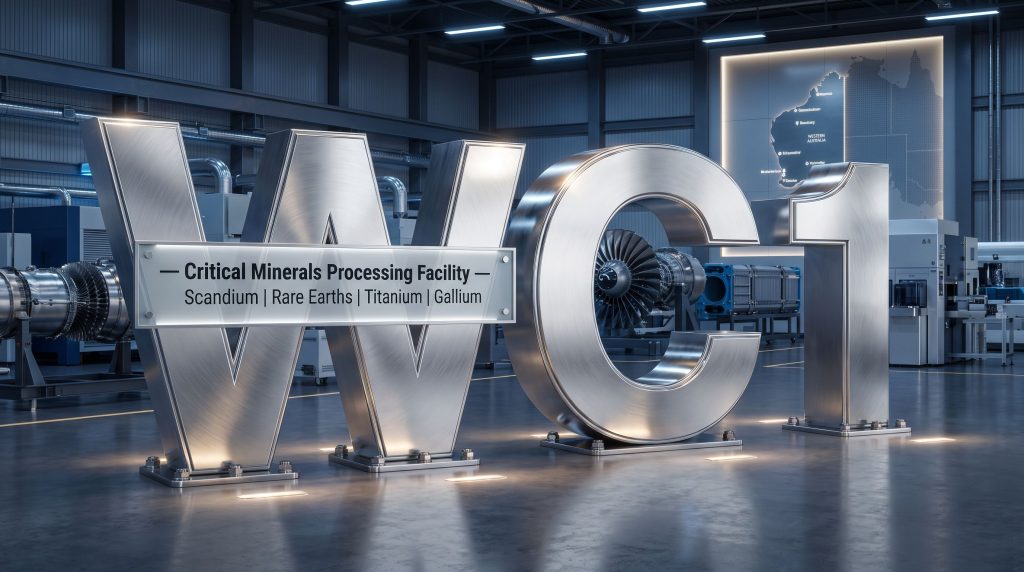
- ASX Code: WC1
- Market Cap: $6,654,765
West Cobar Metals Fast-Tracks Scandium Ambitions as Global Supply Chain Urgency Grows
The West Cobar Metals Salazar scandium project update signals a company moving with purpose. West Cobar Metals (ASX: WC1) has reported accelerating workstreams at its Salazar Critical Minerals Project in Western Australia, with a clear focus on unlocking scandium potential. Approvals are underway for a targeted aircore drilling programme, metallurgical testwork is advancing, and a shifting global supply picture is placing renewed attention on Western scandium developers.
According to the announcement, the coordinated push spans drilling, metallurgy and project development. Aircore drilling targeting higher-grade scandium zones within the Newmont deposit is scheduled for Q4 2026, while atmospheric-leach metallurgical results are providing early indications of a potentially lower-cost processing pathway — a factor that carries significant weight when comparing project economics against global peers.
When big ASX news breaks, our subscribers know first
Why Scandium, Why Now?
Scandium remains a relatively unfamiliar critical mineral to many investors, however, its strategic profile is growing. The metal is used in aerospace-grade aluminium alloys, solid oxide fuel cells, defence technologies, semiconductor manufacturing and advanced materials. China has held a dominant position in global scandium supply for years, a concentration that is drawing increasing attention from Western governments as export controls tighten.
That attention was illustrated recently when the US Government's Department of War, through its Office of Strategic Capital (OSC), announced a US$400 million conditional loan commitment to Sunrise Energy Metals (ASX: SRL) for its New South Wales scandium project. The financing commitment indicates that scandium has entered discussions at senior levels of Western supply-chain strategy.
Managing Director Matt Szwedzicki commented: "The timing for accelerating efforts to develop a scandium project could not be better, with the recently announced US$400 million US Government's Department of War's Office of Strategic Capital's (OSC) conditional debt funding to Sunrise Energy Metals Limited (ASX:SRL), that demonstrates the strategic priority placed on secure scandium supply chains."
For WC1, this external development reinforces the company's decision to accelerate activity at Salazar — a project hosting scandium within a broader critical minerals system that also includes rare earth elements, titanium, gallium and alumina.
The Salazar Project: A Multi-Commodity Critical Minerals Platform
Located approximately 120 km north-east of Esperance in Western Australia, the Salazar Project is not a single-commodity proposition. It hosts a large, shallow saprolite-hosted critical minerals system enriched over underlying amphibolite rock — a geological setting that may support low-strip, open-pit mining and potentially lower-cost processing methods.
Current JORC Mineral Resource Estimates across commodities are set out below.
| Commodity | Resource Quantity | Grade | Classification |
|---|---|---|---|
| Scandium | 15 Mt | 153 ppm Sc₂O₃ | Inferred |
| Rare Earth Elements (TREO) | 230 Mt | 1,178 ppm TREO | Total Indicated and Inferred |
| REE (Indicated only) | 44 Mt | 1,239 ppm TREO | Indicated (600 ppm cut-off) |
| Titanium Dioxide (TiO₂) | 42 Mt | 5.2% TiO₂ | Inferred |
| Gallium | 263 Mt | 35 ppm Ga₂O₃ | Inferred |
| Alumina | 4 Mt | 29.7% Al₂O₃ | Inferred |
This multi-commodity profile is a notable feature of the project. The rare earth resource includes elevated concentrations of heavy rare earth elements (HREE), specifically dysprosium (Dy) and terbium (Tb), which are considered among the more strategically significant elements given current supply constraints.
The potential to recover scandium alongside rare earth by-products could provide additional economic support to any future development scenario, subject to further studies.
Drilling in on the High-Grade Opportunity
The existing scandium Inferred Resource of 15 Mt at 153 ppm Sc₂O₃ was defined using a relatively wide drill spacing of 500m x 100m — a grid designed primarily to establish the larger REE and TiO₂ resource rather than to optimise the scandium picture specifically.
Within that broader dataset, previously reported drill intersections have pointed to discrete zones of higher-grade scandium mineralisation, including:
- SAC358: 13m of 318 ppm Sc₂O₃ from 9m depth, including 3m of 649 ppm Sc₂O₃ from 10m
- SAC391: 11m of 282 ppm Sc₂O₃ from 6m depth, including 4m of 350 ppm Sc₂O₃ from 9m
These intersections suggest the existing resource estimate may understate pockets of higher-grade material. The planned aircore drilling programme, targeting a tighter 100m x 50m drill pattern around these anomalous zones, is designed to test the geometry, continuity and possible extensions of this higher-grade scandium mineralisation.
Approvals processes are progressing, with the drill programme targeted to commence during Q4 2026. A successful campaign could support a future Mineral Resource update focused specifically on the scandium opportunity, though this remains subject to drilling outcomes.
Metallurgy: The Case for Lower-Cost Processing
What Is Atmospheric-Pressure Acid Leaching, and Why Does It Matter?
Many scandium projects globally require high-pressure autoclaves or elevated-temperature processing to extract scandium from ore. This equipment tends to be capital-intensive and costly to operate. Atmospheric-pressure acid leaching, by contrast, operates at ambient pressure and comparatively moderate temperatures — a distinction that can meaningfully reduce both capital expenditure and operating costs.
For investors assessing project economics, the choice of processing route is often a key variable. A lower-cost processing pathway, if confirmed through further studies, could improve project margins and lower the capital hurdle required to reach production.
At Salazar, furthermore, early metallurgical results point in this direction:
- Up to 81% scandium recovery reported using atmospheric-pressure acid leaching (July 2024)
- Up to 39% scandium extraction achieved under atmospheric conditions via bioleaching screening testwork conducted by BiotaTec (May 2026)
WC1 has stated that further testwork and development studies are required before flowsheet performance, recoveries, costs and project economics can be fully assessed. The preliminary results nonetheless support continued evaluation of atmospheric-pressure processing routes and distinguish Salazar from projects reliant on higher-cost, high-pressure processing methods.
Key Terms Explained
- Atmospheric-pressure acid leaching: A chemical process using acid to dissolve target minerals at ambient pressure and moderate temperature, typically lower cost than pressure-based alternatives.
- Bioleaching: The use of microorganisms to extract metals from ore, offering a potentially lower-energy processing route.
- Saprolite: Deeply weathered rock near the surface that is often easier and cheaper to mine and process than fresh rock.
- TREO: Total Rare Earth Oxides, a measure of the combined rare earth content in ore.
- HREE: Heavy Rare Earth Elements, a subset of rare earths considered scarcer and more strategically significant than light rare earths.
- Sc₂O₃: Scandium oxide, the standard reporting form for scandium grades in mineral resource estimates.
- JORC: The Joint Ore Reserves Committee Code, the Australasian standard for reporting mineral resource and ore reserve estimates.
What Comes Next: A Defined Activity Schedule
WC1 has outlined a near-term work programme across several parallel workstreams.
Drilling
- Progress regulatory approvals for the planned aircore drilling programme
- Commence aircore drilling targeting higher-grade scandium zones in Q4 2026
Metallurgy and Processing
3. Advance metallurgical testwork, including heap-leach evaluation, scandium recovery testing and mixed rare earth carbonate (MREC) potential
4. Undertake further bioleaching testwork
5. Progress integrated flowsheet demonstration and staged development studies (Scoping / Pre-Feasibility Study)
Commercial and Strategic Development
6. Continue engagement on potential US funding and offtake pathways
The combination of near-term drilling activity and ongoing metallurgical results points to a sequence of newsflow expected through the second half of 2026 and into 2027.
The Investment Thesis: Multiple Factors, One Project
WC1's positioning at this stage rests on several factors that investors may wish to monitor closely.
High-value commodity in a tightening market: Scandium supply is concentrated and subject to geopolitical risk, illustrated by tightening Chinese export controls. Western governments and industries are seeking alternative supply sources, and recent financing activity involving a peer company suggests this demand is translating into tangible capital commitments.
Existing resource with upside potential: The 15 Mt Inferred scandium resource provides a foundation, however, the wide original drill spacing means there may be scope for a higher-grade resource to be defined through tighter infill drilling — which the Q4 2026 programme is specifically designed to test.
Potentially lower-cost processing pathway: Early atmospheric leach results differentiate Salazar from projects requiring more expensive processing infrastructure. Should further testwork confirm a viable atmospheric processing route, this could represent a competitive advantage in project economics, subject to further validation.
Multi-commodity optionality: The rare earth, titanium, gallium and alumina resources at Salazar provide additional value considerations that could be developed alongside or in conjunction with the scandium pathway. HREE content, including dysprosium and terbium, adds further strategic relevance to the resource base.
Active engagement on US funding and offtake pathways: The US$400 million conditional loan commitment to another ASX-listed scandium developer illustrates the type of institutional interest available to qualifying projects. WC1 has flagged continued engagement on US funding and offtake pathways as an active workstream, though no agreements specific to WC1 have been confirmed at this stage.
The next major ASX story will hit our subscribers first
Why Investors Should Watch WC1 Closely
West Cobar Metals is entering a period of operational activity at Salazar, with the Q4 2026 drilling programme set to deliver the project's first results specifically targeting scandium grade and continuity. Combined with advancing metallurgical work and a global market placing increasing strategic and financial weight on non-Chinese scandium supply, the company appears well positioned to generate ongoing newsflow over coming months.
The Salazar project's combination of scandium, rare earths, titanium, gallium and alumina within a single, shallow, open-pittable system is uncommon among ASX-listed peers. In addition, early processing indicators suggest a potentially lower-cost development pathway, though this requires further confirmation through testwork.
The broader market context — anchored by the US$400 million commitment to a peer scandium project — reflects growing institutional interest in Western scandium supply chains. Consequently, the West Cobar Metals Salazar scandium project update represents a timely catalyst for investors monitoring this space.
Key takeaway: West Cobar Metals has positioned the Salazar Project as a scandium development candidate at a time when demand for secure Western supply chains is gaining momentum. With drilling targeted for Q4 2026, metallurgical programmes advancing, and US engagement pathways being explored, investors may wish to monitor developments closely over the coming catalyst period.
Ready to Learn More About West Cobar Metals and the Salazar Project?
With drilling targeted for Q4 2026, advancing metallurgical testwork, and a global shift toward securing Western scandium supply chains, West Cobar Metals (ASX: WC1) is entering a defining period for the Salazar Critical Minerals Project. Investors seeking to understand the full scope of the opportunity — spanning scandium, rare earths, titanium, gallium and alumina — can explore the company's latest updates, project details and corporate information by visiting www.westcobarmetals.com.au.