August 9, 2026
The Metallurgy of National Security: Why Scandium Is Rewriting U.S. Defense Procurement
Advanced materials science rarely captures mainstream attention, yet the metals underpinning next-generation aerospace platforms often determine strategic outcomes long before a conflict begins. Scandium sits in this understated category: a silvery-white element so sparingly distributed in the Earth's crust that most engineers encountered it only in academic literature until relatively recently. Today, however, that picture is changing rapidly. The Lockheed NioCorp scandium supply deal, formalised through a memorandum of understanding in August 2026, offers a rare window into how the U.S. defense industrial base is quietly restructuring its upstream material dependencies, one specialty metal at a time.
When big ASX news breaks, our subscribers know first
Understanding the MOU: Structure, Scope, and Commercial Reality
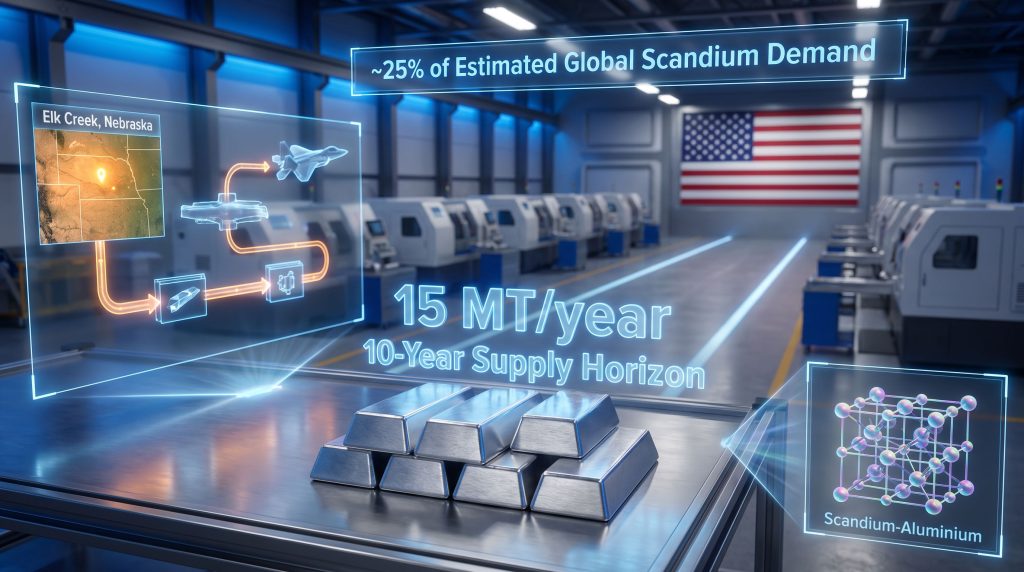
The agreement between Lockheed Martin and NioCorp Developments Ltd. establishes a non-binding framework under which Lockheed Martin could acquire up to 15 metric tons of scandium oxide annually over a 10-year period. Crucially, the material may be delivered either as refined scandium oxide or as finished aluminium-scandium alloys, giving the defense contractor flexibility in how it integrates the supply into its manufacturing workflows.
Both parties have committed to negotiating toward a definitive binding contract in good faith. However, NioCorp has been explicit that no assurance exists that a final agreement will be reached, nor that any particular commercial terms will result. This distinction is commercially significant.
A memorandum of understanding establishes intent and direction, not obligation. Investors evaluating the commercial weight of this arrangement should distinguish clearly between a signed offtake contract and an agreement to negotiate toward one.
The MOU also reflects a broader pattern emerging across U.S. defense procurement. Furthermore, prime contractors are increasingly engaging upstream mineral developers at early stages, using non-binding frameworks to signal demand without committing capital before domestic supply infrastructure is proven.
Key structural terms at a glance:
- Volume ceiling: Up to 15 metric tons of scandium oxide per year
- Duration: 10-year supply horizon
- Delivery optionality: Scandium oxide or aluminium-scandium alloys at the buyer's discretion
- Binding status: Non-binding; subject to further good-faith negotiation
- Relationship context: Built on a joint development programme active since October 2025
Why Scandium Performs Unlike Any Other Lightweight Metal Additive
To understand why defense contractors are willing to pursue long-term agreements for a metal with annual global demand measured in tens of metric tons, it helps to understand what scandium actually does at the atomic level.
Scandium, when added to aluminium at concentrations as low as 0.2% to 0.8% by weight, produces a microstructural effect that no other alloying element replicates cost-effectively. It refines the grain structure of aluminium during solidification, producing smaller, more uniform crystals that resist deformation under mechanical stress. The result is an alloy with substantially improved tensile strength, superior weld joint integrity, and markedly better resistance to corrosion — all without the weight penalty associated with steel or titanium reinforcement.
For aerospace structural applications, particularly in platforms where every kilogram of structural mass reduces payload capacity or fuel efficiency, this combination of properties is extraordinarily valuable. Indeed, the critical minerals demand surge in aerospace applications has only accelerated interest in scandium's unique capabilities.
Scandium Concentration by Application
| Scandium Content | Product Form | Primary Use Case | Key Performance Attribute |
|---|---|---|---|
| 2% to 4% scandium | Master alloy | Intermediate feedstock for downstream alloying | High-concentration base for dilution into finished alloy |
| 0.2% to 0.8% scandium | Finished ingot | Defense and commercial aerospace components | Strength, weld performance, corrosion resistance |
| Pure scandium oxide | Upstream feedstock | Converted to alloy or used in specialty ceramics | Precursor material for all downstream uses |
This tiered structure matters because NioCorp's manufacturing capability addresses multiple levels simultaneously. The company currently produces a 4% aluminium-scandium master alloy using market-sourced scandium oxide, and is developing capacity to manufacture finished ingots in the lower concentration range suited for direct use in aerospace structures.
Why Scandium's Weldability Advantage Is Underappreciated
One less commonly understood property of scandium-aluminium alloys is their exceptional behaviour under welding conditions. Conventional high-strength aluminium alloys frequently suffer from heat-affected zone weakness during welding, a problem that limits their structural application in complex fabricated assemblies. Scandium additions suppress this degradation by stabilising the grain structure even at elevated temperatures.
For fighter aircraft airframes and hypersonic system structures, which involve highly complex welded subassemblies, this property is operationally critical and distinguishes scandium-enhanced alloys from competing material solutions.
The Global Supply Concentration Problem and Why It Matters Now
According to U.S. Geological Survey data, global scandium demand sits at approximately 60 metric tons per year, a figure that has been growing as aerospace and defense applications expand. The proposed volume under the Lockheed NioCorp scandium supply deal, at up to 15 metric tons annually, would represent roughly one quarter of total current global consumption. This is not a marginal transaction; it is a structurally significant offtake framework relative to the size of the existing market.
The concentration of current scandium supply in Chinese producers creates an asymmetric vulnerability for U.S. defense planners. China controls the majority of global scandium production, much of it recovered as a byproduct of titanium and uranium processing. Consequently, the broader geopolitical metals landscape has sharpened the urgency of developing domestic alternatives.
Unlike rare earth elements, where the supply chain problem is widely understood in policy circles, scandium's strategic exposure has historically received less attention — partly because demand volumes are smaller and partly because the metal's defense applications have been less publicised.
As of mid-2026, the United States has no commercial-scale domestic scandium mine in production. The entire domestic defense aerospace sector currently depends on foreign-sourced material for any scandium it uses.
This dependency is what makes the Elk Creek project, and by extension the Lockheed NioCorp scandium supply deal, structurally important beyond its headline volume figures. In the context of strategic mineral supply chains, few domestic projects carry as much potential significance.
NioCorp's Elk Creek Project: What the Deposit Offers
The Elk Creek critical minerals deposit, located approximately 65 miles southeast of Lincoln, Nebraska, is one of the few known domestic resources capable of supporting commercial-scale scandium production. The project targets three primary minerals: niobium, scandium, and titanium, with additional work underway to evaluate the potential for rare earth element recovery from the same orebody.
The 2022 feasibility study projected annual scandium oxide production of approximately 104 metric tons once the project reaches full operational status following financing and construction. The proposed MOU volume of 15 metric tons per year would represent roughly 14% of that projected annual output, leaving substantial capacity available for additional offtake arrangements or spot market sales.
Several geological characteristics of Elk Creek make it particularly suitable for the kind of supply chain NioCorp is attempting to build:
- The deposit is a carbonatite-hosted critical minerals system, a geological formation type known for concentrated multi-element mineralisation
- Niobium is typically the primary value driver in such deposits, with scandium recovered as a co-product, which improves the project economics for both materials simultaneously
- Co-product recovery structures mean that scandium production at Elk Creek is economically supported by niobium revenue, reducing the exposure to scandium price volatility that would affect a monomineral scandium project
The project remains in the pre-production phase, with project financing not yet secured and construction not yet commenced. The gap between current status and the MOU's proposed volumes is real and material.
Defense Production Act Funding: What It Signals and What It Does Not Guarantee
NioCorp subsidiary Elk Creek Resources Corp. has received up to $10 million in milestone-based funding through Title III of the Defense Production Act. Defense Production Act funding of this nature is a specific federal mechanism designed to strengthen domestic industrial base capabilities for materials deemed critical to national defense.
This funding reflects a formal government determination that scandium qualifies as strategically critical and that domestic supply chain development warrants direct financial support. However, it is important to understand what Title III funding does and does not represent.
What it confirms:
- Federal recognition of scandium as a defense-critical material
- Government willingness to invest in supply chain development at the processing and manufacturing stage
- Validation of the mine-to-master-alloy supply chain concept as a policy priority
What it does not confirm:
- A guarantee that Elk Creek will reach production
- A commitment to purchase scandium oxide at any particular price or volume
- Project financing sufficient to fund mine construction
The Title III investment is best understood as a signal of strategic alignment rather than a financial solution to the project's remaining capital requirements.
The next major ASX story will hit our subscribers first
The FEA Materials Acquisition: Building the Downstream Bridge
One of the most technically significant elements of NioCorp's strategy is its $8.4 million acquisition of manufacturing assets and intellectual property from FEA Materials, a Massachusetts-based firm, completed in December 2024 through its NioCorp Advanced Metals and Alloys LLC subsidiary.
What makes this acquisition distinctive is the nature of the process technology it secured. Most conventional routes to aluminium-scandium alloy production require an intermediate step: scandium oxide must first be converted to scandium metal before it can be alloyed with aluminium. This intermediate reduction step adds cost, complexity, and additional processing infrastructure requirements.
The FEA Materials process, however, eliminates this intermediate step entirely, converting scandium oxide directly into aluminium-scandium alloy. This technical shortcut has meaningful economic implications:
| Process Stage | Conventional Route | FEA-Derived Process |
|---|---|---|
| Starting material | Scandium oxide | Scandium oxide |
| Intermediate step | Scandium metal reduction required | Not required |
| Output | Aluminium-scandium alloy | Aluminium-scandium alloy |
| Cost implication | Higher (additional processing stage) | Lower (step eliminated) |
| Complexity | Greater | Reduced |
This process advantage is not merely an operational efficiency; it is a competitive moat. Companies attempting to replicate NioCorp's downstream manufacturing capability would need to either licence comparable technology or develop an alternative route, neither of which is straightforward in a market with limited commercial-scale precedent.
Skunk Works and the Joint Development Programme
The Lockheed NioCorp scandium supply deal did not emerge from a cold commercial negotiation. It was built on a technical collaboration between NioCorp and Lockheed Martin's Skunk Works division that has been active since October 2025. Lockheed Martin's pursuit of U.S. mineral supplies has been widely noted as part of the broader supply chain push following executive-level pressure on domestic sourcing.
Skunk Works, headquartered in Palmdale, California, is Lockheed Martin's advanced aerospace development unit with a history of producing some of the most technically sophisticated aircraft ever built. The joint development programme focuses specifically on developing scandium-based aluminium alloy components for modern fighter aircraft platforms.
The progression from a Pentagon-funded joint development programme to a commercial supply MOU follows an increasingly recognisable pathway in the U.S. critical minerals sector:
- Government-funded R&D establishes technical feasibility and performance benchmarks
- Joint development programme validates material properties in application-specific conditions
- Non-binding commercial framework signals intent to formalise supply once infrastructure is ready
- Binding offtake agreement executed once production capacity is confirmed
The current MOU represents step three of this sequence. The Lockheed NioCorp scandium supply deal is therefore best understood as a milestone in a longer development arc rather than a transaction that stands alone.
Tyler Robinson, vice president of technology roadmaps at Skunk Works, indicated that Lockheed Martin views NioCorp's dual capability — both as a potential domestic oxide source and as an alloy manufacturer — as relevant to its broader material development objectives, and that the company intends to continue evaluating that supply within its wider alloy development work.
The Proposed Mine-to-Warfighter Supply Chain Architecture
The supply chain NioCorp is attempting to construct is vertically integrated in a way that distinguishes it from most critical mineral development stories, which typically focus on mining alone. The full proposed chain spans four discrete stages:
Stage 1: Mining and ore processing at Elk Creek, Nebraska, extracting niobium, scandium oxide, and titanium from the carbonatite deposit.
Stage 2: Oxide refinement, producing scandium oxide at or near the mine site to a purity specification suitable for downstream alloy conversion.
Stage 3: Alloy manufacturing through NioCorp Advanced Metals and Alloys LLC, producing both 4% master alloy and finished ingots in the 0.2% to 0.8% concentration range for defense and commercial customers.
Stage 4: Defense integration, delivering aluminium-scandium components to Lockheed Martin and Skunk Works for incorporation into fighter aircraft, hypersonic systems, and other advanced platforms.
The significance of vertical integration in this context is that it eliminates foreign dependency at each processing stage independently. NioCorp's downstream investment, anchored by the FEA Materials acquisition, is specifically designed to close that gap.
Comparative Context: Where This Deal Sits in the Broader Critical Minerals Landscape
| Agreement | Structure | Value or Volume | Binding Status | Sector Focus |
|---|---|---|---|---|
| Lockheed-NioCorp Scandium MOU | Commercial offtake framework | Up to 15 MT/year over 10 years | Non-binding | Defense aerospace |
| Energy Fuels-VAC Acquisition | Corporate acquisition | $1.9 billion | Binding | Rare earths and uranium |
| USA Rare Earth Federal Funding | Federal grant | $1.6 billion | Binding | Rare earth processing |
| Defense Production Act-NioCorp | Federal milestone funding | Up to $10 million | Binding | Scandium supply chain |
What distinguishes the Lockheed-NioCorp arrangement structurally is that it represents a negotiated commercial relationship between a private defense prime and a critical minerals developer, rather than a government grant or corporate acquisition. This model places commercial risk on both parties and requires ongoing negotiation to convert intent into obligation. In the wider critical minerals race, this kind of private-sector partnership model is attracting increasing attention from policymakers.
Risk Assessment: What Investors and Analysts Need to Weigh
Any honest evaluation of the Lockheed NioCorp scandium supply deal must account for a layered set of uncertainties, several of which are substantial.
Execution risk is perhaps the most fundamental. Elk Creek remains in the pre-production phase, and the project's ability to deliver oxide at the volumes contemplated by the MOU depends entirely on securing project financing and completing construction, neither of which has occurred.
Conversion risk reflects the historical reality that non-binding MOUs frequently fail to evolve into executed supply contracts. The reasons are varied: financing failures, technical qualification setbacks, pricing disagreements, or strategic reprioritisation by either party.
Volume risk is embedded in the MOU's language. The 15 metric tons per year figure represents a ceiling on potential purchases, not a floor. Actual volumes could be materially lower depending on Lockheed Martin's platform development timelines and alloy qualification results.
Market structure risk relates to scandium's unique pricing characteristics. Unlike copper or aluminium, which trade on established exchanges with transparent price discovery, scandium is thinly traded and prices are negotiated bilaterally. NioCorp's confirmed deal with Lockheed Martin has, however, drawn significant analyst attention to the commercial viability of this pricing model.
This article contains forward-looking statements and analysis based on publicly available information. It does not constitute financial advice. Investors should conduct independent due diligence and consult qualified advisers before making investment decisions related to any company or project discussed.
Five conditions that must be met for the MOU to reach full commercial scale:
- Project financing for Elk Creek must be secured and construction commenced
- Mine production must reach operational status at sufficient oxide output volumes
- NioCorp and Lockheed Martin must successfully negotiate and execute a binding definitive agreement on acceptable commercial terms
- NioCorp Advanced Metals and Alloys must achieve defense-grade alloy specifications at commercial manufacturing scale
- Skunk Works must complete technical validation of scandium-aluminium components for specific aircraft programmes
The Bigger Strategic Picture: Scandium's Emerging Role in American Defense Manufacturing
Scandium's trajectory from obscure specialty metal to named defense-critical material is instructive. A decade ago, the element barely appeared in supply chain risk analyses conducted by defense procurement agencies. Today, it sits alongside rare earth magnets and battery materials as a substance warranting formal government investment and prime contractor attention.
This shift reflects several converging dynamics. Hypersonic vehicle programmes require structural materials that can withstand extreme thermal and mechanical stress at minimal weight. Next-generation fighter platforms demand ever-higher performance from airframe structures. Furthermore, advanced manufacturing techniques — including additive manufacturing with aluminium-scandium powders — are opening new application pathways that were not commercially viable even five years ago.
The carbonatite geology underlying Elk Creek, which also hosts niobium and potentially rare earth elements, means that a successfully financed and constructed operation at that site would simultaneously address multiple supply chain vulnerabilities with a single domestic project. This multi-mineral dimension is often underappreciated in coverage focused narrowly on the scandium story.
The Lockheed NioCorp scandium supply deal, taken in isolation, is a non-binding MOU between two companies at very different stages of development. Taken in context, however, it represents a data point in a broader structural shift: U.S. defense contractors are moving upstream into critical mineral supply chains, driven by lessons learned from semiconductor shortages, rare earth dependencies, and the recognised fragility of globalised material flows.
Whether this particular agreement advances to a binding contract and ultimately to commercial supply will depend on execution milestones that remain unresolved. What is already clear is that scandium has graduated from laboratory curiosity to national security consideration — and that transition, regardless of how this specific deal develops, is unlikely to reverse.
For ongoing coverage of critical mineral supply chain developments and defense-sector procurement trends, Metal Tech News provides regular reporting at the intersection of technology metals, mining, and industrial policy.
Want to Stay Ahead of the Next Major Critical Mineral Discovery?
Discovery Alert's proprietary Discovery IQ model scans ASX announcements in real time, instantly identifying significant mineral discoveries — including the critical and specialty metals reshaping defence and aerospace supply chains — and translating complex data into actionable investment insights. Explore how historic mineral discoveries have generated extraordinary returns, then begin your 14-day free trial at Discovery Alert to position yourself ahead of the broader market.