August 24, 2026
The Structural Challenge Facing Integrated Oil Majors in a Volatile Commodity Cycle
Few dynamics in equity markets are as simultaneously compelling and confusing as the earnings season for large integrated energy companies. When commodity prices surge, the instinct is to expect uniformly strong results. But the reality of how diversified oil majors actually generate earnings is far more nuanced. The Shell Q1 earnings preview demands careful attention precisely because different divisions respond to price movements at different speeds, with different margin profiles and different cash conversion characteristics.
Trading desks thrive in volatile environments. Upstream divisions benefit from high prices but suffer when production is disrupted. Downstream operations are driven by crack spreads and throughput, not crude prices alone. Understanding how these forces interact is essential context for interpreting what Shell's Q1 2026 results will actually reveal on 7 May 2026.
When big ASX news breaks, our subscribers know first
Why the May 7 Report Date Carries Unusual Weight
The first quarter of 2026 was defined by the kind of commodity market environment that only appears a handful of times per decade. Brent crude climbed to levels approaching $120 per barrel, driven by a combination of Middle East conflict escalation and meaningful supply disruption. Furthermore, crude oil price trends in early 2025 laid the groundwork for the extraordinary volatility that defined this reporting period.
For integrated energy majors, this backdrop created a powerful but uneven earnings environment, with upstream producers benefiting from high realization prices while gas-linked operations faced operational constraints from geopolitical disruption.
Shell entered this reporting period with notable momentum. Its share price had gained 21% year-to-date through early May 2026 and had delivered a five-year total annualized return of 143%, rising to 196% when dividends were reinvested. That kind of multi-year performance trajectory elevates market expectations significantly, making each quarterly report a high-stakes test of whether that premium valuation is justified.
Adding further complexity, Shell published a trading update in early April 2026 that both raised and lowered expectations simultaneously. It flagged meaningfully stronger trading income while simultaneously warning about gas production declines and a potential $10 to $15 billion working capital outflow. That combination triggered a share price decline of more than 7% immediately following the April 8 update, creating a reset in investor positioning that makes the May 7 results release a genuine inflection point.
What Analysts Are Forecasting for Shell Q1 2026
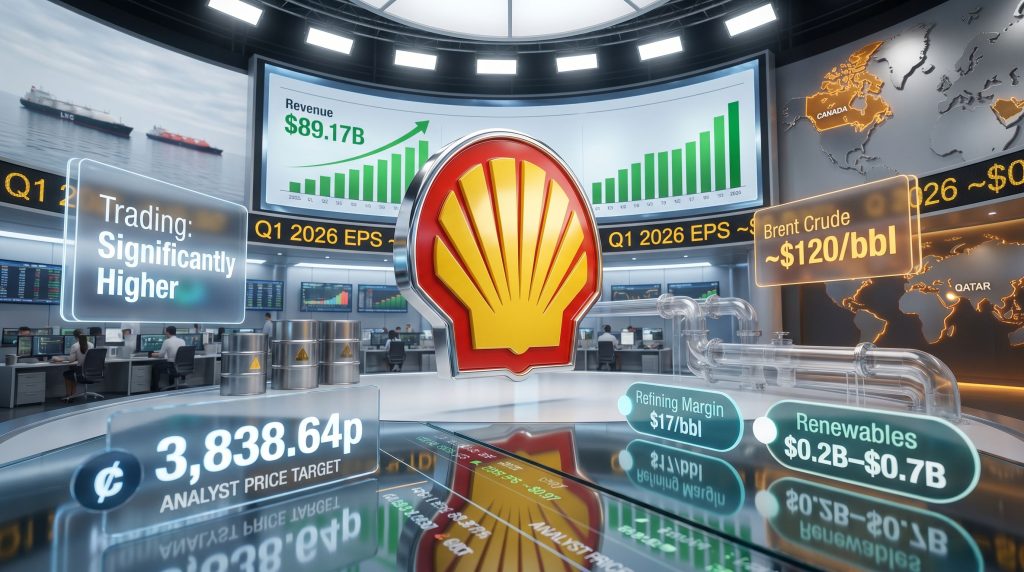
Consensus estimates heading into the results reflect a nuanced, rather than uniformly bullish, outlook. According to available analyst data, the market-wide earnings per share forecast for Q1 2026 sits at approximately $0.97 per share, which would represent roughly 6% growth versus the same period in 2025. Revenue expectations are considerably more optimistic, with consensus placing the top line at approximately $89.17 billion, implying year-on-year growth of around 29%.
The divergence between strong revenue growth and more modest EPS expansion points to margin pressure within specific divisions, even as headline commodity prices support overall income. Pre-tax profit is anticipated at approximately $8.96 billion, which would actually sit around 5.5% below Q1 2025 levels despite the revenue uplift. This divergence is a central analytical puzzle heading into the results.
Analyst Rating Landscape
Sentiment across the analyst community remains broadly constructive but not uniformly enthusiastic. According to LSEG Data and Analytics, the aggregate rating on Shell sits between a buy and a hold, with an average long-term price target of 3,838.64 pence, representing approximately 15% upside from the share price as of early May 2026. TipRanks assigns a buy rating with a Smart Score of 9 out of 10, indicating strong but measured confidence.
| Rating Source | Current Rating | Price Target | Implied Upside |
|---|---|---|---|
| LSEG Data and Analytics | Between Buy and Hold | 3,838.64p | ~15% |
| TipRanks | Buy / Smart Score 9 | Not specified | Broadly constructive |
| Zacks Consensus | Not specified | $1.78 (low-end EPS estimate) | Varies |
Shell's Historical EPS Pattern: Beats and Misses in Recent Quarters
Shell's recent quarterly earnings track record shows meaningful variability, which adds additional uncertainty to the Q1 2026 outcome. Reviewing Shell's earnings history reveals a pattern of alternating beats and misses that underscores the importance of not anchoring too firmly to consensus forecasts.
| Quarter | Reported EPS | Consensus Estimate | Variance |
|---|---|---|---|
| Q1 2025 | $1.84 | $1.54 | +19.5% beat |
| Q4 2025 | $1.14 | $1.26 | -9.5% miss |
| Q1 2026 (forecast) | ~$0.97 to $2.13 | Varies by source | To be determined |
The wide range of current estimates, spanning from approximately $0.97 to $2.13 per share depending on the methodology applied, reflects genuine analytical uncertainty rather than consensus clarity. Investors should treat the midpoint as a directional guide rather than a precise target.
How the Oil Price Environment Shaped Q1 2026 Earnings Dynamics
The movement of Brent crude toward $120 per barrel during Q1 2026 created significant asymmetric benefits across Shell's business. For the upstream division, higher realization prices typically flow almost directly into operating profit, as production costs are largely fixed in the short term. A sustained move from, say, $80 to $120 per barrel can add billions to quarterly upstream earnings without any corresponding increase in output volumes.
However, the most striking outperformance signal heading into the results came from Shell's trading and marketing division. The company's April 2026 trading update confirmed that oil trading and products marketing earnings are expected to be materially higher compared with both Q4 2025 and Q1 2025 simultaneously. This dual-period outperformance in a single division is a rare and significant signal.
Trading desks at integrated majors are not passive price-takers. They actively structure positions across physical cargo flows, derivatives markets, and regional price differentials. In high-volatility commodity environments, the spread between regional benchmarks widens, arbitrage opportunities multiply, and well-capitalised traders with global infrastructure can generate disproportionate returns relative to underlying commodity price moves.
This dynamic is frequently underappreciated by retail investors who assume that oil company earnings simply track crude prices on a one-to-one basis. In reality, Shell's trading division can generate strong results in either direction of price movement, as long as volatility and price dislocations are sufficiently elevated.
Shell Q1 2026: Segment-by-Segment Expectations
Upstream and Integrated Gas Production
The most significant operational headwind in Q1 2026 relates to Shell's gas and integrated gas division. Production is guided at 880,000 to 920,000 barrels of oil equivalent per day, down from levels recorded in late 2025, with the primary cause being geopolitical disruptions in Qatar. For context, total upstream production across all liquids and gas is guided at 1.76 million to 1.86 million boe per day, compared with 1.892 million boe per day in Q4 2025.
Key factors affecting upstream performance include:
- Qatar-linked disruptions reducing integrated gas output by an estimated 40,000 to 50,000 boe/d compared to prior quarter levels
- LNG Canada ramp-up providing a partial offset, though weather and outage constraints have limited the incremental contribution
- Total upstream production trending below Q4 2025 actuals despite higher per-barrel realisations
Refining and Downstream: Quietly Strong
Refining conditions improved meaningfully between Q4 2025 and Q1 2026, with Shell's indicative refining margin rising from approximately $14 per barrel to $17 per barrel. This roughly 21% improvement in margin per barrel, combined with maintained high utilisation rates, makes refining a quietly important earnings contributor in this particular quarter.
| Metric | Q4 2025 Actual | Q1 2026 Guidance |
|---|---|---|
| Indicative Refining Margin | $14/bbl | $17/bbl |
| Refinery Utilisation | 95% | 95% to 99% |
| Chemicals Margin | $140/tonne | $139/tonne |
| Chemicals Utilisation | 76% | 81% to 85% |
The improvement in chemicals utilisation from 76% to 81-85% is also notable. Chemicals are often treated as an afterthought in oil major analysis, but higher throughput at stable margins generates meaningful incremental earnings.
Marketing and Downstream Volumes
Marketing sales volumes are guided at 2.55 million to 2.65 million barrels per day, modestly below the 2.701 million b/d recorded in Q4 2025. Despite the volume softness, earnings from this division are still expected to exceed Q1 2025 levels, suggesting that margin improvement is more than compensating for volume decline.
Renewables and Energy Solutions
| Segment | Q4 2025 Earnings | Q1 2026 Guidance |
|---|---|---|
| Renewables and Energy Solutions | $0.1 billion | $0.2B to $0.7B |
| Corporate Adjusted Earnings | -$0.6 billion | -$1.0B to -$0.8B |
The wide guidance range for Renewables and Energy Solutions reflects genuine uncertainty about the timing of project revenues and power trading margins. The increase from $0.1 billion to a guided range of $0.2 billion to $0.7 billion suggests meaningful improvement but should be interpreted with caution given the breadth of that range.
The Risks That Could Define the Q1 Narrative
Working Capital: The $10-15 Billion Cash Flow Wildcard
The single largest risk factor heading into the May 7 results is not operational performance but balance sheet mechanics. Shell has flagged potential working capital outflows of between $10 billion and $15 billion in Q1 2026. Indeed, the impact on oil markets from geopolitical and macroeconomic pressures has amplified these balance sheet sensitivities considerably.
This figure requires careful interpretation. Working capital outflows of this magnitude in a commodity environment are often described as technical in nature, meaning they reflect the accounting treatment of higher-priced inventory and elevated receivables balances rather than cash permanently leaving the business. When commodity prices stabilise or decline, these balances tend to reverse, releasing cash back into the reported free cash flow figures.
However, in the near term, a working capital outflow of this scale will materially reduce reported free cash flow and push net debt higher. Investors focused on cash generation metrics rather than adjusted earnings will see a meaningfully weaker picture in Q1, regardless of underlying trading performance.
Additional balance sheet pressure comes from non-cash net debt movements, with variable shipping lease obligations expected to add $3 billion to $4 billion to reported net debt figures. Underlying operating expenditure is guided at $1.7 billion to $2.1 billion, modestly below the $2.2 billion recorded in Q4 2025, providing a small offsetting positive.
Key risk factors investors should monitor include:
- Whether the working capital outflow lands at the lower or upper end of the $10-15 billion range
- The trajectory of Brent crude in Q2 2026 and its implications for working capital reversal
- Management commentary on net debt trajectory and the timeline for cash flow normalisation
- Tax paid figures, which can create additional volatility in reported cash generation
The next major ASX story will hit our subscribers first
The ARC Resources Acquisition: Strategic Pivot or Complementary Move?
Shell's announcement of a $16.4 billion acquisition of ARC Resources, a Canadian shale producer, adds a significant strategic dimension to the Q1 results discussion. The deal is not expected to materially affect Q1 reported numbers, but it will dominate the management commentary and analyst questioning during the results call.
The strategic rationale centres on two objectives: bolstering long-term production growth and strengthening Shell's position in LNG supply chains. Canadian shale resources feed into LNG Canada, which is already in ramp-up mode, meaning the ARC acquisition is partly about securing feedgas supply for an infrastructure asset Shell already owns.
The critical question for investors is whether this acquisition represents a permanent reallocation of capital away from shareholder returns, or whether it is being funded through a combination of operating cash flow strength and balance sheet capacity without compromising the buyback and dividend commitments that have underpinned the share price re-rating over the past three years.
Management's tone on capital allocation during the May 7 results call will be closely parsed. A reaffirmation of existing buyback commitments alongside the acquisition would be interpreted positively. Any suggestion that return commitments may need to be moderated would likely be met with renewed selling pressure.
Shell's Break-Even Economics and Capital Return Thresholds
Understanding Shell's structural economics is important context for assessing the sustainability of its capital return programme. Shell has communicated a business model designed to sustain dividends at oil prices well below current market levels, with the break-even for the ordinary dividend sitting meaningfully below the prevailing Brent price environment.
Buyback capacity is available at price levels above dividend-only sustainability, providing an additional layer of financial flexibility. With Brent trading at levels approaching $120 per barrel during Q1, Shell's operations were generating cash at rates well above both the dividend floor and the buyback threshold, even accounting for the working capital headwinds. The 2025 full-year adjusted earnings of $18.5 billion provide the relevant baseline for assessing how Q1 2026 fits within the annual trajectory.
Technical Outlook for Shell's Share Price
From a technical analysis perspective, Shell's share price structure heading into the May 7 results reveals a medium-term uptrend that has been tested but not broken.
| Technical Level | Price (Pence) | Significance |
|---|---|---|
| 55-Day SMA | 3,260.7p | Near-term support; tested multiple times in April |
| April 2026 Trough | 3,169.5p | Critical downside trigger level |
| Early March Low | 3,049p | Secondary support if April trough breaks |
| Psychological Level | 3,000p | Round-number floor with historical significance |
| 200-Day SMA | 2,873.3p | Long-term trend indicator |
| March 2026 Record High | 3,591.5p | Primary upside target and medium-term resistance |
The 55-day simple moving average at 3,260.7p has provided repeated support through April 2026, and the medium-term trend structure remains intact as long as the April trough at 3,169.5p holds on a closing basis. A daily close below that level would suggest a deeper correction toward the early March low at 3,049p, with the psychologically significant 3,000p level and the 200-day SMA at 2,873.3p providing lower support zones.
On the upside, a strong earnings beat that addresses investor concerns about cash flow and working capital dynamics could reopen the path toward the March 2026 record high at 3,591.5p.
Energy Stocks as Cyclical Assets: An Important Investor Framework
It is worth reinforcing a foundational principle of energy sector investing: oil and gas stocks are inherently cyclical, and their earnings, cash flows, and share prices are tightly linked to commodity prices that no management team can control. This cyclicality creates both opportunity and risk. Consequently, a well-considered diversification strategy across sectors reduces concentration risk while still allowing participation in the earnings upside that elevated oil price environments can generate for companies like Shell.
Interpreting a Potentially Mixed Earnings Release
The concept of a two-speed earnings result, where one division delivers exceptional performance while another underperforms, is not unusual in large integrated energy companies. The analytical challenge is distinguishing between structural weakness and temporary disruption within the underperforming segment.
In Shell's case, the gas production decline is attributable to identifiable external disruptions rather than geological depletion, infrastructure deterioration, or cost blowouts. That distinction matters for how investors should weight the miss. Furthermore, commodities trading strategies developed specifically for volatile environments offer useful frameworks for contextualising Shell's trading division outperformance within a broader analytical lens.
Three plausible scenarios for the May 7 results:
- Upside scenario: Trading windfall exceeds guidance, working capital outflow lands at the lower end of the flagged range, and management reaffirms capital return commitments alongside the ARC acquisition. Share price re-tests March record highs.
- In-line scenario: Results broadly match consensus with strong trading offset by gas production declines. Cash flow is weak but management provides reassurance on working capital reversal timeline. Share price reaction is muted with modest upward bias.
- Downside scenario: Working capital outflow is closer to $15 billion, net debt rises more than expected, and management commentary on the ARC acquisition creates uncertainty about near-term buyback sustainability. Share price tests April trough support.
Frequently Asked Questions: Shell Q1 2026 Earnings
When does Shell report Q1 2026 results?
Shell is scheduled to release its first-quarter 2026 financial results on 7 May 2026. Full details will be available through Shell's quarterly results page on its official investor relations platform.
What is the analyst consensus EPS estimate for Shell Q1 2026?
Estimates vary significantly depending on the data source and methodology applied, ranging from approximately $0.97 to $2.13 per share. LSEG-sourced consensus data points toward the lower end of this range at around $0.97, while other platforms apply different adjustments.
Why did Shell shares fall more than 7% after the April trading update?
The April 8, 2026 trading update revealed guidance for potential working capital outflows of $10 to $15 billion, raising concerns about reported free cash flow and near-term net debt movement, even though the underlying operational and trading picture was broadly positive.
What is the average analyst price target for Shell?
According to LSEG Data and Analytics, the average long-term analyst price target as of early May 2026 is 3,838.64 pence, implying approximately 15% upside from prevailing share price levels.
What is driving Shell's trading division outperformance?
The combination of Brent crude approaching $120 per barrel, elevated energy market volatility, and tighter refined product supply created unusually favourable conditions for physical cargo arbitrage, regional price differential trading, and derivatives positioning within Shell's trading and marketing operations.
How does the ARC Resources acquisition affect Q1 results?
The $16.4 billion deal is not expected to materially influence Q1 reported earnings. Its primary significance in the context of the Shell Q1 earnings preview and the May 7 release is the management commentary it will generate around long-term capital allocation, LNG strategy, and whether shareholder return commitments remain fully intact. A sound investment strategy will account for both the near-term earnings picture and these longer-term structural shifts when evaluating Shell's position within a portfolio.
This article is intended for informational purposes only and does not constitute investment advice or a recommendation to buy or sell any financial instrument. All forecasts, analyst estimates, and technical levels referenced are subject to change. Past performance is not indicative of future results. Readers should conduct their own independent research and, where appropriate, seek professional financial advice before making investment decisions. Shell's Q1 2026 results, guidance, and management commentary should be reviewed in full via Shell's official investor relations communications.
Want to Capitalise on Major Resource Discoveries Before the Broader Market Reacts?
While integrated energy majors like Shell navigate complex earnings cycles across multiple divisions, Discovery Alert's proprietary Discovery IQ model delivers real-time alerts the moment significant mineral discoveries are announced on the ASX — instantly translating complex geological data into actionable investment insights for both short-term traders and long-term investors. Explore how historic discoveries have generated substantial returns by visiting Discovery Alert's dedicated discoveries page, and begin your 14-day free trial today to position yourself ahead of the market.