June 13, 2026
The Architecture of Pressure: How Silver Markets Reach Breaking Points
Commodity markets have a long memory. Every major price dislocation in silver's history, from the Hunt Brothers episode in 1980 to the Reddit-driven retail frenzy in early 2021, has shared a common thread: a structural mismatch between the paper promises made in futures markets and the physical metal available to honour them. Understanding that architecture is the starting point for any serious analysis of where silver stands today.
In 2025 and into 2026, the silver short squeeze in the making has moved from fringe commentary into mainstream financial debate, and the data behind it deserves careful, sceptical examination rather than either dismissal or breathless enthusiasm. That architecture is under more stress than it has been in at least a generation.
When big ASX news breaks, our subscribers know first
What a Silver Short Squeeze Actually Means
A short squeeze in any market occurs when traders who have sold contracts they do not own are forced to buy them back as prices rise against them. In equity markets, this dynamic is relatively straightforward. In commodity futures markets, however, the mechanics are more complex and, in some ways, more consequential.
When a trader sells a silver futures contract short, they are promising to deliver silver at a specified price on a future date. If the price rises, they face mounting losses and margin calls. The crucial difference in commodities is that short sellers may theoretically settle obligations with physical metal. This is precisely why the availability of real, deliverable silver in registered vaults becomes a critical variable, not just a background statistic.
Understanding silver's dual role as both a precious metal and an industrial commodity adds another layer of complexity to this pressure dynamic.
A silver short squeeze reaches its most dangerous threshold not simply when prices rise, but when prices rise and physical inventory simultaneously drains to levels where settling paper obligations with real metal becomes structurally impossible for the short side.
The Role of the Big Eight Commercial Traders
Silver's price discovery process operates within a framework that is unlike most other commodity markets. A concentrated group of large commercial traders, commonly referred to as the Big Eight, holds a disproportionate share of the net short position on the COMEX futures exchange. These entities, which include major bullion banks and investment institutions, have maintained significant short exposure in silver for decades, a pattern meticulously documented through the weekly Commitment of Traders (COT) report.
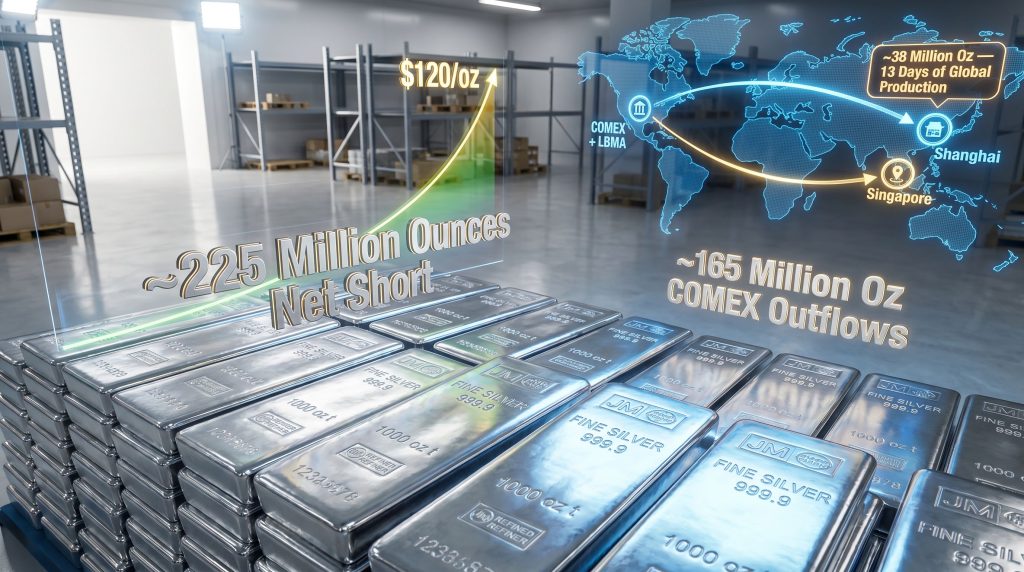
What makes the current setup historically significant is the degree to which this short position has been reduced over the past year, and yet remains large in absolute terms. According to market analysts who closely track the COT data, the Big Eight commercial traders currently hold a net short position of approximately 225 million ounces of silver, equivalent to roughly 45,000 COMEX contracts. Furthermore, while this figure represents a substantial reduction from prior levels, it still constitutes enormous exposure to rising prices.
Three Conditions Required for a True Squeeze
Not every period of rising silver prices constitutes a squeeze scenario. A genuine squeeze requires the convergence of multiple structural factors:
- Concentrated short positioning with limited ability to reduce exposure without driving prices higher.
- Physical inventory depletion that removes the option of settling paper obligations with deliverable metal.
- Long-side resolve where holders of long contracts refuse to sell, eliminating the mechanism through which short sellers can cover positions at manageable prices.
| Squeeze Condition | Current Status (2025–2026) | Severity Rating |
|---|---|---|
| Concentrated short positioning | Near record-low coverage levels | High |
| Physical vault inventory depletion | COMEX and LBMA inventories under strain | High |
| Long-side refusal to capitulate | Managed money holding firm | Elevated |
| Lease rate and borrowing cost spikes | Rising sharply | Moderate–High |
| Backwardation in spot vs. futures | Emerging in pockets | Moderate |
How the Current Setup Was Built: A 12-Month Arc
The current configuration did not emerge overnight. It is the product of a sustained, if uneven, process that began around March or April of 2024, when the large commercial short holders began quietly accumulating long positions to offset their existing short exposure. This gradual short-covering process pushed silver prices gently higher through mid-2024 as incremental demand from the covering activity absorbed supply.
The pace accelerated sharply around September 2024, when speculative capital entered the market in volume. At that point, two buying forces were operating simultaneously: commercial short covering and fresh speculative long positioning. The combination proved powerful. By late 2024, the rally had taken on parabolic characteristics, with silver surging toward $120 per ounce by January 2025.
Silver's move toward $120/oz was not a sign of deteriorating fundamentals reversing, nor was it driven by retail enthusiasm alone. It was structurally propelled by forced short covering colliding with speculative momentum, a combination that becomes self-reinforcing once it reaches sufficient velocity.
At that point, the remaining short holders faced a painful reality: every dollar of price increase required additional margin to be posted against their outstanding positions. With approximately 45,000 contracts still outstanding, the margin obligations became severe enough that the rally was aggressively countered, and prices were pushed back to the $70 range within days. This was not a fundamental-driven decline. It was an intervention driven by the financial pressure on short holders, not by any deterioration in physical demand or industrial fundamentals.
The Wash, Rinse, Spin Pattern
Veteran precious metals analysts refer to this recurring cycle as wash, rinse, and spin: prices rally, margin pressure builds on the short side, an aggressive counter-move crushes the rally, and the cycle resets. This pattern has repeated across multiple timeframes over the past two decades.
What differentiates the current moment is that after the January 2025 intervention, short positions were reduced to near-record lows. The short-covering from March 2024 through January 2025 represented approximately half of the total short exposure being retired, yet the remaining position is still historically large and financially burdensome. In this context, silver squeeze dynamics are increasingly difficult to dismiss as theoretical.
The Physical Market Evidence: Inventory Data That Cannot Be Ignored
While the futures positioning story is compelling on its own, the physical market narrative adds an entirely different dimension of urgency to the analysis.
In 2025 year-to-date, approximately 165 million ounces of silver have departed COMEX warehouses, alongside roughly 8.25 million ounces of gold. The destination of a significant portion of this metal is eastward, either directly to China or via London as a transshipment point.
| Flow Route | Volume (2025 YTD) | Significance |
|---|---|---|
| COMEX silver outflows | ~165 million oz | Equivalent to months of global mine supply |
| COMEX gold outflows | ~8.25 million oz | Concurrent pressure on gold vaults |
| COMEX and LBMA combined (March 2025) | ~30 million oz to China | Single-month record pace |
| Shanghai Gold and Futures Exchange additions (6 weeks) | ~38 million oz | Equivalent to ~13 days of global silver production |
| Shanghai vault low point (late March 2025) | ~18 million oz | Near 10 to 11 year inventory low |
One logistical nuance worth highlighting: Switzerland, which operates several of the world's most significant precious metals refineries, does not appear to ship silver directly to China. Instead, Swiss silver moves to London first, where it is transshipped onward to Shanghai. This routing suggests that the LBMA and COMEX markets function not merely as storage hubs but as active intermediaries in the global redistribution of physical silver from west to east.
The October 2024 Near-Default Event
Perhaps the most striking data point in recent silver market history is what reportedly occurred at the LBMA in October 2024. According to market analysts tracking vault flows, the LBMA approached a critical threshold of deliverable physical silver, coming close to a situation that could have required the declaration of a force majeure event.
To prevent a settlement failure, emergency airfreight shipments of silver were mobilised throughout November and December 2024, with estimates suggesting between 60 and 100 million additional ounces were rushed into the London system during that two-month period.
Important caveat: The October 2024 LBMA near-default has not been formally confirmed by the LBMA as an institution. This account is based on analyst interpretation of vault flow data and is considered a working theory rather than established fact. Investors should weigh this alongside official data sources.
Not All Vault Silver Is Available for Delivery
A critical distinction that often escapes mainstream coverage is that registered COMEX and LBMA inventory figures overstate the genuinely deliverable supply. A meaningful portion of vaulted silver is held by long-term investors, ETF custodians, and strategic holders who have no intention of releasing their metal at current price levels.
This investor hold problem means that as prices rise, the pool of truly deliverable silver shrinks faster than headline inventory numbers suggest. Consequently, silver supply deficits may be considerably more acute than surface-level data implies.
The Skeptical View: Why Silver Is Not GameStop
Any serious analysis of the short squeeze thesis must engage honestly with the counterarguments.
Unlike a small-cap equity with a fixed share count, commodity short sellers often hold hedging positions that offset their paper exposure. A bullion bank short on COMEX futures may simultaneously hold physical inventory, forward purchase agreements, or production-linked contracts that make the net economic exposure very different from the gross short position. Rising futures prices, in this context, can be partially absorbed by the rising value of offsetting physical holdings.
The honest assessment is that the conditions for an elevated squeeze probability exist, but a confirmed squeeze has not yet occurred. The distinction matters enormously for investment positioning.
| Dimension | Bullish Squeeze Thesis | Skeptical Counterpoint |
|---|---|---|
| Futures positioning | Near-record short concentration | Much may represent hedging, not naked speculation |
| Physical supply | Vault inventories severely depleted | Some deliverable supply still exists |
| Price trajectory | Upward bias with suppression episodes | Intervention capacity remains meaningful |
| Eastern demand | Structural and accelerating | Could plateau or diversify geographically |
| Squeeze probability | Elevated but not confirmed | Requires sustained, multi-month price pressure |
For further context on how institutional short exposure compares historically, analysts at Investing.com have modelled several scenarios for what they describe as the potential for silver's greatest short squeeze on record.
The Singapore Factor: A New Physical Delivery Architecture
A development that may materially alter the competitive landscape for silver pricing emerged in mid-2026: the launch of a Singapore-based silver futures contract designed specifically for physical delivery. The contract specification, based on 1,000 troy ounce bars at 4N (99.99%) fine purity, introduces several structural differences from the COMEX model.
The purity standard distinction deserves closer attention than it typically receives. The difference between 3N5 silver (99.95% pure) and 4N fine silver (99.99% pure) is a mere fraction of a percentage point in chemical terms. Yet this specification gap has driven a global refinery reformatting wave, with mints across Europe and Asia retooling production lines to meet Eastern delivery standards.
The Singapore venue offers something the COMEX and LBMA cannot easily replicate: geopolitical neutrality. For industrial users across Southeast Asia, accessing a physically deliverable silver contract through a jurisdiction perceived as neither aligned with western financial interests nor directly controlled by Beijing represents a structurally attractive option.
The implications for western pricing dominance are significant if this platform gains traction. A viable physical alternative exchange could accelerate the redistribution of silver away from COMEX-registered vaults and compress the timeline for the inventory pressures already underway.
The next major ASX story will hit our subscribers first
The Geopolitical Layer: Strategic Accumulation and Asymmetric Risk
China's accumulation of physical commodities including silver, copper, and rare earth materials has been a multi-year strategic programme. What makes the silver dimension particularly complex is the role of unreported reserves. China officially reports gold reserves at levels that many analysts believe substantially understate actual holdings, with some estimates suggesting true reserves could be eight to ten times official figures.
A formal disclosure of significantly larger gold or silver reserves would create immediate repricing pressure on paper short positions globally. The gold-silver ratio analysis for 2025 further underscores the degree to which silver remains historically undervalued relative to gold, amplifying the potential repricing magnitude.
Scenario modelling: If China were to formally declare precious metal reserves substantially above currently reported levels, the resulting repricing of outstanding short contracts could trigger a self-reinforcing short-covering cascade across both gold and silver simultaneously, compressing the timeline for any squeeze scenario from months to days.
The Law of Diminishing Returns for Short Sellers
One of the more technically nuanced dynamics in the current silver market relates to what happens when short sellers have already extracted most of the available downside. When every willing seller of long contracts has already exited the market, the commercial short sellers lose their primary mechanism for driving prices lower.
At this point, even aggressive spoofing, bid withdrawal, and algorithmic pressure produces only minimal contract volume at lower prices. A $10 engineered decline might yield only 50 to 100 contracts of coverage, a tiny fraction of the 45,000-contract short overhang that remains. The ratio of price damage required to achieve each incremental unit of short coverage worsens dramatically, which is precisely what market observers mean when they describe the law of diminishing returns for short sellers approaching a structural price floor. This dynamic is explored in considerable depth by Stonex Bullion's market analysis of how squeeze mechanics ultimately overwhelm suppression tactics.
Six Indicators to Monitor for Squeeze Confirmation
Given the distance between elevated probability and confirmed squeeze, tracking a specific set of indicators provides a more rigorous framework than relying on any single data point:
- COMEX and LBMA inventory trend lines – directional movement matters more than absolute levels.
- Silver lease rates and borrowing costs – sharp sustained increases signal physical tightness in the lending market.
- Weekly COT report, commercial net short position – the primary quantitative measure of institutional squeeze exposure.
- ETF inflows across SLV and global silver vehicles – measures retail and institutional demand pressure on physical backing.
- Physical premium spreads at bullion dealers – widening premiums over spot signal that paper prices are diverging from real-world supply reality.
- Spot vs. futures backwardation depth and duration – a market in sustained backwardation signals that immediate physical delivery commands a premium over future settlement, a classic sign of acute physical shortage.
A convergence of three or more of these indicators moving simultaneously in the same bullish direction would represent a materially stronger confirmation signal than any single data point in isolation.
Three Scenarios for Silver Over the Next 6 to 12 Months
Scenario 1: Controlled Grind Higher (Base Case)
Commercial short holders continue their managed retreat, retiring short exposure in measured increments. Silver grinds toward the $90 to $100 range with periodic engineered pullbacks. The silver short squeeze in the making thesis remains elevated but unconfirmed. Long-term holders, however, continue to accumulate during corrections.
Scenario 2: Accelerated Short Squeeze (Bull Case)
Physical delivery failures at either the COMEX or LBMA, potentially accelerated by Singapore-venue demand drawing metal away from western vaults, force uncontrolled short covering. A bonfire of the silver shorts scenario, as it has been described in market analysis circles, drives silver into three-digit territory with significant velocity.
Scenario 3: Macro Shock Reset (Risk Case)
A broad equity market dislocation triggers temporary precious metals liquidation as investors meet margin calls across asset classes. Silver experiences a sharp but short-lived pullback before supply-demand fundamentals and the short positioning dynamic reassert themselves as the dominant price driver.
Across all three scenarios, the asymmetry of the risk profile favours long-term holders of physical silver. The upside from a squeeze scenario substantially exceeds the downside from a temporary macro reset, particularly given that any macro-driven decline would likely compress the timeline for subsequent short covering rather than eliminate the silver short squeeze in the making thesis entirely.
Disclaimer: This article is for informational and educational purposes only. It does not constitute financial advice. All forward-looking statements, scenario projections, and market analysis involve uncertainty and should not be relied upon as predictions of actual outcomes. Readers should conduct their own due diligence and consult a licensed financial adviser before making any investment decisions. Past performance of any asset class is not indicative of future results.
Want to Stay Ahead of the Next Major Commodity Discovery?
While silver's structural squeeze dynamics unfold across futures markets, the most significant wealth-creation opportunities in commodities often emerge at the exploration stage — Discovery Alert's proprietary Discovery IQ model delivers real-time ASX mineral discovery alerts, translating complex data across 30+ commodities into clear, actionable insights the moment they hit the market. Explore how historic mineral discoveries have generated extraordinary returns and begin a 14-day free trial to position yourself ahead of the next major find.