July 21, 2026
The Geopolitics of Pipeline Gas: Why North Africa Is Winning Europe's Supply Reshuffle
When historians look back at European energy policy in the mid-2020s, the period between 2022 and 2027 will likely be remembered as one of the most consequential supply chain restructurings in the continent's modern industrial history. The near-total elimination of Russian pipeline gas from European markets created a structural vacuum that no single supplier could fill overnight. What emerged instead was a fragmented, multi-source import architecture in which geography, infrastructure reliability, and long-term political trust became the dominant selection criteria for European buyers.
Within that context, Algeria's position has strengthened steadily, and its relationship with Germany, Europe's largest natural gas consumer, has evolved from exploratory to foundational. The Sonatrach gas supply deal with Germany, expanded and formalised in July 2026, represents the most tangible expression of that shift.
When big ASX news breaks, our subscribers know first
Understanding the Sonatrach–VNG Partnership: A Two-Year Commercial Evolution
The commercial relationship between Algeria's state-owned energy company Sonatrach and German energy group VNG did not emerge suddenly. It was constructed incrementally over roughly two and a half years, beginning at a moment when VNG was facing an acute supply crisis following the cessation of Russian gas flows.
Prior to 2022, VNG had been one of Germany's largest buyers of Russian natural gas. The supply disruption that followed Russia's invasion of Ukraine forced the company to fundamentally restructure its import portfolio. The Algerian relationship that grew from that necessity has now become one of VNG's most strategically significant long-term commercial arrangements.
The timeline of key milestones in the partnership illustrates how quickly the relationship has matured:
| Milestone | Date | Significance |
|---|---|---|
| VNG signs first pipeline gas agreement with Sonatrach | February 2024 | First German company to purchase Algerian pipeline gas directly |
| Gas begins flowing via Transmed pipeline | 2024 | Opens Algeria-to-Germany overland supply route through Italy |
| MOU signed on green hydrogen, ammonia, and methane reduction | June 17, 2026 | Signals long-term decarbonisation cooperation beyond fossil fuels |
| First Algerian LNG cargo delivered to Germany | July 2, 2026 | Arrives at Wilhelmshaven 1 floating regasification terminal from GL2Z complex in Bethioua |
| Expanded pipeline gas supply agreement signed | July 17, 2026 | Signed in Berlin during President Tebboune's state visit; increased volumes commence January 1, 2027 |
The July 17, 2026 signing ceremony in Berlin carried notable diplomatic weight. Sonatrach CEO Nour Eddine Daoudi and VNG Chairman Ulf Heitmüller signed the agreement in the presence of Algerian Hydrocarbons Minister Mohamed Arkab, German State Secretary Frank Wetzel, and German Environment State Secretary Jochen Flasbarth. The ceremony coincided with an official state visit by Algerian President Abdelmadjid Tebboune, elevating the commercial agreement into the realm of bilateral statecraft.
Algerian Energy Minister Mohamed Arkab characterised the signing as the culmination of a long-standing relationship built on trust, describing it as confirmation of Algeria's identity as a dependable and secure energy partner for Europe. That characterisation carries particular resonance given how thoroughly the continent's supply map has been redrawn since 2022.
What the Sonatrach Gas Supply Deal With Germany Actually Covers
The expanded agreement centres on increased volumes of pipeline gas delivered from Algeria to Germany via the Transmed pipeline, with a confirmed delivery commencement date of January 1, 2027. However, several core commercial parameters remain undisclosed.
| Contract Element | Status |
|---|---|
| Increased delivery volumes | Not publicly disclosed |
| Contract duration | Not publicly disclosed |
| Financial terms | Not publicly disclosed |
| Delivery start date | January 1, 2027 (confirmed) |
| Pipeline route | Transmed (Algeria to Italy to Central Europe) |
| LNG terminal | Wilhelmshaven 1 floating regasification unit |
The absence of volume and pricing disclosures is consistent with standard practice for long-term bilateral gas agreements of this scale. What is publicly confirmed, however, is that this is the second major commercial agreement between the two companies, building directly on the February 2024 foundation contract.
Algeria's Dual-Route Supply Architecture Into Germany
One of the most strategically significant aspects of the evolving Sonatrach–VNG relationship is that Algeria has now established two independent delivery corridors into Germany simultaneously.
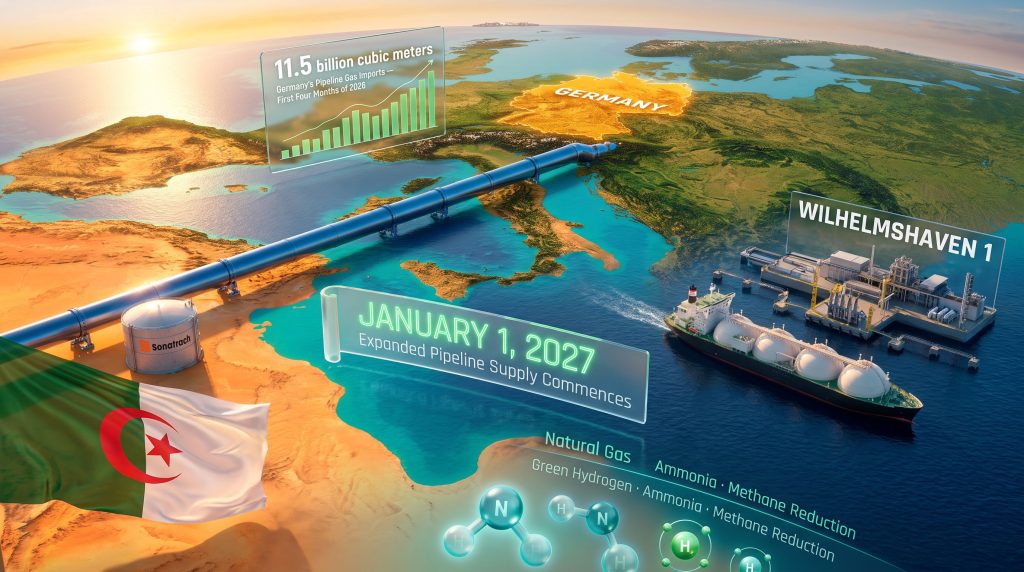
The first is the Transmed overland pipeline route, which originates in Algeria, crosses the Mediterranean into Italy, and connects into Central Europe's integrated gas transmission network. The second is a maritime LNG route, with Algeria's first-ever LNG cargo to Germany arriving at the Wilhelmshaven 1 floating regasification terminal on July 2, 2026, sourced from the GL2Z liquefaction complex in Bethioua.
This dual-route architecture provides a structural resilience that most bilateral supplier relationships cannot match. If one delivery mechanism faces disruption, the other remains operational, giving Germany a meaningful degree of redundancy from a single Algerian counterparty.
Germany's Gas Market Scale and Algeria's Growing Share
To appreciate the commercial significance of the Sonatrach gas supply deal with Germany, the scale of the German market must be understood in European context. Germany is not merely a large gas consumer; it is the dominant gas market on the continent by volume.
During the first four months of 2026 alone, Germany imported approximately 11.5 billion cubic meters of pipeline gas, a figure that represented roughly one-quarter of Europe's total pipeline gas imports over the same period. Furthermore, natural gas price trends continue to influence procurement decisions across the continent, making supply certainty even more valuable. That concentration of demand makes Germany the single most consequential target market for any gas exporter seeking to expand its European footprint.
The competitive supply landscape feeding that demand has shifted dramatically since 2022:
| Supply Source | Status (2026) |
|---|---|
| Russian pipeline gas | Ceased in 2022; previously VNG's primary supply source |
| Norwegian pipeline gas | Active; primary European overland supplier |
| Algerian pipeline gas (Transmed) | Active since 2024; expanding from January 2027 |
| Algerian LNG (Wilhelmshaven) | First cargo delivered July 2, 2026 |
| Other LNG (global spot market) | Active; subject to global price volatility |
Algeria's position within this matrix is strengthening on multiple dimensions simultaneously: increasing pipeline volumes, a newly established LNG delivery capability, and a long-term hydrogen cooperation framework that extends the relationship's relevance well beyond the fossil fuel era.
The Strait of Hormuz Factor and Its Impact on Algerian Gas Demand
Market Context: The closure of the Strait of Hormuz since February 2026 has materially constrained LNG flows from Persian Gulf exporters into European markets. Because Algerian pipeline gas travels overland through the Transmed route and bypasses all maritime chokepoints, it has acquired a structural premium in the eyes of European buyers seeking supply certainty during a period of elevated geopolitical volatility.
This is a dimension of the Algeria–Germany energy relationship that is rarely discussed explicitly but carries significant commercial weight. The geopolitical supply landscape reshaping commodity markets globally has further reinforced Algeria's advantaged position. Qatar, one of Europe's largest LNG suppliers, routes all of its deliveries through the Strait of Hormuz. American LNG, while not constrained by Hormuz, remains subject to Atlantic maritime routing and spot market price volatility. Norwegian pipeline gas is geographically reliable but limited in its capacity to scale rapidly.
Algeria's Transmed pipeline, by contrast, offers predictable, chokepoint-free delivery at scale. In a European market where supply certainty has become more valuable than marginal price optimisation, that attribute is commanding increasing buyer attention.
What Is the Transmed Pipeline and Why Does It Matter?
The Transmed pipeline, formally known as the Enrico Mattei pipeline, is one of the oldest and most strategically important pieces of energy infrastructure connecting North Africa to Europe. It runs from Hassi R'Mel, Algeria's principal gas-producing region, across Tunisia and through the Mediterranean seabed to Sicily before continuing northward through Italy and into Central Europe's gas network.
Several characteristics make the Transmed route particularly valuable in the current European energy environment:
- It bypasses all contested maritime zones, including the Strait of Hormuz, the Red Sea, and the Suez Canal corridor
- It connects directly into Italy's national gas grid, which links onward to Austria, Germany, and Central European markets
- It carries large continuous volumes rather than discrete LNG cargo shipments, enabling more predictable supply scheduling
- It has been operational since the 1980s, giving it decades of demonstrated reliability and technical maturity
- Its capacity has room to accommodate increased throughput as Algerian export ambitions grow
For VNG specifically, whose distribution network spans much of Central and Eastern Europe, the Transmed route represents a geographically logical and operationally familiar supply corridor.
Beyond Natural Gas: The Green Hydrogen and Decarbonisation Dimension
The commercial significance of the Sonatrach–VNG relationship extends well beyond natural gas deliveries. A memorandum of understanding signed on June 17, 2026 committed both companies to joint exploration across three distinct decarbonisation domains:
- Green hydrogen production in Algeria for export to European markets, leveraging the country's substantial solar and wind resource base
- Ammonia as a hydrogen carrier, addressing one of the central logistical challenges of long-distance hydrogen transport by converting hydrogen into ammonia for shipping before reconversion at the destination
- Methane emission reduction across shared operational infrastructure, targeting fugitive emissions across the production and distribution value chain
This cooperation sits within two broader frameworks: the Algeria to Europe Hydrogen Alliance (ALTEH2A) and the SoutH2 Corridor, an infrastructure initiative designed to repurpose existing and new pipeline capacity for hydrogen transport between North Africa and Southern Europe. In addition, this aligns with the broader push for green transition materials and clean energy infrastructure that is reshaping European procurement strategy.
The strategic logic behind Algeria's hydrogen ambitions is well-founded. The country possesses extensive solar irradiation across its Saharan interior, large tracts of undeveloped land for renewable energy deployment, existing gas infrastructure that can potentially be adapted for hydrogen transport, and a geographic position that places it within pipeline reach of Europe's largest industrial gas consumers.
These attributes collectively position Algeria as one of the most credible prospective green hydrogen exporters to Europe, though large-scale commercial viability remains dependent on cost trajectories, electrolyser scaling, and regulatory frameworks that are still evolving.
Speculative Note: Analysts tracking the hydrogen trade corridor space have observed that Algeria's combination of pipeline infrastructure proximity and renewable resource potential gives it structural advantages over more distant exporters such as Australia or Chile when competing for European industrial hydrogen demand. However, this potential remains unrealised at commercial scale, and timelines for meaningful hydrogen export volumes to Germany remain uncertain.
The next major ASX story will hit our subscribers first
Is Algeria Becoming Europe's Most Strategically Important Gas Supplier?
Comparing Algeria's positioning against other major non-Russian gas suppliers into Europe reveals a competitive profile that is increasingly difficult to match:
| Supplier | Primary Route | Reliability Factor | Decarbonisation Roadmap |
|---|---|---|---|
| Norway | North Sea pipeline | High | Moderate, with CCS focus |
| Algeria | Transmed pipeline and LNG | High, no maritime chokepoints for pipeline | Active, via ALTEH2A and SoutH2 |
| Qatar | LNG (maritime via Hormuz) | Moderate, Hormuz exposure | Limited |
| USA | LNG (Atlantic maritime) | High, multiple terminals | Limited near-term |
Algeria's profile scores highly across the criteria that matter most to European energy security planners: reliability, geographic proximity, infrastructure redundancy, and a credible pathway into the low-carbon energy transition. The inclusion of senior German government officials at the July 17 signing ceremony, specifically State Secretaries from both the economy and environment ministries, signals that Berlin views this relationship as strategically important at the national level, not merely as a commercial transaction between two energy companies.
Why Germany Is Structurally Biased Toward Long-Term Bilateral Gas Contracts
Germany's experience during the 2021–2022 energy crisis created a lasting institutional preference for supply security over price optimisation. European spot LNG markets, while providing flexibility, also introduced extreme price volatility during the 2022 crisis period when spot prices in some windows exceeded €300 per megawatt-hour. Long-term bilateral contracts with producers who have demonstrated delivery reliability offer price visibility, supply certainty, and planning horizons that spot market dependency cannot provide.
This structural bias in German energy procurement strategy directly favours suppliers like Sonatrach who can offer volume commitments, multi-year contract frameworks, and pipeline delivery reliability simultaneously. Furthermore, the US-China trade war impacts on global energy flows have added further urgency to Europe's drive for diversified and dependable supply relationships.
Frequently Asked Questions: Sonatrach Gas Supply Deal With Germany
What is the Sonatrach gas supply deal with Germany?
The Sonatrach gas supply deal with Germany refers to an expanded natural gas supply agreement signed between Algeria's state energy company Sonatrach and German energy group VNG on July 17, 2026. The deal increases pipeline gas deliveries from Algeria to Germany beginning January 1, 2027, building on an original supply agreement established in February 2024. It represents the second major commercial agreement between the two companies and is complemented by a separate LNG delivery arrangement and a green hydrogen cooperation memorandum signed on June 17, 2026.
When does the expanded supply agreement take effect?
Increased gas deliveries under the expanded Sonatrach–VNG agreement are confirmed to commence on January 1, 2027.
What pipeline does Algerian gas use to reach Germany?
Algerian pipeline gas travels through the Transmed pipeline, running from Algeria across Tunisia and the Mediterranean into Italy, then connecting into Central Europe's broader gas transmission infrastructure for onward delivery into Germany.
Has Algeria already delivered LNG to Germany?
Yes. Sonatrach delivered its first LNG cargo to Germany on July 2, 2026, arriving at the Wilhelmshaven 1 floating regasification terminal. The cargo originated from the GL2Z liquefaction complex located in Bethioua, Algeria.
Are Sonatrach and VNG cooperating on green energy beyond gas?
Yes. The two companies signed a memorandum of understanding on June 17, 2026, covering cooperation in green hydrogen production, ammonia as a hydrogen carrier, and methane emission reduction. Both companies are also participating in the Algeria to Europe Hydrogen Alliance (ALTEH2A) and the SoutH2 Corridor infrastructure initiative. The renewable energy transition context underpinning these agreements reflects a broader European strategic shift toward clean energy partnerships with North African suppliers.
Key Takeaways: What This Deal Signals for European Energy Markets
Three structural shifts are confirmed or strongly implied by the trajectory of the Sonatrach–VNG relationship:
- Supply reorientation from Russia to North Africa is a permanent commercial realignment, not a temporary bridge strategy. VNG's transition from Russian gas dependency to Algerian supply has now been cemented across multiple contract cycles and supply modalities.
- Dual-route supply architecture from Algeria to Germany is now operational, providing a structural delivery redundancy that distinguishes Algeria from nearly all other individual supplier relationships Germany maintains.
- Energy partnerships in this era are being deliberately designed to span the energy transition, with hydrogen and ammonia cooperation embedded alongside fossil fuel contracts to ensure that commercial relationships between suppliers and buyers remain relevant through the decarbonisation cycle, rather than becoming obsolete as clean energy technologies mature.
For observers tracking European energy security, North African gas export infrastructure, and the evolving hydrogen trade corridor between Africa and Europe, the Sonatrach–VNG expanded agreement is a reference point worth watching closely as delivery commencement approaches in early 2027.
Readers seeking further context on African energy sector developments and bilateral trade relationships can access ongoing reporting from Ecofin Agency at ecofinagency.com.
Want to Stay Ahead of the Next Major Resource Discovery?
While Europe's energy supply map is being redrawn, savvy investors are also watching for the next transformative mineral discovery on the ASX — and Discovery Alert's proprietary Discovery IQ model delivers real-time alerts the moment significant discoveries are announced, turning complex data across 30+ commodities into clear, actionable insights. Explore historic discoveries and the substantial returns they generated, then begin your 14-day free trial to ensure you're positioned ahead of the broader market.