August 14, 2026
The Quiet Comeback of a Metal the Modern World Cannot Function Without
Spend a moment looking around any electronics-dependent environment and you are surrounded by tin. It holds circuit boards together, coats food packaging, and increasingly plays a role in the energy storage systems powering the clean energy transition. Yet despite its ubiquitous presence in modern manufacturing, the global supply of tin remains dangerously concentrated in a handful of countries. The South Crofty tin mine restart represents one of the most tangible responses to that structural vulnerability, sitting beneath the ancient moorlands of Cornwall.
When big ASX news breaks, our subscribers know first
Understanding Why Tin Supply Has Become a Strategic Concern
The Geographic Concentration Problem
Tin does not attract the same headlines as lithium or cobalt, but its supply risk profile is arguably more acute. Approximately two-thirds of global tin production is currently sourced from just three countries: China, Myanmar, and Indonesia. This level of concentration would raise alarm bells for any critical industrial input, but tin's position is compounded by the fact that its applications are non-substitutable in many contexts.
Tin-based solder remains the primary bonding material in printed circuit board manufacturing. There is no widely deployed alternative that matches its melting characteristics, electrical conductivity, and mechanical reliability at scale. Every smartphone, laptop, electric vehicle battery management system, and defence electronics platform relies on it.
Furthermore, tin supply disruption risks are already a reality — the Myanmar tin market shock demonstrated how quickly prices can respond when key producing regions face instability, with prices surging above $45,000 per tonne during the 2021 supply disruption period.
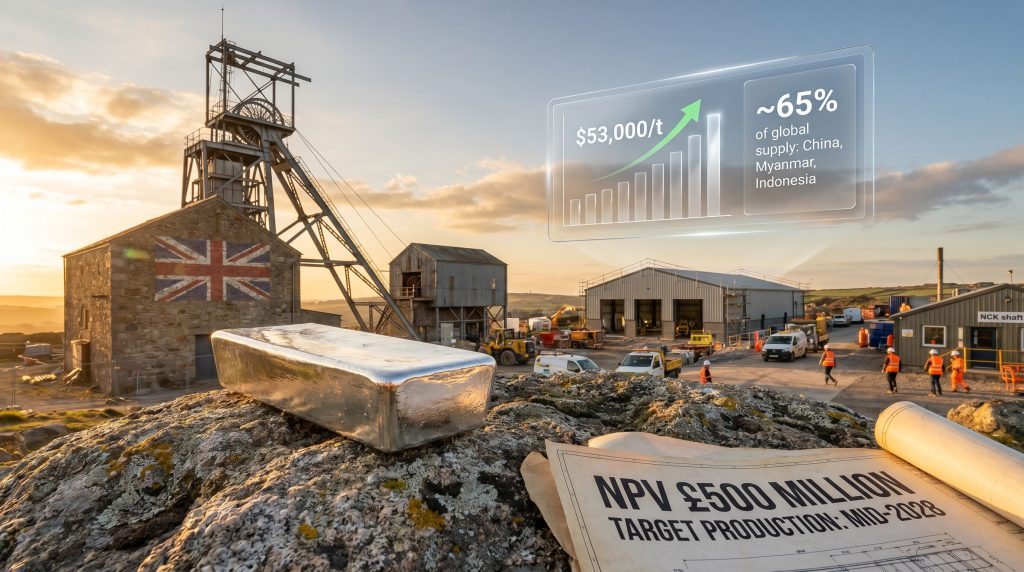
Roughly 65% of global tin production originates from China, Myanmar, and Indonesia. For Western manufacturers operating just-in-time supply chains, this geographic concentration represents a single point of failure with no easy redundancy.
The UK, United States, and Canadian governments have each formally classified tin as a critical mineral, a designation that reflects the strategic importance of securing reliable supply outside geopolitically exposed regions. This classification shapes how policymakers think about domestic resource development, financing frameworks, and industrial strategy.
Tin's Expanding Role in Clean Energy and Electronics
Beyond traditional soldering applications, tin is attracting renewed attention from materials scientists and energy technology developers. Tin is a key component in certain perovskite solar cell formulations, where it serves as a lower-toxicity alternative to lead-based compounds. Tin-anode battery research is also advancing, with the potential for tin to partially replace graphite in next-generation lithium-ion cells.
These emerging demand vectors sit on top of a structural base load from electronics manufacturing that continues to grow as global device penetration expands. The combination creates a demand profile that is both durable in the near term and potentially accelerating over a ten to fifteen year horizon — precisely the timeframe over which a new mine development would reach and sustain production.
What South Crofty Actually Is and Why It Sat Idle
Centuries of Mining History Beneath Cornwall
Cornwall has been a tin-producing region for longer than most modern nation-states have existed. Phoenician traders are historically associated with sourcing Cornish tin as far back as the pre-Roman era, and the region's mining culture shaped everything from local architecture to the global diaspora of Cornish mining expertise that spread to Australia, South Africa, and the Americas during the nineteenth century boom years.
South Crofty itself operated as Europe's last primary tin mine before its closure in 1998. The mine did not fail because the ore ran out. It shut down because tin prices collapsed to levels that made extraction uneconomical — a commodity cycle casualty rather than a geological one. Critically, the underground workings were not sealed and abandoned, preserving the possibility of a future restart.
During the dormancy period, groundwater progressively flooded the underground workings, as is common for mines in Cornwall's geologically complex and water-active environment. Addressing this is a central component of the current restart programme.
Why This Project Carries Less Risk Than a Greenfield Development
One of the less-appreciated aspects of the South Crofty tin mine restart is how substantially its existing permissions reduce development risk relative to a completely new mine. Key credentials include:
- A valid mining permission extending through to 2071, providing long-term operational certainty
- Planning permission already secured for a new on-site processing facility
- An Environment Agency permit enabling the legal dewatering of flooded underground workings
- Established surface infrastructure and shaft access points requiring refurbishment rather than new construction
For junior mining developers, the permitting and approvals phase often represents the longest lead time and greatest execution uncertainty. South Crofty has navigated that phase, leaving an engineering and financing challenge rather than a regulatory one.
A Detailed Look at Where the Restart Programme Stands
Surface Works: A Coordinated Multi-Site Construction Programme
Above ground, the project encompasses several simultaneous workstreams advancing in parallel across different site locations. Surface civil works at the Roskear shaft have been completed. The winder house construction at the same location is well advanced, with mechanical installation of the winders targeted for the second half of 2025 and into 2026.
A new workshop and stores facility is approaching operational readiness, and the NCK shaft offices are now fully operational, supporting the on-site workforce engaged in day-to-day project activities. Excavation for the pre-concentration building is approximately 50% complete.
Underground Works: Managing the Dewatering Challenge
The flooded nature of South Crofty's underground workings is one of the defining technical challenges of the restart. The water treatment plant was commissioned in October 2023, with active dewatering commencing in November 2023. The 195-level pump station is now fully commissioned and operational.
Early-stage shaft refurbishment work has commenced at Roskear, and underground development activity is progressing at the 25-level, which performs a dual function as both a development horizon and a hands-on training environment for newly recruited underground mine workers. This use of active development workings as a training facility is a pragmatic response to a genuine labour market challenge.
Engineering Design and Procurement: Key Milestones Reached
The completion of the front-end engineering design for the process plant represents one of the most significant recent milestones. FEED completion means the project has moved beyond conceptual and prefeasibility design into a level of engineering detail sufficient to support accurate capital cost estimation and procurement activity.
A second FEED programme is now being advanced specifically for the underground loading, unloading, and hoisting infrastructure. Long-lead equipment orders have already been placed, including shaking tables for the processing circuit and skips and cages for the NCK shaft.
| Workstream | Current Status |
|---|---|
| Surface civil works (Roskear shaft) | Completed |
| Winder house construction | Well advanced |
| Workshop and stores facility | Nearing completion |
| NCK offices | Operational |
| Process plant FEED | Completed |
| Underground FEED (loading/hoisting) | In progress |
| Pre-concentration building excavation | ~50% complete |
| 195-level pump station | Fully commissioned |
| Shaking tables (process plant) | Ordered |
| Skips and cages (NCK shaft) | Ordered |
Project Economics: Understanding the Numbers Behind the Restart
Production Profile and Mine Life
The project is designed to produce approximately 4,700 tonnes of tin in concentrate annually over a 14-year operational mine life. Across the full life of the operation, total tin production is estimated at approximately 49,000 tonnes.
For context, global tin consumption has historically run at roughly 350,000 to 380,000 tonnes per year. South Crofty would not reshape the global market, but it would establish a meaningful European primary tin source where Western supply has been essentially non-existent for over two decades. Indeed, this makes it a compelling European tin project in the broader context of allied-nation supply development.
Valuation Sensitivity to Tin Price
The project economics are highly sensitive to the tin price, which is characteristic of single-commodity mine developments. The preliminary economic assessment published by Cornish Metals established a base-case post-tax NPV of £180 million and an internal rate of return of 20%.
At the current tin price environment averaging approximately $53,000 per tonne, the project NPV is estimated to rise significantly to around £500 million, reflecting the substantial uplift that elevated tin prices deliver across a multi-decade cash flow model.
| Metric | Value |
|---|---|
| Annual tin production (concentrate) | ~4,700 t/y |
| Life-of-mine tin output | ~49,000 t |
| Mine life | 14 years |
| Post-tax NPV (base case) | £180 million |
| IRR | 20% |
| NPV at ~$53,000/t tin price | ~£500 million |
| Target production start | Mid-2028 |
Disclaimer: Project economics, NPV estimates, and production projections are based on preliminary economic assessments and are subject to change. They should not be interpreted as guarantees of future financial performance. Investors should conduct their own due diligence.
What Tin Price History Tells Us About Revenue Risk
Tin has historically been one of the more volatile base metals, with prices ranging from below $15,000 per tonne in the mid-2010s to above $45,000 per tonne during the 2021 supply disruption period. The current elevated price environment reflects restrained supply from key producing regions and persistent demand from electronics and green technology sectors.
For mine development economics, the critical threshold is generally considered to be around $30,000 per tonne, below which the majority of new development projects struggle to generate acceptable returns. At current pricing levels, the margin of safety above that threshold is substantial. However, investors should treat any price-dependent NPV projection as a scenario estimate rather than a reliable forecast.
Key Risks That Could Affect the Mid-2028 Target
Capital and Financing
A final investment decision remains the key gateway to full construction mobilisation. The senior debt requirement for a project of this scale will require engagement with project finance lenders who are comfortable with the tin market, the Cornwall regulatory environment, and the technical execution plan.
Cornish Metals is listed on AIM, the London Stock Exchange's market for smaller and growth companies. Equity market conditions on AIM have been challenging for junior resource developers in recent years, which consequently affects the company's ability to fund development expenditure without significantly diluting existing holders.
Technical Execution
- Dewatering timeline: The pace of water level reduction in old workings is difficult to forecast precisely and can affect the schedule for underground access and shaft refurbishment.
- Shaft refurbishment complexity: Roskear shaft infrastructure dates from an earlier era of mining practice and must be brought to modern standards before use for personnel and ore movement.
- Long-lead equipment delivery: Global supply chain constraints for specialist mining equipment remain a real consideration.
- Workforce development: Rebuilding a skilled underground mining workforce in a region without recent mining activity takes time and structured investment.
Regulatory and Environmental Obligations
Operations under the Environment Agency dewatering permit carry ongoing compliance obligations. Water treatment and discharge quality standards must be maintained throughout the dewatering phase. Furthermore, South Crofty sits within the Cornwall and West Devon Mining Landscape UNESCO World Heritage Site, creating a heritage context that shapes how surface development activities are designed and communicated to stakeholders.
The next major ASX story will hit our subscribers first
Cornwall as a Minerals Region: The Wider Picture
South Crofty's Role in a Broader Regional Narrative
The South Crofty tin mine restart does not exist in isolation. Cornwall hosts a range of mineral development activities, including lithium extraction projects targeting the lithium-rich geothermal brines associated with the region's granite geology. The prospect of multiple active mining operations creates the potential for shared infrastructure investment and a critical mass of activity that could attract specialist services.
This clustering dynamic is well understood in mining economics. South Crofty, as the most advanced project in the region, has the potential to serve as an anchor around which broader Cornish minerals sector activity could consolidate.
Comparison With Peer Projects in Allied Nations
Western governments have been actively promoting tin development in allied jurisdictions, including Spanish tin development and projects across Australia and Canada. In addition, Congo tin supply has attracted significant attention following disruptions at major producing operations, further underscoring the value of Western alternatives.
South Crofty stands out within this peer group because of its advanced permitting status, existing infrastructure, and the depth of engineering work already completed. Many peer projects remain at exploration or prefeasibility stage, meaning South Crofty's mid-2028 production target would place it years ahead of most Western alternatives in terms of delivering actual supply.
According to the International Tin Association, South Crofty is on track to become a significant new source of Western primary tin production, reinforcing the strategic importance of the project to allied-nation supply chains.
Frequently Asked Questions: South Crofty Tin Mine Restart
When will South Crofty produce its first tin?
Commercial production is currently targeted for mid-2028, subject to the completion of ongoing construction, dewatering, shaft refurbishment, and securing final project financing.
Why is South Crofty flooded and how is it being addressed?
The underground workings filled with groundwater during the mine's dormancy period following the 1998 closure. A water treatment plant was commissioned in October 2023, with active dewatering commencing in November 2023. The fully commissioned 195-level pump station is maintaining continuous dewatering operations.
What is the projected annual output?
The mine is expected to produce approximately 4,700 tonnes of tin in concentrate per year across a 14-year operational life, totalling an estimated 49,000 tonnes of tin across the full mine life.
Who owns South Crofty?
South Crofty is owned and being developed by Cornish Metals, which is listed on the AIM market of the London Stock Exchange.
Why is tin classified as a critical mineral?
Tin has been formally classified as a critical mineral by the UK, US, and Canadian governments due to its essential role in electronics manufacturing, its emerging relevance to clean energy technologies, and the high geographic concentration of its global supply base in China, Myanmar, and Indonesia.
What does the tin price mean for project value?
At current tin prices averaging approximately $53,000 per tonne, the project NPV is estimated at around £500 million, compared to a base-case NPV of £180 million established in the preliminary economic assessment. This sensitivity underscores why tin price movements are a primary variable for investors assessing the project's financial attractiveness.
Want to Stay Ahead of the Next Major Mineral Discovery?
Discovery Alert's proprietary Discovery IQ model delivers real-time alerts on significant ASX mineral discoveries — from tin to lithium and beyond — instantly translating complex resource data into actionable investment insights for both traders and long-term investors. Explore how historic mineral discoveries have generated extraordinary returns, then begin your 14-day free trial at Discovery Alert to position yourself ahead of the broader market.