
June 12, 2026
When Capital Costs Collide With Reserve Growth: Decoding the Hermosa Paradox
Few dynamics in mining investment create more confusion than the simultaneous release of genuinely positive geological news alongside materially higher cost projections. Investors conditioned to reward exploration success often struggle to reconcile a larger, longer-life deposit with a price tag that has expanded just as dramatically. This tension sits at the heart of the South32 Hermosa project update released on 30 April 2026, and understanding it requires looking beyond the headline share price move toward the underlying mechanics of how large underground mining projects actually develop over time.
The relationship between resource growth and capital escalation is not a contradiction unique to Hermosa. Across the global base metals development landscape, the process of converting geological potential into bankable reserves almost always surfaces additional complexity, whether through deeper ore bodies, more challenging ground conditions, or infrastructure requirements that only become fully visible as engineering matures. What matters for long-term investors is not whether costs have risen, but whether the value of what has been discovered justifies the revised investment.
When big ASX news breaks, our subscribers know first
Why the Taylor Deposit Has Become South32's Most Watched Asset
The Hermosa district, located in Santa Cruz County in southern Arizona, hosts one of the more geologically compelling base metals systems to have advanced toward construction in North America over the past decade. Its centrepiece, the Taylor deposit, sits within a mineralised carbonate replacement system that has demonstrated a notable capacity to grow as exploration drilling continues to intersect new ore zones beyond the boundaries of earlier models.
The Geological Architecture Driving Reserve Growth
Carbonate replacement deposits, the geological category to which Taylor belongs, are structurally complex systems where mineralisation follows the replacement of host limestone by sulphide minerals, typically zinc, lead, and silver-bearing phases. What makes these systems both exciting and challenging from a resource estimation standpoint is their tendency to exhibit irregular, often steeply dipping ore bodies that require systematic drilling programs to fully delineate.
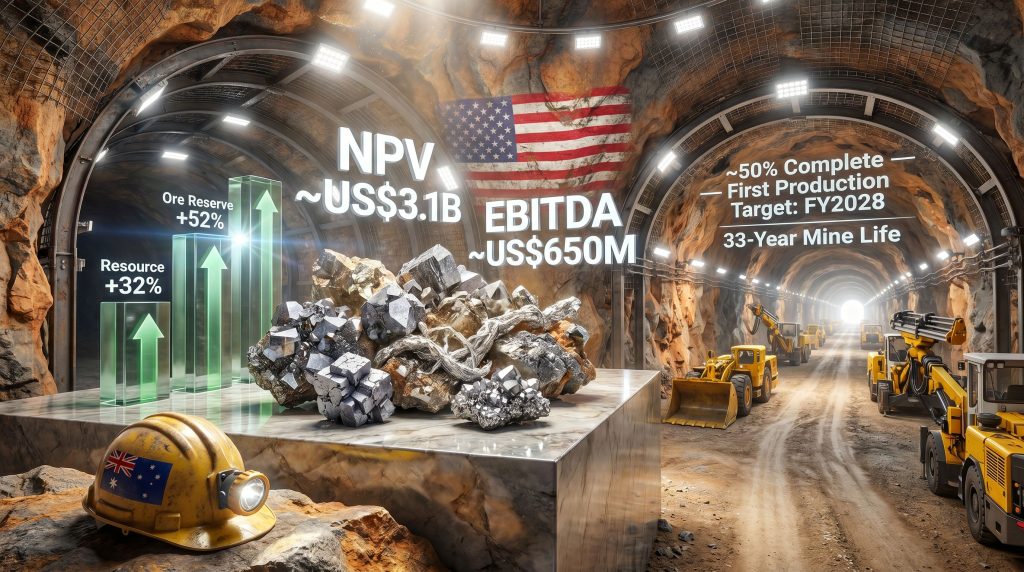
The 32% increase in mineral resources and the 52% uplift in ore reserves announced by South32 are direct products of this geological reality. As drilling has extended into previously untested zones and 3D geological modelling has improved, the economic boundaries of the deposit have expanded materially. This is not a one-off discovery event but rather the expected outcome of a disciplined programme applying modern geological interpretation techniques to a deposit that has consistently returned better continuity than earlier models predicted.
The mine life extension from 28 to 33 years reflects this expanded resource base translating into additional mineable ore, a shift that meaningfully changes how the project is valued under discounted cash flow frameworks. A five-year extension in mine life, representing an 18% increase, adds decades of tail-end cash flows that, even discounted at typical mining industry rates, contribute meaningfully to net present value.
What Zinc Equivalent Production Actually Means for Investors
The project's targeted steady-state annual output of approximately 346,000 tonnes of zinc equivalent requires some unpacking for investors less familiar with the polymetallic mining sector. Zinc equivalent figures are a standard industry convention used to express multi-commodity production in a single comparable metric. The calculation converts lead and silver revenues into their zinc-equivalent volume using prevailing commodity prices, then adds this to actual zinc output.
This methodology means the reported figure is inherently price-sensitive. At higher silver prices relative to zinc, the zinc equivalent output figure rises; at lower silver prices, it falls. Investors should treat the 346,000 tonne figure as an indicative production volume at assumed commodity prices rather than a fixed physical output number. The three-commodity nature of Taylor's production profile also introduces natural revenue diversification, with silver in particular providing exposure to both industrial and monetary demand drivers that differ substantially from zinc and lead.
How the Capital Cost Revision Changes the Investment Equation
The most significant market-moving element of the South32 Hermosa project update was the revised total growth capital expenditure figure of approximately US$3.3 billion, up from prior estimates due to inflationary pressures, scope changes, and higher input costs. The share price reaction of approximately 8.45%, taking the stock to around $3.90, illustrated precisely how sensitive long-duration project valuations are to capital cost changes at this stage of development.
Understanding Capex Escalation in Underground Mining Projects
Capital cost escalation in large-scale underground mining development is a phenomenon well-documented across the industry, particularly for projects advancing through the detailed engineering phase during periods of elevated construction and labour costs. Furthermore, the drivers at Hermosa are consistent with broader industry patterns observed across comparable projects globally:
- Inflationary pressure on steel, cement, electrical equipment, and labour has affected virtually every major mining capital project advancing through detailed engineering since 2022
- Scope expansion resulting from a larger ore reserve base can increase requirements for underground development metres, materials handling capacity, and processing plant throughput
- Higher input costs for specialised underground mining equipment and skilled labour in a competitive North American construction market
- Ground conditions and water management in a deposit requiring active dewatering through a reported seven-well system, including treatment for antimony and selenium contamination at costs exceeding US$500,000
Capital cost revisions of this magnitude warrant careful scrutiny of contingency buffers and project delivery track records. The critical analytical question is not simply whether costs have risen, but whether the project's economics remain robust at the revised figure and whether further escalation risk has been adequately provisioned.
According to reporting from the Australian Financial Review, South32 has directly attributed a portion of this cost escalation to the impact of Trump-era tariffs on construction inputs, adding a geopolitical dimension to what might otherwise appear to be a purely technical cost challenge.
The NPV Calculation and Its Embedded Assumptions
Despite the capex revision, South32 reports a net present value of approximately US$3.1 billion at spot commodity prices, supported by a steady-state annual EBITDA projection of approximately US$650 million. These figures deserve careful contextualisation for investors attempting to assess the project's attractiveness.
The NPV figure uses spot commodity prices as its pricing assumption, a methodology that can produce materially different results depending on when the calculation is performed relative to commodity price cycles. Zinc, lead, and silver are all cyclical commodities subject to significant price volatility driven by global manufacturing activity, supply disruptions, and, in silver's case, monetary system dynamics.
| Financial Metric | Projected Value |
|---|---|
| Total Growth Capital Expenditure | ~US$3.3 billion |
| Steady-State Annual EBITDA (spot prices) | ~US$650 million |
| Net Present Value (NPV) | ~US$3.1 billion |
| Target First Production | Second half of FY2028 |
| Ramp-Up to Steady State | FY2031 |
| Mine Life | 33 years |
| Annual Output | ~346,000t zinc equivalent |
A back-of-envelope EBITDA multiple analysis suggests the project is valued at roughly five times steady-state EBITDA at the NPV estimate, which is broadly consistent with how the market values operating base metal assets. However, the significant capital deployment required before any cash flow is generated introduces a meaningful time-value discount that the NPV calculation attempts to capture. Understanding cut-off grade economics is also essential when evaluating how much of that resource base is genuinely economic at revised cost assumptions.
The Production Ramp-Up Timeline and Construction Progress
South32 is targeting first production from the Taylor deposit in the second half of FY2028, with a ramp-up to steady-state operations expected by FY2031. Underground development and surface infrastructure on private land are reported to be approximately 50% complete, representing tangible physical progress toward the production target.
What 50% Construction Completion Actually Signals
In underground mining project development, the relationship between construction completion percentage and remaining capital expenditure is rarely linear. The first half of construction typically involves extensive underground development, portal establishment, shaft or decline sinking, and early infrastructure works. The second half often involves the more capital-intensive processing plant construction, electrical systems installation, and commissioning activities.
This means investors should not assume that 50% physical completion corresponds to 50% of capital expenditure having been deployed. The processing facility and associated infrastructure required to achieve first production are likely still substantially ahead in the capital deployment schedule, making ongoing cost control and construction execution the critical variables to monitor between now and the FY2028 target.
The ramp-up period from first production in FY2028 to steady-state operations in FY2031 represents a three-year commissioning and production scaling phase. During this period, operating costs per tonne tend to be elevated as the operation learns the orebody and optimises processing parameters, meaning financial results during ramp-up will not reflect the steady-state economics that underpin the NPV calculation.
Regulatory Milestones and the Permitting Pathway
The regulatory and environmental approval process for Hermosa has been progressing through multiple parallel streams, each with its own timeline and decision-making authority. Understanding the structure of this process is important for assessing remaining approval risk. Indeed, mining permitting basics reveal just how complex multi-jurisdictional approvals can become for projects of this scale.
Key Permitting Milestones Achieved
- December 2025: South32 received an updated Class I Air Quality Control Permit from Arizona DEQ following a U.S. EPA review process
- March 2026: The Final Environmental Impact Statement covering ancillary infrastructure including access roads, a dry-stack tailings facility, and a 138kV power transmission line was published
- Early 2026: The U.S. Forest Service issued a Draft Record of Decision indicating intent to approve expansion onto Coronado National Forest lands
- Late 2026: Final Forest Service authorisation anticipated
The dry-stack tailings facility referenced in the FEIS deserves particular attention from an environmental risk perspective. Dry-stack tailings, where processed material is dewatered and stacked rather than stored in conventional wet tailings dams, represent a technically superior approach to tailings management that substantially reduces the risk of catastrophic failure events that have plagued the global mining industry.
This design choice reflects both evolving regulatory expectations and South32's approach to managing long-term environmental liability in a water-sensitive region. The 138kV power transmission line across Coronado National Forest lands is a critical infrastructure element for powering the underground operations and processing facility, meaning that approval of the Forest Service's final Record of Decision effectively unlocks access to grid power, removing a key infrastructure dependency from the critical path.
It is important to note that the regulatory framework described here reflects the normal permitting process applicable to all mining projects of this scale. The reporting of these milestones should not be interpreted as evidence of any special or expedited government support specific to this project beyond what the standard regulatory process provides.
Environmental Commitments and Social Licence in a Biodiversity-Sensitive Region
The Hermosa district sits within one of the most ecologically significant regions of southern Arizona, an area recognised for exceptional biodiversity spanning multiple habitat types influenced by the convergence of the Rocky Mountain and Sierra Madre biological corridors. Operating responsibly within this context requires a substantially more sophisticated environmental management approach than would apply to a more remote or less ecologically sensitive location.
South32 has committed to more than 140 individual mitigation measures as part of its environmental approval framework, with a no-net-loss biodiversity objective embedded in the project's environmental management commitments. This level of mitigation commitment reflects the complexity of the regulatory environment and the ecological sensitivity of the project area, and it carries both cost and operational implications that investors should factor into their assessment of the project's operational risk profile.
The company has also established a US$4 million early-action community protection and benefits agreement with communities including Patagonia, Nogales, and Santa Cruz County. This commitment reflects the importance of building and maintaining community support in a region where social licence to operate cannot be assumed, and where project opponents have historically been well-organised and legally sophisticated.
The next major ASX story will hit our subscribers first
The Multi-Deposit Opportunity: Clark, Peake, and District-Scale Thinking
The Taylor deposit is the current development focus, but the broader Hermosa district hosts additional mineralisation that represents optionality value beyond the core project. The Clark and Peake deposits offer potential future production scenarios that could meaningfully extend the district's production profile and commodity diversity.
| Deposit | Primary Commodity | Status |
|---|---|---|
| Taylor | Zinc, Lead, Silver | Active development, FY2028 first production target |
| Clark | Manganese | Future growth optionality |
| Peake | Additional upside | Exploration stage |
The Clark deposit's manganese exposure is particularly notable given the critical minerals policy environment in the United States. Manganese is an essential component of steel production and is increasingly important in lithium-ion battery cathode chemistries, making it a commodity of growing strategic interest for domestic supply chain development. However, no development timeline or economic assessment for Clark has been confirmed in available public disclosures, and investors should treat Clark as exploration-stage optionality rather than a near-term production asset.
Decoding the Market's Reaction: When Good News Isn't Enough
The approximately 8.45% decline in South32's share price on the day of the Hermosa update illustrates a well-documented phenomenon in mining equity markets: investor asymmetric sensitivity to cost surprises relative to resource upgrades. The psychological mechanism at work is straightforward but important to understand.
Resource and reserve upgrades, while genuinely value-accretive in a discounted cash flow framework, require years of mine life to translate into actual cash flows. Capital cost increases, by contrast, represent immediate and certain cash outflows that must be funded in the near term. This asymmetry between the timing of costs and the timing of benefits creates a systematic tendency for markets to over-react negatively to capex revisions while under-reacting to reserve growth, particularly in projects still multiple years from first production.
The fact that South32 shares remained approximately 10% higher on a year-to-date basis as of late April 2026, even after the day's decline, suggests the sell-off was disproportionate to any fundamental reassessment of long-term value. As detailed analysis from Motley Fool Australia notes, for investors with appropriate time horizons, this type of market reaction to long-duration mining projects has historically created entry points rather than permanent value destruction, provided the underlying project economics remain robust.
Key Execution Risks Investors Must Monitor
The South32 Hermosa project update presents a compelling long-term value proposition, but the path from current construction status to steady-state production carries meaningful execution risks that require ongoing monitoring:
- Multi-year construction execution risk between now and the FY2028 first-production target, including the risk of further capital cost increases or schedule delays
- Commodity price volatility affecting the zinc, lead, and silver price assumptions underpinning the project's NPV and EBITDA projections
- Water management complexity, with ongoing dewatering operations requiring treatment of antimony and selenium contamination adding operational and cost complexity
- Permitting completion risk, with the final U.S. Forest Service authorisation for Coronado National Forest land access still outstanding as of the announcement date
- Ramp-up risk during the FY2028 to FY2031 commissioning period, where actual performance may diverge from steady-state assumptions
This article contains general financial information only and does not constitute personal investment advice. Investors should conduct their own due diligence and consider consulting a licensed financial adviser before making investment decisions. Projections and financial estimates discussed herein are based on company guidance and may not be realised. Past share price performance is not indicative of future returns.
Balancing Long-Duration Value Against Near-Term Complexity
The South32 Hermosa project update presents investors with a genuinely complex analytical challenge. On one hand, the geological story has improved materially: a 33-year mine life, a 52% reserve uplift, and a 32% resource increase confirm that Taylor is a larger and more durable asset than earlier models suggested. On the other hand, the revised US$3.3 billion capital requirement demands disciplined execution across a multi-year construction programme in an inflationary cost environment.
The project's projected US$3.1 billion NPV and US$650 million steady-state EBITDA at spot prices suggest the economics remain compelling at the revised cost figure. However, these projections carry embedded commodity price assumptions and operational performance forecasts that introduce significant uncertainty over a 33-year mine life. A definitive feasibility study of this complexity will always carry embedded assumptions that evolve as construction advances, and consequently the most critical variables to watch are not the geological metrics, which are trending positively, but the capital deployment rate, construction milestone achievement, and final regulatory approvals required to advance the project through to first production in the second half of FY2028.
For long-term investors in South32 (ASX: S32), Hermosa represents the kind of cornerstone asset that defines a mining company's generational value profile. Realising that value, however, depends on flawless execution through the most capital-intensive and operationally complex phase of any mining project's life cycle.
Want to Identify the Next Major ASX Mineral Discovery Before the Market Does?
Discovery Alert's proprietary Discovery IQ model delivers real-time alerts the moment significant mineral discoveries are announced on the ASX, transforming complex geological and financial data into clear, actionable insights for investors at every experience level — explore historic discoveries and their market returns to understand just how transformative early positioning can be, then begin your 14-day free trial to secure a genuine market-leading advantage.