June 3, 2026
When Industrial Scale Meets Energy Transformation
Few forces reshape industrial economies more decisively than the renegotiation of foundational energy contracts. Across the global aluminium sector, smelters have historically risen or fallen not on the quality of their ore, their logistics, or even their management, but on the tariff written into a power supply agreement. This is the central tension now playing out in Richards Bay, KwaZulu-Natal, where the South32 Hillside aluminium smelter power agreement with Eskom has become one of the most structurally significant industrial negotiations on the African continent.
The stakes extend far beyond a bilateral commercial arrangement. What South32 and Eskom are attempting to construct together is a working model for how energy-intensive industry can survive and evolve through a national energy transition, without sacrificing the employment, tax revenue, and downstream manufacturing activity that makes such facilities indispensable to regional economies.
When big ASX news breaks, our subscribers know first
Thirty Years of Output: The Industrial Foundation Being Protected
When former President Nelson Mandela officially opened the Hillside smelter on 19 April 1996, the gesture carried symbolic weight that extended well beyond a ribbon-cutting ceremony. South Africa was barely two years into its democratic era, and foreign capital was watching closely for proof that the country's industrial future remained viable. A facility of Hillside's scale, backed by serious private investment, signalled exactly that.
Three decades later, the numbers validate that early confidence comprehensively.
| Metric | Verified Data Point |
|---|---|
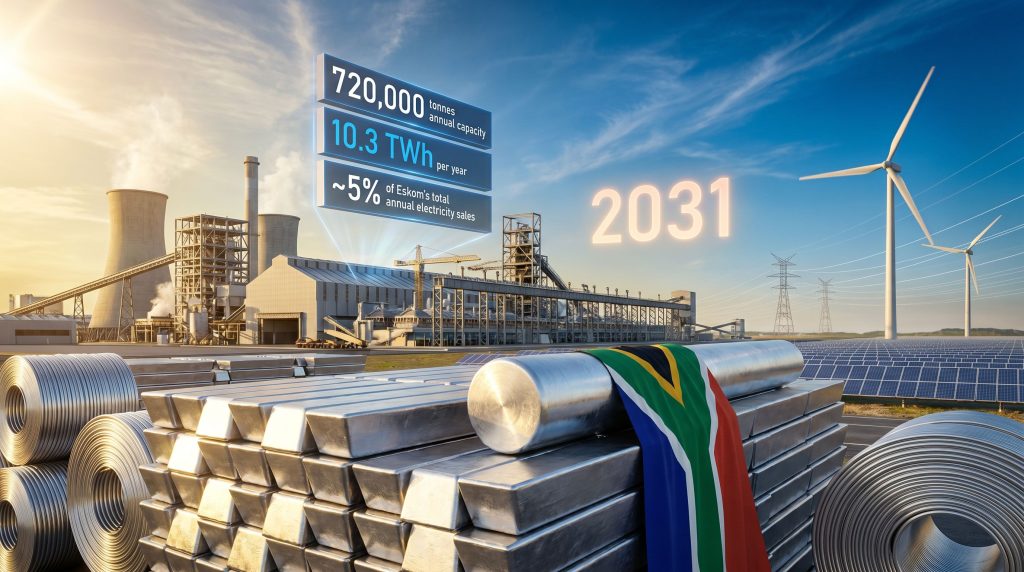
| Annual Production Capacity | 720,000 tonnes of aluminium |
| GDP Contribution (2015 to 2024) | Over R35-billion |
| Direct and Indirect Jobs Supported | Approximately 3,650 |
| Broader Value Chain Employment | Approximately 29,000 |
| Annual Electricity Consumption | Approximately 10.3 TWh |
| Share of Eskom's Annual Sales | Approximately 5% |
| Peak Demand Load | 1,205 MW |
| Community Investment Reach (5 years) | More than five million people |
South32 CEO Graham Kerr, speaking at the facility's 30th anniversary celebrations in Richards Bay, characterised the original investment decision as one that required genuine courage given the political and economic uncertainty of the early 1990s. He noted that from 2015 to 2024, the smelter contributed over R35-billion to South Africa's GDP and currently anchors approximately 3,650 direct and indirect jobs, while an estimated 29,000 further positions are tied to the broader aluminium value chain that Hillside supplies and sustains. (Mining Weekly, 8 May 2026)
President Cyril Ramaphosa, who attended the anniversary celebration, reinforced the facility's standing by highlighting that Hillside's participation in the London Metals Exchange and its compliance with international certification requirements demonstrate that South African industrial output can meet the most demanding global quality and traceability standards. (Mining Weekly, 8 May 2026)
What makes this particularly significant from an industry perspective is that LME Grade A aluminium certification is not a rubber stamp. It requires consistent chemical purity thresholds, documented chain of custody, and the kind of quality management infrastructure that most developing-market smelters struggle to maintain across three decades of operation. Hillside has done precisely that.
The Electricity Arithmetic: Why This Deal Is Structurally Non-Negotiable
To understand the urgency driving the South32 Hillside aluminium smelter power agreement with Eskom, it helps to appreciate what aluminium smelting actually demands from an energy system. Furthermore, the broader context of electrification and decarbonisation across heavy industry makes the stakes even clearer.
The electrolytic reduction process that converts alumina into primary aluminium, known as the Hall-Heroult process, is among the most electricity-intensive industrial operations on earth. Power costs typically represent between 30% and 40% of total production costs for primary aluminium smelters globally, making tariff structures the single most influential variable in determining whether a given facility is economically viable or not.
At Hillside, this translates into concrete numbers:
- Annual electricity consumption of approximately 10.3 TWh, equivalent to the annual power needs of a mid-sized South African city
- A peak demand load of 1,205 MW, comparable to the capacity removed from the national grid during a Stage 1 load curtailment event
- This consumption represents roughly 5% of Eskom's total annual electricity sales, making Hillside the utility's single largest industrial customer by volume
South32 COO Noel Pillay underscored at the 30th anniversary event that Hillside's consistent, predictable demand profile performs an active stabilising function on the national grid. Unlike residential or commercial loads that fluctuate with time of day, weather, and economic cycles, the Hall-Heroult smelting process requires uninterrupted, stable baseload power around the clock, every day of the year. This predictability is genuinely valuable to grid operators navigating an increasingly variable renewable energy mix. (Mining Weekly, 8 May 2026)
Pillay also noted that Hillside participates in load curtailment arrangements with Eskom during periods of peak national demand, effectively functioning as a demand-response asset. This is a sophisticated grid service that most industrial consumers cannot provide, and it further embeds the smelter into the operational architecture of South Africa's electricity system.
The mutual dependency between Hillside and Eskom is not rhetorical. It is structural. Eskom loses a reliable, large-volume paying customer. Hillside loses its ability to operate. Neither outcome is commercially or politically acceptable.
The 2031 Deadline and What the Joint Working Group Is Trying to Solve
The current discounted electricity tariff arrangement, approved by the National Energy Regulator of South Africa (Nersa) in recognition of Hillside's measurable economic contributions, expires in 2031. South32 and Eskom formalised a collaborative framework on 28 April 2026, establishing a joint working group tasked with developing a viable integration pathway before that deadline arrives.
Pillay confirmed that the two organisations had already spent four years exploring long-term renewable and lower-carbon power solutions prior to formalising the arrangement, meaning the analytical groundwork was laid from approximately 2022 onward. (Mining Weekly, 8 May 2026)
The working group's objective is not simply to replace one tariff with another. It is to design an energy supply solution that satisfies three simultaneous requirements:
- Competitiveness: The delivered electricity cost must keep Hillside within a viable global cost position against aluminium smelters in regions with access to cheap hydropower or subsidised natural gas
- Reliability: Aluminium smelting cannot tolerate supply interruptions. Damage to pot lines from power outages can take weeks to repair and carries costs running into hundreds of millions of rands
- Decarbonisation: Global aluminium consumers, particularly in the automotive and packaging sectors, are increasingly demanding verified low-carbon aluminium and are willing to pay a premium for it
Solar and wind generation have been identified as the most technically viable generation technologies at this stage, though both Pillay and the broader energy engineering community acknowledge that intermittency remains the defining challenge. Any renewable solution at 1,205 MW peak industrial scale must be paired with affordable, dispatchable firming capacity, whether through battery storage, pumped hydro, or contracted backup generation, to protect the continuous process integrity of the smelter.
Transmission Infrastructure: The Constraint That Defines the Timeline
One of the more technically nuanced aspects of the Hillside-Eskom negotiation is the geographic mismatch between where South Africa's best renewable resources are located and where Hillside's power needs to arrive.
The Northern Cape and Western Cape provinces host the country's highest-quality solar irradiance and wind resource corridors. However, the existing transmission grid in these regions lacks the capacity to carry large-scale renewable generation to industrial load centres in KwaZulu-Natal at the volumes Hillside requires.
Eskom has announced plans for a 14,000 km grid expansion programme, and Hillside has positioned itself as an active participant in this infrastructure build-out, not merely a passive beneficiary. South32 is advancing funding support for an aluminium rod manufacturing facility in Richards Bay specifically designed to supply the aluminium conductor products needed for that grid expansion. (Mining Weekly, 8 May 2026)
This is a strategically intelligent manoeuvre. By embedding Hillside's downstream manufacturing output into the physical infrastructure of South Africa's energy transition, South32 creates a compelling argument that the smelter's continued operation is a prerequisite for the grid expansion, not an obstacle to it.
Beyond the rod facility, South32 is also conducting exploratory work with local partners on:
- A dross processing plant to recover aluminium from smelting waste streams
- A billet alloy manufacturing facility to supply the construction and transport manufacturing sectors
These investments deepen the Richards Bay industrial corridor's aluminium value chain and extend Hillside's economic footprint beyond primary smelting into higher-value downstream processing. In addition, the broader shift towards renewable energy in mining operations across the continent underscores just how significant this transition moment is.
Regional Precedent: What Mozambique's Mozal Smelter Tells Us
The five-year lead time that South32 and Eskom have allocated to develop and implement a new power solution reflects lessons drawn from comparable facilities in the region. Mozal, a similarly scaled aluminium smelter in Mozambique with an annual capacity of approximately 560,000 tonnes, has faced closure risk when power supply arrangements moved away from concessional structures.
The pattern across Southern African aluminium smelters is consistent: when power costs rise to market-rate levels without a corresponding improvement in product pricing or operational efficiency, the economic case for continued operation deteriorates rapidly. The global industry context amplifies this pressure. Consequently, understanding the mining decarbonisation benefits available through well-structured transitions becomes critical for operations like Hillside.
| Smelter / Region | Primary Power Source | Annual Capacity | Key Risk Variable |
|---|---|---|---|
| Hillside, South Africa | Coal-fired grid (transitioning) | 720,000 tonnes | Tariff expiry in 2031 |
| Mozal, Mozambique | Cahora Bassa hydropower | ~560,000 tonnes | Tariff renegotiation exposure |
| ALBA, Bahrain | Natural gas | ~1,500,000 tonnes | Carbon pricing trajectory |
| Tomago, Australia | Grid plus renewable transition | ~590,000 tonnes | Energy cost competitiveness |
A successful renewable energy integration at Hillside would do more than protect existing operations. It would position South32 to supply verified low-carbon aluminium into premium segments of the global market, where environmental product declarations and lifecycle carbon accounting are becoming procurement prerequisites rather than optional attributes.
The next major ASX story will hit our subscribers first
The Employment Dimension: Why Automation Is Being Approached With Deliberate Caution
One aspect of South32's strategy at Hillside that deserves specific attention is the company's publicly stated caution around automation. COO Noel Pillay explicitly acknowledged at the 30th anniversary event that South32 remains deliberate about avoiding automation pathways that could displace workers, even where technology improvements are being pursued. (Mining Weekly, 8 May 2026)
This is not a trivial commitment in an era when global mining and smelting operations are under significant shareholder pressure to reduce headcount through technology substitution. The decision reflects an understanding that Hillside's social licence to operate in KwaZulu-Natal depends on maintaining employment at a scale that communities can feel.
The smelter's community investment programme has reached more than five million people over the past five years through initiatives focused on education, economic participation, and health outcomes in the Richards Bay region. This is the social infrastructure that underpins the argument that Hillside's continuation represents a public interest outcome independent of its commercial performance.
What Failure Would Actually Cost South Africa
Modelling the downside scenario requires looking beyond the smelter fence line. If a competitive long-term power agreement is not reached before the 2031 tariff expiry, the cascading consequences would extend across multiple systems simultaneously.
Direct consequences:
- Loss of approximately 3,650 direct and indirect positions in the Richards Bay labour market
- Elimination of one of Eskom's largest and most reliable revenue streams at a time when the utility's financial position remains under significant pressure
- Disruption to local manufacturers dependent on Hillside as a domestic aluminium feedstock source
Systemic consequences:
- Potential destabilisation of the estimated 29,000-job broader aluminium value chain
- South Africa would lose its only domestic primary aluminium production capacity, increasing dependence on imported material priced in foreign currency
- A negative signal for foreign direct investment in energy-intensive industry more broadly
- The grid stability contribution currently provided by Hillside's baseload demand profile would need to be replaced through other means, at additional cost
Perhaps most concerning from a policy perspective is the precedent risk. A Hillside closure attributable to power cost unviability would send an unambiguous signal to other energy-intensive industries operating under similar Nersa-approved concessional arrangements that South Africa cannot honour the implicit long-term compact with industrial investors. The rationalisation effects could extend well beyond aluminium.
Frequently Asked Questions
What is the current power arrangement between Hillside and Eskom?
Hillside operates under a discounted electricity tariff approved by Nersa, based on its demonstrated economic contributions to South Africa. This arrangement expires in 2031.
Why are negotiations beginning now, five years ahead of the deadline?
Designing, financing, permitting, and constructing renewable energy infrastructure at the scale required to supply a 1,205 MW industrial load is a multi-year process. The five-year window reflects genuine engineering and regulatory complexity rather than administrative caution.
What renewable technologies are under consideration?
Solar and wind generation have been identified as the most technically viable options. Any solution will require affordable firming capacity to protect the smelter's continuous process requirements.
Could Hillside operate for another two to three decades?
South32 executives have indicated that a competitive long-term power agreement would support continued operations over that timeframe, representing a substantial long-term industrial commitment to KwaZulu-Natal and South Africa. (Mining Weekly, 8 May 2026)
How significant is Hillside's electricity demand relative to the national system?
At approximately 10.3 TWh per year, Hillside accounts for roughly 5% of Eskom's total annual electricity sales, an extraordinary concentration of industrial demand in a single facility.
The Broader Test Case for South Africa's Industrial Energy Transition
What the South32 Hillside aluminium smelter power agreement with Eskom ultimately represents is a test of whether South Africa's energy transition architecture can accommodate the legitimate needs of existing large-scale industrial investors while simultaneously pursuing decarbonisation objectives. This challenge is not unique to Hillside; for instance, progress on South Africa green hydrogen signals a broader national commitment to industrial energy transformation.
The answer to that question will be written over the next five years. Both the scale of the challenge and the deliberateness of the collaborative approach suggest that both parties understand what is at stake. A successful outcome would provide a replicable framework for how state utilities and major industrial energy consumers can co-design energy solutions within complex regulatory environments.
Furthermore, how the country's aluminium industry leaders respond to and learn from this process will shape the competitive positioning of the entire sector for decades to come. According to South32's official announcement, the joint working group represents a genuine commitment from both parties to resolve this challenge collaboratively, creating a model with applications far beyond Richards Bay.
Disclaimer: This article contains forward-looking statements and projections based on publicly available information and executive commentary reported by Mining Weekly (8 May 2026). Outcomes related to power agreement negotiations, renewable energy implementation timelines, and economic projections are subject to regulatory, technical, commercial, and macroeconomic uncertainties. Nothing in this article constitutes financial or investment advice.
Want to Track the ASX Miners Driving the Next Wave of Industrial Transformation?
Discovery Alert's proprietary Discovery IQ model delivers real-time alerts on significant ASX mineral discoveries — instantly translating complex data across more than 30 commodities into clear, actionable insights for investors at every level. Explore historic examples of major discoveries and their market returns, then begin your 14-day free trial to position yourself ahead of the broader market.