
June 18, 2026
The Strait of Hormuz: Why One Waterway Holds the Global Economy Hostage
Few geographic features carry the economic weight of a 33-kilometre-wide strait connecting the Persian Gulf to the Arabian Sea. The Strait of Hormuz is not simply a maritime corridor; it is the single most consequential pressure point in the entire global energy supply chain. When it functions normally, the world barely notices it. When it doesn't, the effects ripple outward through commodity markets, manufacturing costs, and consumer energy bills across every continent within a matter of weeks.
That vulnerability became impossible to ignore after hostilities broke out across the Persian Gulf in late February 2026. The conflict sharply curtailed regional oil exports, accelerated drawdowns of global crude inventories that had already been under pressure, and drove Brent crude prices substantially higher. The downstream consequences touched everything from European gas bills to Asian industrial margins. Against that backdrop, the emerging U.S.-Iran deal to reopen the Strait of Hormuz has quickly become the most closely watched diplomatic development in global energy markets this year.
When big ASX news breaks, our subscribers know first
How Dominant Is the Strait of Hormuz in Global Energy Trade?
Understanding why this deal matters requires first appreciating just how structurally irreplaceable the strait is. Approximately 20% of global oil supply passes through Hormuz on a daily basis, along with roughly one-third of the world's liquefied natural gas trade, the majority of which originates from Qatar and flows toward premium Asian and European markets. Furthermore, global LNG supply constraints mean that alternative sourcing options remain limited even under severe disruption scenarios.
The key alternative routes are widely known but consistently overstated in their capacity to absorb Hormuz-scale volumes:
- The Petroline pipeline (also known as the East-West Pipeline) across Saudi Arabia has a capacity of around 5 million barrels per day (bpd), well below the 17-20 million bpd that transits Hormuz under normal conditions.
- The Abu Dhabi Crude Oil Pipeline to Fujairah bypasses the strait but handles only a fraction of total UAE export volumes.
- LNG rerouting is even more constrained, as the liquefaction infrastructure feeding Hormuz-bound cargoes cannot simply redirect to non-Gulf export terminals.
The structural gap between Hormuz throughput and bypass capacity is not a solvable engineering problem in any near-term timeframe. This is precisely why commodity analysts consistently describe sustained Hormuz disruptions as a genuine systemic risk rather than a manageable supply hiccup.
What the U.S.-Iran Interim Agreement Actually Covers
The framework taking shape around the U.S.-Iran deal to reopen the Strait of Hormuz is best understood as a conflict-suspension mechanism rather than a comprehensive resolution. The memorandum of understanding, details of which were reviewed by Bloomberg ahead of formal signing, establishes a foundation for maritime passage to resume while deferring the harder geopolitical questions to follow-on negotiations. Consequently, crude oil geopolitics will continue to weigh heavily on market sentiment throughout this process.
The confirmed and contested elements of the deal break down as follows:
| Element | Status |
|---|---|
| Ceasefire extension (approx. 60 days) | Confirmed by multiple outlets |
| Sanctions waivers for Iranian oil exports | Included in reviewed draft |
| Formal signing venue (Switzerland) | Expected; final text not publicly released |
| Strait reopening operational timeline | Unclear; delays anticipated |
| Joint control or toll arrangements | Disputed between U.S. and Iranian officials |
| Iran's nuclear program resolution | Not included in interim framework |
| Frozen Iranian asset release | Unresolved |
The formal signing was expected to involve U.S. Vice President JD Vance and Iranian Parliament Speaker Mohammad Bagher Ghalibaf, a pairing that signals meaningful political seniority on both sides without committing either government's executive authority to the full scope of unresolved issues. The choice of Switzerland as the signing location reflects its established role as a neutral diplomatic venue for precisely this type of preliminary accord.
What the deal explicitly does not address is equally significant. Iran's stockpiles of highly enriched uranium, which international inspectors have flagged as a proliferation concern for several years, remain outside the interim framework. The longer-term architecture of sanctions relief, including which waivers require congressional action and which fall within executive discretion, is also unresolved. These gaps are not incidental omissions; they represent the genuinely hard issues that interim frameworks are typically designed to defer.
Commodity markets frequently price in geopolitical resolutions well ahead of confirmed implementation. The gap between anticipation and actual operational normalisation can be substantial, particularly when physical infrastructure barriers are involved.
Crude Markets React Before the Ink Is Dry
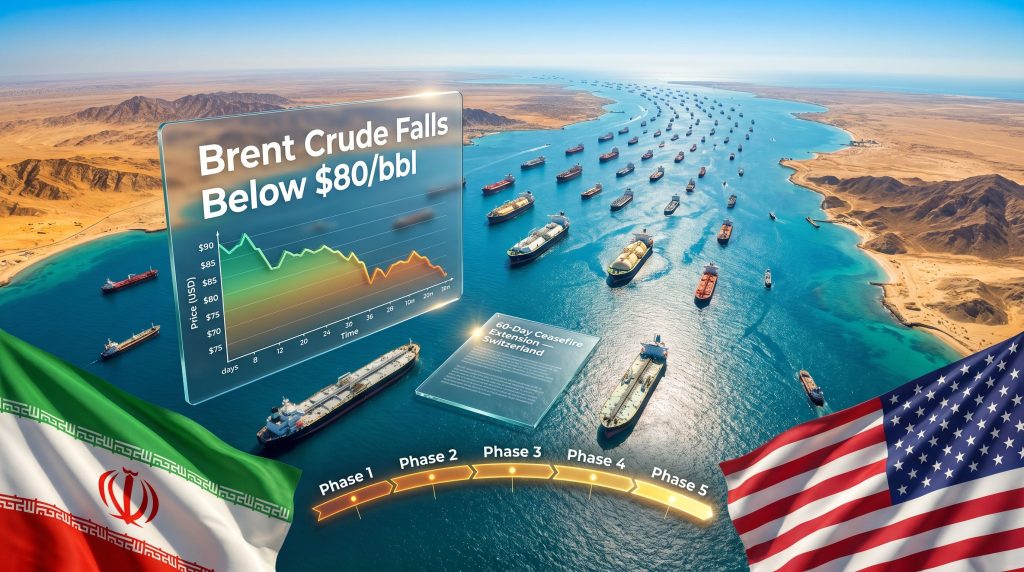
One of the most telling features of this diplomatic episode is how aggressively energy markets moved before any agreement was formally signed. Brent crude fell below $80 per barrel earlier in the week of the announcement, driven almost entirely by trader anticipation of restored Gulf supply. President Trump, speaking at the G7 summit in France, indicated the memorandum of understanding could be signed within days, describing the timeline as imminent.
This pre-emptive pricing behaviour is a well-documented phenomenon in commodity markets, but it carries a specific risk in geopolitical contexts. Markets can overshoot on optimism, particularly when the operational pathway to supply restoration is far more complex than the diplomatic pathway. For instance, geopolitical trade tensions across the broader region have already demonstrated how quickly market confidence can be undermined by renewed instability.
The economic logic behind the deal's acceleration was also made explicit. The sustained disruption to Gulf energy flows had begun generating measurable macroeconomic drag across oil-importing economies, and that pressure reportedly factored into the U.S. administration's decision to prioritise a resolution framework even without resolving the deeper nuclear and sanctions disputes.
The Operational Reality: Reopening Is a Process, Not an Event
Even if the agreement is signed and the ceasefire holds, the physical reopening of the Strait of Hormuz involves a sequence of technically demanding steps that cannot be compressed on diplomatic timelines alone.
Phase 1: Ceasefire stabilisation and diplomatic confirmation of the framework
Phase 2: Mine detection operations, likely requiring coordinated naval assets from multiple countries
Phase 3: Neutralisation of identified ordinance across the transit corridor
Phase 4: Maritime safety assessments and route clearance certification for commercial vessels
Phase 5: Gradual resumption of tanker and LNG carrier transits under escort or monitoring arrangements
Phase 6: Progressive normalisation of Gulf export volumes as confidence in route security builds among commercial operators
Mine clearance operations in particular are notoriously time-consuming. Historical precedents from the Iran-Iraq Tanker War of the 1980s illustrate how mining campaigns can persist well beyond the cessation of active hostilities. Such operations require sustained mine-hunting efforts that take weeks to months to complete even with dedicated naval resources. Commercial shipping operators are also likely to apply their own safety thresholds before resuming high-value cargo transits, independent of any official certification.
What Does This Mean for Tanker Operators?
Oil market disruption of this magnitude has historically forced tanker operators to pursue costly rerouting strategies, absorbing premium freight costs that eventually pass through to end consumers. Even as the diplomatic picture improves, those commercial operators will weigh route security independently of any official assessment, meaning freight rate relief may lag diplomatic progress by several weeks.
What the G7 Context Reveals About the Deal's Architecture
The decision to announce the agreement at the G7 summit in France was not coincidental. Multilateral summits provide diplomatic cover that purely bilateral negotiations do not, allowing both parties to frame concessions within a broader narrative of international economic stabilisation rather than bilateral capitulation.
Allied governments across Europe and Asia had been under significant pressure from their own industrial and consumer constituencies throughout the disruption period. European spot LNG prices had climbed sharply as Qatari cargoes faced routing uncertainty, and Asian buyers relying on long-term Gulf contracts had been absorbing premium spot market costs to cover supply gaps. The G7 setting gave those allied governments a mechanism to publicly welcome the agreement without being seen as having exerted direct pressure on either party.
The seniority of the designated signatories also carries analytical weight. Vance's participation signals White House-level commitment without requiring presidential signature on a preliminary accord. Ghalibaf's role as Iranian Parliament Speaker represents a constitutionally significant but not supreme authority within Iran's complex governance structure, providing Tehran with flexibility to revisit terms if follow-on negotiations stall.
The next major ASX story will hit our subscribers first
Unresolved Issues: The Longer Negotiating Agenda
The 60-day ceasefire extension creates a defined but narrow window for progress on the issues that actually determine whether this deal becomes a durable framework or a temporary pause.
The three most consequential unresolved matters are:
- Iran's highly enriched uranium stockpile. Iran is understood to have accumulated uranium enriched to levels approaching weapons-grade thresholds. This represents the core concern of Western governments and the issue least amenable to compromise within a 60-day negotiating window.
- Sanctions architecture. Immediate export waivers included in the draft represent executive-branch flexibility, but broader sanctions relief likely requires congressional engagement, which introduces legislative timeline uncertainty independent of diplomatic progress.
- Strait control and toll arrangements. Reuters and other outlets have noted a significant divergence between U.S. and Iranian official positions on who administers the strait during and after any transition period. This dispute has the potential to become a practical implementation barrier even if the broader diplomatic framework holds.
Until the final text of the agreement is publicly released and independently verified, the gap between U.S. and Iranian official characterisations of key operational terms represents a material implementation risk that energy market participants should not discount.
Global Energy Market Implications Across Asset Classes
The market impact of the U.S.-Iran deal to reopen the Strait of Hormuz extends well beyond crude oil spot prices. However, different segments of the energy complex face distinct near-term and medium-term trajectories. In addition, OPEC market influence will be a critical variable in determining how quickly supply and price dynamics stabilise following any reopening.
| Market Segment | Near-Term Impact | Medium-Term Outlook |
|---|---|---|
| Brent Crude (spot) | Downward pressure, already below $80/bbl | Gradual stabilisation as supply returns |
| LNG spot prices (Asia) | Relief on elevated premium pricing | Normalisation over 60-90 days post-reopening |
| Tanker freight rates | Elevated due to extended rerouting costs | Decline as Hormuz transits progressively resume |
| Global oil inventories | Depleted from months of disruption | Rebuilding phase expected through Q3-Q4 2026 |
| OPEC+ compliance dynamics | Complicated by Iranian crude re-entry | Strategic recalibration likely across member quotas |
The OPEC+ dimension deserves particular attention. Iranian crude re-entering the market under sanctions waivers creates a structural tension within the cartel's production management framework. Other members who maintained or reduced output during the disruption period now face a supply-side competitor whose export volumes are politically rather than commercially determined. The strategic recalibration this requires is unlikely to be straightforward or swift.
Three Scenarios for What Happens Next
Energy market participants should be actively stress-testing positions against the full range of plausible outcomes rather than anchoring to the most optimistic pathway.
Scenario 1: Successful Implementation and Full Normalisation
The ceasefire framework holds through its 60-day window, mine clearance proceeds on schedule, Iranian crude re-enters the market gradually, and follow-on nuclear talks produce a durable framework within 6-12 months. In this scenario, Brent crude stabilises in the mid-to-upper $70s range and LNG spot markets normalise as Qatari volumes resume full routing flexibility.
Scenario 2: Partial Implementation With Persistent Uncertainty
The strait reopens operationally, but disputes over toll arrangements, sanctions scope, and enrichment levels stall deeper negotiations. Markets enter a prolonged state of cautious optimism, with a geopolitical risk premium persisting above pre-conflict levels. This is arguably the most historically precedented outcome for Middle East interim agreements.
Scenario 3: Framework Collapse and Re-Escalation
Unresolved disagreements over enriched uranium stockpiles or sanctions architecture cause one or both parties to withdraw from the framework before the 60-day window closes. In this scenario, supply disruption returns, crude prices spike sharply from already-depleted inventory levels, and the diplomatic cost of re-engagement rises substantially.
Key Takeaways for Energy Markets and Policymakers
The U.S.-Iran deal to reopen the Strait of Hormuz represents a significant but fragile development. Before drawing strong directional conclusions, market participants and analysts should keep the following in clear view:
- The deal is a preliminary framework, not a comprehensive peace settlement or nuclear resolution.
- A 60-day ceasefire extension provides the negotiating window, but 60 days is a short timeline for resolving issues that have persisted across decades of diplomacy.
- Immediate sanctions waivers for Iranian oil exports appear in the reviewed draft, but the final agreement text has not been publicly released as of this reporting.
- Brent crude's move below $80/bbl reflects market anticipation, not confirmed supply restoration; full normalisation may take considerably longer than prices currently imply.
- Operational barriers including mine clearance and commercial shipping risk assessments will constrain any rapid reopening regardless of diplomatic progress.
- Unresolved disputes over enriched uranium stockpiles, sanctions scope, and strait administrative arrangements represent genuine implementation risks.
- The formal signing was expected in Switzerland, with senior officials from both governments serving as signatories.
For a detailed breakdown of the agreement's announced terms and the diplomatic context surrounding the signing, NBC News provides comprehensive coverage of how both sides have characterised the deal. Furthermore, for those seeking a visual overview of the key developments, the New York Times analysis provides in-depth reporting on the regional implications as they continue to unfold.
For readers seeking deeper context on how this situation continues to develop, ongoing upstream industry coverage of Middle East regional dynamics is available through World Oil's dedicated Iran and Middle East coverage at worldoil.com.
This article contains forward-looking analysis and scenario projections based on information available as of the date of publication. Energy market conditions and diplomatic developments can change rapidly. Nothing in this article constitutes investment or trading advice. Readers should consult independent financial and geopolitical analysis before making decisions based on information contained herein.
Want To Stay Ahead of the Next Major Market-Moving Discovery?
While geopolitical events like the Strait of Hormuz crisis reshape global energy markets, significant mineral discoveries on the ASX can deliver transformative returns entirely independent of macroeconomic turbulence — and Discovery Alert's proprietary Discovery IQ model instantly identifies these opportunities the moment they are announced, turning complex data across more than 30 commodities into clear, actionable insights. Explore historic discovery returns on Discovery Alert's dedicated discoveries page and begin your 14-day free trial today to position yourself ahead of the broader market.