
August 7, 2026
The Hidden Vulnerability in Africa's Energy Architecture
Global energy markets are built on assumptions of corridor reliability. When those assumptions break down, the consequences ripple outward in ways that disproportionately punish the least-insulated economies. Nowhere is this asymmetry more visible than across the African continent, where thin fuel inventory buffers, limited domestic refining capacity, and deep structural reliance on Gulf exporters combine to create an exposure profile unlike any other major consuming region.
The Strait of Hormuz sits at the centre of this vulnerability, and Strait of Hormuz shipping recovery and Africa fuel imports are now inextricably linked in ways that demand serious analytical attention. Running roughly 33 kilometres wide at its narrowest navigable point, this waterway between the Omani and Iranian coastlines functions as the circulatory valve for a substantial portion of the world's hydrocarbon trade. According to the U.S. Energy Information Administration, approximately 21% of global oil trade and around 25% of worldwide LNG flows pass through this single passage. When that valve constricts, energy markets tighten globally. However, for Africa, the pain arrives faster and cuts deeper.
When big ASX news breaks, our subscribers know first
Why the Strait of Hormuz Carries Such Outsided Weight in Global Energy
The Commercial Architecture of a Single Waterway
The five major Gulf exporters whose seaborne shipments depend on unimpeded Hormuz access include Saudi Arabia, the UAE, Kuwait, Iraq, and Qatar. Combined, these nations account for a dominant share of global crude oil production and virtually all of the region's LNG export capacity. Vessel categories that define the strait's daily commercial character span a broad spectrum:
- Crude oil tankers including Very Large Crude Carriers (VLCCs) and Suezmax vessels
- Product tankers carrying refined petroleum fuels
- LPG carriers supplying cooking and heating gas across developing markets
- LNG tankers serving industrial and power generation customers globally
- Bulk carriers and container ships supporting broader regional trade
The economic cost of a fully non-operational strait is staggering. Industry estimates have placed direct daily losses above $4 billion, accounting for cargo value, freight disruption, insurance surcharges, and downstream market repricing. Furthermore, that figure does not capture the secondary inflationary effects transmitted through fuel-dependent supply chains across dozens of importing nations. The LNG supply outlook for African importers is particularly concerning given this structural dependence.
Africa's Structural Dependency on Gulf Supply Routes
A fundamental, often underappreciated reality of Africa's energy landscape is that the continent imports a disproportionately high share of its refined petroleum products rather than crude oil alone. This matters because refining capacity within Africa remains severely underdeveloped relative to consumption needs. The implication is critical: Africa cannot simply substitute crude oil sources and refine domestically when Gulf supply disruptions occur. The continent purchases finished fuels, and those fuels predominantly originate from Gulf refineries whose export logistics run directly through the Strait of Hormuz.
Unlike Europe or Asia, which maintain strategic petroleum reserves and diversified import infrastructure, many African economies operate with fuel inventory cover measured in days rather than weeks, making them acutely sensitive to even short-term disruptions in Gulf export corridors.
Decoding the June 24 Transit Surge: What the Data Actually Shows
A Record Day in Post-Conflict Shipping Activity
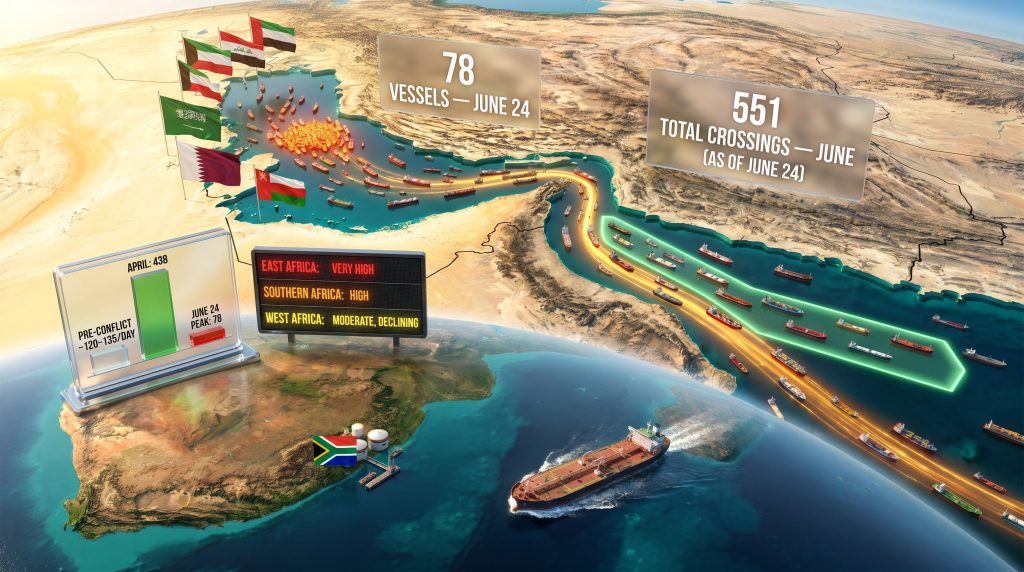
According to data from S&P Global Market Intelligence and S&P Global Commodities at Sea, 78 vessels transited the Strait of Hormuz on June 24, 2026, representing the highest single-day figure recorded since conflict-related disruptions began destabilising the corridor. This is not a trivial milestone. The composition of those transits reveals the breadth of commercial activity that had been suppressed:
| Vessel Type | Count | Primary Direction |
|---|---|---|
| Oil and Chemical Tankers | 22 | Mixed inbound/outbound |
| Bulk Carriers | 21 | Predominantly outbound |
| Cargo Ships | 12 | Mixed |
| Product Tankers | 12 | Evenly split |
| Container Vessels | 7 | Mixed |
| VLCCs (outbound) | 5 | Outbound |
| LPG Tankers | 4 | Outbound |
| Suezmax Vessels (outbound) | 3 | Outbound |
| LNG Tankers | 2 | Outbound |
| Inbound VLCCs | 2 | Inbound |
Source: S&P Global Market Intelligence and S&P Global Commodities at Sea, June 2026
Contextualising the Recovery Trajectory
The single-day record sits within a broader monthly trend that is equally significant. June's cumulative vessel crossings reached 551 transits by June 24, already surpassing April's post-conflict monthly total of 438. Mapped against pre-conflict baselines, however, the picture demands measured interpretation:
| Period | Vessel Activity | Context |
|---|---|---|
| Pre-conflict baseline | ~120-135 vessels per day | Normal operational throughput |
| April 2026 monthly total | 438 crossings | Previous post-conflict high |
| June 2026 (to June 24) | 551 crossings | Exceeded April benchmark |
| June 24 single-day peak | 78 vessels | Approximately 57% of pre-conflict daily average |
S&P Global's analysis characterises the 78-vessel day as representing a recovery to roughly 57% of pre-conflict daily shipping volumes. This is meaningful progress. It is not, however, normalisation. The geopolitical oil risks underpinning these disruptions continue to shape the broader recovery trajectory.
The Omani Safety Corridor: Engineering Around Geopolitical Risk
One structural enabler of the June recovery is the introduction of a maritime safety corridor running along the Omani coastline. This navigational channel provides vessels with a defined, monitored transit path that reduces proximity to contested territorial waters. On June 24 alone, more than 40% of transiting vessels used this corridor, with the majority being outbound cargo carriers actively moving product to international markets.
The corridor's significance extends beyond pure logistics. It represents a geopolitical engineering solution to a security problem, creating a degree of operational predictability that did not exist during the height of the disruption. Crucially, analysts have noted that some vessels that entered the Gulf during more recent, calmer periods have now successfully completed outbound transits. S&P Global interprets this as evidence of a gradual re-establishment of normal navigation and trading patterns.
How Fragile Is This Recovery? Risks That Could Reverse Progress
The Vessel Backlog Problem
The single most underappreciated constraint on a return to normal Hormuz operations is the scale of the stranded vessel backlog. As of mid-June 2026, an estimated 2,300 vessels remain trapped in the Gulf and Gulf of Oman region. The breakdown is alarming:
- Approximately 705 tankers are among the stranded fleet
- Roughly 255 of those tankers are fully loaded and awaiting safe passage
- More than 500 vessels are positioned within Iran's exclusive economic zone, adding layers of diplomatic and navigational complexity
This backlog functions as a structural overhang. Even as new daily transits resume, the queue of delayed vessels must progressively clear before supply chains can approach genuine normalisation. The math here is sobering: at 78 vessels per day, clearing 2,300 stranded ships while simultaneously accommodating normal inbound traffic represents a multi-month process under optimistic assumptions.
Persistent Operational and Transparency Concerns
Beyond the backlog, S&P Global flagged specific concerns from the June 24 data that underscore the recovery's fragility:
- Eight vessels were detected operating without active tracking signals during transit, creating significant safety and situational awareness gaps
- Several ships continued navigating in close proximity to Iranian territorial waters, maintaining elevated exposure to geopolitical risk
- The long-term consistency of vessel movements cannot be assured until more durable security frameworks are established
Risk Perspective: The current shipping resumption should be read as a cautious reopening, not a resolved crisis. Industry estimates for full normalisation range from several weeks for optimistic scenarios to full stabilisation by Q1 2027 under more conservative supply chain models.
| Scenario | Recovery Timeline |
|---|---|
| Optimistic (tanker operator guidance) | Several weeks to one month |
| Base case (supply chain analysts) | Several months |
| Conservative (modelling scenarios) | Full normalisation by Q1 2027 |
Outstanding prerequisites for sustained recovery include mine-clearing operations, diplomatic verification processes, and IMO assessment of whether evacuation corridor protocols adequately protect stranded seafarers and their vessels.
Africa's Strategic Response: South Africa's Pivot and What It Signals
How the Continent's Largest Fuel Importer Repositioned
South Africa's response to the Hormuz disruption illustrates how supply chain shocks force structural adaptations that can outlast the triggering event. As Africa's largest importer of refined oil products, South Africa sought new energy suppliers after Gulf routes became unreliable, with U.S.-sourced fuel imports approximately doubling. Recent shipment data indicated multiple American tankers delivering around 165,000 tonnes of refined fuel to the port of Durban, displacing volume that would previously have originated from Oman, Saudi Arabia, and the UAE.
The economic consequences for South African consumers compound through two simultaneous channels:
- Higher landed costs for fuel sourced from further afield, incorporating both product price premiums and extended freight distances
- Domestic fuel levy adjustments layering additional cost increases onto an already pressured household budget
The broader energy export challenges facing African nations in this environment are considerable, in addition to the immediate supply disruptions. Furthermore, the energy export challenges observed in other resource-dependent economies offer instructive parallels for how African governments might structure more resilient import frameworks going forward.
The Cape of Good Hope Rerouting Premium
Vessels choosing to avoid the Strait of Hormuz entirely have rerouted via the Cape of Good Hope, adding up to 14 additional transit days per voyage. This rerouting has had measurable market effects, with tanker spot rates on key Gulf-to-Asia corridors reportedly tripling as vessel utilisation and voyage costs escalated. For African importers dependent on Gulf-origin fuel, this creates a structural cost elevation regardless of whether their specific cargoes use the Hormuz route or the Cape alternative.
Paradoxically, South Africa's geographic position at the Cape transforms what is a cost burden for most importers into a potential commercial opportunity. Durban and Cape Town occupy uniquely strategic positions as bunkering and transit hubs when the Cape route carries elevated vessel traffic. Consequently, increased vessel traffic through these waters strengthens the long-term investment case for South African port infrastructure.
West Africa's Different Equation: The Dangote Refinery Factor
Domestic Refining as a Strategic Buffer
Nigeria's Dangote Refinery has progressively shifted West Africa's structural dependence on Gulf-sourced refined products. With the refinery's growing output contributing to a reported 23% decline in West Africa's refined fuel import dependency, the sub-region is better insulated against Gulf supply disruptions than it was even three years ago. A more stable Hormuz corridor benefits the refinery's competitive positioning by normalising the pricing environment against which it competes with imported alternatives.
This sub-regional contrast is instructive:
| Sub-Region | Gulf Exposure Level | Domestic Refining Buffer |
|---|---|---|
| West Africa (Nigeria-anchored) | Moderate and declining | High (Dangote capacity expanding) |
| Southern Africa | High | Low |
| East Africa | Very High | Minimal |
| North Africa | Moderate | Moderate (domestic production) |
East Africa's vulnerability is particularly acute and receives comparatively little analytical attention. Countries like Kenya, Tanzania, and Ethiopia are deeply Gulf-dependent for refined fuel imports, operate minimal strategic reserves, and have limited capacity to pivot sourcing at short notice. The supply chain disruptions triggered by Hormuz instability amplify these structural weaknesses considerably.
The next major ASX story will hit our subscribers first
Macroeconomic Transmission: From Shipping Lanes to Consumer Prices
The Inflation Pathway Through African Economies
The mechanism by which Hormuz disruptions translate into African consumer inflation follows a relatively predictable sequence:
- Gulf supply tightens as vessels remain stranded or reroute
- Freight costs escalate as available tanker capacity is absorbed
- Marine insurance premiums surge as geopolitical risk repricing occurs
- Landed fuel costs rise at import terminals
- Transport and logistics costs increase across all supply chains
- Consumer price inflation broadens beyond the energy sector
African governments managing elevated fiscal deficits and debt servicing pressures face compounded vulnerability at each stage of this chain. The partial Strait of Hormuz shipping recovery and Africa fuel imports situation reduces pressure at stages one through four but does not eliminate the risk profile entirely given the outstanding vessel backlog and unresolved security questions. The oil price movements generated by these disruptions have already demonstrated their capacity to destabilise fragile fiscal positions across multiple African economies.
The Subsidy Dilemma and Fiscal Exposure
Fuel subsidy policy has created a bifurcated exposure structure across African governments:
- Subsidy-maintaining governments absorb rising import costs directly into their fiscal accounts, crowding out spending on health, education, and infrastructure
- Post-subsidy reform governments (such as Nigeria following its 2023 subsidy removal) transmit price shocks directly to consumers, elevating social and political stability risks
Neither structure provides adequate protection against persistent Hormuz disruption. The episode reinforces the strategic case for accelerating investment in domestic refining capacity, establishing formal strategic petroleum reserves, and developing diversified supply agreements with non-Gulf producers including U.S. exporters and emerging West African crude producers.
Frequently Asked Questions
What is the Strait of Hormuz and why does it matter for Africa?
The Strait of Hormuz is a narrow maritime passage between the Arabian Peninsula and Iran, serving as the primary seaborne export gateway for crude oil, refined petroleum products, and LPG from the major Gulf-producing nations. For Africa, which imports a substantial proportion of its finished fuels from Gulf refiners, uninterrupted access through this corridor is directly linked to fuel price stability and supply security across dozens of national markets.
How many vessels transited the Strait of Hormuz on June 24, 2026?
A total of 78 vessels crossed the strait on June 24, 2026, the highest single-day figure since the onset of conflict-related disruptions, according to S&P Global Market Intelligence. The composition included 22 oil and chemical tankers, 21 bulk carriers, 12 cargo ships, 12 product tankers, seven container vessels, four LPG tankers, and two LNG tankers.
How long will full Strait of Hormuz shipping recovery take?
Timeline estimates vary considerably. Tanker operators suggest at minimum several weeks to a month for meaningful improvement, while broader supply chain analysts anticipate several months. Conservative modelling scenarios do not project complete normalisation until Q1 2027, contingent on mine clearance completion, diplomatic stability, and progressive clearing of the approximately 2,300-vessel backlog currently stranded in the Gulf.
Why did South Africa shift fuel imports toward the United States?
South Africa pivoted to U.S.-sourced refined petroleum products after Gulf supply routes became operationally unreliable during the Hormuz disruption. With approximately 165,000 tonnes of U.S.-origin refined fuel delivered to Durban in recent shipments, U.S. imports roughly doubled, partially replacing volumes previously sourced from Oman, Saudi Arabia, and the UAE. Whether this represents a temporary substitution or a longer-term sourcing realignment remains an open question with significant strategic implications for Gulf exporters' positioning in African markets.
What is the Omani maritime safety corridor?
The Omani safety corridor is a defined navigational route established along the Omani coastline to provide vessels with a safer transit path through the strait, reducing exposure to contested territorial waters. Approximately 33 of the 78 vessels that transited on June 24 used this corridor, with outbound cargo carriers representing the majority of corridor users.
Key Takeaways for Africa's Energy Security Outlook
- The 78-vessel transit on June 24 represents the strongest operational signal yet of a recovering Hormuz corridor, but at only 57% of pre-conflict daily volumes, substantial normalisation work remains
- A backlog of approximately 2,300 stranded vessels represents a supply chain overhang that will take months to fully clear regardless of how quickly security conditions stabilise
- South Africa's pivot to U.S. fuel imports may reflect a durable sourcing realignment rather than a temporary crisis response, with long-term implications for Gulf exporters' African market share
- East Africa remains the continent's most exposed sub-region, combining deep Gulf dependency with minimal reserves and virtually no domestic refining buffer
- The Dangote Refinery's expanding output is providing West Africa with a partial but growing structural insulation against Gulf supply shocks that other African sub-regions currently lack
- African governments face a strategic imperative that transcends the current crisis: building energy supply resilience through domestic refining investment, strategic reserve development, and formalised supply diversification frameworks
Readers seeking further coverage of Africa's energy import dynamics and global commodity trade developments can explore ongoing market analysis at Business Insider Africa's markets section, available at africa.businessinsider.com/local/markets.
Disclaimer: This article contains forward-looking statements, timeline estimates, and market projections sourced from industry analysts. These represent informed assessments rather than certainties. Energy market conditions are subject to rapid change based on geopolitical developments, and readers should not treat any recovery timeline as guaranteed. This article does not constitute financial or investment advice.
Want to Stay Ahead of ASX Commodity Discoveries Shaped by Global Supply Disruptions?
When geopolitical shocks reshape global energy and commodity markets, identifying the right ASX discoveries ahead of the broader market becomes critical — and Discovery Alert's proprietary Discovery IQ model delivers real-time alerts on significant ASX mineral discoveries the moment they're announced, turning complex commodity data into actionable investment insights. Explore how major mineral discoveries have historically generated substantial returns on Discovery Alert's dedicated discoveries page, and begin your 14-day free trial today to position yourself ahead of the next market-moving find.