Strategic Forces Reshaping Global Tungsten Consumption Patterns
Military modernisation programmes across Western nations have fundamentally altered tungsten consumption trajectories, creating demand patterns that operate independently of traditional economic cycles. This defence materials strategy has elevated requirements for tungsten-based armour-piercing ammunition, high-density alloys for aerospace applications, and specialised components for advanced weapons systems. Furthermore, this defence-driven consumption provides market stability during economic downturns while supporting sustained price appreciation.
The automotive industry's electrification transition represents another transformative demand driver, with electric vehicle manufacturers requiring tungsten carbide tooling for precision battery component fabrication. Battery enclosure welding processes utilise tungsten electrodes specifically engineered for aluminium joining applications, while emerging hydrogen fuel cell technologies incorporate tungsten-based catalytic systems. In addition, as global EV production scales toward projected levels exceeding 30 million annual units by 2030, automotive tungsten consumption could potentially increase by approximately 30% over current levels.
Electronics miniaturisation continues expanding tungsten applications in semiconductor manufacturing, where advanced chip architectures demand tungsten interconnects, barrier layers, and thermal management systems. Artificial intelligence accelerator chips and quantum computing platforms represent emerging high-value applications where tungsten's unique combination of electrical conductivity, thermal stability, and dimensional precision becomes critical for performance optimisation.
Unlike cyclical commodity booms driven by speculation, current tungsten market growth reflects genuine structural demand increases across defence, automotive, and technology sectors, creating more resilient long-term fundamentals.
Analysing Divergent Market Size Projections and Growth Scenarios
Tungsten market growth forecasts vary significantly depending on analytical methodology and market scope definitions, with projections ranging from conservative volume-based estimates to optimistic value-integrated scenarios. Understanding these variances requires examining different approaches to market measurement and their underlying assumptions about price trends, downstream integration, and and geographic coverage.
Comparative Forecast Analysis Framework
| Methodology Type | Market Scope | Growth Driver Focus | Typical CAGR Range |
|---|---|---|---|
| Volume-Based | Physical tungsten content | Supply-demand balance | 4.5% – 6.0% |
| Value-Based | Revenue including pricing | Price appreciation + volume | 8.5% – 10.0% |
| Downstream-Integrated | End-use applications | Industrial value-add | 9.0% – 12.0% |
| Geographic-Weighted | Regional consumption | Localised demand patterns | 6.0% – 8.5% |
Conservative volume projections typically focus on physical tungsten consumption measured in metric tonnes, capturing supply-demand fundamentals while excluding price volatility effects. These forecasts often project 4.7% to 6% annual growth rates based on historical consumption patterns and verified industrial demand increases.
Value-based projections incorporate both volume growth and price appreciation trends, often yielding higher growth rates of 8.5% to 10% annually. These methodologies reflect tungsten's strategic mineral status, supply constraints, and premium pricing for high-purity applications in defence and aerospace sectors. According to the Tungsten Market Report by Grand View Research, the global market is expected to experience significant expansion driven by these structural factors.
Downstream-integrated analyses include tungsten carbide tooling, electronic components, and finished industrial products, potentially reaching growth rates exceeding 9% annually. This approach captures value-added processing and manufacturing applications where tungsten content represents a fraction of final product pricing.
Regional Market Dynamics and Supply Chain Concentration
Asia-Pacific Dominance and Strategic Implications
Asia-Pacific regions command over 54% of global tungsten revenue through concentrated mining operations and integrated downstream processing capabilities. Chinese tungsten operations control approximately 80% of worldwide supply through state-managed production quotas currently limiting annual output to roughly 140,000 tonnes. This quota system creates structural supply constraints as international demand continues expanding.
China's export policies increasingly prioritise domestic value-added processing over raw material exports, compelling international buyers toward higher-priced refined products including ammonium paratungstate (APT) and tungsten carbide powders. State-controlled trade strategies support domestic industrial development while constraining global supply availability for competing manufacturers.
South Korea's Sangdong project represents the most significant non-Chinese tungsten development, with operational capacity expected to materially impact regional supply dynamics. According to industry analysis, Almonty Industries operates this strategic asset alongside established production at the Panasqueira mine in Portugal, creating a dual-asset model combining current cash generation with future growth potential.
North American Supply Security Initiatives
North American tungsten consumption accelerates primarily through defence applications and supply chain security programmes. Pentagon strategic materials initiatives fund domestic production capabilities while 25% tariff duties on Chinese tungsten products create economic incentives for North American mining project development and recycling operations expansion.
Military modernisation programmes drive consumption growth rates exceeding global averages, with defence contractors requiring reliable tungsten supplies for advanced weapons systems, aerospace components, and strategic equipment manufacturing. However, this defence-focused demand operates independently of commercial economic cycles, providing market stability and supporting sustained pricing strength.
European Industrial Integration and Green Transition
European tungsten demand expands through industrial automation, precision manufacturing, and renewable energy infrastructure development. German automotive and machinery sectors drive tungsten carbide tooling consumption, while Nordic renewable energy projects require tungsten components for wind turbine systems and electrical grid infrastructure.
European raw materials supply autonomy initiatives increasingly emphasise critical materials supply diversification, creating opportunities for non-Chinese tungsten suppliers and recycling operations within the continental market.
Industrial Applications Driving Sectoral Growth Acceleration
Defence and Aerospace Strategic Requirements
Military applications represent tungsten's fastest-expanding consumption segment, with defence contractors requiring high-density alloys for kinetic energy penetrators, counterweights, and radiation shielding systems. Modern fighter aircraft incorporate tungsten components throughout engine assemblies and avionics systems, while naval applications include submarine ballast mechanisms and torpedo guidance equipment.
Defence demand characteristics include:
- Long-term contract stability spanning multiple years
- Premium pricing for defence-grade specifications
- Supply chain security requirements favouring allied suppliers
- Technology advancement driving higher tungsten content per platform
Strategic military modernisation programmes across NATO countries create sustained demand growth independent of commercial economic cycles. Consequently, this provides tungsten suppliers with predictable revenue streams and supports price appreciation trends.
Automotive Electrification Manufacturing Requirements
Electric vehicle production requires specialised tungsten applications throughout manufacturing processes and component systems. Battery production facilities utilise tungsten carbide cutting tools for precision electrode manufacturing, while assembly operations require tungsten electrodes for aluminium welding applications specific to battery enclosure fabrication.
Emerging automotive applications include:
- Precision machining tools for battery component manufacturing
- Welding electrodes optimised for aluminium EV chassis construction
- Catalytic systems for hydrogen fuel cell vehicle applications
- Motor manufacturing requiring tungsten carbide tooling for magnetic component production
Industry projections suggest automotive tungsten consumption could increase 30% by 2030 as global EV manufacturing scales from current production levels toward 30+ million annual units. This reflects both increased per-vehicle tungsten content and expanded production volumes.
Electronics and Semiconductor Advanced Applications
Semiconductor fabrication increasingly relies on tungsten for advanced chip architectures requiring superior electrical conductivity, thermal management, and dimensional stability under extreme processing conditions. Modern integrated circuits utilise tungsten interconnects and barrier layers, while next-generation processors demand enhanced heat dissipation systems incorporating tungsten components.
Emerging high-value applications include:
- Artificial intelligence accelerator chips requiring optimised thermal management
- Quantum computing platforms demanding precise dimensional stability
- 5G infrastructure equipment utilising tungsten for signal processing components
- Advanced memory systems incorporating tungsten-based storage elements
These applications represent premium market segments where tungsten's unique material properties become essential for performance optimisation. Furthermore, they support higher pricing and sustained demand growth independent of commodity market cycles.
Supply Constraints and Market Structure Evolution
Chinese Production Management and Export Controls
China's tungsten mining quota system fundamentally shapes global supply availability by limiting annual domestic production to approximately 140,000 tonnes through state-managed allocation mechanisms. Government authorities increasingly view tungsten as strategically critical, implementing policies supporting domestic industrial development while constraining international supply access.
Recent policy developments indicate Chinese priorities include:
- Domestic value-added processing prioritisation over raw material exports
- Strategic stockpiling for national security applications
- Technology sector support through preferential domestic supply allocation
- Export licensing creating additional administrative barriers for international buyers
These supply management policies force international tungsten consumers toward higher-priced refined products. In addition, they create structural market tightness as global demand continues expanding beyond quota limitations.
Development Timeline Challenges and Project Pipeline
Non-Chinese tungsten projects typically require 5-7 years from initial discovery through production commencement, creating supply response delays relative to accelerating demand growth. Environmental permitting processes, metallurgical optimisation studies, and infrastructure development extend project timelines, particularly for remote deposit locations requiring substantial transportation and processing facility investments.
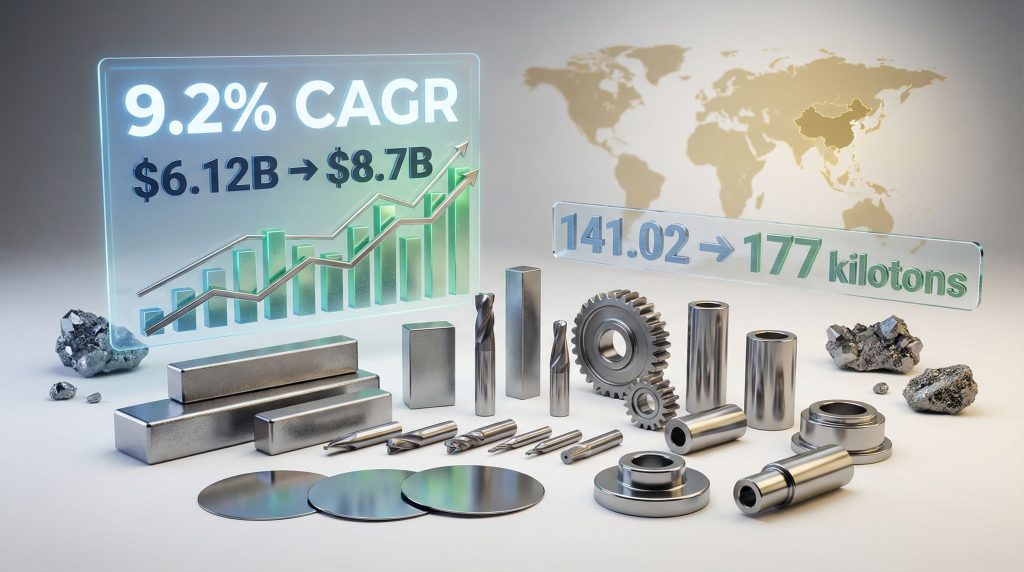
Current project pipeline analysis indicates new supply additions averaging approximately 2.5% annually through 2030, significantly below projected demand growth rates ranging from 4.7% to 9.2% depending on analytical methodology. This supply-demand imbalance supports sustained price appreciation and creates opportunities for existing producers to capture enhanced margins.
Key development challenges include:
- Extended permitting timelines in established mining jurisdictions
- Infrastructure requirements for remote deposit locations
- Technical complexity of tungsten metallurgical processing
- Capital intensity requiring substantial upfront investment commitments
Price Trajectory Analysis and Market Fundamentals
Current Pricing Performance and Structural Changes
Tungsten concentrate pricing has experienced substantial appreciation, with 65% wolframite concentrate reaching RMB 500,000-502,000 per tonne, representing approximately 150% year-over-year increases. Ammonium paratungstate (APT) international trading levels around $94,356 per metric tonne while domestic Chinese pricing exceeds RMB 730,000 per tonne, reflecting supply tightness and strong industrial demand.
Tungsten carbide powder prices demonstrate even more dramatic appreciation, increasing 213% year-over-year to RMB 940 per kilogram. These downstream product price increases reflect both raw material cost pressures and strong demand from precision tooling and industrial manufacturing applications.
Long-Term Price Outlook and Fundamental Drivers
Industry analysts project APT prices potentially reaching $460 per metric tonne unit (MTU) by 2026, establishing a new price floor around $400-450 per MTU significantly above historical trading ranges. Unlike previous commodity cycles driven primarily by speculation, current tungsten market growth reflects genuine supply constraints intersecting with structural demand increases across multiple industrial sectors.
Fundamental price support factors include:
- Supply quota constraints limiting production increases from dominant Chinese operations
- Defence demand growth operating independently of economic cycles
- Technology sector expansion requiring premium-grade tungsten products
- Infrastructure development in emerging markets driving industrial consumption
Price volatility remains elevated during supply transition periods, but underlying market fundamentals suggest sustainably higher long-term pricing compared to historical commodity cycle averages.
Corporate Positioning and Investment Framework Analysis
Operational Maturity Assessment Methodology
Tungsten sector companies demonstrate varying operational characteristics depending on development stage, production scale, and market positioning. Understanding these maturity differences becomes essential for investment evaluation, as financial metrics reflect different business phases rather than comparable operational performance.
Furthermore, this mining industry evolution creates opportunities for companies at different operational stages to capitalise on structural market changes.
Early-Stage Production Companies typically experience rapid revenue growth during operational scaling phases, with financial results reflecting capital investment and working capital expansion rather than steady-state profitability. EQ Resources exemplifies this category, with revenue increasing from $5.57 million in 2022 to approximately $66 million in 2025, though maintaining losses of roughly $39.3 million in 2025 as operations optimise and scale.
Mid-Tier Development Operations combine established cash-generating assets with major expansion projects, providing revenue stability alongside significant growth potential. Almonty Industries represents this model through its Panasqueira mine generating current cash flows while the Sangdong project offers substantial production expansion capabilities.
Large-Scale Integrated Suppliers operate at fundamentally different revenue scales with diversified product portfolios and established customer relationships. MP Materials, though focused on rare earth elements rather than tungsten, demonstrates this operational model with approximately $347 million annual revenue and vertically integrated processing capabilities.
Financial Performance Evaluation Criteria
Tungsten investment analysis requires understanding development stage characteristics rather than focusing exclusively on current profitability metrics. Companies in production ramp-up phases often show expanding revenue with continued losses as they optimise operations, build working capital, and achieve operational leverage.
Critical evaluation factors include:
- Production trajectory and capacity utilisation optimisation rates
- Realised pricing performance relative to benchmark tungsten indices
- Capital efficiency and development cost control capabilities
- Customer diversification and long-term contract security
- Balance sheet strength and financing capacity for expansion
Almonty Industries demonstrates several competitive advantages including operating cash inflows from established mining operations. In addition, they maintain long-term offtake agreements with industrial and defence customers, and project financing arrangements supporting major capacity expansion through the Sangdong development.
Strategic Positioning and Competitive Advantages
Successful tungsten companies typically demonstrate competitive advantages through resource quality, operational efficiency, strategic geographic positioning, or specialised customer relationships. Companies with established offtake agreements, particularly involving defence contractors or industrial original equipment manufacturers, maintain more predictable revenue streams and pricing stability.
The critical minerals pivot creates additional opportunities for strategic positioning, as governments increasingly prioritise supply chain security for critical materials like tungsten.
Vertical integration capabilities, including downstream processing facilities or recycling operations, provide additional value capture opportunities as tungsten market growth accelerates. Strategic location advantages, such as operations in allied countries or proximity to major industrial consumers, become increasingly valuable as supply chain security concerns influence purchasing decisions.
However, the critical minerals energy transition also creates new competitive dynamics, as companies must adapt to evolving demand patterns across traditional and emerging applications.
Tungsten market growth creates investment opportunities across the operational maturity spectrum, but success depends on accurately assessing each company's competitive position, development timeline, and alignment with structural demand trends rather than focusing solely on current financial metrics.
The tungsten sector's evolution reflects broader critical minerals market dynamics where strategic materials gain prominence through defence requirements, technology advancement, and supply chain security considerations. Companies positioned to capitalise on these trends through operational excellence, strategic partnerships, and financial flexibility are likely to benefit from sustained market growth driven by genuine industrial demand rather than speculative commodity cycles.
Looking to Capitalise on Strategic Metals Demand?
Discovery Alert's proprietary Discovery IQ model delivers real-time alerts on significant ASX mineral discoveries, including tungsten and other critical materials driving defence modernisation and technology advancement. Explore exceptional returns from historic discoveries and begin your 30-day free trial today to position yourself ahead of the market for the next major strategic metals breakthrough.