
July 14, 2026
Strategic Infrastructure Investment Reshaping Global Energy Partnerships
Modern energy security requires more than traditional commodity trading relationships. As nations face unprecedented electricity demand from artificial intelligence infrastructure and data centers, strategic partnerships are evolving beyond conventional trade agreements toward direct ownership stakes in critical infrastructure. Japan to invest in US oil gas and critical mineral projects exemplifies this transformation, reflecting sophisticated risk management approaches that prioritise long-term supply chain control over short-term financial returns.
Japan's recent commitment to invest $36 billion across American energy infrastructure represents this new paradigm in international resource partnerships. The investment spans three strategic sectors: natural gas power generation, crude oil export capabilities, and synthetic diamond manufacturing for advanced industrial applications. This initial deployment forms part of a broader $550 billion investment mechanism designed to secure Japan's energy future while providing the United States with essential infrastructure capital.
The financing structure differs fundamentally from traditional foreign direct investment models. Japanese Trade Minister Ryosei Akazawa confirmed that only 1-2% of the total commitment consists of direct cash investments, with the majority structured through loans and loan guarantees. This approach allows Japan to maintain strategic influence while limiting immediate capital exposure across multiple decades of infrastructure operations.
When big ASX news breaks, our subscribers know first
Transforming American Power Generation Infrastructure Through Japanese Capital
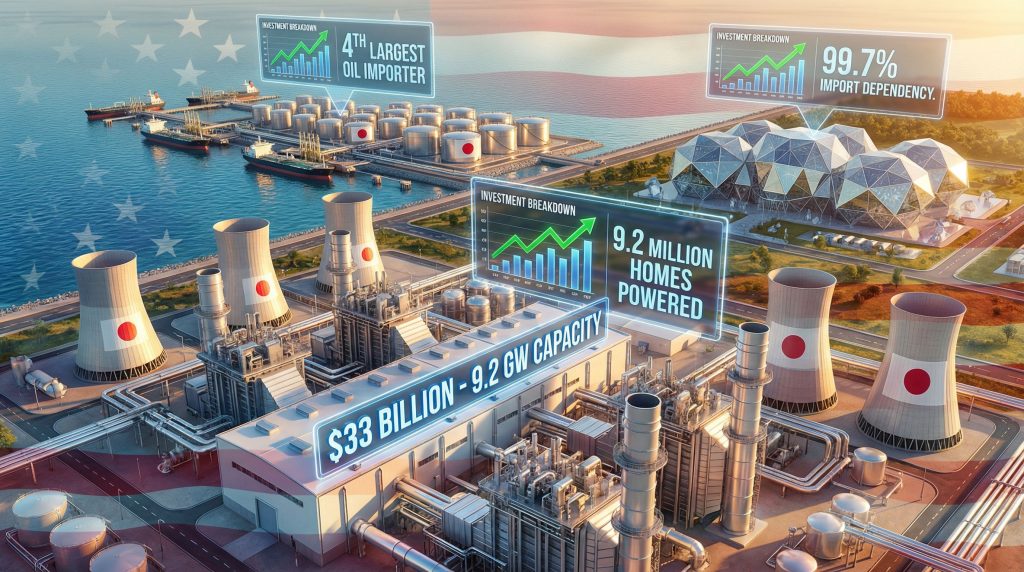
The Ohio natural gas facility represents the centrepiece of Japan's infrastructure investment strategy, commanding $33 billion for 9.2 gigawatts of generating capacity. This scale equals approximately nine nuclear reactors and could power 7.4 million American homes on the PJM Interconnection system, the largest grid operator in the United States.
SoftBank subsidiary SB Energy leads the project development, positioning Japan's technology conglomerate at the centre of America's expanding electricity infrastructure. The timing proves strategic as data centre electricity consumption continues accelerating, driven by artificial intelligence computing requirements and cloud infrastructure expansion.
Power Generation Investment Comparison:
| Project Type | Capacity | Investment | Cost per GW |
|---|---|---|---|
| Ohio Gas Facility | 9.2 GW | $33 billion | $3.6 billion |
| Average Nuclear Plant | 1.0 GW | $15-20 billion | $15-20 billion |
| Large Solar Installation | 0.5 GW | $1-2 billion | $2-4 billion |
The facility's capacity factor and operational characteristics will determine long-term financial returns. Natural gas plants typically operate at 50-80% capacity factors depending on grid demand patterns and fuel costs. Furthermore, Ohio's selection reflects existing natural gas pipeline infrastructure and electrical transmission capacity, though grid interconnection studies typically require 6-12 months for projects of this magnitude.
President Trump characterised the facility as representing "the largest in History," though comparative analysis against facilities like the Grand Coulee Dam (6.8 GW) and Palo Verde Nuclear Station (3.9 GW) suggests this refers specifically to single-phase natural gas development rather than all power generation infrastructure. Consequently, the US economy tariffs framework creates binding incentives for infrastructure completion while maintaining American competitiveness.
Securing American Crude Oil Export Infrastructure for Japanese Energy Security
Japan's $2.1 billion investment in the Texas GulfLink crude export terminal addresses fundamental energy security vulnerabilities. As the world's fourth-largest oil importer, Japan consumes approximately 3.2 million barrels daily with 99.7% import dependency from overseas sources.
The facility, operated by Sentinel Midstream, provides Japan with direct access to American crude oil exports while diversifying supply sources beyond traditional Middle Eastern providers. Current Japanese oil imports predominantly originate from Saudi Arabia, the United Arab Emirates, and Kuwait, creating concentration risk through the Strait of Hormuz shipping corridor.
Japanese Oil Import Diversification Strategy:
• Current US crude share: Approximately 6% of total imports
• Projected US share: Target increase to 15% following infrastructure completion
• Strategic benefit: Reduced dependency on Strait of Hormuz transit routes
• Infrastructure advantage: Preferential access to American crude oil supplies
The export terminal requires specialised infrastructure including deep-water vessel accommodation, multi-million barrel storage capacity, and advanced loading systems. Crude oil export terminals typically feature flow rates measured in hundreds of thousands of barrels per day, though specific design specifications for GulfLink remain undisclosed pending final engineering studies.
Commerce Secretary Howard Lutnick emphasised the reciprocal nature of the arrangement, stating that Japan to invest $36 billion in US energy and mineral projects under a new trade partnership while America gains strategic assets and expanded industrial capacity. This framework creates mutual dependencies that strengthen bilateral energy cooperation beyond conventional trading relationships.
Advanced Manufacturing Capabilities Through Synthetic Diamond Technology
Japan's $600 million investment in Georgia's synthetic diamond manufacturing facility represents strategic positioning in advanced materials production. The facility, developed in partnership with Element Six (a De Beers subsidiary), targets industrial applications rather than jewellery markets.
Synthetic diamonds serve critical functions across multiple high-technology sectors:
• Semiconductor manufacturing: Cutting tools and thermal management systems
• Quantum computing applications: Specialised optical components and quantum bit platforms
• Advanced drilling operations: Industrial cutting implements for oil and gas exploration
• High-precision optical systems: Specialised lenses and measurement equipment
Industrial Diamond Market Projections:
| Application Sector | 2025 Market Size | 2030 Projection | Growth Rate |
|---|---|---|---|
| Industrial Tools | $2.8 billion | $4.7 billion | 68% |
| Semiconductor Applications | $890 million | $1.6 billion | 80% |
| Quantum Technologies | $45 million | $230 million | 411% |
The facility's strategic importance extends beyond immediate manufacturing output. Synthetic diamond production requires specialised expertise in high-pressure, high-temperature processes and advanced chemical vapour deposition techniques. Japanese investment secures access to critical materials while establishing manufacturing capabilities within allied territory.
Georgia's selection likely reflects existing industrial infrastructure, skilled workforce availability, and favourable regulatory environment for advanced manufacturing operations. The state's proximity to major transportation corridors facilitates distribution to key markets across the eastern United States.
What Makes This Investment Framework Unique?
The $550 billion commitment structure represents sophisticated financial engineering rather than conventional foreign direct investment. The Japan Bank for International Cooperation and Nippon Export and Investment Insurance provide institutional backing, while the selection process involves joint panels and presidential approval mechanisms.
Financing Structure Breakdown:
• Direct investment: 1-2% ($5.5-11 billion)
• Loan guarantees: 40-50% ($220-275 billion)
• Project financing: 48-59% ($264-324 billion)
Investment Architecture and Risk Management Framework
The agreement includes unprecedented enforcement provisions. Japan must fund approved projects within 45 business days of selection, or face reimposed tariffs and revenue-sharing obligations. This compressed timeline distinguishes the framework from conventional infrastructure development processes that typically span multiple years from approval to funding.
Trump previously threatened 25% tariffs on Japanese imports, then reduced them to 15% after Japan agreed to the investment commitment. This tariff leverage creates binding financial incentives for project completion while providing the United States with infrastructure funding alternatives to traditional government appropriations. However, the broader implications of tariffs impact investments across global markets remain significant.
William Chou, Senior Fellow at the Hudson Institute, noted that the three projects align with shared priorities in energy, artificial intelligence, and semiconductor sectors. The selection process matches Japanese industrial expertise with American infrastructure requirements, creating synergistic partnerships rather than purely financial arrangements.
Implementation Timeline and Regulatory Challenges
Large-scale infrastructure projects face complex approval processes across multiple jurisdictional levels. The Ohio power generation facility requires federal environmental reviews, state regulatory approvals, local zoning permits, and grid interconnection studies. These processes typically span 12-36 months for projects of comparable magnitude.
Regulatory Approval Sequence:
- Federal environmental review: 12-24 months for environmental impact assessments
- State regulatory approval: 6-18 months for utility commission authorisation
- Local permitting: 3-12 months for zoning and construction permits
- Grid interconnection: 6-12 months for transmission system integration studies
The Texas crude export terminal faces additional complexity through Maritime Administration oversight, Coast Guard navigation approvals, and environmental compliance under the Clean Water Act. Deepwater port facilities require comprehensive safety assessments and emergency response planning coordination with federal agencies.
Construction timelines vary significantly by project type. Natural gas power plants typically require 3-4 years from groundbreaking to commercial operation, while crude export terminals can span 4-6 years depending on dredging requirements and marine infrastructure complexity.
The next major ASX story will hit our subscribers first
Climate Impact and Environmental Considerations
The natural gas facility creates tensions between immediate energy security objectives and long-term decarbonisation commitments. Modern natural gas plants operate at 40-60% thermal efficiency, producing lower emissions than coal alternatives while maintaining higher carbon intensity than renewable sources.
Carbon Impact Assessment:
| Project | Annual CO2 Emissions | Operational Lifespan | Total Carbon Impact |
|---|---|---|---|
| Gas Facility | 18-25 million tons | 30-40 years | 540-1,000 million tons |
| Export Terminal | 2-3 million tons | 25-30 years | 50-90 million tons |
| Diamond Facility | 50,000 tons | 20-25 years | 1-1.25 million tons |
The infrastructure investments lock in fossil fuel utilisation for multiple decades, potentially conflicting with net-zero emissions targets by 2050. However, the natural gas facility provides dispatchable power that supports renewable energy integration by compensating for intermittent solar and wind generation.
Japanese energy planners face similar carbon transition challenges domestically. The country's commitment to carbon neutrality by 2050 requires balancing immediate energy security needs against environmental objectives, particularly following reduced nuclear capacity after the Fukushima incident. In addition, energy security insights demonstrate how strategic partnerships can address long-term supply chain vulnerabilities.
Comparative Analysis with Historical Investment Patterns
Japan's infrastructure investment approach differs fundamentally from previous international partnerships. Traditional arrangements focused on commodity purchase agreements or technology transfer licensing, rather than direct ownership stakes in strategic assets.
The $550 billion commitment mechanism represents Japan's largest foreign investment pledge in a single country, exceeding historical overseas development assistance and private sector commitments. This scale reflects Japan's strategic assessment that energy security requires infrastructure control rather than market-based supply relationships.
Historical Investment Comparison:
• Marshall Plan (1948-1952): $13.3 billion ($150 billion in 2024 dollars)
• Japan's Belt and Road investments: $200 billion commitment over multiple countries
• US-Japan infrastructure partnership: $550 billion commitment to single nation
The enforcement mechanisms also represent innovation in bilateral investment structures. Previous agreements relied on diplomatic pressure and trade dispute resolution processes, while the current framework creates immediate financial consequences through tariff adjustments and revenue-sharing provisions.
Market Psychology and Strategic Positioning
Japan's investment timing reflects sophisticated analysis of American political and economic cycles. The announcement precedes Prime Minister Sanae Takaichi's scheduled Washington meetings in March 2026, demonstrating tangible progress on bilateral cooperation commitments.
The selection process involves joint panels that evaluate projects based on strategic importance, financial viability, and implementation feasibility. Projects range from $350 million to $100 billion in scale, allowing flexible deployment across diverse infrastructure requirements.
Market participants view the investment structure as establishing precedent for allied nation partnerships in critical infrastructure. For instance, South Korea negotiated similar arrangements, though Trump tariff policies have created implementation challenges with renewed tariff increases threatened for insufficient progress.
"The framework demonstrates that Japan functions as an ally that follows through on commitments, creating political momentum for expanded cooperation across multiple sectors beyond traditional trade relationships."
Future Implications for Global Energy Partnerships
Japan's infrastructure investment model may influence other strategic partnerships as nations prioritise supply chain security over cost optimisation. Germany faces similar energy security challenges following reduced Russian natural gas imports, while India seeks diversified critical mineral supplies for domestic manufacturing expansion.
The bilateral investment approach creates precedent for resource partnerships that bypass traditional commodity markets. Direct infrastructure ownership provides greater supply security than spot market purchases, particularly during geopolitical disruptions or price volatility periods.
Potential Replication Scenarios:
• Germany-US critical minerals partnerships: Rare earth processing and battery materials
• India-Australia rare earth collaborations: Mining and refining infrastructure investments
• UK-Canada uranium agreements: Nuclear fuel cycle security partnerships
The success of Japan's investment programme will determine whether other nations adopt similar infrastructure-focused approaches to resource security. Delays, cost overruns, or regulatory challenges could discourage comparable commitments, while successful implementation may accelerate the trend toward direct infrastructure partnerships.
How Will Success Be Measured?
Performance Metrics for Programme Success:
• Timeline adherence: Project completion schedules versus original projections
• Cost management: Final investment amounts compared to initial budgets
• Operational performance: Facility output versus design capacity specifications
• Strategic value delivery: Supply security improvements and risk reduction achievements
The investment framework's long-term viability depends on maintaining political support across electoral cycles in both nations. Infrastructure projects spanning multiple decades require sustained government backing despite potential changes in political leadership or policy priorities. Furthermore, oil price dynamics will significantly influence the economic returns from these strategic investments.
How Does This Change Global Investment Patterns?
The broader implications extend beyond bilateral cooperation to influence global investment flows and strategic partnerships. According to Reuters analysis of energy and critical mineral project announcements, similar frameworks are being explored by other allied nations seeking supply chain security.
Consequently, Japan to invest in US oil gas and critical mineral projects represents a fundamental shift toward strategic infrastructure partnerships that prioritise long-term security over short-term financial optimisation. The success of this $550 billion framework will influence how allied nations structure future resource cooperation agreements and manage energy security challenges in an increasingly complex geopolitical environment.
Looking for the Next Major Energy Infrastructure Play?
Discovery Alert's proprietary Discovery IQ model delivers real-time alerts on significant ASX mineral discoveries, instantly empowering subscribers to identify actionable opportunities ahead of the broader market. Begin your 14-day free trial today and secure your market-leading advantage.