
Strategic Investment Trends in American Manufacturing
Industrial manufacturing across the United States faces unprecedented pressures from global competition, supply chain vulnerabilities, and energy cost disparities that have fundamentally reshaped domestic production economics. The aluminum sector exemplifies these challenges, where decades of plant closures and capacity reductions have left American manufacturers increasingly dependent on foreign suppliers despite growing domestic demand across automotive, construction, and packaging industries. The Century Aluminum expansion in South Carolina emerges as a significant development within this complex landscape.
Strategic investment decisions in heavy manufacturing now require careful evaluation of multiple risk factors including energy pricing, trade policy stability, and international competitive positioning. Recent developments in aluminum production capacity suggest a potential inflection point where domestic manufacturers are beginning to reassess expansion opportunities under evolving market conditions.
When big ASX news breaks, our subscribers know first
What Does Century Aluminum's South Carolina Expansion Signal for US Industrial Policy?
The Century Aluminum expansion in South Carolina represents a significant reversal of long-term trends in American aluminum manufacturing capacity. The Mt. Holly facility commenced metal production in April 2026, targeting full operational capacity by June 30, 2026, marking one of the few instances of domestic aluminum production increases in recent decades.
Reshoring Manufacturing Through Strategic Energy Partnerships
Energy cost management has become the critical determinant of aluminum smelter viability in the United States. The Century Aluminum expansion in South Carolina leverages an extended electricity agreement with Santee Cooper running through 2031, providing operational cost predictability essential for long-term production planning.
Primary aluminum smelting requires approximately 13,000-14,000 kWh per tonne of metal produced through the Hall-Héroult electrolytic process. This energy intensity means electricity costs typically represent 35-40% of total production expenses, making power pricing the primary factor determining competitive positioning against international producers.
The southeastern United States offers several advantages for energy-intensive manufacturing:
- Access to diverse electricity generation sources including nuclear, natural gas, and renewable capacity
- Established industrial transmission infrastructure capable of supporting high-demand facilities
- Regional utility partnerships willing to negotiate long-term industrial rate structures
- Proximity to deepwater ports for raw material imports and finished product exports
Employment Multiplier Effects in Post-Industrial Regions
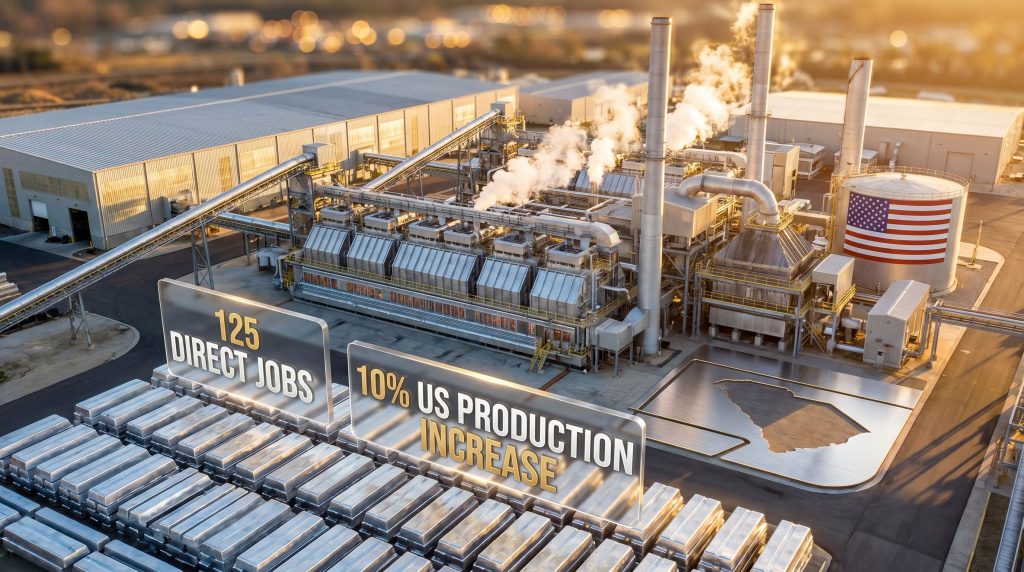
The Mt. Holly expansion generated over 125 direct jobs, representing substantial employment creation in Berkeley County's manufacturing ecosystem. These positions typically offer wages significantly above regional averages, with aluminum smelter workers earning $65,000-85,000 annually including benefits and overtime premiums.
Regional economic development benefits extend beyond direct employment through several mechanisms:
Supplier Network Development
- Local maintenance and repair service providers
- Transportation and logistics companies
- Industrial equipment suppliers
- Professional services including engineering and accounting
Skills Development Infrastructure
- Technical training partnerships with regional community colleges
- Apprenticeship programs for specialized smelter operations
- Cross-training opportunities with other regional manufacturers
- Retention of technical talent that might otherwise relocate
Tax Revenue Generation
- Property tax assessments on expanded industrial facilities
- Income tax collections from higher-wage employment
- Sales tax revenue from increased local spending
- Commercial development supporting worker populations
How Will 10% US Production Increases Impact Global Aluminum Market Dynamics?
The Century Aluminum expansion in South Carolina delivers approximately 10% increase to total US primary aluminum production, representing a meaningful adjustment to domestic supply capacity. Current US primary aluminum production operates at roughly 800,000-900,000 tonnes annually, suggesting the Mt. Holly expansion adds 75,000-90,000 tonnes of new capacity.
Supply Chain Vulnerability Reduction Strategies
American aluminum consumption has grown increasingly dependent on imported material despite robust domestic demand growth. The United States imports approximately 35-40% of aluminum consumption, creating strategic vulnerabilities in sectors critical to national infrastructure and defense applications.
Key import dependency metrics reveal concerning trends:
| Aluminum Product Category | Import Percentage | Primary Sources |
|---|---|---|
| Primary aluminum ingots | 45-50% | Canada, Russia, UAE |
| Aluminum sheet and plate | 25-30% | Canada, Germany, China |
| Extrusions and fabricated products | 20-25% | China, Mexico, Canada |
| Recycled aluminum scrap | 15-20% | Various global sources |
Strategic stockpiling implications for defense and infrastructure sectors include requirements for:
- Military aircraft and vehicle production
- Critical infrastructure construction projects
- Strategic reserve maintenance for emergency response
- Technology manufacturing requiring high-purity aluminum grades
Tariff Policy Effectiveness Assessment
Trade protection measures implemented during the Trump administration have created significant market disruption through elevated aluminum pricing. Furthermore, the tariff market impact has created cost pressures across multiple downstream industries while providing protection for domestic producers.
Market analysis reveals tariff policy effectiveness remains mixed:
Positive Impacts for Domestic Producers:
- Price premiums of $200-400 per tonne above pre-tariff levels
- Improved margins supporting facility maintenance and workforce retention
- Reduced pressure from low-cost international competitors
- Enhanced investment justification for domestic capacity expansion
Negative Impacts for Consumer Industries:
- Construction sector: Increased material costs of 8-12% for aluminum-intensive projects
- Automotive manufacturing: Additional $150-250 per vehicle in aluminum component costs
- Packaging industry: Margin compression from elevated raw material pricing
- Consumer products: Price increases passed through to end users
Why Are Energy Costs Still the Primary Barrier to US Aluminum Expansion?
Energy economics fundamentally determine aluminum smelter competitive positioning, with electricity representing the largest operational cost component. Despite tariff protection creating favorable pricing conditions, major producers remain hesitant to expand capacity due to structural energy cost disadvantages. However, the US energy challenges continue to affect industrial competitiveness.
Electricity Intensity Economics in Smelting Operations
Alcoa's reluctance to expand its underutilized Indiana facility illustrates the energy cost constraint. The company estimates expansion would cost approximately $100 million, primarily reflecting electricity infrastructure requirements and operational modifications necessary for increased production.
International competitive disadvantages stem from fundamental electricity pricing disparities:
| Region | Industrial Electricity Rate | Competitive Advantage |
|---|---|---|
| United States | $70-95 per MWh | Baseline comparison |
| Norway (hydro) | $35-45 per MWh | 50-60% cost advantage |
| Iceland (geothermal/hydro) | $30-40 per MWh | 55-65% cost advantage |
| UAE (subsidized gas) | $25-35 per MWh | 60-70% cost advantage |
| China (state-subsidized) | $40-60 per MWh | 30-40% cost advantage |
These electricity cost differentials translate directly into production cost advantages of $400-800 per tonne for international competitors, representing substantial competitive gaps that tariff protection alone cannot overcome. Additionally, US natural gas pricing plays a crucial role in determining electricity generation costs.
Capital Investment Threshold Analysis
The $100 million expansion cost cited by Alcoa encompasses multiple infrastructure requirements:
Electrical Infrastructure Upgrades:
- High-voltage transmission line capacity expansion
- Substation equipment installation and modernization
- Power factor correction and load balancing systems
- Backup power generation capabilities
Production Equipment Modifications:
- Potline restart and refurbishment costs
- Electrolytic cell replacement and optimization
- Materials handling system expansion
- Environmental control system upgrades
Return on Investment Analysis under current market conditions suggests:
- Minimum aluminum price threshold: $3,800-4,200 per tonne for acceptable ROI
- Current market pricing: $3,314 per tonne (as of April 2026)
- Investment payback period: 8-12 years under favorable scenarios
- Risk-adjusted returns: Below corporate hurdle rates given commodity volatility
What Strategic Advantages Does the Century-Emirates Global Aluminum Partnership Offer?
The Century Aluminum partnership with Emirates Global Aluminum (EGA) represents a transformative approach to domestic aluminum production capacity development. This collaboration will establish the first new US primary aluminum plant since 1980 at a facility in Oklahoma, marking the end of a 46-year gap in domestic smelter construction.
Technology Transfer and Operational Expertise Integration
Emirates Global Aluminum operates among the world's most efficient aluminum production facilities, achieving operational metrics that significantly exceed older US installations. EGA's technological capabilities include:
Advanced Smelting Technologies:
- Energy consumption optimization to 12,000-12,500 kWh per tonne
- Automated potline management systems reducing labor requirements
- Advanced alumina handling and storage systems
- Integrated environmental control technologies
Operational Excellence Standards:
- Production consistency metrics exceeding 99% uptime
- Quality control protocols achieving 99.7% specification compliance
- Predictive maintenance programs reducing unplanned downtime
- Supply chain integration reducing raw material inventory costs
The joint venture financing structure enables Century Aluminum to access EGA's capital resources and technical expertise while maintaining domestic operational control. This partnership model addresses traditional barriers to US aluminum expansion including:
- Capital intensity: Sharing $800 million to $1.2 billion construction costs
- Technical risk: Leveraging proven operational protocols
- Market access: Combining domestic market knowledge with international efficiency
- Regulatory navigation: Utilizing established US permitting expertise
Market Positioning for Domestic Supply Chain Dominance
The Oklahoma facility strategic location offers several competitive advantages:
Transportation Cost Optimization:
- Central US location reducing shipping distances to major demand centers
- Access to Class I railroad networks for raw material delivery
- Proximity to Mississippi River system for barge transportation
- Interstate highway access for finished product distribution
Raw Material Supply Security:
- Domestic alumina refining capacity sufficient for partial supply
- Gulf Coast port access for international bauxite and alumina imports
- Strategic positioning relative to recycled aluminum scrap sources
- Reduced exposure to international shipping disruptions
Production capacity projections suggest the Oklahoma facility will operate at 300,000-400,000 tonnes annually, representing approximately 35-45% increase to total US primary aluminum production capacity when fully operational.
How Do Critical Minerals Policies Drive Private Sector Investment Decisions?
Federal critical minerals classification has created policy frameworks supporting domestic aluminum production development, though direct government funding or strategic project designation has not been explicitly confirmed for specific facilities. The Trump administration's emphasis on supply chain security has influenced private investment calculations through several mechanisms.
Federal Incentive Frameworks Supporting Domestic Production
Critical minerals policy tailwinds include broader regulatory and economic support structures:
Regulatory Streamlining Initiatives:
- Expedited environmental review processes for strategic projects
- Coordination between federal agencies reducing permitting delays
- National Environmental Policy Act (NEPA) reform reducing timeline uncertainty
- Mining Law modernization supporting domestic extraction activities
Tax Policy Considerations:
- Accelerated depreciation schedules for manufacturing equipment
- Research and development tax credits for process optimization
- Domestic content requirements in federal procurement
- State and local economic development incentives
Trade Protection Mechanisms:
- Tariff structures providing pricing stability
- Anti-dumping duty enforcement against unfair international competition
- Buy American provisions in infrastructure spending
- Section 232 national security protections
Risk Mitigation Strategies for Long-Term Operational Viability
Investment decision frameworks for aluminum production must account for multiple risk categories, particularly considering broader US economic pressures and US-China trade impacts affecting manufacturing competitiveness:
Commodity Price Volatility Management:
- Long-term supply contracts with automotive and construction customers
- Financial hedging instruments limiting downside price exposure
- Product mix optimization toward higher-margin specialty applications
- Geographic diversification of sales reducing regional demand risks
Energy Cost Stabilization Approaches:
- Multi-year electricity supply agreements with utility partners
- On-site renewable energy development reducing grid dependency
- Energy efficiency improvements reducing per-tonne consumption
- Industrial demand response programs providing grid service revenue
Market Demand Forecasting Considerations:
- Electric vehicle adoption: Aluminum content per vehicle increasing 15-20% through 2030
- Infrastructure modernization: Federal spending programs supporting aluminum-intensive construction
- Packaging sustainability: Aluminum recycling advantages over plastic alternatives
- Defense applications: Strategic stockpiling requirements supporting baseline demand
The next major ASX story will hit our subscribers first
What Market Conditions Enable Successful Aluminum Smelter Expansions?
Successful aluminum smelter expansion requires convergence of favorable energy pricing, market demand growth, and regulatory stability. The Century Aluminum expansion in South Carolina demonstrates how these factors can align to support domestic production increases despite structural competitive challenges.
Demand Growth Projections Across Key Sectors
US aluminum consumption growth is driven by several secular trends supporting long-term demand expansion:
Electric Vehicle Manufacturing Requirements:
- Average aluminum content per EV: 400-500 kg versus 150-180 kg for conventional vehicles
- US EV production targets: 50% of new vehicle sales by 2030
- Projected aluminum demand increase: 2.5-3.5 million tonnes annually by 2035
- Battery housing and structural component applications growing rapidly
Construction Industry Lightweight Materials Adoption:
- Building efficiency standards driving aluminum window and facade demand
- Infrastructure replacement cycles requiring corrosion-resistant materials
- Solar panel mounting systems utilizing aluminum extrusions
- Commercial construction aluminum consumption growing 4-6% annually
Packaging Sector Sustainability Preferences:
- Consumer preference for recyclable aluminum over plastic packaging
- Beverage industry expanding aluminum can production capacity
- Food packaging migration toward aluminum containers
- Recycled content requirements supporting domestic recycling loops
Competitive Positioning Against Low-Cost International Producers
Domestic aluminum producers maintain competitive advantages in specific market segments despite energy cost disadvantages:
Transportation Cost Benefits:
- Shipping costs from Asia: $150-250 per tonne for bulk aluminum products
- Domestic delivery advantages: $50-100 per tonne savings for regional customers
- Inventory carrying cost reductions through proximity to demand centers
- Supply chain reliability during international shipping disruptions
Quality Premium Opportunities:
- High-specification aerospace applications requiring certified domestic production
- Automotive applications demanding consistent alloy composition
- Defense contracts specifying domestic content requirements
- Just-in-time delivery capabilities reducing customer inventory costs
Service and Customization Capabilities:
- Technical support and application engineering services
- Custom alloy development for specialized applications
- Rapid response to changing customer specifications
- Integrated supply chain management reducing total customer costs
How Does Regional Economic Development Benefit from Heavy Industrial Investment?
The Century Aluminum expansion in South Carolina exemplifies how heavy industrial investment creates multiplier effects extending throughout regional economies. Berkeley County's experience with the Mt. Holly facility expansion provides measurable evidence of economic development benefits.
South Carolina Manufacturing Ecosystem Strengthening
Industrial anchor investments like aluminum smelters create foundation infrastructure supporting broader manufacturing development:
Supplier Network Development:
- Maintenance services: Local providers for specialized smelter equipment servicing
- Transportation logistics: Trucking companies, rail services, and material handling
- Industrial supplies: Consumables, replacement parts, and operational materials
- Professional services: Engineering, environmental consulting, and financial services
Regional supplier spending typically generates $2.50-3.50 in additional economic activity for every dollar of direct facility spending, creating sustainable economic multiplier effects.
Skills Training Partnerships:
- Community college programs developing smelter-specific technical skills
- Apprenticeship programs combining classroom instruction with hands-on training
- Cross-industry skills transfer supporting other regional manufacturers
- Workforce retention initiatives reducing talent migration to other regions
Tax Revenue Generation Analysis:
- Property taxes: Industrial facilities assessed at $200-400 per job created
- Income taxes: Higher-wage employment generating $8,000-12,000 annually per worker
- Sales taxes: Increased local spending supporting retail and service sectors
- Commercial development: Housing, retail, and service sector expansion
Industrial Cluster Formation Potential
Aluminum smelter operations can catalyse development of related manufacturing activities:
Downstream Processing Opportunities:
- Sheet and plate rolling mills utilising primary aluminum
- Extrusion facilities producing construction and automotive components
- Fabrication shops creating finished products for regional markets
- Recycling facilities processing aluminum scrap into feed material
Research and Development Collaboration:
- University partnerships for metallurgical research and process optimisation
- Technology development projects improving energy efficiency and product quality
- Environmental research addressing emissions reduction and waste minimisation
- Workforce development research supporting training programme effectiveness
Transportation Infrastructure Optimisation:
- Rail spur development supporting bulk material handling
- Port facility improvements accommodating increased cargo volumes
- Highway improvements reducing transportation costs for all regional manufacturers
- Intermodal facility development enhancing logistics capabilities
What Operational Metrics Define Success in Smelter Expansion Projects?
Aluminum smelter expansion success requires achievement of specific operational and financial performance targets. The Mt. Holly facility expansion provides a framework for evaluating expansion project effectiveness across multiple dimensions.
Production Efficiency Benchmarking
Operational excellence in aluminum smelting focuses on several key performance indicators:
Capacity Utilisation Optimisation:
- Target utilisation: 95-100% of rated capacity during steady-state operations
- Ramp-up timeline: 3-6 months to achieve full production rates
- Maintenance scheduling: 90-95% uptime through planned maintenance optimisation
- Quality metrics: 99.5%+ specification compliance for customer requirements
Energy Consumption Improvement Targets:
- Current industry average: 13,000-14,000 kWh per tonne aluminum produced
- Best-in-class performance: 12,000-12,500 kWh per tonne through operational optimisation
- Efficiency improvement potential: 5-8% reduction through technology upgrades
- Cost impact: $50-100 per tonne production cost savings from efficiency gains
Product Quality Control Standards:
- Alloy composition consistency: ±0.02% variance from specification
- Surface quality standards: Minimal inclusion defects affecting downstream processing
- Delivery performance: 99%+ on-time delivery supporting just-in-time manufacturing
- Customer satisfaction metrics: Technical support responsiveness and problem resolution
Financial Performance Indicators
Financial success metrics for smelter expansion encompass both operational and strategic objectives:
Revenue per Employee Productivity:
- Target productivity: $400,000-600,000 annual revenue per employee
- Industry benchmarking: Top-quartile performance among North American smelters
- Continuous improvement: 3-5% annual productivity gains through operational optimisation
- Skills development impact: Training investment correlation with productivity improvements
Capital Expenditure Recovery:
- Investment recovery timeline: 7-10 years under favourable market conditions
- Return on invested capital: 12-15% hurdle rate for project justification
- Cash flow generation: Positive operating cash flow within 18-24 months
- Debt service coverage: 1.5x minimum coverage ratio for financial stability
Market Share Growth Projections:
- Regional market penetration: 15-20% share in southeastern US aluminum market
- Customer base expansion: 25-30 core customers within 500-mile radius
- Product mix optimisation: 60% commodity grades, 40% specialty applications
- Pricing premium capture: $100-200 per tonne premium for service and reliability
How Do Geopolitical Factors Influence Domestic Aluminum Production Strategy?
International political and economic relationships significantly impact domestic aluminum production viability through trade policies, supply chain security considerations, and strategic resource planning. The Century Aluminum expansion in South Carolina occurs within broader geopolitical context affecting industry investment decisions.
Supply Chain Security Considerations
National security implications of aluminum import dependency drive policy support for domestic production capacity:
Import Source Diversification Requirements:
- Current dependency: 35-40% of US aluminum consumption from imports
- Primary suppliers: Canada (45%), Russia (15%), UAE (12%), other sources (28%)
- Strategic vulnerability: Concentrated supplier base creating supply disruption risks
- Mitigation strategies: Domestic capacity expansion and strategic stockpiling
Strategic Reserve Requirements:
- Defense applications: Aircraft, vehicles, and equipment requiring aluminum components
- Infrastructure projects: Transportation and energy systems utilising aluminum products
- Emergency response capacity: Disaster recovery and military mobilisation requirements
- Economic security: Price stability through reduced import dependency
Trade Relationship Stability Impact:
- Tariff policy effectiveness: Protection mechanisms supporting domestic investment
- International negotiations: Trade agreement impacts on aluminum market access
- Retaliatory measures: Foreign government responses affecting US export opportunities
- Long-term predictability: Investment timeline requirements exceeding political cycles
International Competitiveness Maintenance
Sustaining domestic aluminum production requires continuous improvement addressing structural competitive disadvantages:
Technology Advancement Requirements:
- Process optimisation: Energy consumption reduction through operational improvements
- Equipment modernisation: Advanced control systems and automation technologies
- Environmental compliance: Emissions reduction meeting regulatory requirements
- Product development: Specialised alloys commanding premium pricing
Environmental Regulation Compliance:
- Emissions standards: Air quality requirements increasing operational costs
- Waste management: Spent potlining disposal and recycling requirements
- Water usage: Environmental permits limiting facility expansion options
- Carbon footprint: Customer preferences for low-carbon aluminum production
Export Market Development:
- NAFTA/USMCA advantages: Preferential access to Mexican and Canadian markets
- Quality certification: International standards compliance for global market access
- Transportation logistics: Port access and shipping capabilities for export sales
- Currency considerations: Dollar strength impact on export competitiveness
The domestic aluminum industry stands at a critical juncture where policy support, market demand growth, and strategic investment convergence create opportunities for production capacity restoration. Furthermore, Century Aluminum's expanded production capabilities demonstrate successful implementation of capacity enhancement strategies. Additionally, the company's power agreement extension with Santee Cooper provides long-term operational stability. Success in this challenging sector requires careful evaluation of energy economics, technological capabilities, and long-term market positioning strategies that address fundamental competitive constraints while capitalising on domestic market advantages.
Investment Risk Disclaimer: Aluminum industry investments involve substantial commodity price volatility, regulatory changes, and international competitive pressures. The analysis presented reflects market conditions and policy frameworks as of April 2026 and may not predict future performance. Investors should conduct independent research and consider professional consultation before making investment decisions in industrial commodity sectors.
Looking to Capitalise on Industrial Investment Opportunities?
Discovery Alert's proprietary Discovery IQ model identifies significant ASX mineral discoveries in real-time, helping investors spot the next major industrial materials breakthrough before the broader market. With major developments like Century Aluminum's expansion highlighting critical supply chain opportunities, understanding which mining discoveries have delivered exceptional returns becomes essential for positioning your portfolio ahead of emerging trends. Begin your 14-day free trial today to gain immediate access to actionable investment alerts powered by advanced AI technology.
