The Strategic Transformation of Global LNG Markets Through Floating Technology
The liquefied natural gas industry stands at a technological inflection point where traditional infrastructure approaches face challenges from innovative floating solutions. This transformation reflects broader shifts in energy project economics, geopolitical supply chain priorities, and the accelerating timeline demands of international energy security strategies. Understanding these dynamics becomes crucial as new market participants leverage unconventional resources to establish long-term export positions.
Argentina's Emergence as a Strategic LNG Supplier
Argentina's entry into global LNG markets represents a fundamental shift in South American energy export strategy. The recent Argentina GNL agreement with SEFE establishes the country's first large-scale liquefied natural gas export commitment, marking a decisive pivot from domestic energy self-sufficiency toward international market participation.
The Consortium Architecture Behind Market Entry
The Southern Energy partnership demonstrates an innovative approach to resource development financing and risk distribution. This five-party consortium structure combines:
- State-owned producer expertise through YPF's established operations
- Private domestic production capacity via PAE and Pampa Energía
- International operational knowledge from Harbour Energy
- Specialised floating LNG technology through Golar LNG partnership
Agreement Specifications:
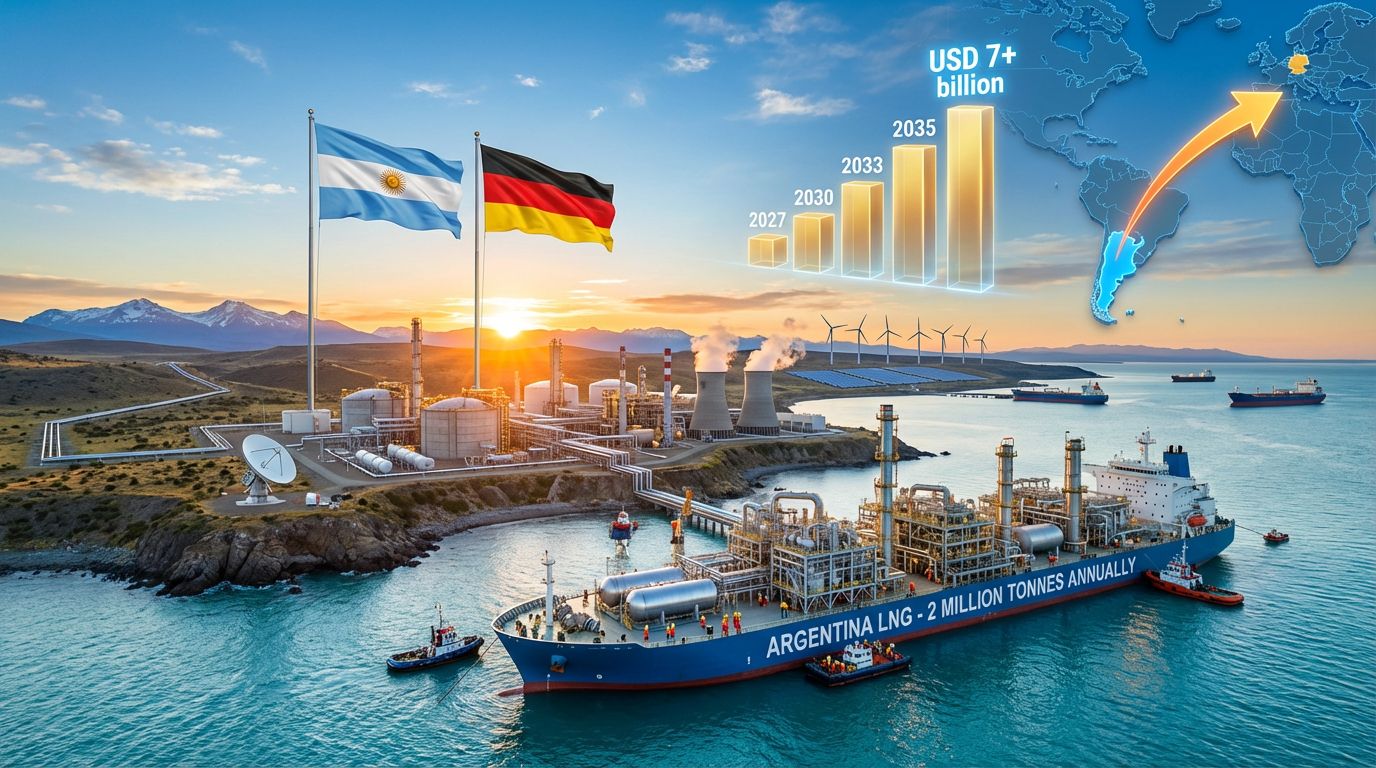
| Component | Details |
|---|---|
| Annual Volume | 2 million tonnes LNG |
| Contract Duration | 8 years (2027-2035) |
| Estimated Value | >USD 7 billion |
| Vessel Capacity | 2.45 MTPA (Hilli Episeyo) |
| SEFE Commitment | 82% of vessel output |
Technological Innovation Through Floating Infrastructure
The deployment of the Hilli Episeyo vessel represents a strategic departure from traditional onshore LNG facility development. This floating liquefaction approach offers several operational advantages:
- Accelerated project timelines compared to greenfield onshore facilities
- Reduced capital expenditure through existing vessel utilisation
- Operational flexibility enabling market responsiveness
- Proven technology deployment following successful Cameroon operations
The vessel's relocation from Cameroon to Argentine waters demonstrates the mobility advantages of floating LNG technology. Furthermore, this approach allows established infrastructure to serve new market opportunities without requiring entirely new facility construction.
European Energy Security and Supply Diversification Strategy
Germany's SEFE represents a critical component of European Union energy independence strategy following recent geopolitical supply disruptions. The Argentina GNL agreement with SEFE provides strategic benefits extending beyond simple volume commitments whilst addressing global natural gas price forecasts that influence European market dynamics.
SEFE's Market Position and Operational Scale
SEFE Operational Metrics:
| Metric | Scale |
|---|---|
| Annual Energy Sales | 200 TWh |
| Customer Base | 50,000 clients |
| Global Workforce | ~2,000 employees |
| Ownership | German Federal Government |
| Operational Scope | Production, commercialisation, transport, storage |
This scale positions SEFE as a significant European energy market participant capable of absorbing substantial LNG volumes. In addition, it provides long-term purchase security for emerging suppliers whilst contributing to broader energy transition insights that shape European strategy.
Geographic Diversification Impact
The agreement establishes a new Atlantic Basin supply corridor, reducing European dependence on traditional supplier concentrations. This diversification strategy encompasses:
- Multi-continental sourcing across Africa, South America, and potential North American suppliers
- Democratic governance alignment through partnerships with stable political systems
- Long-term supply certainty via eight-year commitment structures
- Price stability mechanisms through extended contract duration
European buyers increasingly prioritise supply chain resilience over short-term cost optimisation. Consequently, this makes long-term agreements with emerging democratic suppliers strategically valuable despite potential price premiums.
Economic Impact and Revenue Generation for Argentina
The Argentina GNL agreement with SEFE generates substantial economic multiplier effects extending beyond direct export revenues. The project's scale creates sustained foreign exchange inflows supporting Argentina's broader economic stabilisation objectives whilst addressing energy exports challenges common across emerging market economies.
Foreign Exchange and Investment Flows
Project Economic Impact:
- Direct export revenues: >USD 7 billion (2027-2035)
- Total project investment: >USD 15 billion over 20 years
- Annual average revenues: >USD 875 million
- Construction employment: 1,900 direct and indirect jobs
- Regional economic catalyst: Patagonian port and logistics development
The agreement provides Argentina with sustained foreign currency inflows while establishing precedent for future international energy partnerships, supporting both balance of payments stability and export diversification objectives.
Infrastructure Development and Local Content
Recent cargo arrivals demonstrate active project development progression. The MV Billion Star delivered 10,000 tonnes of steel piping (2,209 units) from Shanghai to San Antonio Este port. This indicates substantial local infrastructure integration requirements whilst highlighting the international supply chain complexity.
This material procurement approach generates secondary economic benefits:
- Local logistics services for international cargo handling
- Port facility utilisation supporting regional development
- Supply chain integration requiring domestic service provider participation
- Skills development through specialised operations training
The project structure emphasises domestic supplier participation during both construction and operational phases. However, it maximises local economic retention rather than capital flight through strategic procurement decisions.
Vaca Muerta Resource Base and Long-Term Supply Security
Vaca Muerta's unconventional shale characteristics provide distinctive advantages for sustained LNG export commitments compared to conventional offshore gas fields. For instance, the formation's technical properties support extended production horizons through incremental development rather than fixed reserve depletion.
Unconventional Resource Development Model
Shale gas production offers scalability advantages through several mechanisms:
- Incremental well development enabling production growth matching demand
- Extended resource life through improved extraction techniques
- Cost competitiveness relative to global LNG supply alternatives
- Production flexibility allowing output adjustments for market conditions
Technology Integration and Processing Requirements
The Vaca Muerta-to-LNG export chain involves several critical processing stages that demonstrate the complexity of modern renewable energy transformation initiatives across the energy sector:
- Raw gas extraction from unconventional shale wells
- Pipeline transmission to floating liquefaction facilities
- Cryogenic processing to -162°C for volume reduction
- LNG carrier loading for international transport
- Regasification at European import terminals
Each stage requires specialised technology and infrastructure investment. Furthermore, this creates employment opportunities across multiple technical disciplines and regional supply chains whilst demonstrating industrial complexity.
Geopolitical Implications and Regional Market Development
The Argentina GNL agreement with SEFE positions South America within broader global energy market evolution. This development complements emerging regional energy export capabilities across multiple countries and resource types, particularly given ongoing trade war market impact considerations affecting global energy flows.
South American Energy Export Evolution
Regional LNG Capacity Development:
| Country | Current Status | Projected 2030 | Strategic Position |
|---|---|---|---|
| Argentina | 0 MTPA | 5+ MTPA | New entrant with shale resources |
| Brazil | Limited capacity | Expanding offshore | Established offshore capabilities |
| Trinidad | 15 MTPA established | Stable production | Mature Atlantic Basin supplier |
This regional development creates competitive dynamics within Atlantic Basin LNG markets. However, it also provides European buyers with multiple sourcing options across politically stable democracies.
Atlantic Basin Market Structure Evolution
Argentina's market entry introduces new supply flexibility affecting several market dynamics:
- Regional price differentials between Atlantic and Pacific Basin markets
- Contract structuring precedents for emerging suppliers
- Buyer negotiating power through increased competitive options
- Supply chain diversification reducing single-supplier dependency risks
The eight-year commitment provides market participants with extended price visibility. Consequently, this establishes benchmarks for future South American LNG transactions whilst creating market transparency.
Global LNG Pricing Dynamics and Market Structure
The Argentina-SEFE agreement influences global LNG pricing through several mechanisms extending beyond direct supply addition. The contract structure and duration create market precedents affecting future transaction negotiations across multiple regions whilst demonstrating new partnership models.
Long-Term Price Discovery Mechanisms
Extended commitment duration provides multiple benefits for market participants:
- Benchmark establishment for emerging supplier pricing
- Risk premium quantification for new market entrants
- Volume commitment security reducing buyer supply uncertainty
- Investment certainty enabling project financing completion
Market Structure Impact Assessment
New supply sources typically influence market dynamics through various channels:
- Competitive pressure on established suppliers requiring price responsiveness
- Portfolio diversification enabling buyers to reduce concentration risk premiums
- Technology validation demonstrating floating LNG viability for other potential projects
- Financing template creation for similar emerging supplier arrangements
This market evolution demonstrates how innovative partnerships can reshape traditional supplier-buyer relationships. Furthermore, it creates opportunities for emerging economies to access international markets through strategic technology deployment.
Implementation Challenges and Risk Assessment
Despite the agreement's strategic benefits, several implementation challenges could affect project success and timeline achievement. These risks span technical, regulatory, and market dimensions requiring active management throughout the development period whilst addressing broader industry uncertainties.
Infrastructure Development Risks
Critical Success Factors:
- Vessel deployment timing for late 2027 commercial operations
- Pipeline infrastructure completion connecting Vaca Muerta to liquefaction facilities
- Port facility optimisation at San Antonio Este for LNG carrier operations
- Regulatory approval processes across multiple jurisdictions
The Hilli Episeyo's relocation from Cameroon to Argentine waters requires comprehensive regulatory approval and operational reconfiguration. However, this potentially creates timeline risks if approvals encounter delays or technical complications during transition.
Market and Financial Risk Factors
Key Risk Categories:
- Commodity price volatility affecting project economics and revenue projections
- Currency exchange fluctuations impacting USD-denominated revenue conversion
- Technology performance of floating liquefaction systems in new operating environments
- Political stability across both supplier and buyer jurisdictions
The agreement's >USD 7 billion valuation depends on international price evolution. Consequently, this creates revenue uncertainty despite volume commitment security and established contract terms.
Future Energy Partnership Models and Replication Potential
The Argentina GNL agreement with SEFE establishes a framework potentially replicable across other emerging LNG suppliers and European buyers seeking supply diversification. The consortium structure and floating technology approach offer templates for similar developments whilst demonstrating innovative financing mechanisms.
Template for Emerging Suppliers
Key replicable elements include several strategic components:
- Multi-stakeholder consortium distribution of financing and operational risks
- Floating LNG technology reducing infrastructure capital requirements
- Long-term buyer commitment providing investment certainty
- Democratic governance alignment supporting European energy security objectives
European Buyer Strategy Evolution
SEFE's approach demonstrates European willingness to invest in new supply sources. Furthermore, this potentially encourages similar arrangements with other emerging producers across:
- African Atlantic Basin suppliers with undeveloped gas resources
- South American regional producers beyond Argentina
- Southeast Asian emerging LNG exporters seeking European market access
This buyer strategy prioritises supply chain resilience and political stability over short-term cost minimisation. Consequently, it creates opportunities for emerging suppliers offering long-term commitment security and operational reliability.
Energy Transition Integration and Climate Strategy Alignment
The Argentina GNL agreement with SEFE supports energy transition strategies while providing bridge fuel capabilities during renewable energy system development. This dual function addresses both immediate energy security requirements and longer-term decarbonisation objectives whilst balancing commercial and environmental considerations.
Natural Gas Bridge Fuel Role
LNG deployment supports transition through multiple pathways according to International Energy Agency analysis:
- Coal displacement in power generation applications
- Industrial decarbonisation enabling manufacturing fuel switching
- Renewable integration providing backup power for intermittent sources
- Heating sector transition from higher-emission alternatives
Investment in Future Energy Systems
Revenue from LNG exports enables Argentina to fund broader energy infrastructure development:
- Renewable energy projects leveraging export revenue for domestic clean energy
- Hydrogen production capabilities using established gas infrastructure
- Grid modernisation supporting renewable integration requirements
- Technology development advancing clean energy manufacturing capabilities
This approach treats LNG exports as financing mechanisms for energy transition acceleration. However, it avoids long-term fossil fuel dependency through strategic revenue deployment and infrastructure planning.
Strategic Market Positioning and Long-Term Outlook
The Argentina GNL agreement with SEFE establishes Argentina as a credible long-term LNG supplier while providing Germany with strategic supply diversification. Success of this partnership will likely influence future South American energy export strategies and European import diversification efforts whilst demonstrating new collaborative models.
The agreement's structure combining established international partners with emerging regional producers offers a replicable model for global energy market development. Furthermore, this occurs in an era of increasing supply chain resilience requirements and geopolitical complexity.
Market Development Implications
This landmark agreement demonstrates how emerging suppliers can leverage innovative technology and strategic partnerships to enter global markets rapidly according to Energy Intelligence Group research. The floating LNG approach reduces traditional infrastructure barriers while consortium structures distribute risks across multiple stakeholders with complementary capabilities.
Future developments will likely depend on successful operational performance, international price evolution, and broader geopolitical stability across both South American and European regions. The project's success could catalyse additional South American LNG development while supporting European energy independence objectives through proven partnership frameworks.
Disclaimer: This analysis contains forward-looking projections based on announced agreements and industry estimates. Actual outcomes may vary based on market conditions, regulatory developments, and operational performance. Revenue projections depend on commodity price evolution and are subject to significant uncertainty.
Ready to Capitalise on Strategic Energy Market Opportunities?
Discovery Alert's proprietary Discovery IQ model delivers real-time alerts on significant mineral discoveries across the ASX, helping subscribers identify actionable opportunities in the rapidly evolving resources sector. Begin your 30-day free trial today to position yourself ahead of the market and gain access to the insights that could transform your investment strategy.