What Makes Subduction Zones Earth's Premier Gold Factories?
The Earth's crust operates as a vast metallurgical factory, with subduction zone gold formation representing the most efficient gold-concentrating mechanisms on our planet. These dynamic geological environments, where oceanic plates descend beneath continental masses, create the precise conditions necessary for transforming trace amounts of gold into economically viable deposits. Understanding these processes requires examining the intricate dance between tectonic forces, fluid chemistry, and thermal gradients that have operated for billions of years.
The Geological Architecture of Gold Creation
Convergent plate boundaries establish the fundamental framework for gold concentration through a series of interconnected processes. When oceanic crust, laden with sediments and volcanic material, begins its descent into the mantle, it carries with it trace amounts of gold locked within various mineral structures. The descending slab experiences increasing temperature and pressure, triggering dehydration reactions that release metal-bearing fluids.
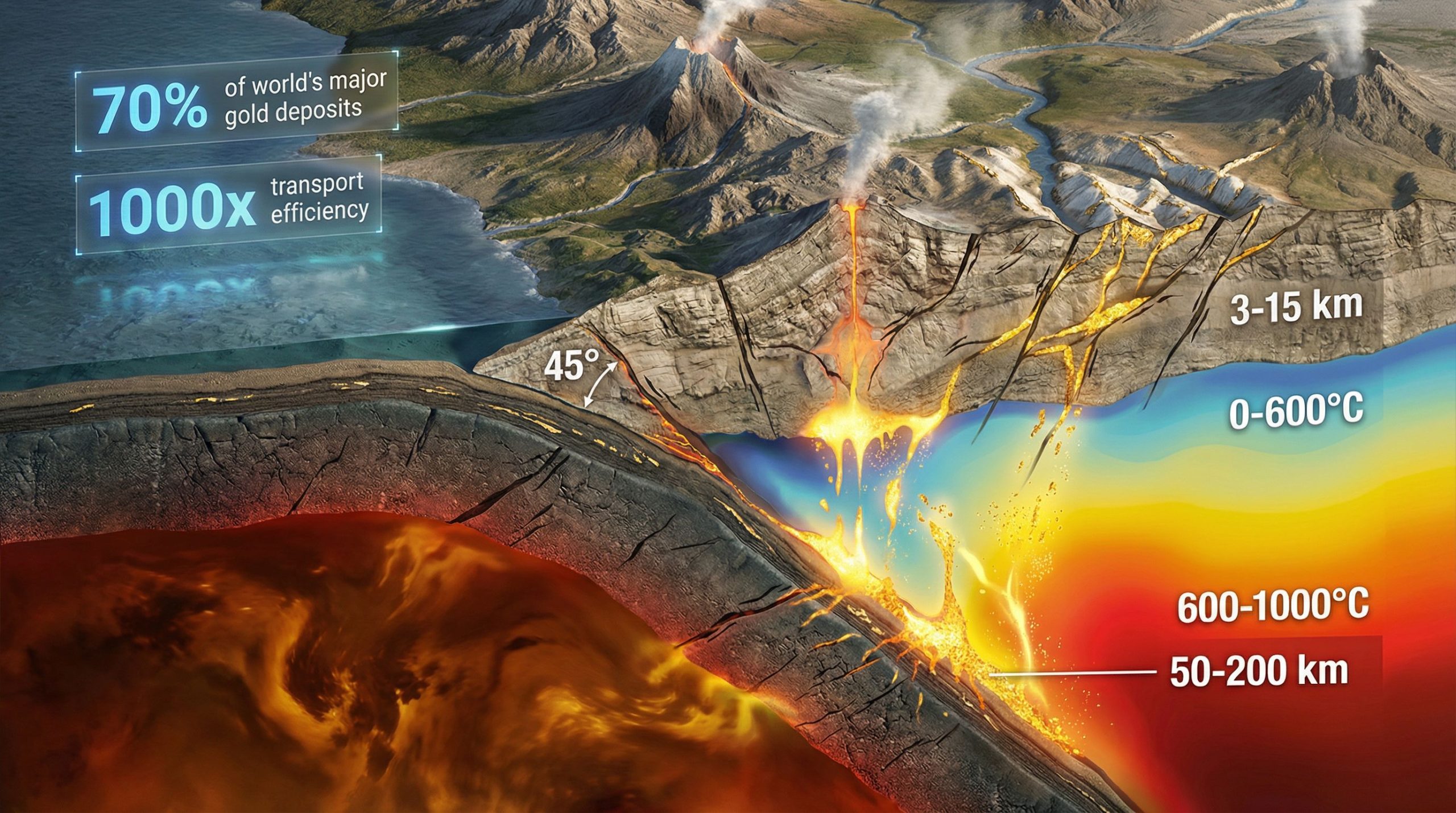
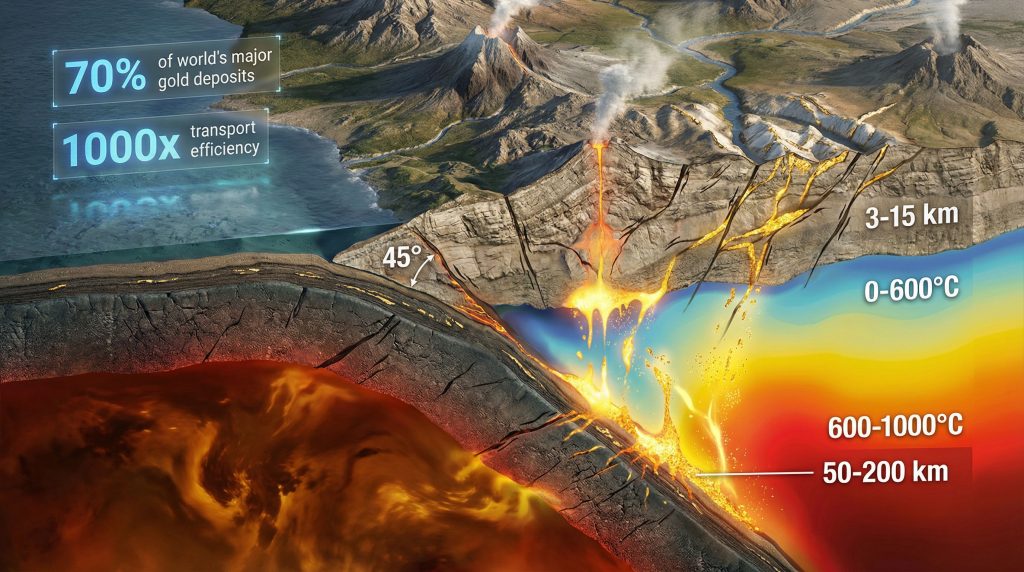
Research indicates that approximately 70% of the world's major gold deposits can be traced back to subduction zone processes, highlighting the dominant role these environments play in global gold distribution. The Pacific Ring of Fire exemplifies this relationship, hosting numerous world-class gold deposits from the Andes Mountains to the Indonesian archipelago. This comprehensive gold deposits analysis reveals patterns that have shaped modern exploration strategies.
The efficiency of subduction zones stems from their ability to process vast volumes of crustal material over extended periods. A typical subduction zone may consume oceanic crust at rates of 2-10 centimeters per year, continuously feeding new material into the gold concentration system. This steady-state process ensures consistent fluid generation and metal transport over millions of years.
Temperature and Pressure Conditions Required for Gold Mobilization
Gold mobilization in subduction zones occurs within specific thermal windows that optimize metal solubility and transport. The critical depth range for initial gold liberation extends from 50 to 200 kilometers below the surface, where temperatures reach 600-1000°C. These conditions activate dehydration reactions in hydrous minerals such as amphibole, serpentine, and chlorite, releasing fluids capable of dissolving gold from its host rocks.
The pressure regime at these depths, typically ranging from 1.5 to 6 gigapascals, creates the driving force necessary for fluid migration toward the surface. As these metal-laden solutions ascend through fracture networks and fault systems, they encounter progressively lower pressures and temperatures, triggering precipitation processes that concentrate gold into economically significant deposits.
Temperature gradients within subduction zones vary significantly based on several factors:
• Convergence rate: Faster subduction creates steeper thermal gradients
• Slab age: Younger oceanic crust retains more heat during descent
• Mantle wedge dynamics: Convection patterns influence thermal structure
• Crustal thickness: Thicker continental plates modify heat flow patterns
How Does the Trisulfur Ion Revolutionize Gold Transport Efficiency?
Recent advances in geochemical research have revealed the crucial role of trisulfur complexes in gold transport within subduction zone fluids. This discovery represents a paradigm shift in understanding gold mobility, as traditional models significantly underestimated the metal-carrying capacity of hydrothermal solutions. Furthermore, this breakthrough has enhanced our understanding of the mineral exploration importance in modern geological investigations.
The Chemical Breakthrough in Gold Mobility Science
A recent study from the University of Michigan has identified specific mechanisms that explain how gold reaches Earth's surface through complex chemical processes. The formation of gold-trisulfur complexes increases transport efficiency by approximately 1000 times compared to conventional gold-chloride or gold-bisulfide complexes. This enhanced solubility allows subduction zone fluids to carry several grams of gold per cubic meter, transforming our understanding of how economic deposits form in these environments.
| Transport Mechanism | Gold Concentration | Efficiency Factor |
|---|---|---|
| Traditional chloride complexes | 0.1-1 mg/L | 1x (baseline) |
| Bisulfide complexes | 1-10 mg/L | 10x |
| Trisulfur complexes | 100-1000 mg/L | 1000x |
The stability of gold-trisulfur complexes depends on specific chemical conditions present in subduction zone fluids. High sulfur fugacity, moderate pH levels, and elevated temperatures create an optimal environment for complex formation and stability during fluid migration.
Fluid Chemistry Dynamics in Descending Oceanic Slabs
Subduction zone gold formation processes depend heavily on fluid chemistry dynamics in descending oceanic slabs. As temperatures increase with depth, different mineral assemblages break down in sequence, each contributing specific elements to the evolving fluid composition. Serpentinized ultramafic rocks release sulfur-rich solutions, while altered basalts contribute gold and other metals.
The pH and oxidation state of these fluids undergo systematic changes during ascent. Initially alkaline conditions gradually shift toward neutral or slightly acidic as the fluids interact with crustal rocks. These chemical transitions directly influence gold solubility and the stability of different transport complexes.
Key chemical parameters controlling gold transport include:
• Sulfur speciation: Balance between sulfide, sulfate, and elemental sulfur
• Redox conditions: Oxidation state determines complex stability
• Temperature dependence: Higher temperatures favour trisulfur formation
• Pressure effects: Influence on fluid density and species distribution
What Are the Primary Mechanisms of Gold Precipitation in Hydrothermal Systems?
Gold precipitation from hydrothermal fluids represents the final stage in deposit formation, transforming dissolved metal complexes into solid ore minerals. This process requires precise triggering mechanisms that destabilise gold-bearing solutions and force crystallisation within favourable geological environments. Understanding these mechanisms is crucial for successful drill results interpretation in modern exploration programmes.
Temperature-Pressure Drop Triggers for Gold Crystallization
The optimal precipitation zone for subduction zone gold deposits occurs at depths between 3 and 15 kilometers within the upper crustal environment. At these depths, ascending hydrothermal fluids experience rapid decompression and cooling, creating conditions that favour gold precipitation over continued transport.
Temperature drops of 100-300°C over relatively short vertical distances trigger massive gold precipitation events. The rate of cooling directly influences grain size distribution within ore deposits. Rapid cooling produces fine-grained gold disseminated throughout host rocks, while slower cooling allows larger gold grains to develop within quartz veins.
Quartz vein formation serves as the primary host structure for precipitated gold in most subduction zone deposits. The simultaneous precipitation of silica and gold reflects similar solubility responses to changing pressure-temperature conditions. These veins typically display characteristic textures:
• Cockade structures: Indicating episodic fluid flow and precipitation
• Banded quartz: Reflecting cyclic changes in fluid chemistry
• Drusy cavities: Evidence of late-stage fluid circulation
• Brecciated zones: Showing multiple generations of fluid activity
Structural Controls and Fault System Pathways
Fault systems provide the critical pathways that channel gold-bearing fluids from deep sources to shallow precipitation zones. The architecture of these structural networks determines where and how efficiently gold deposits form within subduction zone environments.
Major crustal-scale fault systems typically control regional fluid flow patterns, while subsidiary fracture networks create local concentration zones. The intersection of different fault orientations creates structural traps where fluids pool and interact with reactive host rocks, enhancing gold precipitation efficiency.
Strike-slip reactivation of pre-existing thrust faults creates particularly favourable conditions for gold deposit formation. This structural style generates extensive fracture systems with high permeability, allowing sustained fluid circulation over extended periods. The episodic nature of fault movement creates pressure cycling that triggers repeated precipitation events, building up economic gold concentrations over time.
Which Deposit Types Form at Different Levels of Subduction Zone Systems?
Subduction zones create distinct deposit types based on depth, temperature, and fluid evolution stage. Understanding these variations helps exploration geologists target specific environments and predict deposit characteristics, with different mineral deposit tiers forming at various depths and conditions.
Epithermal Gold Systems (0-2km depth)
| Deposit Type | Depth Range | Temperature | Key Characteristics |
|---|---|---|---|
| Low-sulfidation | 50-1000m | 150-300°C | Banded quartz veins, precious metal-rich |
| High-sulfidation | 100-800m | 200-350°C | Acid alteration haloes, copper association |
| Intermediate-sulfidation | 200-1500m | 180-320°C | Mixed sulfide assemblages, variable grades |
Low-sulfidation epithermal deposits form from near-neutral pH fluids that create distinctive textures and mineral assemblages. These systems often produce bonanza-grade gold concentrations within quartz-adularia veins, with grades sometimes exceeding 100 grams per ton. The relatively shallow formation depth makes these deposits attractive exploration targets.
High-sulfidation systems develop from more oxidised, acidic fluids that create extensive alteration zones around mineralised centres. While individual gold grades may be lower than low-sulfidation systems, the larger alteration footprints make these deposits easier to detect using modern exploration techniques.
Mesothermal and Orogenic Systems (2-15km depth)
Mesothermal gold deposits form at intermediate depths where fluids retain higher temperatures and pressures compared to epithermal systems. These deposits typically show greater structural control and association with regional metamorphic events. Formation temperatures range from 300-500°C, creating distinct mineral assemblages that include gold-bearing arsenopyrite, pyrite, and pyrrhotite.
Orogenic gold systems represent some of the largest and most economically significant deposits associated with subduction zones. These deep-seated systems form during regional deformation events and can extend vertically for several kilometers. The Archean greenstone belts of Canada and Australia contain numerous examples of orogenic gold deposits that formed in ancient subduction zone settings.
Metamorphic fluid sources contribute significantly to orogenic deposit formation. As regional metamorphism progresses, dehydration reactions release metal-bearing fluids that migrate along crustal-scale fault systems. These fluids often show evidence for multiple sources, including:
• Metamorphic devolatilisation: Water and CO2 release from mineral breakdown
• Magmatic contributions: Fluids from crystallising intrusions
• Connate waters: Trapped seawater or formation fluids
• Meteoric circulation: Surface-derived waters in shallow systems
Porphyry and Intrusion-Related Deposits
Porphyry copper-gold systems form in the magmatic-hydrothermal transition zone where cooling intrusions release metal-bearing fluids. These large-tonnage, lower-grade deposits typically contain 0.3-1.0 grams per ton gold and 0.2-1.5% copper, but their enormous size makes them economically attractive.
The formation process involves multiple stages of intrusion, hydrothermal activity, and structural development. Early potassic alteration creates the core mineralised zone, while later phyllic and argillic alteration expand the deposit footprint. Understanding the relationship between mineralogy and ores helps geologists recognise the tonnage and grade relationships in porphyry systems.
Intrusion-related gold deposits represent a hybrid category combining elements of both porphyry and orogenic systems. These deposits form around small intrusions in subduction zone settings and often show higher gold grades than typical porphyry systems while maintaining significant size and continuity.
Where Do the World's Major Subduction-Related Gold Provinces Occur?
Global gold distribution patterns clearly demonstrate the dominant role of subduction zones in concentrating precious metals into economic deposits. Current and ancient convergent margins host the majority of world-class gold districts, reflecting the fundamental importance of these geological environments.
Pacific Ring of Fire Gold Distribution Analysis
The Andes Mountains exemplify active subduction zone gold formation, contributing approximately 40% of South America's total gold production. This linear belt extends over 7,000 kilometers and contains numerous epithermal, porphyry, and orogenic gold deposits formed during Cenozoic subduction of the Nazca Plate beneath South America.
Indonesian arc systems host several world-class gold deposits, including the famous Grasberg mine in Papua. This region represents one of the most geologically active subduction zones on Earth, with ongoing volcanism and rapid tectonic deformation creating ideal conditions for continued gold concentration. The Indonesian archipelago contains over 200 active volcanoes, many associated with gold-bearing hydrothermal systems.
The Philippines-Papua New Guinea corridor represents an emerging frontier for high-grade gold discoveries. This complex tectonic region involves multiple converging plates and active volcanic arcs, creating diverse deposit types within a relatively small geographic area. Recent discoveries have revealed epithermal systems with grades exceeding 20 grams per ton gold.
Ancient Subduction Zones and Their Gold Legacy
The Sierra Nevada Foothills of California preserve evidence of Mesozoic subduction that produced over 100 million ounces of gold from both primary and placer deposits. This ancient subduction zone created the geological framework that later supplied gold to the California Gold Rush, demonstrating how subduction zone deposits can influence human history long after their formation.
Canadian Cordillera gold deposits formed through complex interactions between subduction, terrane accretion, and regional metamorphism. The relationship between different geological terranes and gold distribution patterns provides insights into how subduction zones evolve over time and concentrate metals in specific structural settings.
Australian Archean greenstone belts contain some of Earth's oldest preserved subduction zone gold deposits. These ancient systems, formed over 2.5 billion years ago, demonstrate that subduction zone gold formation has operated throughout Earth's history. The Yilgarn Craton alone has produced over 70 million ounces of gold from numerous orogenic deposits.
What Precise Conditions Must Align for Economic Gold Deposit Formation?
Economic gold deposit formation requires the precise alignment of multiple geological variables operating within narrow parameter ranges. Understanding these requirements helps explain why gold deposits are relatively rare despite widespread subduction zone activity throughout Earth's history.
The Goldilocks Zone of Subduction Parameters
Optimal convergence rates for maximum gold efficiency range between 2-8 centimeters per year. Rates below this range fail to generate sufficient thermal energy for extensive fluid production, while rates above this range create thermal conditions too extreme for efficient metal transport and precipitation.
Plate age requirements favour young, hot oceanic crust for optimal gold formation. Oceanic plates less than 50 million years old retain sufficient thermal energy to drive extensive hydrothermal circulation during subduction. Older, colder plates may descend too rapidly without generating the sustained fluid flow necessary for significant gold concentration.
Thermal structure controls represent the critical balance between melting depth and fluid generation zones. The thermal structure must maintain:
• Slab dehydration temperatures: 600-800°C for optimal fluid release
• Mantle wedge conditions: 1000-1200°C for partial melting
• Crustal thermal gradients: 25-40°C/km for efficient fluid ascent
• Surface heat flow: 60-100 mW/m² indicating active hydrothermal systems
Mantle Fertility and Source Rock Requirements
Gold abundance thresholds in mantle source regions must exceed 1-2 parts per billion to generate economically significant deposits. While this concentration seems minimal, the vast volumes of material processed through subduction zones over millions of years allow effective gold extraction and concentration.
Sulfur content requirements prove equally critical for efficient gold transport. Source rocks must contain sufficient sulfur-bearing minerals to generate the trisulfur complexes necessary for high-efficiency gold transport. Serpentinised ultramafic rocks and altered basalts provide optimal sulfur sources for gold mobilisation.
Timing relationships require perfect synchronisation between multiple geological processes. Economic deposit formation demands:
• Fluid generation timing: Coordinated with structural preparation
• Precipitation triggers: Aligned with favourable chemical conditions
• Structural development: Creation of effective fluid pathways
• Preservation factors: Protection from subsequent erosion or deformation
How Do Modern Exploration Techniques Target Subduction Zone Gold?
Contemporary gold exploration has evolved into a sophisticated scientific discipline that combines traditional geological knowledge with cutting-edge technology. Modern exploration programmes integrate multiple data types to create comprehensive models of subduction zone gold systems.
Geophysical Signatures of Buried Gold Systems
Magnetic anomaly patterns provide crucial information about subsurface geology and hydrothermal alteration. Gold deposits often associate with magnetic lows created by pyrite oxidation or magnetic highs from magnetite-rich alteration zones. High-resolution aeromagnetic surveys can detect these signatures at depths exceeding 1000 metres.
Resistivity surveys excel at detecting sulfide-rich mineralised zones that characterise many subduction zone gold deposits. Induced polarisation techniques measure the electrical response of disseminated sulfides, creating detailed subsurface maps of potential ore zones. These methods can detect mineralisation at depths up to 500 metres in favourable geological conditions.
Gravity surveys help map dense mineralised bodies and underlying intrusive complexes that drive gold-bearing hydrothermal systems. Modern gravity gradiometry provides unprecedented resolution for detecting subtle density variations associated with gold deposits. These techniques prove particularly valuable in areas with thick vegetation or soil cover.
Geochemical Pathfinder Elements and Their Applications
Arsenic, antimony, and thallium serve as primary pathfinder elements for gold proximity in subduction zone environments. These elements form extensive geochemical haloes around gold deposits, often extending hundreds of metres beyond economic mineralisation. Pathfinder element ratios provide information about:
• Proximity to gold: As ratios indicate distance to ore zones
• Deposit type: Different ratios characterise epithermal vs. orogenic systems
• Exploration vectors: Directional information toward mineralised centres
• Alteration intensity: Degree of hydrothermal modification
Stream sediment sampling strategies in mountainous subduction zone terrain require careful consideration of drainage patterns and sediment transport processes. Optimal sampling locations include:
• First-order tributaries: Minimising dilution effects
• Bedrock exposed areas: Direct access to primary sources
• Alluvial fan deposits: Concentration of heavy minerals
• Ancient terraces: Preserved paleodrainage systems
Soil geochemistry patterns above buried deposits reflect both primary dispersion from weathering ore zones and secondary dispersion through groundwater movement. Understanding these patterns requires detailed knowledge of local climate, topography, and surficial geology.
Advanced Remote Sensing Applications
Satellite spectral analysis enables rapid identification of alteration minerals associated with gold deposits across large areas. Advanced sensors can detect:
• Clay minerals: Argillic alteration zones around epithermal deposits
• Iron oxides: Gossans marking oxidised sulfide zones
• Carbonate minerals: Propylitic alteration in porphyry systems
• Silica phases: Quartz veining and silicification patterns
Thermal imaging detects subsurface fluid circulation patterns that may indicate active or recently active hydrothermal systems. Temperature variations of just 1-2°C can reveal buried fault systems or areas of enhanced groundwater flow associated with gold deposits.
LiDAR structural analysis provides detailed topographic information that reveals fault systems, fracture networks, and other structural controls on gold mineralisation. This technology proves particularly valuable in heavily vegetated areas where traditional geological mapping faces limitations.
What Does the Future Hold for Subduction Zone Gold Discovery?
The future of subduction zone gold exploration will likely involve increasingly sophisticated integration of geological understanding with advanced technology. Environmental considerations and sustainability requirements will shape exploration approaches while new analytical techniques expand discovery potential.
Emerging Technologies in Deep Exploration
Three-dimensional seismic imaging adapted from petroleum exploration shows promise for mapping fault system architecture in gold districts. This technology can resolve structural details at depths exceeding 5 kilometres, providing unprecedented views of deep crustal fluid pathways and intrusive complexes that drive gold-bearing hydrothermal systems.
Machine learning applications in geochemical data interpretation are revolutionising how exploration geologists process and analyse large datasets. Artificial intelligence algorithms can identify subtle patterns in multi-element geochemistry that traditional statistical methods might miss, potentially revealing new pathfinder element associations or deposit recognition criteria.
Drone-based hyperspectral surveys enable rapid terrain assessment with spectral resolution exceeding satellite-based systems. These platforms can collect detailed mineralogical information over large areas while maintaining the flexibility to focus on specific targets identified through preliminary exploration programmes.
Sustainability Challenges in Subduction Zone Mining
Environmental considerations in tectonically active regions require specialised approaches to minimise ecological impact while ensuring operational safety. Subduction zone environments often feature:
• Seismic activity: Earthquake risks affecting mine infrastructure
• Volcanic hazards: Potential impacts on operations and safety
• Steep terrain: Challenges for waste management and construction
• High precipitation: Increased acid mine drainage potential
Community engagement strategies in remote mountainous areas must account for indigenous rights, traditional land use patterns, and limited infrastructure development. Successful projects increasingly emphasise:
• Local employment: Training programmes for community members
• Infrastructure development: Roads, power, and communication systems
• Environmental stewardship: Protection of water resources and ecosystems
• Cultural preservation: Respect for traditional practices and sites
Regulatory frameworks for exploration in seismically active zones continue evolving to address unique challenges posed by subduction zone environments. These regulations increasingly emphasise comprehensive risk assessment and adaptive management strategies.
Investment Implications and Resource Security
Strategic importance of subduction zone gold provinces reflects both their economic significance and geopolitical considerations. Nations hosting major subduction zone gold deposits often implement policies to:
• Maximise domestic benefits: Local processing and value-added activities
• Ensure resource security: Strategic reserves and supply chain control
• Attract investment: Competitive fiscal terms and regulatory certainty
• Promote sustainable development: Environmental and social standards
Supply chain vulnerabilities in geologically active regions create both risks and opportunities for gold investors. While seismic and volcanic hazards can disrupt production, the exceptional gold endowment of subduction zones often justifies these risks through superior economic returns.
Future discovery potential in underexplored convergent margins represents significant opportunity for both major mining companies and junior exploration firms. Research from Macquarie University indicates that mantle oxidation by sulfur drives the formation of giant gold deposits, providing new insights for targeting regions with:
• Central Asian collision zones: Active convergent margins with limited exploration
• Caribbean arc systems: Complex tectonics and volcanic activity
• Southwest Pacific islands: Emerging exploration targets
• Andean extensions: Underexplored segments of productive belts
Key Takeaways: Why Subduction Zones Remain Earth's Gold Treasure Vaults
The dominance of subduction zones in global gold production reflects fundamental geological processes that have operated throughout Earth's history. Efficiency Factor demonstrates how trisulfur-mediated transport increases gold mobility by 1000 times compared to other geological processes, explaining the exceptional metal-concentrating power of these environments.
Global Dominance statistics reveal that over 70% of major gold deposits trace their origins to subduction zone processes, from ancient Archean systems to currently active convergent margins. This overwhelming representation in world gold production highlights the fundamental importance of understanding subduction zone geology for successful exploration.
Precision Requirements for economic deposits emphasise how exact convergence rates, thermal conditions, and timing relationships must align to create viable gold deposits. This understanding helps explain why gold deposits remain relatively rare despite widespread subduction zone activity.
Future Potential in underexplored subduction zones represents the next frontier for major gold discoveries. As exploration technology advances and geological understanding deepens, these dynamic environments will continue serving as Earth's premier gold factories for future generations.
Disclaimer: This article presents geological and technical information for educational purposes. Any investment decisions should be based on comprehensive due diligence and professional financial advice. Geological predictions and resource estimates involve inherent uncertainties and should not be considered guarantees of future performance.
Ready to Discover the Next Major Subduction Zone Gold Deposit?
Discovery Alert provides instant notifications on significant ASX mineral discoveries, powered by its proprietary Discovery IQ model, helping investors capitalise on gold exploration breakthroughs in tectonically active regions. Start your 30-day free trial at Discovery Alert today and position yourself ahead of the market when the next major subduction zone gold discovery hits the ASX.