
August 6, 2026
When Weather Becomes a Macro Force: Rethinking Commodity Risk in the Age of Climate Volatility
For most of modern financial history, weather was treated as background noise in commodity portfolios, a seasonal variable to be managed through diversification and mean-reversion assumptions. That framework is breaking down. The convergence of a structurally warmer global baseline with increasingly intense Pacific Ocean warming cycles is forcing a fundamental reassessment of how climate risk is priced across agricultural and industrial commodity markets. The 2026 super El Niño and commodity markets are now inseparable topics for any serious portfolio analysis.
When big ASX news breaks, our subscribers know first
Understanding the Super El Niño Classification and Why 2026 Is Different
El Niño is a periodic warming of Pacific Ocean sea surface temperatures that reshapes rainfall patterns, drought zones, and storm tracks across multiple continents simultaneously. The "super" designation is applied when temperature anomalies exceed +2.0°C above the long-run Pacific average, a threshold that dramatically amplifies downstream weather disruptions compared to a standard event.
NOAA declared El Niño onset in June 2026, attaching a 63% probability of super-status materialising by September 2026. The World Meteorological Organization has also flagged the risk of a strong El Niño event developing in the tropical Pacific between July and September 2026. Forecasters have pointed to the landmark events of 1982, 1997, and 2015 as the closest historical comparisons, with some analysts suggesting the 2026 cycle could surpass all three in intensity.
The factor separating 2026 from prior episodes is the compounding effect of a permanently warmer global baseline. Europe is warming faster than any other continent, according to Bank of America analysts, meaning that El Niño's disruptions are layered on top of an already elevated temperature foundation rather than against a stable historical norm. This shifts the conversation from cyclical weather management to structural climate exposure, a distinction with profound implications for commodity pricing models.
Bank of America commodity strategists have stated that heat stress is transitioning from an episodic, manageable risk to a permanent pricing variable embedded in global commodity markets.
The Transmission Mechanism: From Ocean Temperatures to Market Prices
The pathway from Pacific Ocean warming to commodity price inflation follows a consistent sequence, though the timing is often misunderstood by markets. Climate shock generates regional weather disruption, which compresses agricultural yields during critical growing windows, which triggers supply-side price inflation across affected commodity categories. Furthermore, commodity volatility hedging strategies are becoming increasingly relevant as these transmission pathways grow more pronounced.
Crucially, the physical supply shock typically lags the climate peak by 6 to 12 months. Markets priced on current conditions are therefore structurally behind the curve. With the 2026 El Niño expected to peak in late 2026, the most acute commodity supply tightness is projected to materialise through 2027 and into early 2028, a timeline that many investors focused on near-term price action may be systematically underweighting.
Historical Price Behaviour During Major El Niño Events
| El Niño Event | Peak Intensity | Key Commodity Impacts | Food Inflation Outcome |
|---|---|---|---|
| 1982-83 | Severe | Grain and sugar disruption | Multi-year food price elevation |
| 1997-98 | Very Strong | Coffee, cocoa, rice, palm oil shocks | Global food CPI spike |
| 2015-16 | Strong | Sugar, corn, wheat volatility | Moderate to significant inflation |
| 2026 (Projected) | Potential Super | Broad agricultural and metals exposure | 15.8% global food price surge forecast |
An often-overlooked historical pattern is that broad equity indices such as the S&P 500 have generally rallied during super El Niño periods, driven by the prevailing macro environment rather than the climate event itself. Commodity-specific assets, however, exhibit highly divergent and frequently extreme behaviour. Blanket equity exposure provides no meaningful hedge against the commodity volatility embedded within a super El Niño cycle.
Agricultural Commodities: The Highest-Exposure Asset Class
Agriculture occupies the front line of super El Niño exposure. Heat stress during critical crop development windows, specifically flowering, pollination, grain filling, and pod development, can permanently impair yields even from brief temperature spikes. This sensitivity creates a direct transmission channel from weather anomalies to food price inflation. Indeed, critical minerals demand is also being reshaped as climate disruption accelerates shifts in energy infrastructure investment.
Portfolio manager analysis from Man Group estimates that crop yields could fall by 5% to 12% across affected growing regions, with staple grains such as rice potentially declining by 2% to 8% under elevated temperature scenarios. The breadth of this impact across crop types is what distinguishes a super El Niño from a localised drought event.
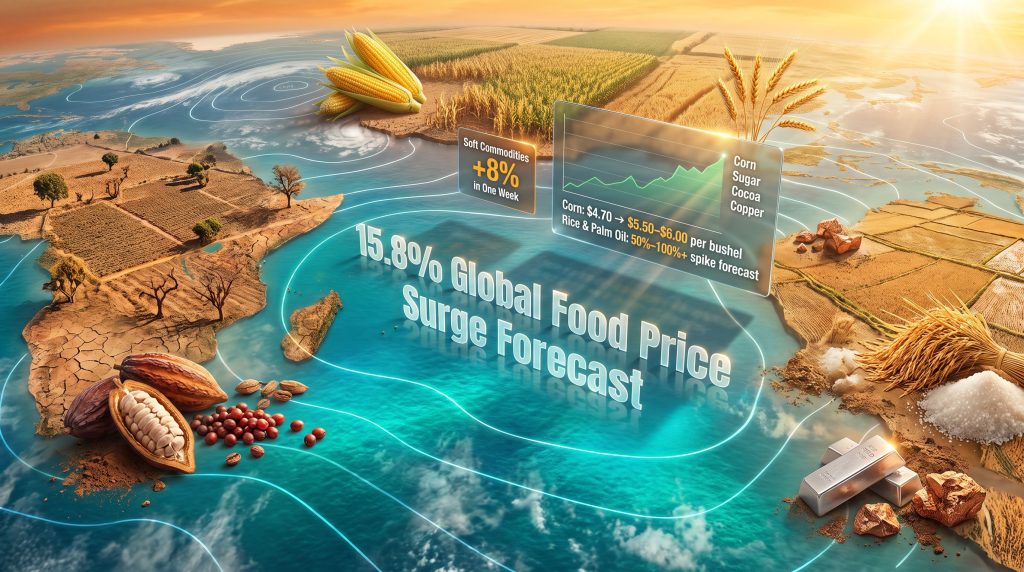
Evidence of market repricing is already visible. According to Societe Generale data, agricultural commodity prices rose 7% in a single month in mid-2026, with soft commodities including cocoa, coffee, and wheat climbing 8% in a single week.
The Most Exposed Individual Commodities
Corn: The Standout Bullish Case
Bank of America commodity strategist Daryna Kovalska has identified corn as markedly undervalued relative to its current weather risk profile, citing a rarely-seen convergence of three simultaneous growing-season threats:
- Accelerating heat stress across European corn-growing regions
- El Niño-related disruption threatening Brazilian production
- Hotter, drier conditions during the critical U.S. corn-pollination window
Current prices of approximately $4.70 per bushel are seen as inconsistent with this triple exposure. Bank of America's analyst price target range sits at $5.50 to $6.00 per bushel, representing a near $1.00 per bushel upside from current levels.
Sugar
Brazil and Thailand, two of the world's largest sugar producers, face projected output declines of up to 10% in the 2026-27 season from El Niño-related effects, according to Bank of America analysis. Low global inventory buffers amplify the price transmission risk considerably, as production shortfalls cannot be absorbed through drawdowns when stocks are already depleted.
Cocoa and Robusta Coffee
West African cocoa harvests are already under sustained pressure, with the commodity having hit historic price highs in 2024, creating an elevated and volatile baseline entering 2026. Robusta coffee faces supply disruption from drought conditions across Southeast Asian growing regions.
Rice and Palm Oil
Southeast Asia and parts of West Africa represent the highest-drought-risk zones for these commodities. Under a severe El Niño scenario, price spike forecasts for rice and palm oil reach 50% to 100% or more, with implications extending into food security policy across import-dependent nations across Asia and Africa.
Arabica Coffee: The Contrarian Case
Not all agricultural commodities face upward pressure. Arabica coffee presents a counterintuitive situation, with improved growing conditions in South America potentially pushing prices lower and creating a meaningful divergence within the broader coffee complex. This asymmetry is an example of the geographic bifurcation that defines super El Niño and commodity markets more broadly.
The Geographic Divide: Inflationary Pressure vs. Commodity Abundance
The 2026 super El Niño is not a uniform global commodity shock. It is a geographically bifurcated event that simultaneously creates inflationary supply stress in some regions while generating relative abundance in others.
Regions Facing Inflationary Commodity Pressure
| Region | Primary Commodities at Risk | Mechanism |
|---|---|---|
| Southeast Asia | Rice, Palm Oil, Sugar | Drought, reduced monsoon rainfall |
| West Africa | Cocoa, Robusta Coffee | Heat stress, erratic precipitation |
| Southern Europe | Wheat, Corn | Structural heat exposure acceleration |
| South Korea and East Asia | Imported food staples | Supply chain cost pass-through |
Regions Positioned for Relative Commodity Abundance
| Region | Primary Commodities Benefiting | Mechanism |
|---|---|---|
| Brazil | Soybeans, Arabica Coffee | Improved rainfall distribution |
| Argentina | Corn, Soybeans | Favourable growing season conditions |
| Northern Hemisphere (Winter) | Natural Gas | Reduced heating demand |
Brazil and Argentina are positioned to benefit from improved growing conditions under this El Niño configuration, potentially generating oversupply in grains and oilseeds. This creates a geographic arbitrage dynamic between Northern Hemisphere supply stress and Southern Hemisphere supply abundance that sophisticated commodity traders may be able to exploit directionally.
Industrial Metals: The Water and Energy Exposure Channels
The relationship between super El Niño conditions and industrial metals operates through two distinct supply-side mechanisms that are separate from demand dynamics.
Copper and Water Scarcity
Copper smelting and refining are highly water-intensive processes. Drought conditions in key mining regions create a supply-tightening mechanism that operates independently of global demand levels. The ongoing copper supply crunch is therefore likely to be further exacerbated as water availability contracts and production capacity becomes increasingly constrained.
Aluminium and the Energy Cost Channel
Electricity accounts for 30% to 40% of aluminium production costs, according to Man Group analysis, and many smelters depend on hydroelectric power for cost-competitive generation. When drought reduces reservoir levels, hydro-generation capacity falls, driving up power costs and compressing smelter economics. The additional demand pressure from cooling infrastructure, food production systems, and the rapid expansion of AI data centres is intensifying competition for the same constrained power and water resources, creating a structural rather than purely cyclical cost elevation for aluminium production.
The next major ASX story will hit our subscribers first
The Inflation Timeline Investors Should Be Tracking
Understanding the phased timeline of super El Niño commodity impacts is critical for positioning. The effects do not arrive simultaneously.
Phase 1: Immediate Market Reaction (Mid-2026)
Financial derivatives markets are already pricing in elevated volatility across agricultural commodity contracts. Soft commodity indices are rising sharply, speculative positioning in corn, cocoa, sugar, and coffee futures is increasing, and early evidence of supply concern is appearing in forward curves.
Phase 2: Physical Supply Shock (Late 2026 to Early 2027)
Harvest shortfalls become visible in production data from Southeast Asia, West Africa, and Europe. Fresh produce price increases hit consumers first, representing the fastest transmission channel from farm to shelf. Food inflation in Asia could reach double-digit levels by 2027, according to Man Group projections.
Phase 3: Broad Consumer Price Impact (Mid-2027 Peak)
Rising input costs flow through to processed food categories including bakery products, cereals, confectionery, dairy, and meat. G7 headline inflation could rise by more than 1 percentage point from food price pass-through alone. The global food price surge forecast sits at 15.8%, with the most exposed individual crops facing 50% to 100% price spikes in severe scenarios.
Commodity Investment Positioning: A Framework for 2026-2028
Institutional strategists are characterising the approaching cycle as a meaningful tailwind for agricultural commodity prices and recommending a reassessment of commodity allocations as an inflation hedge. Consequently, commodity diversification strategies are attracting renewed attention as investors seek to rebalance portfolios in anticipation of a prolonged period of weather-driven supply disruption.
Directional Commodity Outlook Summary
| Commodity | Directional Bias | Risk Level | Primary Catalyst |
|---|---|---|---|
| Corn | Bullish | High | Triple weather-risk convergence |
| Sugar | Bullish | High | Brazil and Thailand output declines |
| Cocoa | Bullish (Volatile) | Very High | West African supply disruption |
| Robusta Coffee | Bullish | High | Southeast Asian drought exposure |
| Arabica Coffee | Bearish | Moderate | South American supply improvement |
| Soybeans | Bearish | Moderate | Latin American oversupply |
| Natural Gas | Bearish (Seasonal) | Moderate | Warmer northern winter demand reduction |
| Copper | Bullish | Moderate-High | Water scarcity constraining production |
| Aluminium | Bullish | Moderate | Hydro-power shortfalls and energy cost inflation |
The most important analytical reframe for investors approaching 2026 is recognising that this is not simply a weather event to be traded around opportunistically. Man Group analysis explicitly warns that chronically underpricing climate volatility in commodity portfolios represents a material and growing investment risk. Portfolios built on historical weather-normalised commodity price assumptions may be systematically mispriced relative to the new climate regime now emerging.
The commodity price impacts for mining companies are particularly significant, as water scarcity and energy cost inflation simultaneously compress margins and constrain output. The forward question is not simply how severe 2026 will be. The deeper strategic question is what a world of recurring super El Niño cycles means for long-run commodity valuations, supply chain resilience, and the embedded inflation assumptions within multi-asset portfolios. That question does not have a comfortable historical precedent to anchor against, which is precisely what makes it so consequential.
This article is intended for informational purposes only and does not constitute financial advice. Commodity price forecasts and analyst projections referenced herein represent forward-looking estimates subject to material uncertainty. Past commodity price behaviour during prior El Niño events does not guarantee similar outcomes in future cycles. Investors should conduct their own due diligence and consult qualified financial advisors before making investment decisions.
Want to Stay Ahead of the Commodity Discoveries Driving the Next Market Move?
As climate volatility reshapes commodity supply chains and accelerates demand for critical minerals, Discovery Alert's proprietary Discovery IQ model delivers real-time ASX mineral discovery alerts, instantly transforming complex geological data into actionable investment insights — explore historic discovery returns on Discovery Alert's dedicated discoveries page and begin your 14-day free trial to position yourself ahead of the market.