
July 23, 2026
The Global Reserve Architecture Is Quietly Shifting Beneath Our Feet
For most of the post-World War II era, sovereign reserve management was a relatively predictable discipline. Central banks held U.S. Treasuries, maintained modest gold positions as a legacy of the Bretton Woods system, and operated within a dollar-centric framework that few seriously questioned. That orthodoxy is now fracturing in real time, and nowhere is this shift more visible than across sub-Saharan Africa, where resource-rich nations are beginning to rethink what a reserve asset actually means in a world defined by geopolitical fragmentation and eroding institutional trust.
Tanzania's ongoing Tanzania gold reserves expansion is one of the most instructive case studies in this broader monetary transformation. It is not simply a story about buying gold. It is a story about how a resource-producing nation is redesigning its sovereign monetary architecture from the ground up, using domestic production capacity as the raw material for reserve sovereignty.
When big ASX news breaks, our subscribers know first
Where Tanzania Sits in Africa's Gold Hierarchy
Tanzania occupies a structurally significant position within Africa's gold production landscape. Ranked as the continent's third-largest gold producer, the country contributes approximately 1.3% of total annual global gold supply, a figure that may sound modest in isolation but carries substantial weight when translated into central bank acquisition volumes over time.
To understand how Tanzania's reserve strategy compares with its African peers, the following table offers context across the continent's major producing nations:
| Country | Gold Production Rank (Africa) | Est. Global Output Share | Central Bank Gold Strategy |
|---|---|---|---|
| South Africa | 1st | ~3.5% | Established reserve holder |
| Ghana | 2nd | ~2.8% | Active accumulation |
| Tanzania | 3rd | ~1.3% | Rapid domestic acquisition |
| Mali | 4th | ~1.1% | Emerging strategy |
| Burkina Faso | 5th | ~0.9% | Limited formal reserves |
What distinguishes Tanzania from several of these peers is the deliberate policy architecture it has constructed around its production base. Rather than simply selling gold into international markets and receiving foreign exchange, Tanzania has begun treating its domestic gold output as a direct input into the reserve system itself.
Tanzania's Geological Advantage and Production Capacity
Tanzania's gold sector is anchored by the Lake Victoria Goldfields, one of Africa's most productive orogenic gold belts, stretching across the northwestern corner of the country into the broader East African Craton. The geology is characterised by greenstone belts hosting mesothermal lode gold deposits, the same structural setting responsible for major discoveries across West Africa and historically in Zimbabwe.
This geological endowment gives Tanzania's mining sector a durable production base that underpins the government's confidence in building a long-term domestic accumulation strategy. The country's production profile spans both large-scale industrial operations and a substantial artisanal and small-scale mining sector that has historically operated outside formal financial channels. This dual structure is directly relevant to understanding how Tanzania's reserve policy is designed.
What Regulatory Mechanisms Are Driving Tanzania's Gold Reserve Build-Up?
The 20% Domestic Retention Mandate
The foundation of Tanzania's gold accumulation strategy rests on a regulatory intervention introduced in June 2025. Under the new framework, large-scale gold miners operating within the country are required to direct a minimum of 20% of their production to domestic buyers rather than exporting it in its entirety. Simultaneously, gold exporters face a parallel obligation to sell 20% of their export volumes directly to the Bank of Tanzania.
This type of regulatory mechanism is sometimes described in commodity economics as a domestic absorption requirement. It functions by capturing a share of the upstream value chain before the commodity exits the national economy, redirecting what would otherwise be foreign exchange earnings into physical reserve accumulation instead. The policy rationale is straightforward: rather than earning dollars and then purchasing gold on the open market, Tanzania effectively converts its own mineral production directly into reserve assets, bypassing the dollar as an intermediary.
Comparable frameworks have appeared in various forms across resource-rich nations. Indonesia has employed domestic market obligations for nickel and coal. Several Gulf states have used analogous mechanisms for hydrocarbon revenues. Tanzania's approach adapts this logic to gold, with the central bank as the direct beneficiary of the retained production share.
The Tanzanian Shilling Mandate: Currency Localisation as Reserve Policy
Running in parallel with the gold retention requirement is a separate but architecturally connected currency directive. Issued in mid-2025, the mandate requires that all domestic transactions be advertised and conducted in Tanzanian shillings, with an effective implementation date of July 1, 2026.
The strategic logic connecting these two policies is worth examining closely. By reducing the use of foreign currencies in domestic commerce, Tanzania simultaneously reduces structural demand for dollars within its economy. This lowers the outflow pressure on foreign exchange reserves and reinforces the case for holding gold — which generates no yield but also carries no currency risk — as the primary reserve anchor.
Policy Architecture Note: Tanzania's dual-mandate approach, combining physical gold retention with currency localisation, represents an architecturally integrated sovereign monetary strategy. The two policies are mutually reinforcing rather than independent regulatory actions.
Formalising the Artisanal Sector: A Hidden Dividend of Reserve Policy
One of the less-discussed dimensions of Tanzania's domestic gold-buying program is its effect on financial inclusion. The Bank of Tanzania has reported that mineral traders and small-scale miners have collectively opened more than 4,000 new bank accounts as a direct outcome of the domestic acquisition program.
This matters for several reasons beyond the headline reserve figures. The artisanal and small-scale mining sector across sub-Saharan Africa has historically operated in an informal economy largely invisible to financial regulators. When central bank purchasing programs create structured procurement channels, they simultaneously create incentives for informal miners to enter the formal financial system.
Tanzania's experience mirrors, to a degree, formalisation efforts undertaken in West African nations such as Ghana, where state gold-buying programs have had similar downstream financial inclusion effects. Furthermore, the difference is that Tanzania has pursued this simultaneously with a broader reserve strategy, giving the formalisation dividend a macroeconomic dimension.
How Much Gold Has Tanzania Actually Accumulated?
The Reserve Build-Up in Numbers
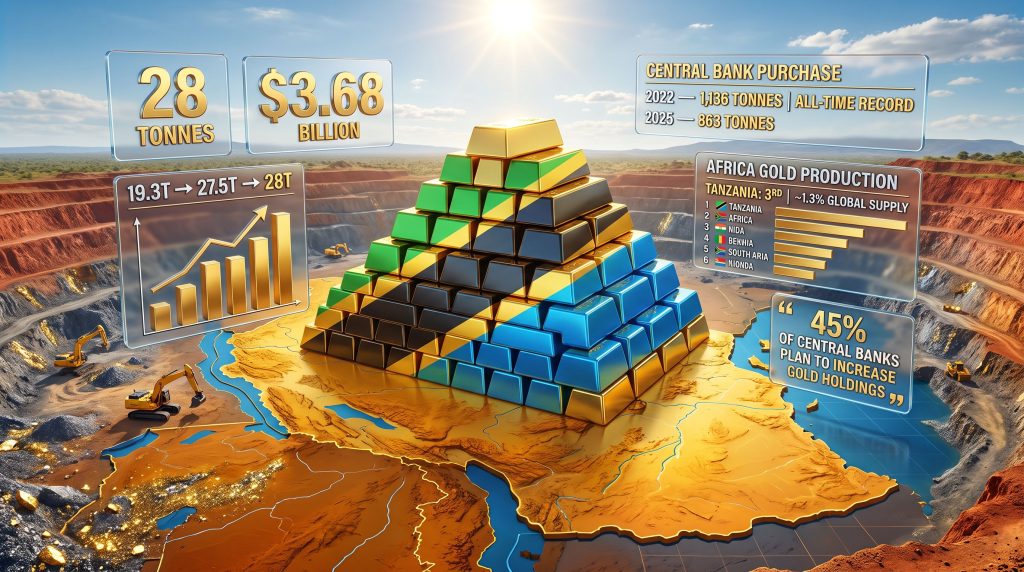
The scale of Tanzania's acquisition over a compressed timeframe is notable by any measure. According to a statement from Bank of Tanzania Governor Emmanuel Tutuba, the country added 28 tonnes of gold to its reserves over approximately 18 months, with the acquired holdings valued at roughly $3.68 billion at prevailing market prices.
The accumulation trajectory shows consistent progression across the reporting period:
- 19.3 tonnes reported by February 2026
- 27.5 tonnes reported by June 2026
- 28 tonnes confirmed in the most recent official statement
The program commenced around 2023, with the central bank conducting purchases using Tanzanian shillings, further reinforcing the currency localisation objective embedded in the broader policy framework.
Total Reserve Position and What the Numbers Mean
Tanzania's total foreign exchange reserves currently stand at approximately $6 billion, providing import coverage of roughly 4.3 to 4.7 months, depending on the specific reporting period. This comfortably exceeds the IMF's standard adequacy threshold of three months of import coverage, providing a buffer against external shocks.
Key Concentration Metric: At current valuations, the 28 tonnes of gold acquired represents more than 61% of Tanzania's total reported reserve base. This is not a supplementary hedge. Gold has become the structural core of Tanzania's reserve portfolio.
This concentration level is unusual among emerging market central banks, most of which hold gold as a minor percentage of total reserves. It reflects a deliberate strategic choice rather than a gradual drift, and it introduces specific risk considerations around gold price volatility that reserve managers will need to manage on an ongoing basis.
Is Tanzania Planning to Hold or Liquidate Its Reserves?
The Infrastructure Liquidity Strategy
In January 2026, President Samia Suluhu Hassan issued a directive authorising the Bank of Tanzania to liquidate a portion of its gold holdings to finance infrastructure development priorities. Analysis conducted by the Tanzania Investment and Consultant Group (TICGL) estimates the potential liquidity unlocked under different liquidation scenarios:
| Liquidation Scenario | Estimated Liquidity Released |
|---|---|
| 15% of gold reserves | Approximately $260 million |
| 50% of gold reserves | Up to $650 million |
This planned partial liquidation introduces a structural tension within the reserve strategy that deserves careful analysis. A policy framework designed to accumulate gold as a long-term reserve anchor is now simultaneously being positioned as a source of development financing. The coherence of this dual objective depends heavily on gold price stability, the speed of future accumulation to replace liquidated holdings, and the quality of the infrastructure investments funded by the proceeds.
The Pragmatic Reserve Philosophy
What Tanzania's approach reveals is a reserve management philosophy that is fundamentally pragmatic rather than ideologically committed to either accumulation or liquidity. This distinguishes it from the reserve strategies of nations like China or Russia, which have pursued gold accumulation primarily as a long-term geopolitical hedge with limited intention of liquidation.
Tanzania is treating its gold reserve as a dynamic instrument — one that can serve both monetary stability and development financing functions depending on near-term fiscal requirements. This model is not without precedent. Several sovereign wealth funds across the Gulf Cooperation Council have employed similar logic, accumulating commodity revenues during high-price periods and deploying them into development capital when domestic financing needs arise.
How Does Tanzania's Strategy Reflect the Global Central Bank Gold Trend?
The Scale of Global Central Bank Demand
The Tanzania gold reserves expansion is unfolding against a backdrop of historically elevated central bank gold demand globally. The data across recent years illustrates the structural nature of this shift:
| Year | Central Bank Gold Purchases (Tonnes) | Historical Context |
|---|---|---|
| 2022 | 1,136 | All-time record since 1950 |
| 2023 | ~1,037 | Second-highest on record |
| 2024 | ~1,090 | Third-highest on record |
| 2025 | 863 | Fourth-highest; 21% YoY decline |
| 2010-2021 Average | 473 | Pre-acceleration baseline |
The 2025 figure of 863 tonnes, while representing a 21% year-on-year decline from 2024, remains 82% above the 2010 to 2021 annual average of 473 tonnes. The current purchasing environment is not a temporary spike. It represents a genuine structural recalibration of how central banks globally value gold relative to paper reserve assets.
The 2022 record of 1,136 tonnes is particularly significant in historical context. It represents the highest level of net central bank gold purchases since formal records began in 1950, including the period immediately following the end of the gold standard under the Nixon administration in 1971, which formally ended the Bretton Woods system. Central banks are buying more gold now, in absolute terms, than they did when the dollar was being explicitly decoupled from gold.
Gold Overtaking U.S. Treasuries as the Primary Reserve Asset
The European Central Bank confirmed in June 2026 that gold has surpassed U.S. Treasuries as the world's leading reserve asset by value. This milestone, which would have been considered implausible a decade ago, reflects a fundamental shift in how sovereign institutions assess reserve safety. Consequently, this has profound implications for gold in the monetary system going forward.
The Official Monetary and Financial Institutions Forum (OMFIF) attributes this shift primarily to geopolitical risk hedging and declining confidence in the stability of the international monetary system. The OMFIF's 2026 Central Bank Gold Reserves Survey, covering 76 respondents, produced findings that are striking in their consistency:
- A record 45% of surveyed central banks indicated plans to increase gold holdings over the next 12 months
- Only 1% of respondents anticipated any reduction in gold reserves
- 51% of reserve managers cited geopolitical risk protection as a primary motivation for holding gold, an increase of 11 percentage points from 2024
OMFIF research indicates that reserve managers remain committed to gold accumulation despite continued price appreciation, suggesting that demand is structurally driven rather than price-sensitive. The conventional expectation in financial markets is that rising asset prices dampen demand. Gold's reserve demand appears to operate under a different logic, where price appreciation reinforces rather than suppresses institutional confidence in the asset.
Structural Insight: When 99% of surveyed central banks either plan to hold or increase gold reserves, and only 1% anticipate reduction, that distribution is not a sentiment reading. It is a policy commitment signal with multi-year implications for gold market dynamics.
The next major ASX story will hit our subscribers first
What Tanzania's Model Means for Africa's Monetary Sovereignty Movement
Resource Nationalism Reframed as Monetary Policy
Tanzania's regulatory framework is intellectually interesting because it reframes what might conventionally be described as resource nationalism — requiring domestic use of locally produced minerals — as a sovereign monetary policy instrument. The distinction matters. Resource nationalism is typically analysed through the lens of trade policy and foreign investment relations. Monetary policy operates within an entirely different analytical and institutional framework.
By treating domestic gold retention as a mechanism for reserve asset creation, Tanzania is effectively running an unconventional form of monetary accumulation — one that bypasses foreign exchange markets entirely and directly converts productive mineral output into sovereign reserve wealth. In addition, the growing interest in central bank gold reserves across emerging markets suggests Tanzania's model may find willing adopters elsewhere.
De-Dollarisation in Practice: The Sequential Logic
Tanzania's approach to reducing dollar dependency follows a sequential policy logic that is worth tracing explicitly:
- Local currency mandate reduces domestic dollar circulation and structural dollar demand
- Domestic gold retention requirement redirects a share of mineral production into the reserve system
- Central bank gold accumulation diversifies reserves away from dollar-denominated assets
- Reduced dollar dependency lowers vulnerability to U.S. monetary policy decisions and dollar liquidity conditions
This sequential framework is more architecturally sophisticated than purely financial de-dollarisation strategies such as bilateral currency swap agreements, which address trade settlement but do not alter the underlying reserve composition.
The Hypothetical African Multiplier Effect
If Africa's top ten gold-producing nations were to adopt comparable domestic retention mandates at the 20% threshold, the aggregate annual gold flows into African central bank reserves could increase substantially. Furthermore, geopolitical central bank buying at scale would represent a meaningful structural shift in global gold demand, carrying significance well beyond the continent's current weight in international monetary institutions.
This remains a speculative scenario. Each producing nation faces distinct regulatory environments, political constraints, and investment treaty obligations that would shape implementation. However, Tanzania's experience, if successful, provides an empirical reference point that regional policymakers can study and adapt.
Frequently Asked Questions: Tanzania Gold Reserves Expansion
How much gold has Tanzania added to its reserves?
Tanzania's central bank acquired approximately 28 tonnes of gold over an 18-month accumulation period, with a market value of around $3.68 billion at prevailing prices.
When did Tanzania's domestic gold-buying program begin?
The program commenced around 2023, with formal regulatory mandates introduced in June 2025 requiring large-scale miners and exporters to direct 20% of output to domestic buyers and the central bank respectively.
What are Tanzania's total foreign exchange reserves?
Total reserves are estimated at approximately $6 billion, providing import coverage of roughly 4.3 to 4.7 months, comfortably above the IMF minimum adequacy threshold of three months.
Is Tanzania planning to sell its gold reserves?
A presidential directive issued in January 2026 authorised partial liquidation to finance infrastructure development. Analysis by TICGL estimates that liquidating between 15% and 50% of holdings could generate between $260 million and $650 million in accessible capital.
Why are central banks globally buying more gold?
The OMFIF's 2026 survey identifies geopolitical risk hedging and declining institutional confidence in the international monetary system as the primary structural drivers, with 51% of reserve managers citing geopolitical protection as a core motivation.
Has gold surpassed U.S. Treasuries as the top global reserve asset?
The European Central Bank confirmed in June 2026 that gold has overtaken U.S. Treasuries as the world's leading reserve asset by value, marking a historically significant milestone in global monetary architecture.
This article is intended for informational and educational purposes only and does not constitute financial or investment advice. All figures, statistics, and policy details are sourced from publicly available statements and reports. Forecasts, projections, and scenario analyses involve inherent uncertainty and should not be relied upon as predictions of future outcomes. Readers should conduct their own due diligence before making any investment decisions.
Want to Capitalise on the Next Major Mineral Discovery Before the Broader Market?
As sovereign reserve strategies reshape global demand for gold and other commodities, Discovery Alert's proprietary Discovery IQ model delivers real-time alerts on significant ASX mineral discoveries — turning complex geological and market data into actionable investment insights for both short-term traders and long-term investors. Explore why historic discoveries have generated extraordinary returns on Discovery Alert's dedicated discoveries page, and begin your 14-day free trial today to position yourself ahead of the market.