
July 28, 2026
The Physics of Extraction: Why Hard-Rock Mining Is Approaching an Inflection Point
For most of the twentieth century, the economics of metal extraction followed a straightforward logic: find a deposit, blast the rock, haul it to the surface, and process it through increasingly energy-intensive circuits. Thunderstone lightning metal separation in mining represents a radical departure from this model, and its emergence is timely. Ore grades at established operations are declining, deposits amenable to open-pit development are becoming scarcer, and the energy and water costs embedded in conventional processing are compounding at a time when both commodities face structural price pressure.
The consequence is a widening gap between the metals the global economy needs and the mining industry's capacity to deliver them affordably and sustainably. This is the context in which a new class of extraction technology is emerging — one that does not simply optimise existing processes but fundamentally rethinks where and how metal recovery occurs. Thunderstone's electrical pulse stimulation approach, which uses controlled high-voltage discharges underground to unlock previously inaccessible ore, sits at the frontier of this shift.
When big ASX news breaks, our subscribers know first
How Conventional In-Situ Extraction Works and Where It Falls Short
In-situ leaching, or ISL, is not a new concept. The approach has been commercially deployed for decades in uranium extraction and, to a lesser extent, copper recovery from oxidised near-surface ore bodies. The underlying principle is straightforward: rather than removing rock to the surface for processing, a chemical solution is introduced underground to dissolve the target metal, and the resulting metal-laden solution is pumped back to surface for recovery.
The critical prerequisite for this method is permeability — the capacity of rock to allow fluids to move through it. Natural permeability is adequate in porous sandstone-hosted uranium deposits and in heavily weathered copper oxide zones, which is precisely why ISL has succeeded in those specific geological settings. However, the vast majority of the world's nickel, copper, and cobalt mineralisation is hosted in hard, crystalline, low-permeability rock where natural fluid movement is negligible.
This is the core technical barrier. Without engineered permeability, the leaching fluid simply cannot reach the metal-bearing minerals, regardless of how effective the chemistry is. Conventional approaches to this problem have included hydraulic fracturing, adapted from the oil and gas sector, but this technique carries significant concerns around water volumes, induced seismicity, and imprecise fracture control that make it poorly suited to hard-rock metal extraction. Furthermore, the in-situ leaching benefits of eliminating surface disturbance are lost if the enabling stimulation method introduces its own environmental complications.
The fundamental challenge of in-situ metal extraction in hard rock is not chemistry. It is permeability engineering at depth, at scale, and with enough geological precision to make recovery predictable and commercially viable.
Thunderstone Lightning Metal Separation in Mining: The Mechanism Explained
How Does Electrical Pulse Stimulation Work?
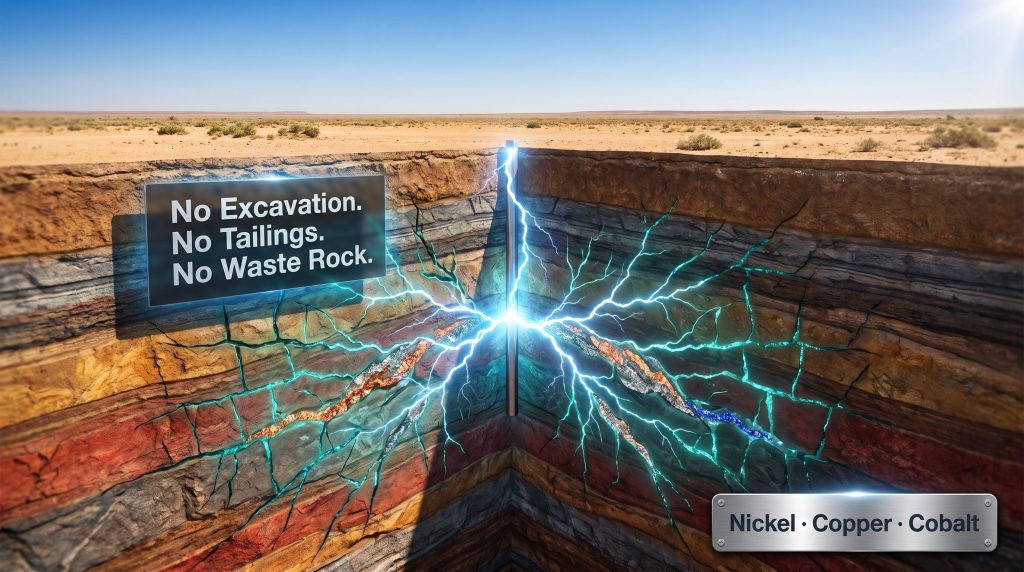
Thunderstone's approach to the permeability problem draws on a physical phenomenon that geologists and materials scientists have studied for decades: the behaviour of rock under rapid, high-voltage electrical discharge. When a pulse of electrical energy is delivered into a rock mass at sufficient voltage and speed, the energy propagates preferentially along grain boundaries and mineral interfaces rather than through the bulk material. The result is a network of micro-fractures that form along paths of least electrical resistance, creating permeability where none previously existed.
This is the mechanism that gives Thunderstone's technology its colloquial descriptor. Natural lightning, when it strikes the earth, releases enormous energy across a very short timescale. The controlled electrical pulses used in underground stimulation replicate this physics at a targeted, calibrated scale, directing energy into specific ore zones to engineer the fracture networks that leaching fluids require.
The sequence of operations can be understood in three stages:
- Pulse delivery: High-voltage electrical equipment is positioned at depth, and calibrated pulses are discharged into the target ore zone through electrode arrays placed in drill holes.
- Fracture formation: The rapid energy release generates micro-fractures through electromechanical and thermomechanical stress, preferentially extending along mineralised zones and grain boundaries.
- Leach fluid introduction: Once permeability has been established, hydrometallurgical leaching solutions are introduced into the fractured zone. The fluid penetrates the newly created network, contacts the target minerals, and dissolves them into solution for recovery at surface.
This three-stage workflow fundamentally reconfigures the mine's processing geography. Stimulation and primary metal dissolution both occur underground, consequently eliminating the need for the large-scale surface infrastructure that defines conventional mining operations.
What Metals Can This Technology Target?
The suitability of electrical pulse stimulation as a precursor to hydrometallurgical leaching depends on two intersecting factors: the mineralogy of the target metal and the geometry of the ore body.
Metals that respond well to acid or alkaline leaching chemistry are natural candidates. Nickel sulphide mineralisation, which is among the most strategically important ore types given its role as a precursor to battery-grade nickel products, represents a primary target. Copper sulphides and oxides, cobalt-bearing laterites at depth, and certain lithium-bearing formations also present potential applications, though each requires specific leach chemistry and geological conditions.
The ore body geometry matters equally. Disseminated mineralisation, where target metals are spread relatively uniformly through a large rock volume, is better suited to this approach than narrow, high-grade vein systems. Depth is also a practical consideration: the technology is designed for deposits that are either too deep or too low-grade to justify conventional development, which is precisely the category where the majority of unmined global resources sit.
| Metal | Leach Chemistry Compatibility | Primary Application Context | Key Consideration |
|---|---|---|---|
| Nickel (sulphide) | Moderate to high | Deep, low-grade disseminated deposits | Requires oxidative or pressure leaching conditions |
| Copper (sulphide/oxide) | High | Existing tenements with residual low-grade ore | Well-established leach chemistry reduces technical risk |
| Cobalt | Moderate | Co-product recovery from nickel or copper systems | Grade distribution affects recovery economics |
| Lithium | Experimental | Brine-adjacent hard rock formations | Less proven; leach chemistry still under development |
The Three Dimensions of Mining's Structural Problem
Understanding why Thunderstone's technology is attracting serious attention from major mining companies requires appreciating the depth of the structural challenge the industry faces. The constraints are not cyclical — they are architectural.
Ore Grade Decline
Ore grade decline is the most well-documented trend. The average grade of copper deposits being mined today is roughly half what it was fifty years ago. Processing lower grades requires proportionally more energy, water, and reagents per tonne of metal produced. For nickel, the shift away from high-grade sulphide deposits toward lower-grade laterites has added significant processing complexity and cost.
Surface Disturbance and Emissions Constraints
Surface disturbance constraints are intensifying in parallel. Environmental approvals for new open-pit operations in ecologically sensitive regions have become protracted, expensive, and increasingly uncertain. Tailings storage facility failures at operations including Brumadinho in Brazil and Mount Polley in Canada have sharpened regulatory scrutiny globally.
Emissions accountability is the third dimension. Mining's scope 1 and scope 2 emissions are dominated by diesel combustion in haulage and grinding energy in processing plants. As carbon pricing mechanisms expand and downstream customers impose lifecycle emissions requirements, the industry faces growing pressure around mining electrification and decarbonisation. In-situ electrical pulse extraction addresses all three dimensions simultaneously:
- No surface excavation means no new open pit, no waste rock dumps, and no tailings storage facility
- No hauling or crushing eliminates the diesel and electricity consumption embedded in those stages
- Targeted underground operations can access ore bodies in environmentally sensitive areas with minimal surface expression
Rio Tinto's Corporate Venture Strategy and What It Signals
Thunderstone's development has been supported through Rio Tinto's corporate venture program, which operates in partnership with Founders Factory to identify and back early-stage mining technology companies. This program structure reflects a deliberate strategic approach adopted by major miners over the past decade: rather than attempting to develop disruptive technologies internally, they identify external startups that have already cleared the initial proof-of-concept threshold and provide capital and operational access to accelerate commercialisation.
For Rio Tinto, the investment logic is straightforward. The company operates some of the world's largest hard-rock mining operations and holds extensive tenements across geological provinces that include deep, low-grade ore bodies that are currently uneconomic under conventional development assumptions. A technology that could unlock in-situ recovery from those assets without new surface infrastructure represents a potentially transformative option on existing portfolio value.
This dynamic is not unique to Rio Tinto. Across the major mining sector, corporate venture and accelerator programs have become standard practice. BHP Ventures, Glencore's technology partnerships, and Anglo American's FutureSmart Mining program all reflect the same underlying logic: the industry's next productivity step-change is more likely to emerge from startups unburdened by legacy infrastructure thinking. As noted in a recent Mining Technology interview, Thunderstone's CEO has articulated this case directly — extracting more metal with less rock disruption is the central commercial proposition.
Deep-tech mining startups typically require between seven and twelve years from initial concept to commercial-scale deployment. The transition from pilot to full field trial represents the most capital-intensive and technically uncertain phase of that journey.
The next major ASX story will hit our subscribers first
Comparing Thunderstone's Method to Other Advanced Separation and Stimulation Technologies
A common source of confusion when discussing Thunderstone lightning metal separation in mining is the conflation of underground stimulation with surface-based mineral separation methods. Magnetic separation and electrostatic separation are both commercially mature technologies, but they operate on already-extracted material at surface processing plants. They are downstream separation tools, not extraction enablers.
Thunderstone's electrical pulse method operates at a fundamentally different point in the value chain. It is a stimulation technology applied to the ore body itself, before any material reaches the surface. The comparison matrix below clarifies these distinctions:
| Technology | Where It Operates | What It Does | Maturity Level | Surface Impact |
|---|---|---|---|---|
| Electrical Pulse Stimulation (Thunderstone) | Underground, in-situ | Creates permeability for leaching | Early-stage / pilot | Minimal |
| Heap Leach | Surface pad | Dissolves metals from crushed ore | Commercially mature | Moderate |
| Magnetic Separation | Surface plant | Separates magnetic from non-magnetic minerals | Commercially mature | Moderate |
| Electrostatic Separation | Surface plant | Separates by electrical conductivity | Commercially mature | Low to moderate |
| Hydraulic Fracturing (mining-adapted) | Underground | Fractures rock using fluid pressure | Experimental in mining | Higher |
The integration of stimulation and leaching into a single underground workflow is what distinguishes Thunderstone's approach. If metal dissolution occurs underground, the surface plant is reduced to a recovery and refining operation, stripping out the most capital-intensive and operationally complex elements of a conventional mine flowsheet.
Technical Risks That Must Be Resolved Before Commercial Deployment
Geological Variability and Fluid Management
Intellectual honesty about where this technology sits on the development curve is essential. Geological variability is the most pervasive challenge. Rock properties vary over short distances in ways that can cause electrical pulses to propagate inconsistently, making it difficult to extrapolate pilot results to full-scale operations without extensive characterisation work. When interpreting drill results from stimulation trials, this heterogeneity must be carefully accounted for.
Fluid management underground presents a related problem. Once a fracture network has been created, the movement of leaching fluids must be controlled precisely. Uncontrolled fluid migration risks groundwater contamination and loss of metal-bearing solution before it can be recovered at surface.
Pulse calibration across geological variability is a third challenge. The energy required to create commercially meaningful permeability improvements varies with rock hardness, natural fracture density, moisture content, and mineralogical composition. Developing calibration protocols that reliably deliver adequate fracturing across diverse geological settings is an ongoing engineering task.
From a regulatory standpoint, underground high-voltage operations in mining jurisdictions fall under occupational health and safety frameworks that were not designed with electrical pulse stimulation in mind. Approval pathways for novel in-situ leaching operations also vary significantly between jurisdictions, and even well-developed regulatory environments require bespoke assessment processes that can extend timelines considerably.
The Long-Term Economic Case: Stranded Assets and the In-Situ Option
Perhaps the most compelling commercial argument for electrical pulse in-situ extraction is the scale of mineral resources currently classified as economically stranded under conventional mining assumptions. These are ore bodies that are well-characterised, sometimes extensively drilled, and known to contain substantial metal endowment, but which cannot be developed profitably given the capital requirements of conventional infrastructure.
If in-situ stimulation and leaching can be deployed at commercially viable cost, the economic threshold shifts substantially. Understanding cut-off grade economics is central to appreciating this shift: a deposit that requires 0.5% nickel equivalent to justify a conventional underground mine might be developable at 0.25% or lower under an in-situ model that eliminates much of the fixed cost base.
The implications for the critical minerals supply chain are material. Global critical minerals demand projections for battery-grade nickel consistently indicate that existing mine pipelines are insufficient to meet demand through the 2030s without either significant new discoveries or step-changes in recovery technology. Thunderstone lightning metal separation in mining represents one credible pathway toward closing that gap, though the technology must first demonstrate commercial-scale reliability before it can be counted on in supply forecasts.
Disclaimer: This article contains forward-looking analysis and speculative projections regarding emerging mining technologies and market dynamics. These assessments are based on publicly available information and independent analysis. They do not constitute financial or investment advice. Readers should conduct independent due diligence before making investment decisions related to any companies or technologies discussed herein.
Want to Track the Next Major Mineral Discovery Before the Market Does?
Discovery Alert's proprietary Discovery IQ model delivers real-time alerts on significant ASX mineral discoveries — instantly translating complex geological data into actionable investment insights for both short-term traders and long-term investors. Explore how historic discoveries have generated substantial returns and begin your 14-day free trial today to position yourself ahead of the market.