
July 14, 2026
The Quiet Signal Traders Are Watching in Global Energy Markets
Not every oil price cycle announces itself loudly. Some of the most rewarding entry points in ASX energy stocks have emerged not from dramatic headlines, but from the slow accumulation of structural pressures that most investors dismiss as background noise. Mid-2026 is shaping up as exactly that kind of moment, where a convergence of geopolitical stress, supply-side caution, and improving technical setups across key ASX names is drawing serious attention from market participants who understand how energy cycles actually work.
Understanding the difference between a geopolitical spike and a structural supply tightening is perhaps the most important conceptual distinction any energy investor can make right now. The former produces sharp, short-lived price surges that punish late entrants. The latter builds gradually, offers a longer window for positioning, and tends to reward investors who identify the trend before it becomes consensus. Market analysts tracking the current environment suggest the conditions emerging in mid-2026 more closely resemble the second dynamic — a slow grind upward rather than a vertical shock — which could prove advantageous for investors looking at the top 3 ASX oil stocks to watch in the months ahead.
When big ASX news breaks, our subscribers know first
What Is Actually Driving Oil Price Momentum in Mid-2026?
Renewed geopolitical friction involving the United States and Iran has historically functioned as one of the most reliable short-term catalysts for crude oil price movements. The Strait of Hormuz, through which roughly 20% of global oil supply transits, remains the single most consequential maritime chokepoint in the energy world. Any credible threat to that corridor creates an immediate premium in Brent and WTI futures markets, as traders reprice supply disruption risk.
However, market analysts have noted something subtler at work in the current cycle. Rather than the rapid spike-and-reversal pattern that characterised previous U.S.-Iran flashpoints — including periods such as early 2020 when Brent briefly spiked following geopolitical escalation before collapsing on demand destruction fears — the present environment appears to be generating a more measured and sustained upward trajectory. This matters enormously for ASX energy investors because it changes the tactical calculus.
A sudden geopolitical spike typically rewards only those already positioned before the event. A gradual, structurally-supported price rise, by contrast, allows investors more time to conduct research, assess company fundamentals, and establish positions before peak pricing is reached. The distinction is not academic. It directly affects how aggressively investors should size positions and how patiently they should hold them.
Several factors are converging beyond the geopolitical dimension to support crude prices:
- OPEC's influence on oil production discipline has remained broadly intact, limiting the supply buffer available to absorb demand surprises
- Underinvestment in upstream exploration over the past decade means new production capacity cannot come online quickly enough to suppress sustained price rallies
- Global LNG demand continues to expand, particularly across Asia, as nations seek to diversify away from pipeline dependence
- Refining capacity constraints in key regions support elevated margins for downstream operators
The critical insight for ASX investors is this: when multiple supply-side forces align with geopolitical pressure simultaneously, oil price cycles tend to be longer and more rewarding than simple event-driven spikes. Patience and fundamental selection matter more in this environment than speed.
How ASX Energy Stocks Respond to Rising Crude Prices
The relationship between global crude benchmarks and ASX-listed energy company revenues is direct but nuanced. Upstream producers — those who explore for and extract oil and gas — experience an almost immediate revenue impact when oil prices move. Every dollar increase in the per-barrel price flows through to top-line revenue with a multiplier effect that depends on production volume, hedging ratios, and operating cost structure.
Downstream operators like refiners experience a fundamentally different dynamic. Their profitability is governed not by the absolute price of crude, but by the crack spread — the margin between the cost of crude oil inputs and the sale price of refined petroleum products such as gasoline, diesel, and jet fuel. A rising crude price environment does not automatically benefit refiners if product prices fail to keep pace with input costs.
The Australian dollar adds a further layer of complexity. Because oil's role in the global economy means it is priced globally in US dollars, a weakening AUD amplifies the local-currency revenue gain for ASX-listed producers, while a strengthening AUD compresses it. This currency dimension is frequently underappreciated by retail investors who focus purely on the commodity price without considering the exchange rate overlay.
Key financial metrics worth monitoring when evaluating ASX oil stocks in a rising price environment:
- Revenue sensitivity per barrel — how much earnings change for each $10/barrel move in oil price
- Hedging ratio — the proportion of production sold forward at fixed prices, which limits both downside protection and upside participation
- Free cash flow at various oil price scenarios — the true test of financial resilience and dividend sustainability
- Breakeven cost per barrel — companies with low breakeven costs generate positive cash flow across a wider range of market conditions
| Characteristic | Upstream Producers | Downstream Refiners |
|---|---|---|
| Revenue driver | Oil and gas sale price | Crack spread (refining margin) |
| Oil price sensitivity | High, direct correlation | Moderate, margin-dependent |
| Benefit from price spike | Immediate revenue uplift | Delayed, depends on product pricing |
| Key financial risk | Production cost vs. commodity price | Input cost vs. refined product price |
| ASX examples | Woodside (WDS), Santos (STO) | Viva Energy (VEA) |
What Makes an ASX Oil Stock Worth Watching Right Now?
Not all energy stocks respond equally to an improving oil price environment. Experienced traders use a multi-lens framework to distinguish between names that will genuinely benefit and those where the macro tailwind is already fully priced in or structurally irrelevant to the business model.
Three analytical lenses apply particularly well in the current environment:
- Technical positioning looks at where a stock is trading relative to historically significant support and resistance levels. A stock approaching a key resistance level in a rising commodity environment often becomes a self-fulfilling opportunity, as more market participants recognise the same setup simultaneously.
- Fundamental strength examines the balance sheet, production volume trajectory, cost structure, and cash flow generation. Strong fundamentals provide the margin of safety that pure technical traders lack.
- Strategic relevance considers whether the company is exposed to long-duration energy security themes, LNG export demand growth, or domestic fuel supply chain criticality — factors that extend the investment thesis beyond a short-term commodity trade.
Market capitalisation also matters as a selection criterion. Large-cap ASX energy names offer institutional liquidity, analyst coverage depth, and balance sheet resilience that smaller explorers simply cannot match. Furthermore, smaller explorers like Karoon Energy (ASX: KAR) may present technically interesting setups, but carry substantially higher volatility and are better suited to risk-tolerant traders with shorter time horizons and disciplined stop-loss frameworks. For a broader view of ASX-listed oil and gas companies, it is worth reviewing the full sector landscape before narrowing your focus.
Top 3 ASX Oil Stocks to Watch in 2026
Woodside Energy Group (ASX: WDS): Australia's LNG Benchmark
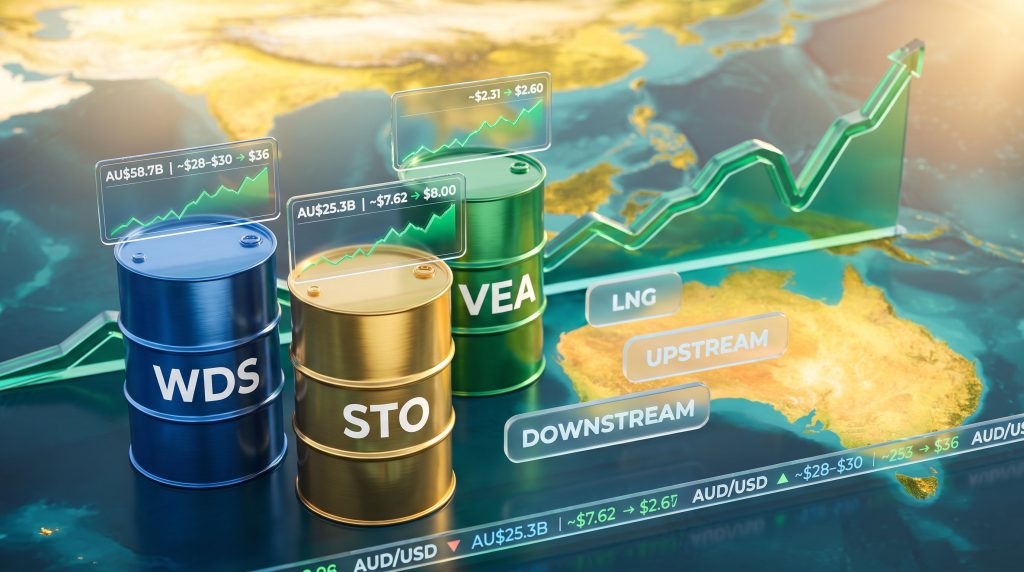
With a market capitalisation of approximately AU$58.7 billion, Woodside Energy is the undisputed heavyweight of the ASX energy sector and the primary institutional benchmark for Australian oil and gas exposure. Its scale alone ensures that any sustained move in global energy prices registers meaningfully in its earnings profile.
Woodside's business model is weighted toward long-term LNG supply contracts rather than spot market volatility, which creates a degree of earnings predictability that pure oil producers cannot offer. This structural feature means that even during periods of short-term crude price softness, Woodside's contracted revenue base provides a floor beneath earnings, supporting dividend continuity.
Technical setup: The stock has been consolidating in a range of approximately $28 to $30 per share — a zone that has repeatedly acted as support during the recent period of macro uncertainty. Market analysts have identified a resistance target near $36 per share, which would represent meaningful upside from current levels if the oil price catalyst materialises and sustains. A confirmed move above the near-term consolidation range, supported by volume, would be a technically significant development.
Snapshot: Woodside Energy (ASX: WDS)
- Market Cap: approximately AU$58.7 billion
- Technical Support Zone: approximately $28 to $30
- Key Resistance Target: approximately $36
- Core Business: LNG production and global export
- Risk Profile: Lower, large-cap with diversified operations
What makes Woodside particularly interesting in the current environment is the dual nature of its energy exposure. LNG spot prices have a strong historical correlation with crude oil benchmarks, meaning Woodside benefits from the commodity price environment even when its long-term contracts are priced off different reference benchmarks. Simultaneously, the global structural shift toward LNG as a transitional energy source — driven by nations moving away from coal and seeking energy security through diversified gas supply — positions Woodside as a long-duration investment thesis rather than a short-term commodity trade.
Santos (ASX: STO): The Low-Cost Operator Approaching a Critical Technical Threshold
Santos, with a market capitalisation of approximately AU$25.3 billion, occupies a distinct position in the ASX energy landscape. Where Woodside competes on scale, Santos competes on cost discipline. Its reputation as one of the lowest-cost operators among major ASX-listed energy producers means it generates meaningful free cash flow at oil price levels well below current market rates, providing investors with a margin of safety that higher-cost peers cannot match.
The company's operational footprint spans Australia, Papua New Guinea, and North America — a geographic diversification that reduces single-basin production risk and provides exposure to multiple gas market dynamics simultaneously. The PNG LNG project and the Barossa field development in the Timor Sea represent medium-term production growth catalysts that will deliver volume increases independent of short-term oil price movements.
Santos has also been investing in carbon capture and storage (CCS) technology, positioning itself ahead of what many analysts anticipate will be increasingly stringent emissions frameworks for fossil fuel producers. This forward-looking capital allocation distinguishes Santos from peers who treat energy transition as a distant problem rather than a present strategic consideration.
Technical setup: Santos is currently trading near $7.62 per share and approaching the psychologically and technically significant $8.00 resistance level. In technical analysis, round-number resistance levels often function as concentration points for both seller supply and, if breached convincingly, breakout momentum. A high-volume close above $8.00 would represent a meaningful shift in market sentiment and could attract both momentum-driven and fundamentally-oriented buyers simultaneously.
Snapshot: Santos (ASX: STO)
- Market Cap: approximately AU$25.3 billion
- Current Price Zone: approximately $7.62
- Key Resistance to Monitor: $8.00
- Core Business: Low-cost oil and gas production
- Risk Profile: Moderate, geographically diversified with strong cost discipline
Viva Energy (ASX: VEA): Differentiated Downstream Exposure with a Different Risk Curve
Viva Energy operates the Geelong refinery — one of Australia's most strategically significant fuel processing facilities — and plays a role in the domestic energy supply chain that neither Woodside nor Santos can replicate. As the operator of downstream refining infrastructure, Viva's profitability is driven by crack spreads rather than raw commodity prices, creating a genuinely differentiated risk profile within a portfolio of ASX energy holdings.
This distinction is important for portfolio construction purposes. Investors who already hold upstream exposure through WDS or STO and seek additional energy sector participation without doubling their direct commodity price risk may find VEA's downstream model structurally complementary. The correlation between VEA's earnings and crude oil spot prices is meaningfully lower than for pure upstream producers.
Australia's domestic fuel security considerations are increasingly relevant to Viva's strategic positioning. The country imports a significant proportion of its refined fuel needs, making domestic refining capacity a national infrastructure asset of considerable importance. This context supports the long-term relevance of Viva's Geelong operations, though investors should form their own assessment of how this may or may not translate into specific regulatory or policy outcomes.
Technical setup: Viva is currently trading near $2.31 per share, with technical support identified around $1.75. The resistance level to monitor sits near $2.60, and improving technical structure suggests a degree of accumulation interest building in the stock ahead of a potential directional move.
Snapshot: Viva Energy (ASX: VEA)
- Current Price Zone: approximately $2.31
- Technical Support: approximately $1.75
- Resistance Target: approximately $2.60
- Core Business: Fuel refining and domestic distribution
- Risk Profile: Moderate, downstream model with lower direct commodity correlation
How the Three Stocks Compare: A Side-by-Side Framework
| Metric | Woodside (WDS) | Santos (STO) | Viva Energy (VEA) |
|---|---|---|---|
| Market Capitalisation | approximately AU$58.7B | approximately AU$25.3B | Mid-cap |
| Business Model | Upstream LNG and gas | Upstream oil and gas | Downstream refining |
| Oil Price Sensitivity | High | High | Moderate |
| Technical Support | $28 to $30 | $7.00 to $7.62 | $1.75 |
| Key Resistance Target | $36 | $8.00 | $2.60 |
| Geographic Diversification | Global | Australia, PNG, North America | Domestic Australia |
| Dividend Reliability | Strong | Moderate to strong | Moderate |
| Risk Profile | Lower, large-cap | Moderate | Moderate |
The next major ASX story will hit our subscribers first
Key Risks That Could Disrupt the Thesis
Geopolitical Reversal Risk
The same geopolitical dynamic driving oil prices higher can reverse with equal speed. Historical examples — including the rapid de-escalation following multiple Middle East flashpoints over the past decade — illustrate how quickly a risk premium can evaporate from energy markets. Investors must assess whether their time horizon aligns with the duration of the catalyst, not just the initial price response.
Energy Transition Structural Headwinds
The long-term demand trajectory for fossil fuels carries genuine uncertainty as renewable energy capacity expands globally. Both Woodside and Santos are responding through LNG positioning (gas as a transitional fuel) and CCS investment, but this structural headwind is real and should feature in any honest assessment of long-duration energy investment.
Currency Volatility
AUD/USD movements create a secondary layer of price risk that operates independently of commodity fundamentals. A strengthening Australian dollar can meaningfully compress the local-currency earnings benefit of a global oil price rally, partially or fully offsetting the commodity tailwind for ASX-listed producers.
Hedging Program Limitations
Producers who have sold production forward through hedging programmes to protect against downside scenarios may find that those same programmes limit their upside participation during a price rally. Understanding a company's hedging ratio and the price levels at which contracts are struck is essential before assuming full leverage to rising commodity prices.
Frequently Asked Questions
What are the top 3 ASX oil stocks to watch in 2026?
Market analysts have identified Woodside Energy (WDS), Santos (STO), and Viva Energy (VEA) as the three most closely watched ASX energy stocks entering the second half of 2026, combining scale, cost efficiency, and differentiated business model characteristics. For additional context on the broader sector, investing in ASX oil shares is worth exploring as further reading.
Is Woodside Energy the largest ASX-listed oil and gas company?
Yes. With a market capitalisation of approximately AU$58.7 billion, Woodside Energy is the largest ASX-listed oil and gas company and the primary institutional reference point for Australian energy sector exposure.
How does a rising oil price affect ASX energy stocks differently?
Rising crude prices deliver an immediate and direct revenue uplift to upstream producers like WDS and STO. For downstream refiners like VEA, however, the impact depends on whether product prices rise faster or slower than crude input costs, making the crack spread the critical variable to monitor.
What is the difference between upstream and downstream ASX oil stocks?
Upstream companies explore for and produce crude oil and natural gas. Their earnings move in close correlation with commodity prices. Downstream companies refine crude into usable fuel products. Their earnings depend on the spread between crude input costs and refined product selling prices, not on the absolute commodity price level.
Strategic Positioning: Navigating ASX Oil Stocks Through a Price Cycle Upswing
The framework for approaching the current ASX energy opportunity is built around three complementary exposures rather than a single concentrated bet. Woodside offers large-cap stability, institutional liquidity, and long-duration LNG exposure that extends beyond a simple oil trade. Santos provides the leverage of a low-cost producer approaching a technically meaningful breakout level. Viva Energy, furthermore, offers a structurally differentiated downstream exposure with a lower correlation to raw commodity prices.
The technical levels identified across all three stocks — $36 for WDS, $8.00 for STO, and $2.60 for VEA — represent confirmation thresholds rather than entry signals in isolation. Experienced traders treat a high-conviction breach of these levels, ideally on expanding volume, as evidence that the market has shifted rather than speculating that it might.
Position sizing, stop-loss discipline, and time horizon clarity remain the non-negotiable foundations of any strategy built around geopolitically-linked commodity themes. The opportunity in mid-2026 ASX energy stocks is real, but so is the risk that the catalyst resolves faster than expected, leaving late or oversized positions exposed to a sharp mean reversion. Reviewing ASX trading insights can help investors sharpen their broader market awareness before committing capital.
Within a diversified Australian equity portfolio, the top 3 ASX oil stocks to watch can serve dual purposes simultaneously: as an inflation hedge when energy costs are rising across the broader economy, and as an energy security play that benefits from structural shifts in how nations think about fuel supply resilience. Both dynamics are present in the current environment, making this a particularly compelling moment for considered, well-researched positioning across the sector.
Important Disclaimer: All price levels, technical observations, and market commentary referenced in this article are provided for informational and educational purposes only. Past price behaviour does not guarantee or reliably predict future performance. The material in this article does not constitute financial advice. Readers should conduct independent research and consult with a licensed financial adviser before making any investment decisions. Refer to The Market Online's full disclaimer for further information.
Want to Know When the Next Major ASX Energy or Mineral Discovery Hits the Market?
Discovery Alert's proprietary Discovery IQ model delivers real-time alerts on significant ASX announcements — turning complex market data into actionable investment insights the moment they emerge — so subscribers can position themselves ahead of the broader market. Explore Discovery Alert's dedicated discoveries page to see how major ASX discoveries have historically generated substantial returns, and begin your 14-day free trial today to secure your market-leading advantage.