July 13, 2026
Why the Geology Beneath Australia Shapes Global Supply Chains
Long before commodity prices became Wall Street talking points, the geological conditions formed across billions of years in the Australian continent were quietly determining the future of global industry. The Pilbara's ancient iron formations, Western Australia's lithium-bearing pegmatites, and the rare earth concentrations at Mt Weld did not emerge from policy decisions or investment cycles. They emerged from geological time. Today, those formations sit at the intersection of two of the most powerful economic forces of the 21st century: the continued industrialisation of developing economies and the accelerating transition away from fossil fuels.
Understanding which companies have positioned themselves atop this geological inheritance, and how they are translating it into shareholder value and strategic influence, is the central challenge for any investor or analyst navigating the ANZ resource sector in 2026.
What follows is a comprehensive breakdown of the top 10 mining companies in ANZ, ranked primarily by ASX market capitalisation as of early 2026, with secondary consideration given to revenue scale, commodity diversification, and strategic alignment with energy transition demand. New Zealand does not produce top-tier mining corporations at this scale: its mining sector remains focused on coal, gold, and construction aggregates, with individual operations typically valued well below A$3 billion. Where NZ-based assets exist within globally listed entities (such as OceanaGold's Macraes Mine in Otago), the parent companies are incorporated and primarily listed outside ANZ's ASX framework.
The defining characteristic of ANZ mining in 2026 is what industry observers have called a dual-track reality: legacy commodity operations in the Pilbara and Bowen Basin continue generating the cashflows that fund aggressive expansion into lithium, copper, rare earths, and hydrogen infrastructure. It is a structural pivot that distinguishes ANZ's majors from almost any comparable peer group globally.
When big ASX news breaks, our subscribers know first
ANZ Mining at a Glance: Sector-Level Statistics
Before examining individual companies, the sheer scale of Australia's resource sector warrants context. Australia accounts for approximately 50% of global seaborne iron ore trade, roughly 8-9% of global gold production (making it the world's second-largest gold producer after China), and approximately 16-18% of global lithium output. These figures are drawn from U.S. Geological Survey Mineral Commodity Summaries and Australian Bureau of Agricultural and Resource Economics publications.
| Metric | Approximate Figure |
|---|---|
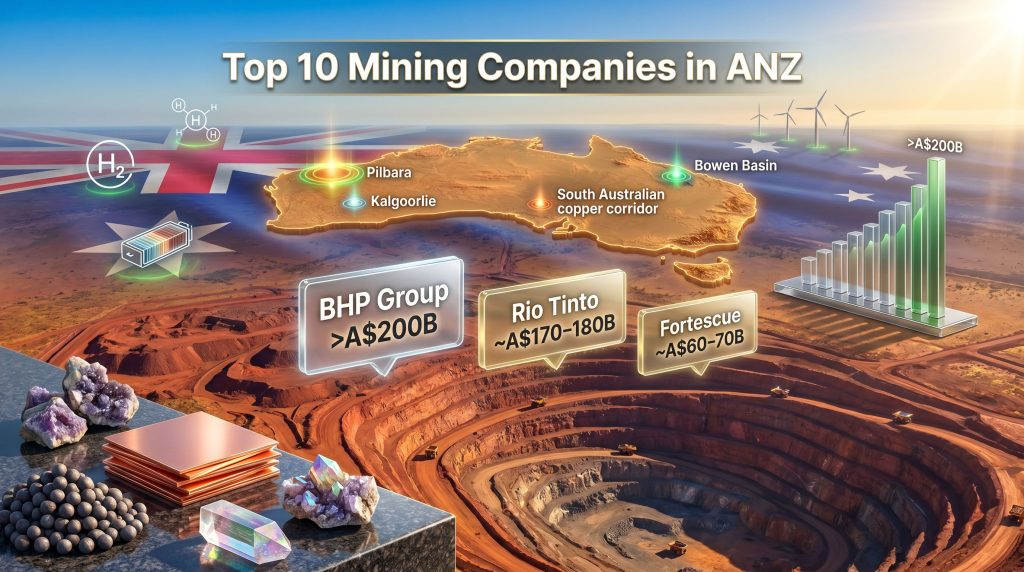
| BHP Market Cap (ASX, 2025) | >A$200 billion |
| Rio Tinto Market Cap (ASX, 2025) | ~A$170-180 billion |
| Fortescue Market Cap (ASX, 2025) | ~A$60-70 billion |
| Gold Price Context (2025-26) | >US$2,500/oz |
| Fortescue Green Hydrogen Investment | US$7 billion committed |
| BHP Revenue (FY2023) | ~US$60 billion |
| Rio Tinto Revenue (FY2023) | ~US$51 billion |
| Australia's Share of Global Iron Ore Exports | ~50% |
| Australia's Annual Lithium Production (LCE) | ~50,000-55,000 tonnes |
Important Note for Investors: All market capitalisation figures represent point-in-time valuations subject to commodity price movements, AUD/USD exchange rate fluctuations, and broader equity market conditions. These figures should be verified against live ASX data before any investment decision. This article does not constitute financial advice.
Rio Tinto, while operating the majority of its assets in Australia and maintaining operational headquarters there, is incorporated in the United Kingdom and dual-listed on the LSE. As a result, it is categorised separately in strict ANZ-specific rankings. Its market capitalisation of approximately A$170-180 billion would otherwise position it second in this analysis. For a broader view of top mining companies in ANZ, independent sector analysis provides useful comparative context.
10. Mineral Resources: The Pit-to-Port Model That Changed the Cost Equation
Founded: 1992 | HQ: Perth, WA | Type: Mining Services and Diversified Producer | Market Cap (2025): ~A$8-10 billion
Most mining companies choose between operating mines and providing services to those that do. Mineral Resources (MinRes) built its competitive advantage by refusing that choice. The company's integrated owner-operator model spans crushing, processing, haulage, and port logistics, all held in-house. This vertical integration, often described as a pit-to-port capability, compresses cost structures in ways that asset-light competitors cannot easily replicate.
What the Onslow Iron Project Actually Represents
The Onslow Iron project in the Pilbara was not merely a capacity addition. Its successful execution elevated MinRes into a different tier of iron ore production, demonstrating that the company could deliver large-scale infrastructure on its own terms. The project required the construction of road and port infrastructure in a remote corridor, a feat that larger, slower-moving organisations typically avoid due to capital risk and execution complexity.
MinRes also holds significant stakes in two of Australia's most strategically positioned lithium operations:
- Wodgina Lithium Mine (Pilbara region, WA): One of the world's largest hard-rock lithium deposits by resource tonnage, operated in joint venture with Albemarle Corporation
- Mt Marion Lithium Mine (near Kalgoorlie, WA): A high-volume spodumene concentrate producer with established offtake relationships into Asian battery supply chains
Investment-Relevant Considerations
MinRes presents a dual earnings risk profile. On one hand, its iron ore division benefits from Pilbara hematite grade advantages and integrated logistics cost control. On the other, its lithium exposure makes it sensitive to spodumene concentrate prices, which have experienced significant volatility between 2022 and 2025, ranging from US$6,000/tonne at peak to below US$1,000/tonne during oversupply periods.
Investors evaluating MinRes must therefore model both commodity cycles simultaneously, with lithium price recovery representing a potential earnings rerating catalyst. Furthermore, spodumene lithium extraction processes have become increasingly central to how markets value hard-rock lithium producers across the ASX.
The owner-operator culture also creates rapid capital deployment capability that larger peers cannot match institutionally, though this speed introduces execution risk during downturns when capital discipline becomes critical.
9. Washington H. Soul Pattinson: When Patient Capital Outperforms Aggressive Growth
Founded: 1903 | HQ: Sydney, NSW | Type: Diversified Investment House with Resource Exposure
Few corporate structures in Australian business history have proven as durable as Washington H. Soul Pattinson, known colloquially as Soul Patts. As one of Australia's oldest continuously listed companies, it offers a fundamentally different kind of mining exposure than its operational peers on this list. Soul Patts does not mine anything itself. Instead, it provides strategic, long-duration capital to resource entities, most significantly through its controlling interest in New Hope Corporation.
Why a 123-Year-Old Investment House Belongs Among ANZ's Mining Leaders
New Hope Corporation operates thermal and metallurgical coal assets across Queensland and New South Wales, making Soul Patts an indirect but substantial participant in Australian coal output and employment. The distinction matters: Soul Patts' investment horizon extends across commodity cycles rather than being defined by them.
This architectural conservatism, which would look like underperformance during bull markets, has repeatedly demonstrated its value during the sharp commodity contractions that characterise resource cycles. During periods of coal price suppression, Soul Patts' diversified portfolio structure absorbs sector-specific shocks without triggering the balance sheet distress that pure-play producers face.
During periods of elevated commodity pricing (as seen in the coal price surge of 2022-2023), its controlling stake in New Hope delivers substantial dividends and capital appreciation.
Strategic Insight: The multi-decade investment horizon employed by patient capital structures like Soul Patts represents a fundamentally different risk-reward proposition than operational miners. Investors seeking indirect commodity exposure with institutional governance stability may find this model more aligned with long-term portfolio objectives than direct commodity producers.
The company has also begun adding emerging mineral venture exposure to its broader portfolio, reflecting awareness that energy transition commodities will define the next capital cycle in Australian resource investment.
8. South32: From Unwanted Assets to Low-Carbon Metals Leader
Founded: 2015 (BHP demerger) | HQ: Perth, WA | Type: Diversified Metals and Mining | Market Cap (2025): ~A$15-20 billion
South32's origin story carries an irony worth noting: the assets BHP considered non-core in 2015, and transferred into a newly listed entity, have since positioned themselves as structurally aligned with the energy transition in ways BHP's own retained portfolio has had to actively work toward. South32 inherited manganese, aluminium, silver, nickel, and coal assets, then spent nearly a decade systematically divesting the coal exposure while deepening its low-carbon metals footprint.
The Portfolio Transformation Timeline
South32's corporate evolution involved deliberate asset reshaping:
- Divestment of South Africa Energy Coal operations (completed 2021)
- Sale of Illawarra Metallurgical Coal operations, removing remaining coal exposure from the portfolio
- Acquisition and development of the Hermosa project in Arizona, United States, targeting zinc, lead, and manganese battery materials
- Retention and expansion of global manganese leadership through GEMCO (Groote Eylandt Mining Company) in the Northern Territory
Why Manganese Matters More Than Most Investors Recognise
South32's manganese production leadership represents a strategic position that is significantly underappreciated in mainstream investment analysis. Manganese is a critical component in lithium-ion battery cathode chemistry, particularly in lithium manganese oxide (LMO) and lithium nickel manganese cobalt oxide (NMC) formulations.
As battery manufacturers seek to reduce cobalt dependency due to ethical sourcing concerns and cost volatility, manganese-rich cathode chemistries are gaining favour. South32's GEMCO operation on Groote Eylandt, producing approximately 4-5 million tonnes of manganese ore annually, sits at the centre of this structural demand shift.
The Hermosa project in Arizona represents South32's long-term North American growth anchor, targeting battery-grade manganese alongside zinc production, with development timelines extending into the early 2030s for full production ramp-up.
7. Lynas Rare Earths: The Western World's Only Scaled Alternative to Chinese Processing
Founded: 1983 | HQ: Perth, WA | Type: Rare Earths Producer
Understanding why Lynas Rare Earths commands a premium valuation relative to conventional mining metrics requires understanding a distinction that most non-specialist investors overlook: the difference between rare earth mining and rare earth separation. Mining is the relatively straightforward extraction of ore. Separation, the chemical isolation of individual rare earth elements from mixed ore concentrates, is extraordinarily technically complex and represents the genuine bottleneck in global supply chains.
China controls approximately 70% of global rare earth separation capacity. Outside that dominance, Lynas Rare Earths operates the only significant scaled separation facility serving Western markets. Consequently, rare earth supply chains have become a focal point of government procurement and national security policy across multiple Western economies.
The Mt Weld Geological Advantage
Lynas' Mt Weld deposit in Western Australia is not merely a large rare earth deposit; it is one of the highest-grade rare earth deposits ever characterised geologically. Grade matters enormously in rare earth economics because processing costs are largely fixed regardless of ore input grade, meaning higher-grade ore translates directly into lower per-unit processing costs and stronger margins. Mt Weld's exceptional grade profile represents a geological competitive advantage that cannot be manufactured through operational efficiency alone.
The primary output of strategic interest is neodymium-praseodymium (NdPr) mixed oxide, the material from which permanent magnets are manufactured. These magnets are essential components in:
- Electric vehicle traction motors (approximately 1-2 kg of NdPr per EV)
- Direct-drive wind turbine generators
- Defence systems including missile guidance and radar components
- Consumer electronics and industrial motors
Geopolitical Demand Drivers Elevating Lynas Beyond Commodity Classification
Lynas has established offtake and cooperation agreements with Western government-affiliated entities seeking to secure non-Chinese rare earth supply. The company operates processing facilities in Kuantan, Malaysia (its established rare earth processing plant), alongside the newer Kalgoorlie rare earth processing facility in Western Australia, which is designed to provide domestic Australian processing capacity and reduce Malaysian operational dependency.
Geopolitical Context: Rare earth supply chain security has become a component of national defence planning for the United States, European Union, Japan, and Australia. Lynas Rare Earths is not simply a commodity producer in this context; it functions as critical infrastructure for Western industrial and defence supply chains. This classification creates demand dynamics distinct from conventional commodity markets.
Investors should note that Lynas' Malaysian operations have faced periodic regulatory scrutiny over waste management and licensing, representing an ongoing operational risk that warrants monitoring through Malaysian regulatory announcements.
The next major ASX story will hit our subscribers first
6. Pilbara Minerals: Hard-Rock Lithium and the Battery Value Chain Race
Founded: 2005 | HQ: West Perth, WA | Type: Hard-Rock Lithium Mining | Market Cap (2025): ~A$7-8 billion
The lithium sector bifurcates broadly into two geological production pathways: hard-rock spodumene mining (dominant in Australia) and lithium brine extraction (dominant in South America's Lithium Triangle). These are not equivalent. Hard-rock spodumene produces higher-consistency lithium concentrate with more predictable grade profiles, while brine operations offer lower operating costs but longer construction timelines and greater climate exposure. Pilbara Minerals operates exclusively in the hard-rock category, and its Pilgangoora operation stands as one of the sector's defining assets.
The Pilgangoora Operation: Asset Profile
| Metric | Detail |
|---|---|
| Ownership | 100% (Pilbara Minerals) |
| Deposit Type | Hard-rock spodumene pegmatite |
| Global Significance | Among the largest single-operator lithium deposits globally |
| Primary Product | Spodumene concentrate (typically 5.5% Li₂O grade) |
| Downstream Integration | Joint ventures targeting lithium hydroxide chemical conversion |
The 5.5% Li₂O grade of Pilgangoora spodumene concentrate is a critical technical detail. Battery-grade lithium hydroxide for EV applications requires conversion from this concentrate through a chemical refining process. Pilbara Minerals has pursued downstream joint ventures targeting lithium hydroxide production, aiming to capture the significant value-add that occurs between raw concentrate and battery-ready chemical product.
Lithium Price Cycle Risk and Cost Discipline
Pilbara Minerals has experienced the full amplitude of the lithium price cycle: extraordinary earnings during the 2022 price spike (spodumene concentrate exceeding US$6,000/tonne), followed by severe margin compression during the 2023-2024 correction (prices declining below US$1,000/tonne). The company's ability to maintain operations through this cycle without balance sheet distress reflects the operational cost discipline built into Pilgangoora's design.
However, investors should treat lithium price recovery as speculative until structural demand growth from EV market expansion absorbs current oversupply conditions. Global EV sales reached approximately 14 million units in 2023, with projections targeting 35-40 million units annually by 2030. Each EV battery pack requires approximately 8-10 kg of lithium carbonate equivalent, creating structural demand growth that most analysts expect to absorb current supply surpluses by the mid-2020s, though precise timing remains contested within the industry.
5. MMG Limited: Base Metals Expertise Bridging Australian Operations and Asian Demand
Founded: 2009 | HQ: Melbourne, VIC | Type: Base Metals Mining | Majority Shareholder: China Minmetals Corporation
MMG Limited occupies a structurally distinctive position among the top 10 mining companies in ANZ, functioning as a connection point between Australian mining technical capability and Chinese industrial capital markets. The company's majority ownership by China Minmetals, a Chinese state-owned enterprise, provides access to Asian capital markets and offtake security that independent producers cannot easily replicate, while simultaneously creating governance considerations that Western institutional investors weigh differently than domestic entities.
Australian Operations: Dugald River and Rosebery
MMG's Australian asset base centres on two underground operations:
- Dugald River (Queensland): A high-grade zinc-lead-silver deposit operating as an underground mine, contributing meaningfully to MMG's global zinc production profile
- Rosebery (Tasmania): A long-life polymetallic underground mine producing zinc, lead, silver, and copper concentrates, with an operational history spanning decades that demonstrates the technical complexity the company manages effectively
Both operations require sophisticated underground mining techniques in geologically complex environments, representing genuine technical capability differentiation. MMG's proficiency in managing these operations underpins its competitive position in the base metals sector.
The Infrastructure and Renewable Energy Demand Tailwind
Zinc's primary use as a galvanising agent for steel structures, combined with copper's role in electrical infrastructure, positions MMG's production portfolio as a structural beneficiary of both conventional infrastructure investment and renewable energy build-out. Every wind turbine, solar farm, and EV charging network requires substantial copper wiring and zinc-coated structural steel, creating durable demand regardless of which specific energy transition pathway proves dominant.
4. Evolution Mining: The Acquisition Discipline That Redefined ASX Gold Economics
Founded: 2011 | HQ: Sydney, NSW | Type: Gold and Copper Producer | Market Cap (2025): ~A$10 billion
Evolution Mining's rise within Australian gold production demonstrates a principle that contradicts conventional mining sector wisdom: disciplined, selective acquisition can outperform both organic exploration programmes and aggressive volume-focused growth strategies. Since founding, Evolution has assembled a portfolio of long-life, high-margin assets by targeting operations with structural cost advantages rather than simply headline resource size. For investors comparing individual producer performance, top Australian gold mines provide useful context on how Evolution's operations benchmark against the broader sector.
The Copper Credit Mechanism: An Often Misunderstood Cost Advantage
The Ernest Henry copper-gold mine in Queensland is the key to understanding Evolution's cost competitiveness. Ernest Henry produces significant copper volumes as a co-product of gold mining. Under standard industry reporting conventions, copper revenue is deducted from total mining costs before calculating the all-in sustaining cost (AISC) per gold ounce. This by-product credit mechanism can reduce reported AISC by several hundred USD per ounce, making Evolution appear dramatically more cost-efficient than single-commodity gold producers.
| Cost Metric | Evolution Mining | Typical ASX Gold Producer |
|---|---|---|
| Gross AISC (before credits) | Higher due to copper infrastructure | Standard range |
| Copper By-Product Credit | Substantial reduction | Minimal or none |
| Reported Net AISC | Structurally lower | Higher by comparison |
| Margin at US$2,500/oz Gold | Elevated relative to peers | Varies |
This mechanism is not accounting manipulation; it is standard industry practice endorsed by the World Gold Council. However, it means Evolution's cost competitiveness is partly contingent on copper price levels maintaining by-product credit value.
The Cowal Operation
The Cowal gold mine in New South Wales represents Evolution's flagship asset: a large, open-pit and underground operation with substantial reserve life that contributes consistent production volumes and margins. Cowal's ongoing underground expansion programme represents the primary organic growth pathway within Evolution's portfolio, extending mine life and accessing higher-grade underground ore.
3. Northern Star Resources: Gold's Margin-Over-Volume Philosophy at Industrial Scale
Founded: 2000 | HQ: Subiaco, WA | Type: Gold Mining | Market Cap (2025): ~A$15 billion
In an industry where the instinct to maximise production volume is deeply ingrained, Northern Star Resources has built its reputation on a philosophically different foundation: extracting the most profitable ounces, not the most ounces. This distinction sounds simple but has profound implications for capital allocation, mine planning, and earnings consistency across commodity cycles.
The Kalgoorlie Super Pit: Synergy Creation Through Integration
The Kalgoorlie Consolidated Gold Mines (KCGM) Super Pit, in which Northern Star holds a 50% interest, represents one of Australia's most iconic mining operations. The Super Pit is a massive open-cut gold mine in the heart of Kalgoorlie-Boulder, Western Australia, a region with over 130 years of continuous gold mining history. Northern Star's management of its interest in this operation, combined with surrounding underground assets, creates processing and logistics synergies that compress costs relative to standalone operations.
The Super Pit processes ore through a centralised mill infrastructure, allowing Northern Star to feed multiple underground mines' output through shared processing capacity, a form of operational leverage that reduces per-ounce processing costs significantly.
Gold Price Tailwinds and Margin Implications
Gold prices exceeding US$2,500/oz during 2025-26 (compared to typical ranges of US$1,200-1,800/oz during 2015-2022) create exceptional margin conditions for Northern Star. With all-in sustaining costs typically ranging between US$1,300-1,600/oz across its portfolio, current gold pricing generates per-ounce margins that are extraordinary by historical standards.
This creates a nuanced investor decision: current earnings are elevated relative to long-term sustainable averages, meaning valuation should account for price cycle mean reversion rather than assuming current margins persist indefinitely. Northern Star's North American asset diversification (including operations in Alaska) provides geographic risk mitigation against Western Australian regulatory or operational concentration risk.
2. Fortescue: Iron Ore Cashflows Funding the Hydrogen Economy Bet
Founded: 2003 | HQ: Perth, WA | Type: Iron Ore and Green Energy | Market Cap (2025): ~A$60-70 billion
Few corporate transformations in global mining have been as audacious as Fortescue's pivot from pure-play iron ore producer toward self-described integrated green energy company. The company that Andrew Forrest built from a contested geological report into one of the world's largest iron ore exporters is now channelling billions of dollars from Pilbara hematite sales into green hydrogen infrastructure on multiple continents. In addition, green iron production initiatives emerging from South Australia are further evidence of how the broader sector is decarbonising at pace.
The Pilbara Iron Ore Engine
Fortescue's Hematite operations across the Pilbara remain one of the world's most cost-competitive iron ore businesses. The company has invested heavily in fleet automation, deploying autonomous haul trucks, autonomous drilling systems, and centralised operations centre management that reduces labour intensity per tonne produced. This automation programme has progressively improved operational efficiency metrics, contributing to Fortescue's position as one of the lowest-cost iron ore producers globally on a C1 cash cost basis.
The company's iron ore grade profile (typically 56-58% Fe, lower than BHP and Rio Tinto's benchmark-grade products) has historically required a pricing discount relative to higher-grade competitors. However, Fortescue has pursued ore blending and processing investments to improve realised pricing, partially closing this grade discount gap.
Fortescue Energy: Dissecting the US$7 Billion Commitment
Scenario Analysis: If green hydrogen achieves cost parity with fossil fuel-derived hydrogen by the early 2030s, as some analysts project under optimistic electrolyser cost reduction assumptions, Fortescue's early capital deployment could position it as a vertically integrated clean energy exporter. If this timeline extends significantly, however, the capital intensity of the green energy division creates an ongoing drag on consolidated returns that iron ore margins must subsidise.
Fortescue Energy's committed investment of US$7 billion targets green hydrogen production using renewable electricity (solar and wind) to power electrolysis, splitting water into hydrogen and oxygen without carbon emissions. The company has targeted projects across Australia, the United States, and other jurisdictions, with the stated ambition of becoming a major clean energy exporter.
Critically, Fortescue has also committed to decarbonising its own heavy mobile mining fleet using green ammonia and hydrogen technologies, which would make its Pilbara operations among the world's first large-scale mines to eliminate diesel entirely from haulage operations. The technical and commercial feasibility of this fleet transition remains the subject of genuine engineering debate, making it a speculative but potentially transformative operational commitment.
1. BHP Group: The Benchmark by Which All ANZ Mining Is Measured
Founded: 1885 | HQ: Melbourne, VIC | Type: Diversified Resources | Market Cap (2025): >A$200 billion | Revenue (FY2023): ~US$60 billion
When analysts seek a reference point for operational excellence in global mining, BHP Group is almost invariably the standard against which others are measured. Its scale, commodity diversification, balance sheet strength, and tier-one asset quality combine into a corporate profile that competitors can benchmark but rarely replicate in totality. Indeed, Australia's iron ore advantage is perhaps most visibly embodied in BHP's Western Australian operations, which set the global benchmark for iron ore production efficiency.
The Commodity Portfolio Architecture
| Commodity | Key Asset | Strategic Significance |
|---|---|---|
| Iron Ore | Western Australia Iron Ore (WAIO) | Industry-leading margin operations; approximately 250+ Mtpa production |
| Copper | Olympic Dam, South Australia | One of the world's largest known copper-uranium-gold-silver deposits |
| Potash | Jansen Project, Saskatchewan, Canada | Long-duration food security commodity; multi-decade development timeline |
The Strategic Sharpening: Petroleum Exit and Copper Acquisition Ambition
BHP's divestment of its petroleum business through the merger with Woodside Energy in 2022 represented a fundamental reallocation of capital toward future-facing commodities. By exiting oil and gas, BHP freed balance sheet capacity and management attention for copper, nickel, and potash expansion, explicitly positioning the portfolio around electrification and food security themes.
The attempted acquisition of Anglo American in 2024, valued at approximately US$39 billion at proposal, was ultimately unsuccessful but revealed BHP's copper growth ambitions with clarity. Anglo American's copper assets in Chile and Peru, combined with BHP's Olympic Dam operations and South Australian exploration pipeline, would have created a copper supply position of extraordinary scale. The failed bid has since elevated speculation about alternative acquisition targets as BHP continues seeking copper portfolio growth through M&A.
Olympic Dam: The Asset That Could Define the 2030s
Olympic Dam in South Australia contains one of the world's largest known deposits of copper, uranium, gold, and silver within a single ore body. Current operations process approximately 230,000-250,000 tonnes of refined copper annually, but the deposit's identified resource supports potential expansion to multiples of current throughput.
BHP's expansion studies have examined scenarios targeting 450,000-500,000 tonnes per year of copper production, which would position Olympic Dam as one of the world's top individual copper operations. These expansion scenarios involve substantial capital expenditure and multi-year development timelines, making them long-duration investment theses rather than near-term catalysts.
How ANZ's Top 10 Miners Stack Up: A Consolidated Comparison
| Rank | Company | Market Cap (AUD, 2025) | Primary Commodity | Key Strategic Theme |
|---|---|---|---|---|
| 1 | BHP Group | >A$200B | Iron ore, copper, potash | Electrification metals focus |
| 2 | Fortescue | ~A$60-70B | Iron ore, green energy | Hydrogen economy pivot |
| 3 | Northern Star Resources | ~A$15B | Gold | Margin-over-volume discipline |
| 4 | South32 | ~A$15-20B | Manganese, aluminium, silver | Low-carbon metals portfolio |
| 5 | Evolution Mining | ~A$10B | Gold, copper | Acquisition-led cost efficiency |
| 6 | Mineral Resources | ~A$8-10B | Iron ore, lithium | Integrated pit-to-port model |
| 7 | Pilbara Minerals | ~A$7-8B | Lithium | EV battery value chain positioning |
| 8 | Lynas Rare Earths | ASX-listed | Rare earths (NdPr) | Western supply chain security |
| 9 | Soul Pattinson | ASX-listed | Coal (indirect), diversified | Patient capital, multi-decade view |
| 10 | MMG Limited | Not ASX-primary | Zinc, copper | Asian demand alignment |
Disclaimer: Rankings and market capitalisation figures are approximate and reflect early 2026 conditions. Valuations fluctuate continuously with commodity prices, currency movements, and broader market conditions. This comparison is intended for informational and educational purposes only and does not constitute financial advice.
The Macro Forces Reshaping ANZ Mining Through 2030
The Energy Transition Commodity Demand Shift
The energy transition is not applying equal pressure across all commodities. A clear hierarchy has emerged based on material requirements for electrification infrastructure, and critical minerals demand is reshaping how capital flows toward producers positioned across this spectrum:
- Strong structural tailwinds: Copper (wiring and motors), lithium (battery anodes and cathodes), rare earths (permanent magnets), manganese (battery cathodes), and nickel (high-energy-density batteries)
- Mixed outlook: Metallurgical coal maintains relevance while blast furnace steel production persists globally, though hydrogen-based direct reduction steelmaking is advancing
- Managed decline: Thermal coal faces accelerating demand reduction in developed markets, with demand sustained by developing economy energy needs for a transitional period
ESG Accountability: Scope 3 Emissions as the Next Frontier
An emerging regulatory development with significant implications for ANZ miners is the expanding expectation that companies account for Scope 3 emissions, specifically the downstream greenhouse gas emissions generated by customers using their products. For iron ore producers, this means steel manufacturing emissions attributable to their ore. For coal producers, it encompasses combustion emissions.
As ESG reporting standards evolve and institutional investors apply screening criteria, Scope 3 accountability may materially affect access to capital for commodity producers with high downstream emission profiles. Indigenous land rights, water management, and tailings storage liability also represent escalating social licence considerations across Western Australian and Queensland operations specifically.
Consolidation Dynamics and the Battle for Critical Mineral Assets
The mid-tier ASX mining space is experiencing consolidation pressure from two directions simultaneously: Western-backed entities seeking to build critical mineral supply positions, and Chinese-affiliated capital seeking to maintain processing and supply chain influence. This creates competitive dynamics around asset acquisition that inflate transaction multiples for well-positioned lithium, copper, and rare earth assets.
Balance sheet strength has consequently become a decisive strategic weapon: companies like BHP, with unmatched financial capacity, can pursue transformative acquisitions that would be structurally inaccessible to smaller peers.
Frequently Asked Questions
What is the largest mining company in Australia by market capitalisation?
BHP Group holds the top position with market capitalisation exceeding A$200 billion as of 2025, making it not only Australia's largest miner but one of the largest mining companies globally by this metric.
Does New Zealand have any major mining companies in the top 10 ANZ rankings?
No. New Zealand's mining sector operates at fundamentally smaller scales, focused on coal, gold, and construction aggregates. No NZ-headquartered company currently achieves the market capitalisation or revenue scale required to rank among ANZ's top 10 producers. Companies operating NZ assets, such as OceanaGold's Macraes Mine in Otago, are incorporated and primarily listed outside ANZ's ASX framework.
Which ANZ mining company has the greatest exposure to the energy transition?
Multiple companies hold significant positions across different transition commodities. Lynas Rare Earths supplies critical NdPr for EV motors and wind turbines. Pilbara Minerals produces hard-rock lithium for battery manufacturing. Fortescue is investing US$7 billion in green hydrogen infrastructure. BHP is expanding its copper footprint to serve global electrification demand. South32 holds manganese production leadership relevant to next-generation battery cathode chemistry.
What distinguishes BHP from Fortescue despite both being Pilbara iron ore producers?
BHP operates higher-grade hematite products (typically 61-65% Fe) commanding premium benchmark pricing, alongside diversified copper, potash, and nickel operations providing earnings diversification. Fortescue operates lower-grade hematite products (typically 56-58% Fe) at lower cost, accepting grade discounts while generating substantial free cashflow that is increasingly being redeployed into green energy infrastructure. The two companies represent fundamentally different capital allocation philosophies within the same geological province.
Want to Know Which ASX Companies Are Discovering the Next Generation of Critical Minerals?
The geological advantages underpinning Australia's mining dominance — from Pilbara iron ore to hard-rock lithium and rare earths — make real-time discovery intelligence essential for investors seeking to identify the next transformative find before the broader market reacts. Discovery Alert's proprietary Discovery IQ model instantly scans ASX announcements to deliver actionable alerts on significant mineral discoveries, turning complex geological data into clear investment signals — explore historic discovery returns to understand what early positioning in major finds has meant for investors, and begin a 14-day free trial at Discovery Alert to stay ahead of the next major ASX discovery.