June 5, 2026
When Supply Chains Break: The Strategic Logic Behind Egypt's Aluminum Surge
Few industrial commodities expose the fragility of global supply chains quite like primary aluminum. Unlike oil, which benefits from a sprawling network of diversified producers, primary aluminum smelting is overwhelmingly concentrated in a single country. China accounts for more than half of annual global output, and outside of Russia, Canada, and the Gulf Cooperation Council states, meaningful primary production capacity is scarce. When that scarcity compounds with regional disruptions, the pressure to develop new, geopolitically stable supply nodes becomes acute. That is precisely the environment that has made Egypt one of the most compelling aluminum investment destinations of the mid-2020s.
The Trafigura Egyptalum aluminum smelter in Egypt, announced in early May 2026, is not simply a bilateral industrial agreement between a commodity trader and a state-owned manufacturer. It is a calculated structural response to a decade-long erosion of non-Chinese aluminum stocks that has left global supply chains precariously thin. Understanding why this project exists, how it is structured, and what it means for global aluminum markets requires looking well beyond the headline investment figure.
When big ASX news breaks, our subscribers know first
The Structural Supply Crisis That Created This Opportunity
A Decade of Declining Non-Chinese Stocks
The numbers underpinning this investment are stark. According to Trafigura, aluminum inventories held outside China have fallen by approximately 6 million tonnes over the past decade, reaching levels that many commodity analysts describe as historically constrained. This is not a cyclical inventory drawdown of the kind that typically self-corrects within a few quarters. It reflects a deeper structural imbalance: demand for primary aluminum has grown steadily across automotive, construction, packaging, and energy transition applications, while new smelting capacity outside China has been slow to materialise.
Building a new primary aluminum smelter from the ground up is a capital-intensive, multi-year undertaking. The economics require reliable, competitively priced electricity, access to alumina feedstock, logistics infrastructure, and long-term offtake commitments before a shovel enters the ground. These barriers to entry mean that the gap between when supply tightness becomes apparent and when new capacity actually comes online can span many years. Commodity traders operating at a global scale are acutely aware of this lag, and it creates a powerful incentive to move early in identifying and anchoring new production sites.
Why MENA Matters and Why Egypt Stands Apart
The Gulf Cooperation Council region has historically served as the primary non-Chinese aluminum production hub outside of Russia and Canada, anchored by Aluminium Bahrain (Alba) and Emirates Global Aluminium (EGA). These facilities represent significant production capacity, but the broader MENA region's concentration of output in a small number of politically and geographically proximate sites creates systemic vulnerability. Any disruption affecting the Arabian Gulf, whether geopolitical, infrastructure-related, or energy-driven, can ripple rapidly through regional supply chains serving European and Asian buyers.
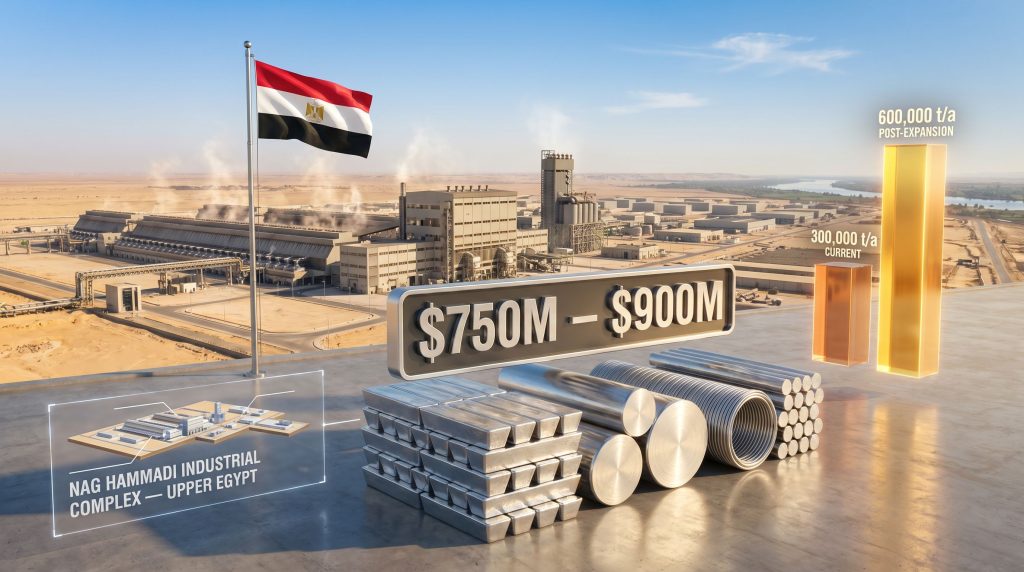
Egypt's position is meaningfully different. It sits at the crossroads of North Africa, the Mediterranean basin, and the Middle East, giving it natural logistics advantages for serving multiple buyer geographies simultaneously. It has an established industrial base with decades of operating experience in primary aluminum production. Furthermore, it has an existing smelting complex at Nag Hammadi in Upper Egypt that provides the infrastructure foundation for expansion at a fraction of the cost and timeline of a greenfield development.
The strategic calculus is clear: expanding an existing, proven facility in a geographically diversified location is categorically lower risk than constructing a new smelter in an untested location, particularly when financing complexity is already a challenge across emerging market industrial projects.
What the Trafigura Egyptalum Aluminum Smelter Project Actually Involves
Core Project Parameters at a Glance
| Parameter | Detail |
|---|---|
| Project Location | Nag Hammadi Industrial Complex, Upper Egypt |
| New Smelter Capacity | 300,000 tonnes per annum |
| New Anode Plant Capacity | 150,000 tonnes per annum |
| Total Investment Range | $750 million to $900 million |
| Current Complex Capacity | Approximately 300,000 tonnes per annum |
| Post-Expansion Capacity | Approximately 600,000 tonnes per annum |
| Agreement Structure | Letter of intent; exclusive negotiations underway |
| Announcement Date | 7 May 2026 |
The proposed development would effectively double the Nag Hammadi complex's annual primary aluminum output. Rather than building on an undeveloped site, the expansion leverages an existing industrial footprint that already includes a primary smelter, cast house, rolling mill, anode plant, and various support facilities, all spread across a site of 6.3 million square metres. This brownfield approach significantly compresses execution risk and reduces the infrastructure investment required compared to a greenfield project of equivalent scale.
Understanding the Three Key Partners
Trafigura is a Singapore-headquartered commodity trading group with more than two decades of active commercial operations in Egypt. The firm has served as a leading supplier of metals, including alumina, and liquefied natural gas to Egyptian counterparties throughout this period. Its involvement in this project spans multiple commercial dimensions simultaneously, which is a structural feature of how Trafigura approaches large-scale industrial investments.
Egyptian Aluminium Company (Egyptalum) is a state-owned primary aluminum producer that has operated the Nag Hammadi complex for decades. Its product range is broad and technically sophisticated, encompassing:
- Primary aluminum ingots
- Wire rods and billets
- Slabs and T-bars
- Foundry alloys
- Hot-rolled and cold-rolled flat products
- Aluminum extrusion profiles
Metallurgical Industries Holding Company (MIH) is the Egyptian state entity that serves as Egyptalum's parent company, overseeing a portfolio of industrial subsidiaries across aluminum production, steel manufacturing, and mineral processing activities. MIH's involvement ensures direct Egyptian sovereign engagement in the project's governance and oversight.
The Financial Architecture: How a $750 to $900 Million Industrial Project Gets Funded
Ownership Structure and Capital Layers
The two parties intend to incorporate a newly created entity that will build, own, and operate both the smelter and the anode plant. Trafigura will hold a minority equity stake in this joint venture, with MIH and Egyptalum retaining majority ownership. This structure serves multiple interests simultaneously: it preserves Egyptian state control over a strategically significant industrial asset while unlocking international private capital and commercial expertise that the project requires.
Financing is expected to be assembled across three complementary pillars:
- Equity contributions from both joint venture partners
- Debt financing, with Trafigura participating as a co-financier alongside external lenders
- Long-term offtake commitments from Trafigura, which provide revenue certainty that supports the debt underwriting case
This layered structure is worth examining carefully. In large emerging market industrial projects, the bankability of a transaction frequently depends not just on the equity strength of the sponsors but on whether there is credible, contracted revenue visible to lenders. Trafigura's role as offtake partner transforms what might otherwise be a speculative capacity investment into a project with a visible commercial rationale, reducing the risk premium that debt providers would otherwise demand. This approach is broadly consistent with the aluminium joint venture model being adopted by other major industry players in recent years.
Trafigura's Integrated Commercial Model
What makes Trafigura's participation structurally distinctive is its simultaneous engagement across four separate commercial roles: minority equity owner, debt co-financier, alumina feedstock supplier, and guaranteed long-term offtake partner for the smelter's aluminum output.
This vertically integrated approach is not unique to Egypt. It mirrors Trafigura's participation model in other large-scale smelter investments it has pursued across emerging markets, where the company has developed a replicable framework for securing long-term commodity flows to serve its global customer base. By controlling both the input supply chain and the output marketing channel, Trafigura positions itself to capture value across multiple stages of the aluminum value chain, not merely through its equity position.
For Egyptalum and MIH, this arrangement substantially de-risks the project. Rather than needing to independently source alumina, arrange debt financing, and develop new marketing relationships for a significant volume increment, they partner with a counterparty that handles all three simultaneously. The trade-off is ceding minority equity and accepting Trafigura as a preferred commercial partner across these dimensions, a trade-off that the state parties appear to regard as attractive given Egypt's industrial ambitions.
Egypt's Aluminum Ambitions: Industrial Policy Meets Investment Reality
From Regional Participant to Continental Hub
The Egyptian government's positioning of this transaction as validation of foreign investor confidence in Egypt's economic trajectory reflects a broader industrial policy agenda. Egypt has consistently sought to develop domestic value-added manufacturing capacity rather than remaining a net exporter of unprocessed or semi-processed industrial inputs.
A successful doubling of Nag Hammadi's primary aluminum output would position Egypt as a materially more significant aluminum producer within Africa and the broader MENA region. The expanded facility would supply a range of semi-processed and value-added aluminum products to buyers across European, African, and Middle Eastern markets, establishing Egypt as a credible alternative supply node for customers seeking to diversify away from GCC-concentrated sourcing.
Gonzalo De Olazaval, Trafigura's head of metals and minerals, noted that Egypt's existing industrial base gives it the genuine potential to become a major aluminum producer. This assessment from a firm that has operated in Egypt for over two decades carries practical weight. It reflects not aspirational positioning but a commercial judgement made by a counterparty with direct knowledge of the site, the operating environment, and the logistics infrastructure.
Mohamed Al Saadawi, chairman of MIH, framed the transaction as evidence that international investors regard Egypt's economic trajectory positively. While this characterisation is consistent with the deal's structure, investors should note that a single transaction, even one of this scale, does not itself constitute a systemic shift in country risk perceptions.
Energy: The Variable That Determines Competitiveness
Primary aluminum smelting is one of the most electricity-intensive industrial processes in existence. A typical primary aluminum smelter consumes between 13,000 and 15,000 kilowatt-hours of electricity per tonne of aluminum produced, making electricity cost the single largest operating expense and the primary determinant of long-run competitiveness. This is why historically, primary smelters have clustered near low-cost hydroelectric resources, as is the case in Canada and parts of the Middle East where natural gas-to-power economics are favourable.
Egypt's energy infrastructure, including its natural gas network and an expanding renewable energy sector, will need to accommodate the additional power demand that a 300,000-tonne-per-annum smelter represents. The aluminium energy transition challenges being navigated by major smelter operators globally serve as a useful reference point here. Any constraints on grid reliability, energy pricing, or fuel supply could materially affect the project's operating economics, and this is arguably the most consequential execution risk that the Trafigura Egyptalum aluminum smelter faces.
Upper Egypt's Development Dimension
The Nag Hammadi complex sits in Upper Egypt, a region that has historically lagged behind the Nile Delta and greater Cairo in terms of economic development, industrial employment, and income levels. Large-scale industrial projects of this magnitude typically generate substantial construction-phase employment, often numbering in the thousands of direct and indirect roles across civil engineering, mechanical installation, electrical infrastructure, and support services.
Beyond the construction phase, the operational workforce required for a 300,000-tonne smelter expansion adds to Upper Egypt's long-term industrial employment base. The multiplier effects extend further, touching local suppliers, logistics providers, and community services. While these effects are difficult to quantify precisely without detailed project labour plans, the regional development dimension of this investment is a meaningful secondary benefit beyond the direct industrial and export revenue implications.
Egypt's Emerging Dual-Track Aluminum Strategy
Two Major Projects, Two Distinct Market Segments
What makes Egypt's aluminum investment story particularly compelling in mid-2026 is that the Trafigura Egyptalum project is not occurring in isolation. Within weeks of the Trafigura announcement, a separate investment of comparable scale was revealed by a different investor with a different product focus.
| Project | Investor | Location | Product Focus | Investment |
|---|---|---|---|---|
| Trafigura-Egyptalum Smelter | Trafigura and MIH/Egyptalum | Nag Hammadi, Upper Egypt | Primary aluminum and anode production | $750M to $900M |
| Henan Zhongfu Industrial Plant | Henan Zhongfu Industrial (China) | East Port Said, Suez Canal Economic Zone | Premium aluminum alloys for packaging, batteries, electronics, aviation, and rail | Approximately $2 billion |
These two investments are structurally complementary rather than directly competitive. The Trafigura project focuses on upstream primary aluminum production, the foundational feedstock layer of the aluminum value chain. The Henan Zhongfu facility targets downstream premium alloy manufacturing, serving high-growth end markets with more sophisticated product specifications. Together, they sketch the outline of a more complete Egyptian aluminum value chain, one capable of serving both commodity-grade demand and specialist industrial applications.
The combined investment value of these two projects approaches $3 billion, a concentration of capital into a single country's aluminum sector within a matter of weeks that reflects a decisive shift in how international industrial investors are assessing Egypt's attractiveness. Indeed, as aluminium industry leaders continue to seek geographically diversified production, Egypt's dual-track strategy positions it well within the global competitive landscape.
The next major ASX story will hit our subscribers first
Risk Scenarios: Three Pathways to Project Outcomes
Scenario 1: Full Execution on Schedule
Exclusive negotiations conclude successfully and the joint venture company is incorporated within the expected timeframe. Financing is structured and closed, construction commences within 12 to 18 months of financial close, and the expanded Nag Hammadi complex reaches approximately 600,000 tonnes per annum of total capacity. Egypt establishes itself among the most significant primary aluminum producers outside of China, Russia, and the GCC.
Scenario 2: Delayed Execution Due to Financing Complexity
Debt structuring proves more challenging than anticipated. Egypt's macroeconomic environment, including currency considerations and sovereign credit positioning, extends the financing timeline by 12 to 24 months. Construction is delayed but the project proceeds. Trafigura's offtake commitments serve as the critical anchor that maintains lender confidence and keeps the financing package viable through the delay period.
Scenario 3: Scope Reduction or Restructuring
Commodity price volatility, changes in project economics, or shifts in Egyptian industrial policy trigger a renegotiation of the agreement. The project scope is reduced, for example by deferring the anode plant and proceeding with the smelter only, lowering the initial capital requirement to a more manageable level. Partial capacity expansion still delivers meaningful strategic value, though at a reduced scale and with a longer timeline to full production.
Investors and analysts should note that the current agreement remains a non-binding letter of intent. Execution risk is material. However, the depth of Trafigura's two-decade commercial relationship with Egypt and the involvement of institutional advisors in the transaction structure suggest both parties have substantial incentives to reach financial close. This is not a speculative announcement from a first-time entrant to the market.
This article contains forward-looking analysis based on publicly available information as of May 2026. Projections, scenario analyses, and capacity estimates are illustrative in nature and should not be construed as investment advice. Readers should conduct independent due diligence before making any financial decisions.
Frequently Asked Questions: Trafigura Egyptalum Aluminum Smelter
What is the Trafigura Egyptalum aluminum smelter project?
It is a proposed joint venture between Trafigura, Egyptalum, and MIH to construct a new 300,000-tonne-per-annum primary aluminum smelter and a 150,000-tonne-per-annum anode plant at the Nag Hammadi industrial complex in Upper Egypt, with total capital expenditure estimated between $750 million and $900 million.
What is Trafigura's role in the project?
Trafigura participates as a minority equity investor, debt co-financier, long-term alumina feedstock supplier, and committed offtake partner for the smelter's aluminum output. This multi-role structure is a defining feature of how the transaction is designed.
How will the project affect Egypt's aluminum production?
Adding 300,000 tonnes per annum of new primary capacity will approximately double the Nag Hammadi complex's current annual output, bringing total site production capacity to roughly 600,000 tonnes per annum.
What is the current status of the agreement?
As of early May 2026, Trafigura, Egyptalum, and MIH have signed a letter of intent and entered exclusive negotiations. The deal has not reached financial close and the agreement remains non-binding at this stage.
Why is Egypt attracting large-scale aluminum investment?
A combination of factors is driving investor interest: Egypt's established industrial base at Nag Hammadi, its geographic positioning bridging multiple buyer geographies, Trafigura's longstanding commercial relationship with Egyptian counterparties, the Egyptian state's active industrial policy agenda, and the broader structural tightness in non-Chinese primary aluminum supply. Consequently, the broader aluminium tariff impact seen across global markets has also accelerated the search for geopolitically stable production alternatives.
What This Signals for the Global Aluminum Industry
The concentration of primary aluminum production in China has long been understood as a structural vulnerability for manufacturers, commodity traders, and end-users across Europe, North America, and Asia. Trade policy developments, including steel and aluminum tariffs, export controls, and shifting geopolitical alignments, have elevated the urgency of diversifying reliable non-Chinese supply. The Trafigura Egyptalum aluminum smelter project represents a deliberate effort by a major commodity trading house to anchor long-term metal flows in a geopolitically diversified location that can serve multiple buyer markets simultaneously.
For Africa more broadly, the convergence of two major aluminum investments totalling nearly $3 billion within weeks signals something beyond opportunism. It reflects a growing recognition that the continent's industrial infrastructure, when combined with strategic geographic positioning and sovereign industrial partners with operating track records, can compete credibly for the capital flows that will build the next generation of global primary aluminum capacity. Trafigura's official announcement provides further detail on the strategic rationale underpinning this commitment.
The key variables that will determine whether this recognition translates into operational reality are energy supply reliability, financing timeline, and the transition from a non-binding letter of intent to a bankable project agreement. Each of these deserves careful monitoring by investors, industrial buyers, and policymakers with a stake in how global aluminum supply chains evolve across the remainder of this decade. Industry observers at Mining Indaba have noted that a successful execution could effectively double Egypt's aluminum output, a development with far-reaching implications for African industrial competitiveness.
Want to Identify the Next Major Mineral Discovery Before the Broader Market Does?
Discovery Alert's proprietary Discovery IQ model delivers real-time alerts on significant ASX mineral discoveries — including those tied to critical commodities like aluminium — instantly translating complex data into actionable investment insights for both short-term traders and long-term investors. Explore how historic discoveries have generated substantial returns by visiting Discovery Alert's dedicated discoveries page, and begin your 14-day free trial today to secure a market-leading edge.