
June 11, 2026
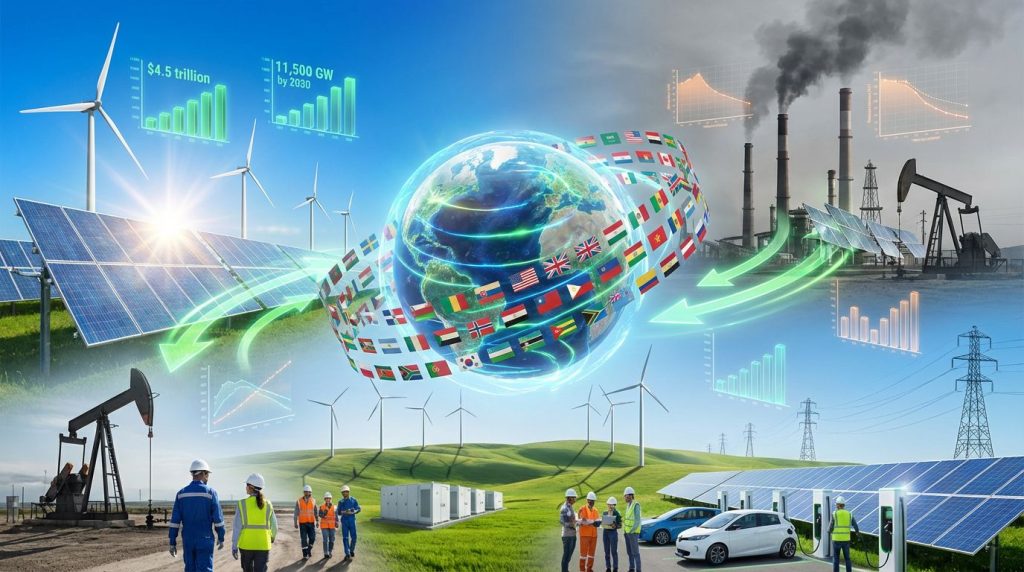
The global energy landscape stands at an unprecedented crossroads as nations grapple with the urgent need to transition away from fossil fuels while maintaining economic stability and energy security. This transformation represents one of the most complex undertakings in human history, requiring coordinated action across multiple sectors and stakeholders within increasingly compressed timeframes.
Understanding the Fundamental Energy System Transformation
The magnitude of global energy infrastructure replacement represents one of the largest coordinated undertakings in human history. Current fossil fuel dependency encompasses approximately 80% of global primary energy supply, according to the International Energy Agency's 2024 World Energy Outlook. Furthermore, this systematic replacement with renewable alternatives must occur across electricity generation, transportation, industrial heating, and chemical feedstock applications.
Scale of Infrastructure Replacement Requirements
Achieving net-zero emissions by 2050 demands tripling renewable energy capacity to 11,500 GW by 2030, based on International Renewable Energy Agency projections. This expansion rate requires installing renewable capacity equivalent to the entire current U.S. electricity system every two years through the decade.
The transformation encompasses multiple simultaneous transitions:
- Supply-side decarbonisation: Converting coal, oil, and natural gas infrastructure to solar, wind, nuclear, and hydrogen systems
- Demand-side electrification: Retrofitting buildings, industrial processes, and transportation networks
- Grid infrastructure modernisation: Implementing smart grid technologies capable of managing variable renewable generation
- Energy storage deployment: Installing battery and alternative storage systems to address renewable intermittency
Timeline Constraints and System Dependencies
The 2050 timeline reflects requirements for limiting global temperature increase to 1.5°C, as established in the Paris Agreement. The Intergovernmental Panel on Climate Change's Sixth Assessment Report confirms this necessitates 43% reduction in global CO2 emissions by 2030 relative to 2019 levels. Consequently, this creates narrow windows for infrastructure deployment.
Energy system transformation differs fundamentally from historical technology transitions due to the interconnected nature of modern energy networks. Unlike isolated technology adoption patterns, simultaneous changes across generation, transmission, distribution, and consumption systems create complex coordination requirements.
When big ASX news breaks, our subscribers know first
Economic Implications of Energy System Restructuring
The financial architecture supporting global energy transition extends far beyond renewable energy deployment costs. In addition, it encompasses stranded asset management, workforce transition, and regional economic diversification across multiple decades.
Capital Requirements and Investment Flows
Annual clean energy investment needs reach approximately $4.5 trillion through 2030, according to the International Energy Agency's Net Zero Roadmap Update 2024. This figure encompasses renewable energy deployment, grid infrastructure modernisation, energy efficiency measures, and complementary technologies including energy storage and hydrogen systems.
Current global fossil fuel subsidies, when accounting for unpriced environmental externalities, reach approximately $7 trillion annually per Bloomberg New Energy Finance analysis. This subsidy scale demonstrates existing financial flows available for redirection toward clean energy systems, though political economy factors complicate such transitions.
The renewable energy sector employed 13.7 million people globally in 2023, with IRENA projecting growth to 37-42 million clean energy jobs by 2030. However, job creation requires explicit workforce development policies to ensure affected fossil fuel workers can transition to emerging industries. The electric vehicles transformation of transportation sectors demonstrates how technological change creates new employment opportunities while displacing traditional roles.
Stranded Asset Risks and Economic Vulnerabilities
Resource-dependent economies face particular challenges in managing the transition away from fossil fuels. Nigeria exemplifies these vulnerabilities, with approximately 80% of its economy based on fossil fuels and reliance on 4 gigawatts of fossil fuel power generation for electricity production.
The Transition Pathway Initiative estimates $1-4 trillion in potential stranded fossil fuel assets globally, varying by climate scenario assumptions. This includes coal mines, oil fields, gas infrastructure, and refineries that may become economically unviable before full depreciation.
World Bank analysis indicates oil-dependent economies face fiscal risks estimated at 10-15% of GDP for resource-rich nations in climate-vulnerable regions. Furthermore, this combines declining fossil fuel demand with physical climate impacts on economic infrastructure.
Regional Economic Transition Challenges
Developing nations confront particular financing constraints in accessing capital for energy transition investments. Many countries cannot secure required funding without concessional financing mechanisms, according to the IMF World Economic Outlook 2024.
Brazil demonstrates alternative pathways, with renewable energy sources representing 65% of electricity generation and clean energy exports contributing $2.1 billion annually to the economy. This success illustrates how lithium industry innovations can support broader economic transformation in resource-rich nations.
COP Framework Evolution and Implementation Challenges
International climate negotiations have evolved from indirect fossil fuel references to explicit transition language. However, implementation mechanisms remain contested among nation-states with divergent economic interests.
Historical Progression of Fossil Fuel Language
COP28 in Dubai marked the first explicit mention of fossil fuels in international climate agreement text. This represented a significant departure from previous conferences that referenced only coal-specific phase-out measures. The COP28 agreement signals beginning of the end of the fossil fuel era, though implementation challenges persist.
The historic nature of this development cannot be understated, as previous international climate negotiations deliberately avoided direct fossil fuel terminology. This occurred due to diplomatic sensitivities among oil, gas, and coal producing countries that participate in consensus-based decision-making processes.
However, momentum for fossil fuel transition language faced headwinds at subsequent conferences. Climate finance priorities dominated negotiations and energy transition specifics received reduced attention.
COP30 Coalition Dynamics and Opposition Patterns
At COP30 in Belém, Brazil, a coalition of 80-85 countries supported roadmap development for the transition away from fossil fuels. This coalition included developed nations, Latin American countries, and small island states facing immediate climate impacts.
Opposition emerged from multiple sources:
- Major fossil fuel producers: Russia, Saudi Arabia
- Oil-dependent developing nations: Nigeria, with 80% economic dependence on fossil fuels
- Energy security-focused countries: Uganda, Tanzania, prioritising gas development over transition commitments
The Brazilian presidency employed strategic procedural management. It removed four controversial agenda items to "informal presidency consultations" to enable progress on other negotiation topics.
Procedural Innovations and Institutional Constraints
COP30 achieved several procedural innovations despite contentious fossil fuel discussions:
- Common climate resilience indicators: First-time agreement on standardised metrics for extreme climate event preparedness
- Adaptation finance commitments: Agreement to triple adaptation finance by 2035, though some countries advocated for 2030 targets
- Critical minerals balance recognition: Initial acknowledgement of copper, lithium, nickel, cobalt, and rare earth supply chain considerations
However, consensus-based decision-making continues limiting transformative outcomes. This is documented by the Cambridge Institute for Sustainability Leadership's analysis of multilateral negotiation dynamics.
A significant disruption occurred when a fire at the COP30 venue on November 20th temporarily halted negotiations. This demonstrated the fragility of international climate diplomacy timelines.
Political Economy of Fossil Fuel Phase-Out Agreements
National positions on fossil fuel transition reflect complex interactions between economic dependencies, development priorities, and climate vulnerability. Consequently, this creates persistent negotiation deadlocks across multiple dimensions.
Economic Dependencies and Transition Resistance
Countries with substantial fossil fuel economic dependencies face structural challenges in supporting rapid transition agreements. Nigeria's situation exemplifies these constraints, with fossil fuel revenues funding 80% of government operations. Simultaneously, the country recognises vulnerability to oil price shocks and climate risks.
African nations including Uganda and Tanzania argue that fossil fuel phase-out requirements contradict their right to development and energy security. This reflects broader tensions between climate ambition and economic development priorities among developing countries.
These positions reflect rational economic calculations rather than climate denial. Fossil fuel infrastructure represents significant sunk investments and employment for millions of workers across resource-dependent regions.
Coalition Building and Diplomatic Strategies
The COP30 coalition supporting fossil fuel transition roadmaps employed multi-track diplomacy:
Developed country leadership: UK Minister Ed Miliband characterised fossil fuel transition as central to COP30 outcomes. EU Climate Commissioner Wopke Hoekstra called texts without transition language "non-starters."
Latin American regional coordination: Colombia's Environment Minister advocated for inevitable fossil fuel transition. Panama's Special Envoy for Climate Change described the absence of fossil fuel language as "unacceptable and Orwellian."
Small island state urgency: Nations facing immediate climate impacts provided moral authority for transition arguments. However, their limited economic leverage constrains negotiation influence.
Future Diplomatic Pathways
Colombia will host a dedicated fossil fuel phase-out conference in April, potentially maintaining momentum outside formal COP processes. Brazil's presidency committed to developing transition roadmaps for presentation at COP31 in Turkey. This suggests continued diplomatic engagement despite COP30's limited outcomes.
The Turkish presidency indicated fossil fuel transition discussions will feature prominently in COP31 negotiations. This potentially builds on informal momentum generated at COP30 despite formal agreement limitations.
Renewable Energy Deployment at Scale
Meeting 2030 renewable energy targets requires deployment rates substantially exceeding historical installation patterns. Furthermore, this demands coordinated policy support, supply chain expansion, and grid infrastructure modernisation across all major economies.
Current Deployment Patterns and Acceleration Requirements
Global renewable electricity capacity additions reached approximately 500 GW in 2023, according to IEA analysis. Sustaining the required acceleration to 11,500 GW total renewable capacity by 2030 necessitates consistent annual installation rates. This is equivalent to adding the entire current European renewable energy system every twelve months.
Solar and wind technologies demonstrate the most rapid scaling potential, with manufacturing capacity expansion already underway across multiple regions. However, deployment bottlenecks emerge in grid connection infrastructure, permitting processes, and skilled workforce availability. These challenges arise rather than technology manufacturing constraints.
Grid Integration and Intermittency Solutions
Variable renewable generation creates fundamental challenges for electricity system stability. Consequently, this requires sophisticated grid management technologies and complementary flexibility resources.
Modern electricity grids developed around predictable, dispatchable fossil fuel generation patterns. Accommodating high renewable penetration demands:
- Advanced forecasting systems for wind and solar generation prediction
- Demand response programmes enabling consumption pattern optimisation
- Grid-scale energy storage providing short-term generation balancing
- Inter-regional transmission expansion for renewable resource sharing
Germany's experience demonstrates both opportunities and challenges, with renewables generating 61% of electricity in the first half of 2024. This increased from 46% in 2019, according to Fraunhofer ISE Institute analysis.
Manufacturing and Supply Chain Considerations
Renewable energy scaling faces supply chain constraints across multiple components. The critical minerals energy transition creates dependencies on specific materials and regions.
Solar photovoltaic systems: Silicon purification, rare metal components, and manufacturing equipment capacity
Wind energy systems: Rare earth permanent magnets for generators, steel for towers, and specialised transportation for offshore installations
Energy storage systems: Lithium, cobalt, nickel availability for battery manufacturing
These supply chain dependencies create potential vulnerabilities in renewable energy deployment timelines. This occurs particularly given geographic concentration of critical mineral resources in limited regions.
Critical Minerals and Supply Chain Dependencies
The transition away from fossil fuels creates new dependencies on critical minerals essential for renewable energy technologies. In addition, these materials are crucial for energy storage systems and electric vehicle manufacturing, concentrating supply risks in geographically limited regions.
Essential Mineral Requirements for Clean Technologies
COP30 discussions marked the first explicit recognition of critical mineral balance requirements. These include copper, lithium, nickel, cobalt, and rare earth elements. However, specific supply chain security measures were not included in final agreement texts.
This acknowledgement reflects growing awareness that renewable energy deployment faces potential constraints from mineral availability. These limitations emerge rather than from technology readiness or manufacturing capacity limitations.
Each technology pathway requires distinct mineral inputs:
Solar photovoltaics: Silver, silicon, tellurium for thin-film technologies
Wind turbines: Neodymium, dysprosium for permanent magnet generators
Battery storage: Lithium, cobalt, nickel, graphite for lithium-ion systems
Electric vehicles: Lithium, cobalt, nickel, rare earth elements for motors and batteries
Geographic Concentration and Supply Vulnerabilities
Critical mineral supply chains demonstrate significant geographic concentration. Greenland critical minerals represent an emerging source of strategic materials for clean energy technologies.
- Lithium: Australia, Chile, Argentina control majority of production capacity
- Cobalt: Democratic Republic of Congo produces approximately 70% globally
- Rare earths: China dominates processing and refining despite distributed mineral deposits
- Copper: Chile, Peru, China represent largest producing regions
This concentration creates potential supply disruption risks from geopolitical tensions, infrastructure challenges, or environmental constraints in producing regions.
Sustainable Mineral Sourcing and Recycling Systems
Responsible mineral extraction requires environmental and social standards addressing community impacts, ecosystem protection, and worker safety across global supply chains.
Battery recycling systems offer pathways for reducing primary mineral demand as electric vehicle and energy storage deployment scales. The recent battery recycling breakthrough demonstrates promising technological advances in material recovery.
Circular economy approaches incorporating design for recyclability, material recovery systems, and alternative battery chemistries could reduce critical mineral dependencies over longer time horizons.
The next major ASX story will hit our subscribers first
Transportation System Electrification
Decarbonising transportation requires coordinated vehicle electrification, charging infrastructure deployment, and sustainable fuel development. This spans passenger vehicles, freight transport, and aviation sectors.
Electric Vehicle Infrastructure Requirements
Electric vehicle adoption depends critically on charging infrastructure availability. Range anxiety represents primary adoption barriers for potential buyers.
Charging network deployment must accommodate:
- Residential charging: Home installation for daily charging convenience
- Workplace charging: Employer-provided systems supporting commuter needs
- Public fast charging: Highway corridor and urban quick-charging networks
- Commercial fleet charging: Depot-based systems for delivery and transit vehicles
Infrastructure investment coordination between public and private sectors ensures comprehensive coverage. Furthermore, this avoids redundant capacity in high-adoption areas.
Public Transportation Electrification
Electric bus systems demonstrate immediate emission reduction potential with established technology and favourable economics in high-utilisation urban applications.
Rail electrification provides efficient long-distance passenger and freight transport alternatives to aviation and trucking. However, infrastructure requirements demand substantial upfront investment.
Transit electrification offers air quality benefits in urban areas while reducing petroleum consumption. Additionally, it provides demonstration effects encouraging private vehicle electrification.
Financing Mechanisms for Clean Energy Investment
Mobilising the $4.5 trillion annual investment required for global energy transition demands innovative financial instruments. These combine public policy support with private capital deployment across diverse economic contexts.
Blended Finance Structures and Risk Mitigation
Developing countries face particular challenges accessing commercial capital for clean energy investments. This occurs due to perceived political, currency, and regulatory risks. Blended finance mechanisms combine concessional public funding with commercial private investment to improve project economics and risk profiles.
Multilateral development banks play crucial roles providing first-loss guarantees, currency hedging, and technical assistance. These enable private sector participation in emerging market clean energy projects.
The Green Climate Fund and other climate finance institutions target $100 billion annually in climate finance commitments. However, current deployment remains below target levels across adaptation and mitigation investments.
Green Bonds and Sustainable Finance Markets
Green bond issuance reached approximately $500 billion globally in 2023. This provided dedicated financing for renewable energy, energy efficiency, and sustainable transportation projects.
Sustainability-linked finance instruments tie borrowing costs to measurable environmental performance. Consequently, this creates incentives for corporate emissions reduction and renewable energy adoption across multiple sectors.
However, green finance standards require standardisation across jurisdictions to prevent greenwashing. This ensures capital allocation toward genuinely climate-positive investments.
Worker Retraining and Economic Transition
Successful energy transition requires comprehensive workforce development addressing displacement in fossil fuel industries. Furthermore, this creates pathways for clean energy employment across multiple skill levels and geographic regions.
Skills Development for Clean Energy Jobs
Clean energy employment spans diverse occupations including manufacturing, installation, maintenance, and professional services. This requires targeted training programmes matching worker capabilities with emerging opportunities.
Transferable skills from fossil fuel industries include:
- Engineering expertise: Power plant operations, project management, and systems engineering
- Construction capabilities: Electrical work, heavy equipment operation, and infrastructure development
- Maintenance skills: Equipment servicing, troubleshooting, and repair across energy systems
Training programme effectiveness requires coordination between educational institutions, labour unions, and employers. This ensures curricula match evolving industry requirements.
Regional Economic Development Strategies
Coal mining and oil refining communities face concentrated economic impacts from energy transition. Consequently, this requires comprehensive regional development approaches beyond individual worker support.
Successful transition strategies include:
- Clean energy manufacturing: Leveraging existing industrial infrastructure and skilled workforces
- Research and development: Universities and national laboratories anchoring innovation ecosystems
- Tourism and recreation: Natural amenity development replacing extractive industries
Regional transition success depends on community engagement, stakeholder coordination, and sustained policy commitment across multiple levels of government.
International Cooperation and Climate Diplomacy
The first international conference on fossil fuel transition highlighted the growing momentum for coordinated global action. However, implementation challenges remain significant across diverse national contexts.
Many countries recognise that achieving the transition away from fossil fuels requires unprecedented international cooperation. This spans technology transfer, climate finance, and diplomatic coordination across multiple forums and institutions.
The complexity of global energy systems means that successful transition outcomes depend on coordinated action rather than isolated national policies. Furthermore, this creates both opportunities and challenges for international climate diplomacy moving forward.
This analysis represents current understanding of energy transition dynamics based on available data through late 2025. Market conditions, policy developments, and technological advancement may significantly alter projected outcomes. Readers should consult multiple authoritative sources for investment and policy decisions.
Looking to Invest in the Next Major Discovery?
Discovery Alert's proprietary Discovery IQ model delivers instant notifications on significant ASX mineral discoveries, empowering subscribers to identify actionable opportunities ahead of the broader market. With renewable energy and critical minerals driving unprecedented demand, positioning yourself to capture the next major discovery could prove transformational – begin your 30-day free trial today to secure your market-leading advantage.