
August 4, 2026
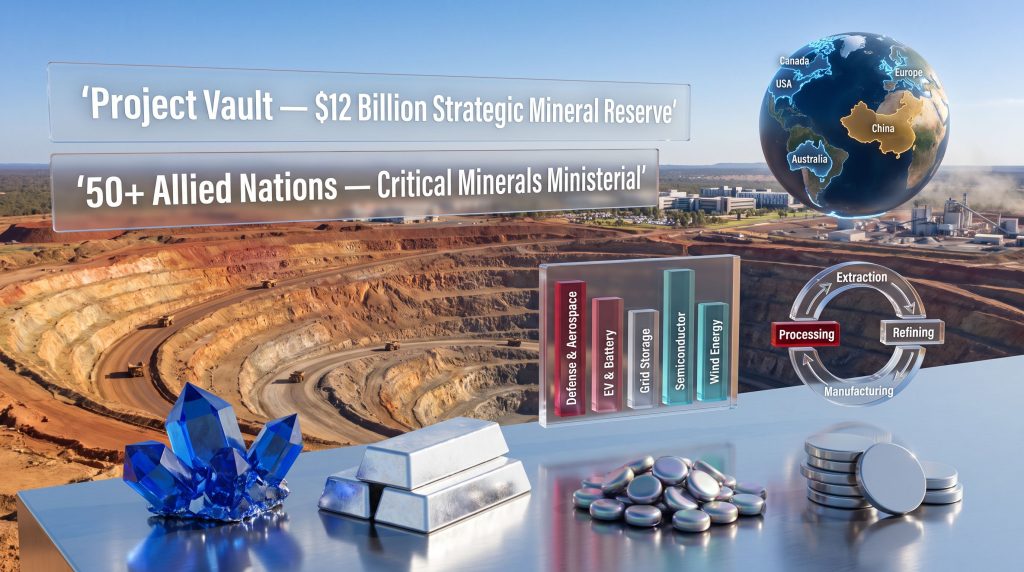
The Hidden Architecture of Mineral Dependency: Why Supply Chains Are the New Battleground
Long before trade tariffs or export controls dominated financial headlines, the structural vulnerability embedded within global mineral supply chains was quietly compounding. For decades, the economics of commodity production favoured consolidation, and the nation most willing to absorb the environmental, financial, and operational costs of large-scale mineral processing captured enormous strategic leverage. That nation was China. Understanding how deeply that leverage extends, and what it would realistically cost to unwind it, is essential context for evaluating the Trump critical minerals push and what it means for industry, investors, and allied economies.
The challenge is not simply about mining more ore. It is about controlling the full value chain from extraction through refining, processing, and downstream manufacturing. Raw material production is only the most visible layer of a far more complex industrial system. Furthermore, it is the intermediate processing stages, where minerals are transformed into usable inputs, where China's dominance is most entrenched and most difficult to replicate quickly.
When big ASX news breaks, our subscribers know first
How Dominant Is China's Position in Global Critical Mineral Supply Chains?
China's Structural Advantages Across the Mineral Value Chain
China's position in global critical mineral markets is the product of deliberate, decades-long state-directed investment rather than purely geological fortune. While China does hold significant reserves of rare earth elements and other critical minerals, its decisive advantage lies in processing capacity, not resource ownership alone.
Key dimensions of China's structural advantage include:
- China accounts for approximately 85–90% of global rare earth processing capacity, even though rare earth deposits exist across multiple continents
- Chinese refiners dominate lithium hydroxide and lithium carbonate conversion, critical intermediates for battery manufacturing
- Cobalt intermediate processing, despite the Democratic Republic of Congo producing the majority of mined cobalt, is heavily concentrated in Chinese facilities
- China's state-owned enterprise network provides access to subsidised capital, compressed permitting timelines, and guaranteed domestic offtake that private Western producers cannot match
A factor that receives far less attention in Western policy discussions is the role of China's education infrastructure. China's extensive national network of mining-focused universities has functioned as a foundational enabler of its mineral sector dominance, producing a continuous pipeline of geologists, metallurgists, mining engineers, and processing specialists over generations. This institutional depth cannot be replicated by a single policy directive or budget allocation; it requires sustained, multi-decade investment in human capital.
What a Minerals Supply Disruption Could Cost the U.S. Economy
The downstream consequences of a sustained minerals supply disruption extend well beyond commodity price spikes. A 12-month interruption in rare earth supply alone would cascade across defence procurement, clean energy manufacturing, and advanced semiconductor fabrication simultaneously.
| Sector | Key Minerals at Risk | Estimated Exposure Level |
|---|---|---|
| Defense & Aerospace | Rare Earths, Tungsten | Critical |
| EV & Battery Manufacturing | Lithium, Cobalt, Nickel | High |
| Grid-Scale Energy Storage | Lithium, Manganese | High |
| Semiconductor Fabrication | Gallium, Germanium | Moderate-Critical |
| Wind Energy Infrastructure | Rare Earth Magnets | High |
Rare earth permanent magnets are irreplaceable components in precision-guided munitions, advanced radar systems, and military aircraft. There is currently no commercially viable synthetic substitute. For electric vehicles and grid storage, lithium and cobalt dependency represents a cost and availability risk that directly affects the economics of energy transition targets. Consequently, the energy security minerals debate has moved firmly to the centre of national policy discussions.
"The downstream chokepoint problem is often underappreciated: a nation can possess significant mineral reserves and still remain strategically exposed if it lacks the processing infrastructure to convert those reserves into usable industrial inputs."
What Specific Policy Actions Has the Trump Administration Taken?
Project Vault: The $12 Billion Strategic Mineral Reserve
The most financially significant instrument deployed under the Trump critical minerals push is Project Vault, a strategic mineral stockpiling initiative structured around approximately $10 billion in Export-Import Bank financing and roughly $1.67 billion in private capital commitments, bringing the total reported programme value to approximately $12 billion.
The structure of Project Vault is significant for several reasons beyond its headline figure:
- It represents one of the largest government-directed commodity reserve programmes in U.S. history
- The combination of sovereign financing with private sector co-investment creates a hybrid capital structure that reduces taxpayer concentration risk
- Strategic stockpiling functions simultaneously as a physical supply buffer and as a market signal to allied producers, communicating long-term U.S. demand commitments that can underpin project financing decisions in partner nations
- Prioritised mineral categories span both energy transition inputs and defence-critical materials, reflecting the dual-use nature of the supply chain vulnerability
For mining investors and project developers, the significance of a government-backed offtake-adjacent framework cannot be overstated. One of the most persistent barriers to greenfield mineral project financing has been the absence of reliable long-term demand signals. Project Vault partially addresses this by creating an institutional buyer with sovereign backing.
The Section 232 Proclamation: Trade Leverage as a Policy Tool
Issued in January 2026, the Section 232 proclamation on critical minerals directed U.S. trade negotiators to pursue bilateral agreements covering processed critical minerals and their derivative manufactured products. The proclamation establishes a tariff escalation pathway as a consequence mechanism if negotiations fail to produce acceptable outcomes.
This approach mirrors the structural logic of previous Section 232 applications in steel and aluminium, with one important distinction: the target is not overcapacity dumping but rather strategic dependency. The goal is to incentivise allied nations to formalise supply commitments and to create trade friction that disadvantages Chinese-processed mineral imports. The Trump critical minerals order underpins much of this trade policy architecture, providing the legal foundation for these bilateral negotiations.
Domestic Production Acceleration: Permitting Reform and Federal Approvals
Executive actions targeting mine permitting timelines have been a consistent feature of the Trump critical minerals agenda. The USDA approval of the Hermosa Critical Mineral Project in Arizona has been cited as a practical example of federal agencies compressing approval processes for projects deemed strategically significant.
Additional domestic production levers include:
- Federal land access policy adjustments expanding exploration footprint on public lands
- Direct equity participation mechanisms enabling federal agencies to take stakes in critical mineral producers
- DOE loan programme deployments targeting rare earth and processing facility development
- Interagency coordination designed to reduce duplicative review processes across federal departments
The Critical Minerals Ministerial: Building an Allied Market Architecture
Perhaps the most structurally ambitious element of the Trump critical minerals push is the Washington-hosted Critical Minerals Ministerial, which convened representatives from more than 50 allied nations to develop coordinated supply chain strategies outside China's pricing influence.
The ministerial's working agenda has focused on:
- Price floor mechanisms that provide revenue certainty to allied producers and reduce the competitive advantage of state-subsidised Chinese pricing
- Coordinated offtake agreements that aggregate demand across allied nations to justify large-scale project investment
- Supply chain transparency standards that allow governments and manufacturers to verify mineral provenance and processing origin
- Architectural development of a parallel minerals market that can function independently of Chinese commodity pricing benchmarks
The geopolitical logic here is sophisticated. China has demonstrated willingness to deploy China rare earth restrictions on gallium, germanium, and other critical minerals as trade negotiation leverage. By constructing a multi-nation coordinated supply framework, the U.S. aims to reduce the effectiveness of that lever whilst simultaneously creating new market infrastructure for allied producers.
How Is the U.S. Addressing the Critical Minerals Workforce Gap?
The Talent Shortage as a Structural Bottleneck
Workforce capacity has emerged as a binding constraint that sits alongside capital availability and permitting complexity in limiting domestic critical mineral production growth. The occupational categories in shortest supply span:
- Geologists with specialised experience in hard rock mineral exploration
- Mining engineers capable of designing and operating large-scale extraction systems
- Metallurgists with expertise in mineral processing and hydrometallurgical refining
- Processing technicians skilled in operating chemical separation and concentration facilities
- Environmental compliance specialists who can navigate the regulatory requirements of modern mine permitting
The pipeline problem is structural rather than cyclical. Academic enrolment in mining-related disciplines declined during the commodity downturn years of 2012–2016, and the lag between undergraduate enrolment and deployable professional capacity in capital-intensive technical fields typically spans five to ten years.
The Department of Energy's Workforce Development Initiative
The U.S. Department of Energy convened representatives from all 14 accredited U.S. mining schools at a dedicated workforce development event, establishing a framework for expanding the student pipeline into mining and mineral processing careers.
The initiative's design reflects an explicit acknowledgment that China's dominance in mineral production is not purely a function of capital or resource endowment. China's national network of mining universities has produced a generational talent base that Western competitors have not prioritised replicating. By convening all accredited domestic institutions simultaneously, the DOE is signalling a coordinated national approach to human capital development. This mirrors the broader critical minerals demand surge that has made workforce capacity a matter of national urgency.
"Benchmarking against China's mining education infrastructure as a competitive reference point represents a significant conceptual shift in U.S. industrial policy, acknowledging that workforce depth is as strategically important as capital deployment."
Key objectives of the workforce initiative include raising public awareness of mining as a viable and economically attractive career pathway, expanding industry-academic partnership structures, and accelerating the development of credential programmes that reduce time-to-deployment for technical graduates.
What a Future U.S. Mining Workforce Needs to Look Like
Projected workforce demand based on planned mine development and processing facility construction suggests the U.S. will require a substantially expanded talent base. Modern mineral operations increasingly require proficiency in:
- Automated equipment operation and remote monitoring systems
- Environmental data collection and real-time compliance reporting
- Hydrometallurgical processing chemistry
- Digital mine planning and geological modelling software
- Supply chain traceability and certification systems
Federal and state-level funding mechanisms, including workforce development grants and vocational training programmes, are available to support institutional capacity expansion, though the scale of current allocations remains modest relative to projected demand.
What Role Does Industry Play in the Trump Critical Minerals Strategy?
Mining Executives and the State Department Roundtable
President Trump's expected participation in a State Department-hosted roundtable with senior mining industry executives represents a notable elevation of the sector's political priority. Presidential-level engagement with commodity industry leadership is uncommon, and its occurrence sends a durable signal of policy continuity to both domestic and international investors evaluating long-duration capital commitments in mineral projects.
Industry priorities likely to be on the agenda span several interconnected challenges:
- Permitting certainty: developers need assurance that regulatory frameworks will not shift materially between project approval and production commencement
- Financing access: particularly for processing and refining facilities that carry higher capital intensity than conventional mining operations
- Offtake agreements: binding demand commitments from government or government-backed purchasers that underpin project economics
- Workforce policy: coordinated action on training pipelines and visa frameworks for specialised technical talent
The National Mining Association has publicly supported collaborative approaches to domestic resource development and supply chain security, framing the sector's expansion as both an economic and national security imperative.
Private Capital's Role in Financing the Minerals Build-Out
The investment thesis for critical minerals under a policy-supported demand environment has become increasingly compelling for institutional capital, though the risk profile remains complex. Key structural considerations for investors include:
- Greenfield versus brownfield distinction: brownfield projects with existing infrastructure and historical resource data carry meaningfully lower execution risk than greenfield exploration plays
- Processing exposure: projects that incorporate domestic refining and processing capacity command strategic premiums under the current policy environment but also require substantially higher capital expenditure
- Sovereign co-investment structures: Ex-Im Bank financing and DOE loan facilities can significantly improve project economics by reducing the cost of debt capital
- Allied-nation frameworks: cross-border project financing unlocked through ministerial-level coordination agreements can broaden the investor base for projects in partner nations
Disclaimer: This article is for informational purposes only and does not constitute financial advice or a solicitation to invest in any security or commodity. Investors should conduct independent due diligence before making investment decisions.
How Does the U.S. Strategy Compare to Allied and Competitor Approaches?
A Multi-Nation Race to Secure Mineral Supply Chains
| Country/Bloc | Primary Strategy | Key Instruments |
|---|---|---|
| United States | Domestic production + allied sourcing | Project Vault, Section 232, Ex-Im financing |
| European Union | Circular economy + allied trade agreements | Critical Raw Materials Act, strategic partnerships |
| China | Vertical integration + export controls | State-owned enterprise dominance, processing monopolies |
| Australia | Export-oriented production + allied alignment | Critical Minerals Strategy, U.S.-Australia supply agreements |
| Canada | Domestic processing + North American integration | Critical Minerals Strategy, IRA supply chain alignment |
Where the U.S. Strategy Has Structural Gaps
An honest assessment of the Trump critical minerals push must acknowledge the significant gaps that persist despite the scale of policy ambition. According to analysis from CSIS, the most durable vulnerabilities lie not in extraction capacity but in the intermediate processing stages that remain heavily concentrated in China.
Processing and refining capacity remains the most critically underdeveloped segment of the domestic value chain. The U.S. can expand mine approvals and exploration activity substantially, but without corresponding investment in hydrometallurgical processing, solvent extraction, and separation facilities, raw material production simply relocates the dependency problem rather than resolving it.
Timeline mismatches between policy ambition and mine-to-market development cycles represent a structural constraint that no executive order can compress away entirely. The typical development timeline from initial discovery to commercial production for a greenfield hard rock mineral project spans 10 to 15 years. Brownfield redevelopment can compress this timeline, but the U.S. inventory of advanced-stage brownfield critical mineral projects is limited.
Competing with state-subsidised Chinese pricing in global commodity markets is a challenge that market mechanisms alone cannot resolve. Chinese state-owned processors can operate at below-market pricing for extended periods without the capital market accountability that disciplines private sector competitors. Price floor mechanisms and allied offtake coordination through the ministerial framework are direct responses to this structural disadvantage, but their effectiveness depends on sustained political commitment across multiple national governments.
The next major ASX story will hit our subscribers first
Frequently Asked Questions: Trump's Critical Minerals Push
What is the Trump administration's critical minerals strategy?
A coordinated federal effort combining domestic production incentives, strategic stockpiling through Project Vault, allied nation sourcing agreements negotiated through the Critical Minerals Ministerial, trade policy instruments including the Section 232 proclamation, and workforce development programmes targeting all 14 accredited U.S. mining schools.
What is Project Vault?
A reported $12 billion U.S. strategic mineral reserve initiative financed through approximately $10 billion in Export-Import Bank lending and around $1.67 billion in private capital commitments, designed to build national stockpiles of critical minerals across defence and energy transition categories.
Why is China's dominance in critical minerals a concern?
China controls the majority of global rare earth processing, lithium refining, and cobalt intermediate production. This concentration creates acute supply chain vulnerabilities for U.S. defence systems, clean energy manufacturing, and advanced semiconductor fabrication. Furthermore, America's rare earth supply chain remains heavily exposed to disruption, as no near-term alternative supplier base exists at comparable scale.
What did the Section 232 proclamation on critical minerals do?
Issued in January 2026, it directed U.S. trade officials to negotiate bilateral agreements on processed critical minerals and their derivative products, with tariffs or other trade restrictions available as consequence mechanisms if negotiations fail to produce acceptable outcomes.
How many mining schools are involved in the DOE workforce initiative?
All 14 accredited U.S. mining schools are participating in the Department of Energy's workforce development programme, which aims to expand the pipeline of qualified mining and mineral processing professionals.
What is the Critical Minerals Ministerial?
A Washington-hosted diplomatic forum convening more than 50 allied nations to develop coordinated supply chain strategies, explore price floor mechanisms, and construct a minerals market architecture that reduces dependency on Chinese commodity pricing benchmarks. The historic framework signed between President Trump and Prime Minister Albanese represents one of the most significant bilateral outcomes to emerge from this coordinated diplomatic process.
What Are the Long-Term Implications for Global Mineral Markets?
Structural Market Shifts Driven by Policy-Backed Demand
Government-guaranteed offtake frameworks and sovereign stockpiling programmes introduce a qualitatively different demand dynamic into commodity markets that have historically been priced purely on supply-demand fundamentals. When a sovereign buyer with a guaranteed budget enters the market as a consistent purchaser, it alters price discovery, reduces cyclical volatility for qualifying products, and accelerates investment decision timelines for project developers.
The potential emergence of allied-nation price floors through ministerial coordination could create a structurally bifurcated global minerals market: one tier operating within the allied framework at floors designed to sustain economic project development, and a second tier driven by Chinese market pricing that may reflect state subsidy rather than genuine cost-of-production economics.
The Processing Gap: The Next Frontier of U.S. Mineral Policy
Raw material extraction without corresponding domestic processing capacity does not resolve supply chain dependency; it relocates it. A tonne of mined rare earth ore that must be shipped to China for separation and processing before returning as a usable magnet precursor represents a structural dependency that persists regardless of where the ore was originally extracted.
Closing the refining and processing gap within a decade would require:
- Substantial federal co-investment in hydrometallurgical processing facility construction
- Accelerated permitting pathways specifically for processing infrastructure, which faces different but equally complex environmental review requirements compared to mine sites
- Development of domestic technical expertise in separation chemistry and materials science
- Long-term offtake commitments from downstream manufacturers to justify the capital expenditure required for processing facility construction
Geopolitical Scenarios: Three Possible Trajectories for the U.S.-China Minerals Rivalry
-
Coordinated Allied Decoupling: Allied nations successfully construct parallel supply chains with sufficient scale and policy coordination to gradually erode Chinese market leverage across most critical mineral categories. This scenario requires sustained political commitment across multiple electoral cycles in several nations simultaneously.
-
Partial Diversification with Continued Exposure: Domestic and allied production scales meaningfully in extraction but processing dependency on China persists in select categories, particularly rare earth separation and lithium chemical conversion. This is arguably the most probable near-term trajectory given existing infrastructure gaps.
-
Accelerated Chinese Export Controls: China responds to U.S. policy pressure by expanding export restrictions beyond gallium and germanium to broader rare earth and battery mineral categories, triggering supply shocks that simultaneously increase short-term industrial costs whilst accelerating the investment case for allied processing infrastructure.
Key Takeaways: What the Trump Critical Minerals Push Means for Industry and Investors
- The strategy spans the full mineral value chain, from extraction and processing through refining and workforce development, not merely mine approvals
- Project Vault and the Section 232 proclamation represent the most financially significant and legally forceful instruments deployed to date
- Workforce development is now recognised as a co-equal constraint alongside capital access and permitting complexity
- The Critical Minerals Ministerial creates a multi-nation coordination architecture that extends beyond bilateral trade agreements
- Processing and refining capacity remains the most critical unresolved gap in the overall U.S. strategy, and closing it will require capital, time, and technical expertise that cannot be created by executive action alone
This article is intended for informational purposes only. It does not constitute financial, investment, or legal advice. Forward-looking statements and scenario projections involve inherent uncertainty, and actual outcomes may differ materially from those described. Readers should seek independent professional advice before making investment decisions related to the critical minerals sector.
Want to Know Which ASX Discoveries Could Benefit From the Critical Minerals Boom?
Discovery Alert's proprietary Discovery IQ model scans ASX announcements in real time, instantly identifying significant mineral discoveries across critical commodities — turning complex geological data into actionable investment insights before the broader market reacts. Explore historic examples of what major mineral discoveries have returned for investors, then begin your 14-day free trial at Discovery Alert to position yourself at the forefront of the next significant find.