Critical Resources Ltd
- ASX Code: CRR
- Market Cap: $28,746,769
Critical Resources Expands Its Tungsten Footprint as APT Prices Surge More Than 8x in 16 Months
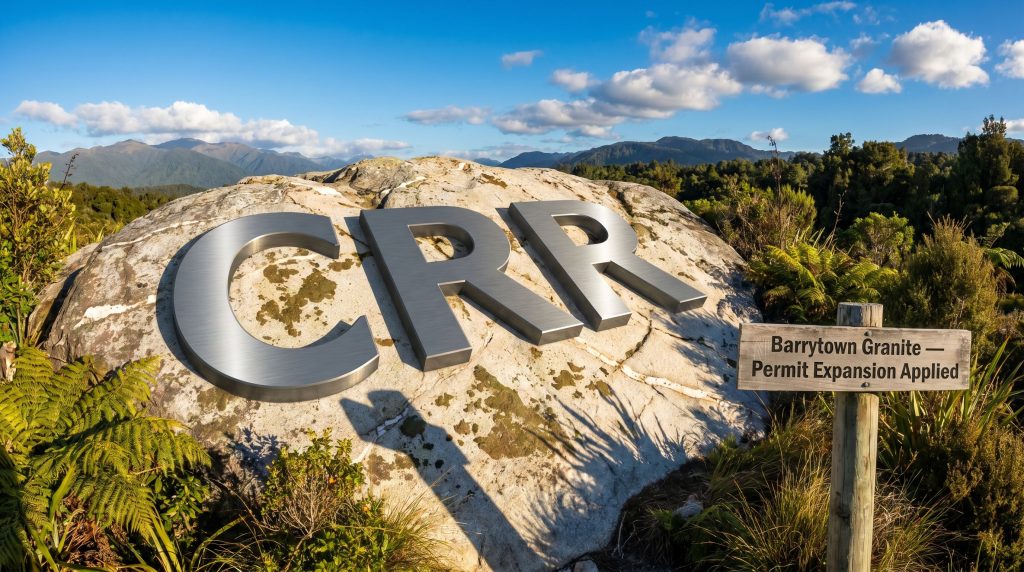
Critical Resources Limited (ASX: CRR) has lodged an Extension of Land (EOL) application with New Zealand Petroleum and Minerals (NZP&M) to expand its Critical Resources Croesus tungsten project expansion in New Zealand westward — capturing the full mapped extent of the Barrytown Granite Pluton, the host intrusion for greisen-hosted tungsten mineralisation at Granite Creek.
The move comes as tungsten's global market undergoes one of its most dramatic pricing re-ratings in recent memory, with Ammonium Paratungstate (APT) prices rising from approximately $335/MTU in January 2025 to $2,900–$3,200/MTU by late April 2026 — a more than 8x increase in just 16 months.
The timing is deliberate. Recent first-pass reconnaissance fieldwork across the Granite Creek catchment confirmed greisen alteration and outcropping quartz vein structures at multiple locations — consistent with a broader intrusion-related tungsten system extending beyond the existing permit boundary.
By lodging the EOL, Critical Resources is positioning itself to evaluate this system at intrusion scale, rather than in piecemeal fashion constrained by an administrative boundary.
When big ASX news breaks, our subscribers know first
Why the Barrytown Granite Matters
The Croesus Project sits on the southwestern flank of the Reefton Goldfield on New Zealand's West Coast — a well-established orogenic gold province with over 2 million ounces of historical gold production. The announcement notes the project hosts two distinct mineral systems:
- A structurally controlled gold-antimony lode system within Greenland Group metasediments
- A greisen-hosted tungsten system associated with the Barrytown Granite (Karamea Suite)
The existing Prospecting Permit (PP61277) covers the majority of the mapped Barrytown Granite Pluton, but the intrusion continues westward beyond the current boundary into previously untested ground. The proposed EOL covers approximately 270 hectares (~2.7 km²) and comprises a mix of private and Department of Conservation (DOC) managed land immediately west of the existing permit.
Aligning the permit boundary with the full mapped extent of the intrusion enables coherent, intrusion-scale evaluation of the greisen-hosted tungsten system — a critical step in understanding the true potential of what has already been documented at Granite Creek.
Historical Grades That Command Attention
The tungsten mineralisation already documented at Granite Creek — though historical in nature — sets a compelling baseline for further exploration. Key results from historical programs conducted by Mineral Resources NZ Ltd and others include:
| Sample Location | Grade | Notes |
|---|---|---|
| Granite Creek | 42.6% WO₃ (337,642 ppm W) | Scheelite-rich quartz rubble |
| Little Granite Creek | 26.6% WO₃ (210,985 ppm W) | Granite boulder with parallel quartz veinlets up to 20 cm |
| Little Granite Creek | 19.9% WO₃ | Float samples from granite boulders |
| Bedrock greisen zones | Up to 0.90% WO₃ | Greisenised granites with thin quartz veinlets |
| Alteration halos | Up to 1,320 ppm As | Consistent with zoned polymetallic alteration in intrusion-related systems |
The announcement cautions that these are historical results from programs conducted between 1971 and 2006, and the highest grades come from selective grab samples of vein rubble and transported float boulders — they are not representative of average or continuous bedrock mineralisation.
However, they are considered suitable for target generation and reconnaissance assessment, and have been assessed as material by the Company's Competent Person given they define the priority exploration targets now being evaluated.
Importantly, the recent field program confirmed greisen alteration at Granite Creek consistent with what was documented in 1988, with the mapped extent of that alteration interpreted to extend beyond the area originally sampled — a signal that the system may be larger than previously understood.
"The tungsten mineralisation documented at Granite Creek is highly encouraging — including the historic 42.6% WO₃ result. Extending the permit to capture the full mapped extent of the intrusion gives us a coherent footprint over the system we're targeting. With tungsten formally designated a strategic critical mineral across the US, EU, UK, Japan, New Zealand and Australia, and APT prices having risen more than 8x since January 2025, capturing a Western-aligned tungsten target of this scale and at this point in the cycle is strategically significant." — Managing Director Tim Wither
Understanding Greisen-Hosted Tungsten Systems — A Primer for Investors
What Is a Greisen-Hosted Tungsten System?
Greisen is a hydrothermally altered granite rock, transformed when hot, mineral-rich fluids interact with an intrusion and convert feldspar and mica into quartz and specialised mica minerals. In tungsten exploration, greisen zones are highly significant because tungsten — typically found in the mineral scheelite or wolframite — preferentially deposits within these alteration zones and associated quartz veins.
Why Does It Matter for Investors?
Greisen-hosted systems are among the most economically important tungsten deposit types globally. They tend to be spatially predictable — associated with specific granite intrusions — which means that if you can map the full extent of the host intrusion, you can systematically evaluate the mineralised system.
That is precisely what the Critical Resources Croesus tungsten project expansion in New Zealand is achieving by extending the permit boundary to align with the Barrytown Granite's full mapped footprint.
Glossary of Key Terms
- WO₃: Tungsten trioxide — the standard unit for expressing tungsten grade in ore samples
- MTU: Metric Tonne Unit — used in APT pricing; one MTU equals 10 kg of WO₃
- APT (Ammonium Paratungstate): The primary refined tungsten product traded in international markets
- Greisen: Hydrothermally altered granite, often associated with tungsten and tin mineralisation
- Scheelite: A calcium tungstate mineral (CaWO₄) — the dominant tungsten ore mineral in the Croesus system
- EOL (Extension of Land): An application to expand the area covered by an existing prospecting permit
- NZP&M: New Zealand Petroleum and Minerals — the government body administering mineral permits in New Zealand
The Tungsten Market Has Structurally Shifted
The market context underpinning Critical Resources' accelerated activity at Croesus is difficult to overstate. Tungsten has historically been a niche industrial metal, but a confluence of supply and demand forces has transformed its strategic profile considerably.
Supply Disruption — China's Dominance
China produces approximately 80–85% of global tungsten mine supply (USGS Mineral Commodity Summaries, 2025). In February 2026, China introduced export licensing restrictions on APT and tungsten concentrate, materially constraining availability to Western buyers. Non-Chinese sources are structurally insufficient to meet demand.
Price Re-Rating
| Period | APT Price (CIF Rotterdam) |
|---|---|
| January 2025 | ~$335/MTU |
| April 2026 | ~$2,900–$3,200/MTU |
| Change | >8x increase in 16 months |
Source: Shanghai Metals Market, 24 April 2026
Demand Acceleration
Growing consumption across defence munitions, semiconductor fabrication, aerospace alloys, and high-performance industrial tooling — sectors where tungsten's properties (highest melting point of any metal, exceptional hardness and density, chemical stability) have no viable substitutes — is compounding the supply shortfall. Furthermore, Western governments have begun stockpiling, adding a further demand layer.
Formal Critical Mineral Designation
Tungsten has been formally designated a critical mineral by the United States, European Union, United Kingdom, Japan, New Zealand, and Australia — reflecting the structural supply vulnerability created by Chinese dominance. This designation influences how projects in Western-aligned jurisdictions are viewed by institutional investors, governments, and potential strategic partners.
The announcement notes New Zealand's Fast-Track investment reforms as supporting its land holding across the country's prospective gold and critical minerals regions, though no project-specific government support has been confirmed at this stage.
What Comes Next — Near-Term Catalysts Across the New Zealand Portfolio
According to the announcement, Critical Resources has outlined a clear activity schedule through mid-2026 across its New Zealand assets:
| Catalyst | Expected Timing |
|---|---|
| Lammerlaw initial field program assay results | Mid-May 2026 |
| Croesus first-pass field program assay results | Early June 2026 |
| Croesus EOL progress through NZP&M review | Ongoing |
| Follow-up mapping at Granite and Little Granite Creek | Weather-dependent, planned |
| Follow-up RC drilling at Cap Burn Gold Project | Planning ongoing |
| Cap Burn Fault soil-geochemistry mapping | Ongoing |
| Silver Peaks and Tokomairiro desktop review and targeting | Advancing |
The assay results from the Croesus first-pass program — expected early June 2026 — represent the most immediate catalyst for the tungsten story. These will be the Company's first laboratory-verified data from the Granite Creek catchment under its own exploration program, providing an objective read on the grades and extent of the mineralised system confirmed by fieldwork.
The announcement states that no material amendment to the existing minimum work programme is expected for the permit expansion. Exploration of the additional EOL land will be incorporated into the existing programme, with an increase in mapping and sampling expenditure.
The Investment Thesis — Right Metal, Right Jurisdiction, Right Timing
The Critical Resources Croesus tungsten project expansion in New Zealand combines several elements rarely found together in junior exploration.
1. A structurally relevant commodity
Tungsten is not a speculative theme — it is a material with no viable substitutes in defence and advanced manufacturing, with formal critical mineral status across six major Western economies and a verified supply crisis unfolding in real time.
2. Historical data pointing to a high-grade system
The 42.6% WO₃ result at Granite Creek is exceptional by any measure. While selective grab samples cannot define a resource, they indicate the presence of concentrated tungsten mineralisation that warrants systematic follow-up — which is now underway.
3. A coherent, expanding exploration footprint
By extending the permit to cover the full Barrytown Granite Pluton, Critical Resources is positioning to evaluate a system at intrusion scale. The EOL adds approximately 270 hectares of untested ground directly along strike from known mineralisation.
4. A diversified New Zealand portfolio providing multiple near-term news flow
Beyond Croesus, Critical Resources holds the Lammerlaw project (assays expected mid-May 2026), the Cap Burn Gold Project in Central Otago (follow-up RC drilling in planning), and the Rock and Pillar, Silver Peaks, and Tokomairiro projects — providing multiple potential newsflow events across a concentrated near-term timeline.
5. A Western-aligned, politically stable jurisdiction
New Zealand offers geological prospectivity combined with political stability and an established mining regulatory framework — characteristics that have become increasingly valued as investors seek non-Chinese exposure to critical minerals supply chains.
The next major ASX story will hit our subscribers first
Why Investors Should Watch This Closely
The announcement itself — a permit expansion application — is an administrative step, but the context around it elevates its significance considerably. This is a company moving quickly to secure its position over a tungsten system with high-grade historical precedent, at a point when the tungsten market is experiencing its most significant repricing event in recent history.
The assay results expected in early June 2026 from the Croesus first-pass field program will be the pivotal data point. Confirmation of tungsten mineralisation consistent with historical grades — under the Company's own supervised sampling — would represent a material step forward in establishing Granite Creek as a credible exploration target.
Combined with a diversified project portfolio generating near-term newsflow, and exposure to a commodity whose strategic importance is being actively repriced by Western governments and industrial buyers alike, the Critical Resources Croesus tungsten project expansion in New Zealand presents a concentrated package of exploration upside in a sector where supply-side pressure is real and accelerating.
"Critical Resources has moved decisively to secure a coherent footprint over the Barrytown Granite Pluton at a moment when tungsten's strategic and economic profile is undergoing a fundamental re-rating. With assay results from Granite Creek expected in early June 2026, multiple project catalysts across the New Zealand portfolio, and APT prices sitting more than 8x above their January 2025 level, investors with an interest in Western-aligned critical minerals exposure have good reason to monitor developments closely."
Ready to Learn More About Critical Resources' Tungsten Expansion?
Critical Resources Limited (ASX: CRR) is moving quickly to secure its position over a high-grade tungsten system in New Zealand — at a time when APT prices have surged more than 8x in just 16 months. With assay results from the Croesus first-pass field program expected in early June 2026, multiple near-term catalysts across the New Zealand portfolio, and a growing footprint over the Barrytown Granite Pluton, this is a company worth watching closely. To learn more about Critical Resources and its projects, visit criticalresources.com.au.