
August 5, 2026
When the Piggy Bank Runs Dry: Understanding the Dollar System's Most Vulnerable Fault Line
Every dominant monetary system in history has contained within it a structural dependency that, once exposed, reveals the fragility hiding beneath the surface. The Roman denarius, the British pound, the Dutch guilder — each appeared unassailable until the conditions that sustained them quietly shifted. Understanding why Turkey selling gold to buy diesel matters requires stepping back from the headline and examining the architecture of the global dollar system itself, because what is unfolding is not a Turkish story. It is a stress test of the entire framework that powers international trade.
When big ASX news breaks, our subscribers know first
Turkey's Reserve Liquidation: Treasuries First, Gold Second
The sequencing of how a country burns through its reserves during a crisis tells you more than the headline figures alone. Before a single gold bar left Turkey's central bank vault, the central bank moved through its most liquid dollar asset first: US Treasury bonds.
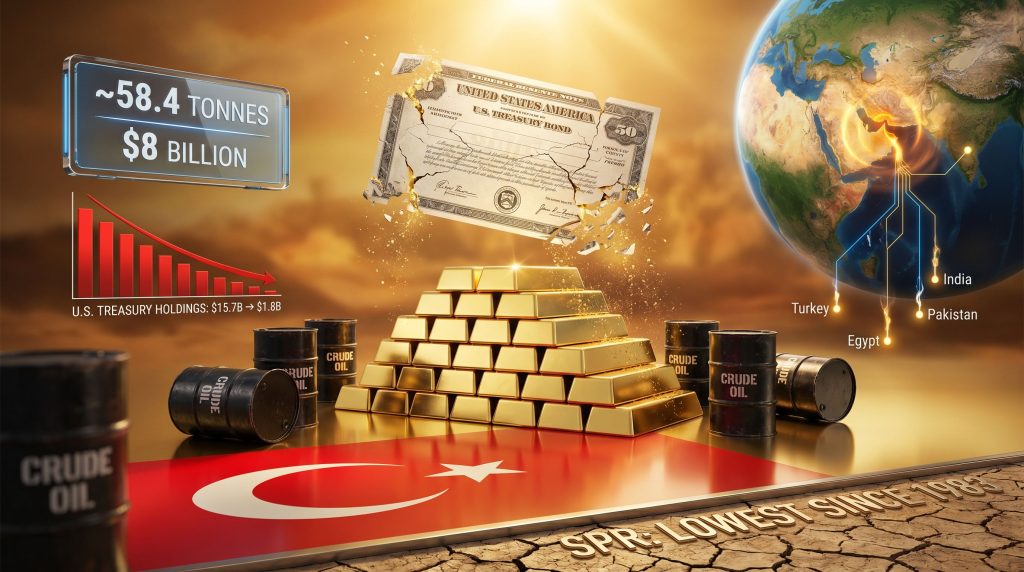
In March 2025, Turkey's US Treasury holdings collapsed from $15.7 billion to approximately $1.8 billion in a single month — a reduction of roughly 90%. Only after that reserve layer was largely exhausted did the central bank begin mobilising gold. This pattern raises deeper questions about trust in the US dollar and what it means when nations are forced to liquidate their holdings under pressure.
This sequencing follows a well-documented emerging market stress pattern:
- Treasuries are liquidated first because they trade in the deepest, most liquid markets on earth and can be converted to dollars rapidly with minimal price impact at low volumes.
- Gold mobilisation follows because it carries a higher reputational signal, implying that the easier options have already been exhausted.
- Gold swaps provide a middle path, allowing central banks to access short-term liquidity without permanently surrendering reserves, preserving the option to rebuild once conditions stabilise.
In the first two weeks following the onset of the Iran war in 2025, Turkey's central bank sold or swapped approximately 58.4 tonnes of gold, worth over $8 billion. That figure breaks down as follows:
| Mechanism | Estimated Volume | Purpose | Permanent Loss? |
|---|---|---|---|
| Outright gold sales | ~22 tonnes | Immediate USD liquidity | Yes |
| Gold-for-currency swaps | ~34-36 tonnes | Short-term FX stabilisation | No (reversible) |
| Total mobilised | ~58.4 tonnes | Energy imports + lira defence | Partial |
Importantly, Turkey's foreign exchange reserves fell by approximately $40 billion during the peak of the crisis, dropping to around $175 billion. By mid-April 2026, following a ceasefire-driven stabilisation, gold holdings had partially recovered to approximately 730 tonnes.
A country does not begin selling its gold to cover energy import costs unless it has already exhausted every less painful option available to it.
Turkey's Energy Import Vulnerability: Why This Country First?
Turkey is not the only oil-importing emerging market, but it is among the most structurally exposed. Turkey imports approximately 93 to 98% of its oil, placing it among the most energy-import-dependent major economies globally. When global oil prices spike, Turkey's import bill expands rapidly, and the demand for US dollars to pay that bill expands with it. Furthermore, when the lira is simultaneously weakening, the problem compounds in both directions at once.
This structural exposure is shared, to varying degrees, across a group of economies that share two critical characteristics:
- They import the majority of their oil from international export markets.
- They hold national savings primarily in US Treasury bonds, which become the first asset liquidated when the energy bill surges.
Illustrative High-Exposure Emerging Market Economies:
| Country | Oil Import Dependency | Treasury Holdings Risk |
|---|---|---|
| Turkey | ~93-98% imported | High, already largely liquidated |
| India | ~85% imported | Moderate to high |
| Indonesia | Net importer | Moderate |
| Philippines | High import dependency | Moderate |
| Pakistan | High import dependency | High |
| Egypt | High import dependency | High |
| Vietnam | Growing import dependency | Moderate |
Beginning in March 2025, this specific group of economies — still growing but not wealthy enough to absorb energy shocks passively — began selling US Treasuries at a pace not seen in years. Turkey simply moved furthest and fastest down a road that others were also travelling. Consequently, the broader implications for oil market disruption and dollar demand became impossible to ignore.
The Strait of Hormuz: Why One Chokepoint Reshapes Everything
The Strait of Hormuz processes approximately 20% of total global oil flows. However, the more consequential figure is that it handles roughly 40% of the world's seaborne export oil — meaning the oil that is actually available for purchase on international markets.
The distinction matters enormously. Oil that a country produces and consumes domestically never enters the export market and is therefore irrelevant to import-dependent nations. Japan, Turkey, India, and the Philippines do not compete for domestic American oil production. They compete for export-market oil, and the Strait of Hormuz is the dominant chokepoint for that supply.
When that chokepoint tightens, two things happen simultaneously:
- The price of available export oil rises sharply, because the same number of import-dependent buyers are competing for a reduced supply.
- The dollar demand of oil-importing nations spikes, because they need more USD to purchase the same volume of fuel at higher prices.
The result is a mechanically predictable sequence: higher oil prices force oil-importing nations to sell their most liquid dollar asset — US Treasuries — to raise the cash needed to cover their import bills. Each country selling pushes Treasury prices down slightly. Falling prices make the next holder more likely to sell preemptively. The feedback loop that begins as orderly liquidation can, under sufficient pressure, become something structurally resembling a bank run.
The US Treasury Market Feedback Loop
The United States funds its government operations by continuously issuing Treasury bonds into global markets. This system depends on there being more buyers than sellers at any given time. When multiple oil-importing nations are simultaneously forced to liquidate Treasuries, that balance shifts.
The mechanical consequences are straightforward:
- Increased Treasury supply on secondary markets pushes bond prices lower.
- Falling bond prices mechanically push yields — meaning interest rates — higher.
- Higher yields increase the annual interest cost the US government must pay on its existing debt.
- Rising debt servicing costs compound the national debt burden and eventually force a binary choice: default or monetary expansion.
Market analysts have identified approximately 5% on the 10-year US Treasury yield as a critical threshold above which America's interest obligations begin compounding in ways that strain normal fiscal management. In addition, the gold and bond volatility observed during this period has underscored just how interconnected these pressures have become.
When individual country Treasury sales are isolated events, the system absorbs them. When selling becomes synchronised across multiple import-dependent economies simultaneously, the dynamics shift from orderly adjustment to something closer to a cascade failure.
The Three Buffers That Absorbed the Shock at $90 Oil
The reason the system held during the initial phases of the 2025 energy shock was not that the stress was small. It was that three distinct cushions absorbed the impact before it reached the Treasury market's critical threshold.
Buffer 1: Global Commercial Oil Inventories
As Hormuz supply tightened, import-dependent nations initially drew down existing storage rather than bidding export oil prices to crisis levels. This delayed the price spike and moderated the immediate dollar demand increase. However, global oil inventories are now at historically low levels, with a senior vice president at ExxonMobil describing them publicly in late May 2025 as approaching conditions the industry had not seen before. The cushion that global storage provided is largely exhausted.
Buffer 2: The US Strategic Petroleum Reserve
The US began releasing oil from its Strategic Petroleum Reserve at a historically elevated pace. Critically, a significant share of those releases was directed to international markets rather than domestic American consumers — an unusual deployment of emergency reserves that signals a strategic objective beyond domestic fuel security.
The SPR is currently at its lowest level since 1983. The ExxonMobil assessment, delivered at an investor conference, suggested that once global inventory levels reached their projected lows, an oil price move to $150 to $160 per barrel should be expected.
Buffer 3: Emerging Market Foreign Reserves
Countries like Turkey entered the crisis with meaningful Treasury holdings that could be liquidated gradually. Turkey's $15.7 billion in Treasuries provided a meaningful runway before gold needed to be touched. That runway is now largely gone. When gold is exhausted, no additional liquid reserve assets remain to absorb the next shock.
The simultaneous depletion of all three buffers is what makes the $150 oil scenario qualitatively different from the $90 oil scenario — not merely quantitatively larger.
Scenario Comparison: $90 Oil vs $150 Oil
| System Component | Status at $90 Oil | Projected Status at $150 Oil |
|---|---|---|
| Global oil inventories | Low and falling | Near-critical or depleted |
| US Strategic Petroleum Reserve | 1983-era lows | Minimal remaining capacity |
| Emerging market Treasury holdings | Partially liquidated | Largely exhausted |
| Emerging market gold reserves | Mobilisation beginning | Significant drawdown underway |
| US 10-year Treasury yield | Elevated | Risk of breaching critical threshold |
The next major ASX story will hit our subscribers first
The Sri Lanka Precedent: What Reserve Exhaustion Looks Like in Practice
Sri Lanka's 2022 foreign reserve collapse provides a documented, real-world reference point for what happens when an import-dependent economy exhausts its dollar liquidity entirely.
| Metric | 2019 Level | Spring 2022 Level |
|---|---|---|
| Foreign exchange reserves | ~$7.6 billion | ~$50 million |
| Primary reserve source | Tourism revenue and Treasuries | Fully depleted |
| Outcome | Stable government | Presidential collapse |
Sri Lanka's reserve base was decimated not by an energy shock but by a tourism revenue collapse triggered by the 2020 pandemic. The mechanism was identical to what is now playing out across multiple emerging markets: reserves drawn down to cover import costs until nothing remained to sell. When the reserves ran out, so did fuel, medicine, and food. Fuel queues stretched for miles, rolling power outages lasted hours daily, and the political consequences culminated in a popular uprising that forced the sitting president to flee the country.
The critical structural difference between Sri Lanka 2022 and the current dynamic is one of scope:
- Sri Lanka's crisis was idiosyncratic, driven by a country-specific revenue collapse.
- The current stress is systemic, driven by a shared external shock affecting all oil-importing nations simultaneously.
- The probability of contagion across multiple emerging markets is materially higher when the trigger is common rather than isolated.
The 2003 Northeast Blackout: A Model for Cascade Failure
On August 14, 2003, a single power line in Ohio sagged in summer heat and contacted an overgrown tree. Within ten minutes, 55 million people across eight US states and Canada lost electricity. The cascade did not involve 55 million simultaneous failures. It involved one failure whose load transferred to adjacent lines, overloading and tripping each in sequence until the entire northeastern grid collapsed.
In the control rooms, system operators were reading stable indicators on their screens minutes before the collapse. There was no flicker, no dimming, no warning signal. The system appeared fully operational until it was gone.
This is precisely how interconnected financial systems fail under sufficient stress. Each oil-importing country represents a node on a grid powered by US dollar liquidity. When nodes begin failing simultaneously, the load transfers to remaining nodes, accelerating their failure in turn. The dynamic is non-linear: the same magnitude of additional stress produces disproportionately larger systemic damage once the slack has been removed from the system.
The financial system equivalent of that Ohio power line is the first major economy to collapse following Turkey's trajectory. Once it falls, the cascade does not move gradually. It moves faster than institutional responses can follow.
What US Policy Behaviour Reveals About Official Awareness
Two specific US policy actions in 2025 are notable not for what they stated but for what they implied about official awareness of Treasury market fragility.
Action 1: Directing SPR Releases to International Markets
Emergency petroleum reserves exist, by design, for domestic crisis scenarios. Directing a substantial share of those releases to international markets suggests an objective that goes beyond American fuel supply security. Keeping global oil prices lower than they would otherwise be reduces the dollar demand of import-dependent nations and slows the pace at which those nations are forced to liquidate Treasury holdings.
Action 2: Partial Easing of Sanctions on Russian Oil
Reducing restrictions on Russian oil exports increases global supply, which moderates prices, which reduces the immediate incentive for import-dependent nations to sell Treasuries to cover their energy bills. This occurred while Russia remained involved in active conflict affecting American interests — a policy contradiction that is difficult to explain through conventional geopolitical logic but follows clearly from Treasury market preservation logic.
Both actions share a common underlying objective: keeping the global oil price low enough that the most vulnerable emerging markets do not need to sell Treasuries at a pace that destabilises the US bond market. The policy logic implies Treasury market stability was being treated as a higher-order priority than the stated objectives those policies appeared to contradict.
The Long Arc: Reserve Currency Cycles and Terminal Patterns
The current dynamic, while acute, is an accelerant of a structural trajectory that predates the Hormuz closure by decades. Every dominant global reserve currency has followed a recognisable terminal pattern.
| Reserve Currency Era | Issuing Power | Terminal Phase |
|---|---|---|
| Roman Denarius | Roman Empire | Debasement through metal dilution |
| Islamic Gold Dinar | Abbasid Caliphate | Fiscal overextension |
| Dutch Guilder | Dutch Republic | Debt accumulation, British displacement |
| British Pound Sterling | British Empire | WWI and WWII debt, USD displacement |
| US Dollar | United States | Ongoing: debt accumulation, monetary expansion |
The common terminal mechanism across every historical case is consistent: the issuing nation accumulates unsustainable debt, then expands the money supply to service it, gradually eroding the currency's purchasing power and the international trust that sustains its reserve status. This broader context explains why the role of gold in the monetary system is receiving renewed scrutiny from analysts and central banks alike.
Hormuz did not create this structural trajectory. It is functioning as an accelerant, compressing a timeline that was already in motion. As one financial commentator with a long track record of covering macro cycles has put it, even if the strait reopened tomorrow, the destination of the US dollar system does not change. Only the timetable shifts.
When cornered between sovereign default and monetary expansion, governments across history have overwhelmingly chosen to print. The nominal value of obligations is preserved while their real value is gradually eroded through inflation, effectively transferring the cost to the holders of paper savings.
How This Reaches Different Populations at Different Speeds
The geography of financial exposure determines how quickly and visibly this dynamic translates into lived experience.
For citizens of wealthy, dollar-adjacent economies:
- The primary transmission mechanism is gradual inflation — an erosion of purchasing power that leaves nominal savings balances intact while reducing what those balances can buy.
- The process is slow enough that the structural causes are rarely obvious to those experiencing it.
- The connection between distant reserve liquidation and rising domestic food and housing costs is almost never made in mainstream economic commentary.
For citizens of exposed emerging market economies:
- Currency depreciation, fuel shortages, and food price spikes can materialise within weeks of reserve exhaustion.
- Many populations in these economies have direct lived experience of prior currency crises and recognise the pattern earlier than external observers.
- For these populations, the current dynamic is not a theoretical scenario. It is a recognisable sequence that may have already touched their families within living memory.
Assets that have historically preserved value during monetary expansion phases:
- Physical gold, which cannot be created through monetary policy decisions.
- Energy assets and producers, whose value is anchored to real-world resource scarcity.
- Hard commodity producers, providing exposure to physical goods with structurally inelastic demand.
- Real assets broadly, as distinct from paper claims whose value depends entirely on issuer solvency and monetary discipline.
Furthermore, the enduring appeal of gold as a safe haven during periods of monetary stress is well-supported by historical precedent, and the current environment is reinforcing that case in real time.
The asymmetry of holding real assets during a period of potential monetary expansion is notable: if conditions stabilise and the analysis proves premature, the cost of holding those assets is modest. If conditions deteriorate as the structural trajectory suggests, those assets are among the few that hold their value as paper alternatives erode.
Disclaimer: This article is intended for informational and educational purposes only. It does not constitute financial advice. All references to price forecasts, scenario projections, and reserve trajectory estimates involve inherent uncertainty. Readers should conduct their own research and consult qualified financial professionals before making investment decisions. All data referenced reflects conditions reported through mid-2025 and may not reflect current circumstances.
Frequently Asked Questions: Turkey, Gold, and the Global Dollar System
Did Turkey literally sell gold to buy diesel?
Not precisely. Turkey's central bank sold approximately 22 tonnes of gold outright and used a further 34 to 36 tonnes in gold-for-currency swap agreements. The USD liquidity raised was used to cover broad energy import costs including oil and gas, and to defend the Turkish lira. Diesel was one component of those energy imports, not the exclusive purpose of the sales.
Has Turkey's gold reserve recovered following the crisis?
Partially. Following a ceasefire that reduced energy price pressure, Turkey began rebuilding its gold reserves. By mid-April 2026, holdings had recovered to approximately 730 tonnes, though this remains below pre-crisis levels. According to reporting on Turkey's reserve drawdown, the scale of the mobilisation underscored just how rapidly a lira defence operation can consume national savings.
How much did Turkey's foreign exchange reserves fall during the peak of the crisis?
Turkey's foreign exchange reserves declined by approximately $40 billion, falling to around $175 billion at the height of the crisis pressure.
What makes the current situation structurally different from Sri Lanka 2022?
Sri Lanka's crisis was largely idiosyncratic, triggered by a tourism revenue collapse specific to that economy. The current dynamic is driven by a shared external shock affecting all oil-importing nations simultaneously. The probability of contagion spreading across multiple emerging markets is materially higher when the triggering event is systemic rather than country-specific.
What would synchronised Treasury selling across multiple emerging markets look like in practice?
Simultaneous Treasury liquidation across multiple oil-importing nations increases bond supply on secondary markets, pushes US yields higher, raises American borrowing costs, and can force the Federal Reserve to choose between intervening through market purchases — which expands the money supply — or accepting structurally higher interest rates that compound the national debt burden at an accelerating pace.
Is the Strait of Hormuz still closed?
Readers should consult current news sources for the most up-to-date status. The analysis in this article is based on conditions and publicly available data reported through mid-2025. The case of Turkey selling gold to buy diesel, however, remains a consequential reference point regardless of how geopolitical conditions evolve from here.
Want to Understand Which Resource Companies Could Benefit From a Shifting Monetary Landscape?
Discovery Alert's proprietary Discovery IQ model delivers real-time alerts on significant ASX mineral discoveries — instantly transforming complex resource data into actionable opportunities for investors navigating an environment of rising commodity demand and monetary uncertainty. Explore historic discoveries and their exceptional returns, then begin your 14-day free trial at Discovery Alert to position yourself ahead of the broader market.