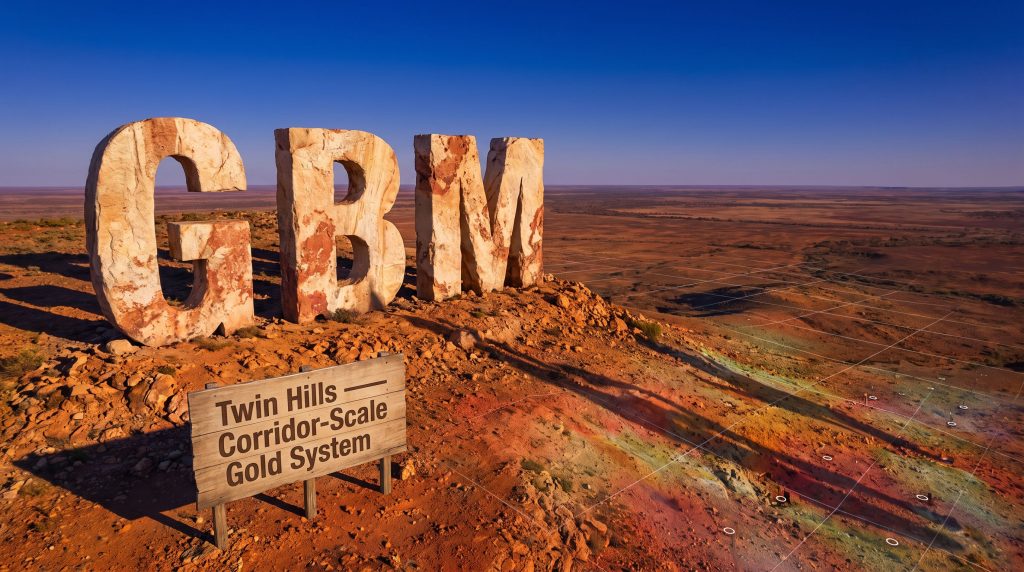
GBM Resources Ltd
- ASX Code: GBM
- Market Cap: $98,167,994
GBM Resources Twin Hills Gold Discovery Extends 700 Metres South
GBM Resources Limited (ASX: GBM) has reported that recent step-out drilling at the Stella prospect has confirmed the continuation of the prospective Milled Matrix Breccia (BXM) host horizon at least 700 metres south of the existing 309 Mineral Resource Estimate (MRE) at the Twin Hills Gold Project in Queensland's Drummond Basin. The result materially expands the exploration footprint at Twin Hills and supports a revised geological model that reinterprets the system as more laterally extensive than previously understood.
The update matters because the BXM is described by the company as the principal host to gold mineralisation at Twin Hills. If that host unit continues beyond the current resource boundary, it increases the area that may warrant further drilling and could, if subsequent results support it, provide a pathway for future resource growth.
When big ASX news breaks, our subscribers know first
What Has the Drilling Confirmed at Stella?
In the ASX announcement, GBM said the Stella drilling represents the first deep holes drilled within the Twin Hills tenure outside the MRE to depths greater than 200 metres that have successfully intersected the BXM host horizon. Management stated that historical drilling in the broader corridor was generally too shallow to properly test this target.
Four holes have been drilled at Stella so far, and the company reported that gold mineralisation has been confirmed in each hole drilled. The strongest result received to date is from THDH005, which returned 8m @ 1.31 g/t Au from 126m, including 1m @ 2.18 g/t Au from 131m, hosted within an interpreted brecciated structural zone.
Stella Prospect Assay Results Reported So Far
| Hole ID | From (m) | To (m) | Interval (m) | Grade (g/t Au) | Host |
|---|---|---|---|---|---|
| THDH004 | 18.0 | 24.0 | 6.0 | 0.50 | BXM horizon |
| THDH004 | 68.0 | 69.0 | 1.0 | 0.44 | BXM horizon |
| THDH005 | 126.0 | 134.0 | 8.0 | 1.31 | Brecciated structural zone |
| THDH005 | 131.0 | 132.0 | 1.0 | 2.18 | Included higher-grade interval |
| THDH005 | 180.0 | 182.0 | 2.0 | 0.61 | BXM horizon |
Two additional holes, THDH006 and THDH007, reached planned end-of-hole depths of 350m and 400m respectively, with assays still pending. Furthermore, GBM noted that about 60% of the metres drilled at Stella remain outstanding, including deeper portions of completed holes and diamond tail sections.
For investors, that means the current results provide only a partial view of the target. The geological significance may already be material, however the full grade and width profile across Stella has not yet been reported.
"A significant outcome from our Stage 2 drilling program has been the recognition that much of the historical drilling across Twin Hills was simply too shallow to adequately test the prospective BXM host sequence," said Daniel Hastings, Chief Executive Officer.
"Rather than isolated mineralised bodies, we now recognise a laterally extensive mineralised host sequence extending well beyond the existing 309 MRE."
Why Does the Revised Geological Model Matter?
The more important part of the update may be the geological interpretation rather than any single intercept. In the report, GBM stated that Stage 2 drilling has materially improved its understanding of the controls on gold mineralisation at Twin Hills.
Previously, mineralisation across Twin Hills appears to have been viewed as occurring in more isolated bodies. The revised interpretation now suggests the BXM is developed along a laterally continuous sedimentary horizon, rather than as separate pods. That distinction changes how exploration potential is assessed across the corridor.
In addition, the updated model provides an explanation for historical gold intersections in the overlying andesite at Stella. These earlier shallow results are now interpreted as leakage of mineralising fluids from the underlying BXM system into the rocks above.
In practical terms, that means historical anomalous gold at Stella may not have been random or isolated. Instead, it may point to a more substantial mineralised source at depth, which is now being tested through deeper drilling.
GBM said this interpretation is also supported by high-resolution magnetic processing, which identified alteration zones and intrusive centres interpreted as favourable pathways for mineralising fluids. The company has used these datasets alongside the updated geological model to generate additional drill targets.
Understanding the BXM and Why Investors Should Care
For non-specialist investors, the BXM is the key concept in this announcement.
What Is the Milled Matrix Breccia?
A breccia is a rock made up of broken angular fragments that have been cemented together. In this case, the BXM contains a fine matrix formed during intense geological activity. At Twin Hills, GBM describes this rock unit as the main host for gold mineralisation.
That matters because broken and porous rocks can provide spaces where hot mineral-rich fluids move through the ground and deposit gold. If the BXM is the main host unit, then tracing its position and continuity is critical to finding more mineralisation.
Why Does Lateral Continuity Matter?
If the BXM extends laterally as a continuous horizon, the search area becomes much larger. Instead of testing isolated targets, drilling can follow a mineralised host sequence across a broader corridor.
This does not confirm that all of that ground contains economic gold grades. However, it does mean the geological target is more extensive, and it raises the probability that additional mineralised zones could be identified where fluid pathways and structures are favourable.
Glossary of Key Terms
| Term | Meaning |
|---|---|
| BXM | Milled Matrix Breccia, the main gold-hosting rock unit at Twin Hills |
| MRE | Mineral Resource Estimate, a formal estimate of tonnes and grade reported under JORC standards |
| Epithermal | A type of gold deposit formed at relatively shallow depths from hot fluids |
| Sinter | Silica-rich rock formed near surface from hydrothermal fluids, often indicating an underlying mineral system |
| Step-out drilling | Drilling beyond a known deposit boundary to test extensions |
| g/t Au | Grams of gold per tonne of rock |
| JORC | The Australian reporting code for exploration results, mineral resources and ore reserves |
Stage 2 Drilling Program and Assay Pipeline
The Stella update sits within a larger Stage 2 drilling effort at Twin Hills. GBM said it has completed about 25,000 metres of drilling since February 2026 across the 309 and Lone Sister deposits, representing 50% of the planned Stage 2 total.
The company stated that drilling outside the current modelled mineralisation at both deposits has already returned encouraging indications that the system may extend beyond the existing MRE.
Stage 2 Drilling Summary
| Area | Metres Drilled | Status |
|---|---|---|
| 309 deposit | ~9,500m awaiting assays | Resource development |
| Lone Sister | ~1,500m awaiting assays | Resource development |
| Stella | ~1,315m across 4 holes | Exploration step-out |
| Total completed | ~25,000m | 50% of planned Stage 2 program |
| Pending assays | ~11,500m | Results expected progressively |
Assay turnaround has been slower than planned. GBM attributed delays to a combination of borax shortages, staffing issues, and higher laboratory volumes across the sector. The company has responded by dispatching samples to two laboratories in Queensland, with results expected to recommence progressively within the next fortnight.
This matters because the pending assays represent a substantial amount of unreported drilling. For investors following near-term catalysts, the flow of these results may become an important driver of how the market assesses Twin Hills over coming weeks and months.
What to Watch Next at Twin Hills
The outlook described in the ASX announcement points to several milestones that could further test the revised model. The immediate focus remains systematic step-out drilling along the interpreted BXM horizon, especially between the north of 309, Coreshed and Stella.
Near-term catalysts identified from the report include:
- Progressive assay results from about 11,500m of completed drilling.
- Outstanding Stella assays, including deeper sections from existing holes.
- Continued step-out drilling along the BXM corridor.
- Updated geological and mineralisation models as new data is incorporated.
- A medium-term objective of supporting growth of the existing MRE if results warrant it.
None of these outcomes are guaranteed, and the company has framed them as ongoing work programs and objectives. However, the volume of pending data suggests Twin Hills could remain active from a newsflow perspective.
Twin Hills in the Context of GBM's Broader Resource Base
GBM's Drummond Basin portfolio currently hosts a reported ~1.84 million ounces of gold in mineral resources across Twin Hills, Yandan and Mt Coolon. Twin Hills accounts for the largest portion of that inventory.
GBM Drummond Basin Mineral Resource Summary
| Project | Tonnes (000t) | Grade (g/t Au) | Gold (oz) |
|---|---|---|---|
| Twin Hills | 23,110 | 1.3 | 999,200 |
| Yandan | 15,892 | 1.0 | 514,500 |
| Mt Coolon | 6,653 | 1.5 | 330,500 |
| Total | 45,655 | 1.3 | 1,844,200 |
For Twin Hills specifically, the investment question is shifting from the current resource base alone to the extent of potential growth around it. The updated interpretation implies that historical drilling may have systematically under-tested the key host horizon outside known deposits.
That is relevant because, as a result, the company is no longer just following isolated mineral occurrences. According to the report, it is now testing a broader host sequence that may extend through the 309, Coreshed and Stella corridor.
The next major ASX story will hit our subscribers first
Why This Announcement Matters to Investors
This ASX update does not establish a new resource, and much of the Stella drilling still awaits assay results. However, it does provide support for a revised geological framework that may have a material bearing on Twin Hills' exploration potential.
Three points stand out:
- The BXM host horizon has now been interpreted to continue at least 700 metres south of the 309 MRE.
- Gold mineralisation has been reported in each of the four Stella holes drilled so far.
- A large pipeline of pending assays remains to be released across 309, Lone Sister and Stella.
For informed investors, the significance lies in the combination of model validation and upcoming data. If further drilling and assays continue to support the continuity of the BXM and identify additional mineralised zones, Twin Hills may ultimately be viewed as a larger corridor-scale gold system than the existing resource footprint alone suggests.
At this stage, the main evidence is geological continuity, early mineralised intercepts, and a large volume of drilling still to be reported. According to GBM's latest quarterly exploration progress, that is enough to keep Twin Hills firmly on watch as Stage 2 results continue to emerge.
Ready to Catch the Next Major ASX Gold Discovery as It Happens?
Discovery Alert's proprietary Discovery IQ model scans ASX announcements in real time, instantly identifying significant mineral discoveries like developing gold corridor systems before the broader market has time to react — explore historic examples of major discovery returns to understand what early positioning can mean for investors, then start your 14-day free trial to receive actionable alerts the moment the next significant find is announced.