
May 17, 2026
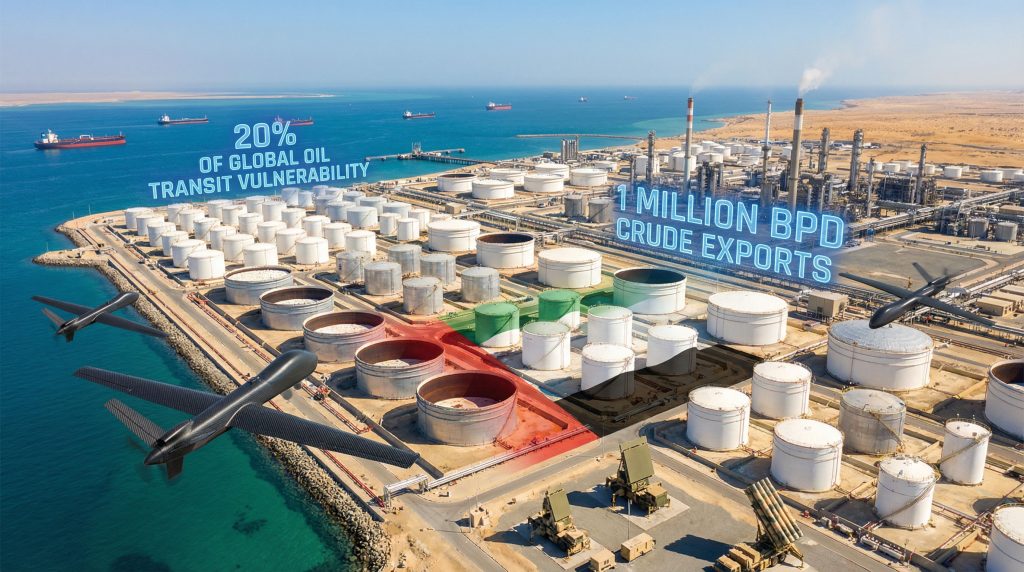
The recent UAE drone attack on critical energy infrastructure has exposed fundamental vulnerabilities in global oil markets that extend far beyond immediate operational disruptions. The convergence of advanced drone technology with strategic infrastructure targeting creates cascading risks that extend far beyond immediate operational disruptions. Understanding these evolving threat dynamics requires comprehensive analysis of how low-cost attack vectors can compromise high-value energy systems, triggering worldwide supply chain vulnerabilities and market instability.
The sophistication of contemporary drone warfare demonstrates how technological advancement democratizes strategic capabilities, enabling state and non-state actors to project power across vast distances with minimal resource investment. This fundamental shift in warfare economics forces energy-dependent nations to recalculate defensive priorities, infrastructure hardening requirements, and emergency response protocols.
Energy security planners must now integrate asymmetric threat assessments into long-term investment frameworks, considering scenarios where critical infrastructure faces sustained pressure from coordinated attack campaigns. The implications extend beyond immediate supply disruptions to encompass insurance market dynamics, international cooperation mechanisms, and the fundamental architecture of global energy distribution systems.
What Makes the UAE's Energy Infrastructure a Strategic Target?
The UAE's position as a critical energy transit hub creates multiple vulnerability vectors that adversaries can exploit for maximum strategic impact. The concentration of export facilities, refining capacity, and storage infrastructure within geographically constrained areas amplifies the potential consequences of successful attacks on individual facilities.
Fujairah's strategic importance stems from its unique geographic positioning outside the Strait of Hormuz chokepoint, enabling the UAE to export approximately 1 million barrels per day of Murban crude oil even when traditional shipping routes face disruption. This volume represents roughly 1% of global oil demand, making any operational suspension significant for international energy markets.
The emirate functions as a critical bypass mechanism when regional conflicts threaten traditional export channels, processing substantial volumes of crude oil that would otherwise transit through more vulnerable waterways. This strategic redundancy makes Fujairah infrastructure particularly attractive for adversaries seeking to maximise economic disruption with targeted strikes.
Geographic Positioning and Global Energy Flow Control
The UAE's energy infrastructure operates within a complex web of regional dependencies and international supply chains. Major facilities like ADNOC's Ruwais refinery represent concentrated processing capacity that, when disrupted, creates immediate downstream effects across regional energy markets.
Port facilities in Fujairah, Jebel Ali, and Khalifa handle substantial portions of regional energy exports, creating single-point failure risks that sophisticated adversaries can exploit. The concentration of these facilities within relatively small geographic areas enables coordinated attack strategies targeting multiple infrastructure nodes simultaneously.
Storage terminal dependencies compound vulnerability factors, as successful strikes on tank farms and loading facilities can disrupt operations for extended periods while creating secondary environmental and safety hazards. The interconnected nature of these systems means that damage to one component can cascade through entire operational networks.
Critical Infrastructure Vulnerability Assessment
Modern energy infrastructure faces threats from multiple attack vectors, including direct strikes on processing facilities, transportation networks, and control systems. The UAE's experience demonstrates how even intercepted drones can cause significant damage through debris impact, highlighting the challenge of achieving complete defensive coverage.
According to Reuters reports, the fire at Fujairah terminal occurred after debris fell during drone interception, illustrating how successful air defence operations can still result in infrastructure damage and operational disruptions. This secondary damage mechanism complicates defensive planning and resource allocation decisions.
Recent incidents involving ADNOC facilities showcase systematic targeting of UAE energy infrastructure, with attacks occurring across multiple locations within compressed timeframes. The ADNOC Ruwais refinery shutdown following a UAE drone attack demonstrates how individual facility attacks can remove substantial processing capacity from regional markets.
When big ASX news breaks, our subscribers know first
How Do Modern Drone Warfare Tactics Reshape Energy Security Calculations?
Asymmetric warfare capabilities enable adversaries to achieve strategic objectives through coordinated infrastructure targeting campaigns that bypass traditional military confrontation. The evolution of drone technology creates new calculus for both offensive operations and defensive resource allocation across critical energy systems.
The demonstrated ability to conduct precision strikes on energy infrastructure using relatively low-cost platforms fundamentally alters risk-reward calculations for both attackers and defenders. Success rates for individual strikes become less critical when attack campaigns can sustain operations across extended timeframes with minimal resource depletion.
Defensive systems face increasing pressure as swarm attack methodologies and coordinated strike timing overwhelm traditional air defence capabilities. The economic disparity between attack costs and defensive expenditure creates sustainable pressure that can degrade protective systems through resource exhaustion.
Asymmetric Warfare Impact on Critical Infrastructure
Modern drone warfare leverages technological advancement to achieve strategic effects through coordinated infrastructure targeting. The rapid escalation sequence observed in recent Middle Eastern conflicts demonstrates how attacks on energy facilities can occur within hours of triggering events, compressing response timeframes for defensive systems.
The targeting of multiple UAE port facilities within a single operational cycle illustrates coordinated campaign planning designed to maximise economic disruption. Threats issued against Fujairah, Jebel Ali, and Khalifa ports simultaneously demonstrate systematic vulnerability assessment and strategic timing coordination.
Contemporary attack methodologies focus on creating cascading effects that extend beyond immediate physical damage to encompass operational disruptions, market confidence degradation, and international supply chain instability. This comprehensive impact approach maximises strategic return on relatively modest operational investment.
Defence System Effectiveness Under Sustained Pressure
Air defence systems demonstrate high individual interception rates but face degradation under sustained operational pressure from multiple threat vectors. The debris damage pattern at Fujairah illustrates how successful intercepts can still create secondary infrastructure damage requiring extended recovery periods.
Defensive resource calculations must account for attack campaign sustainability, where adversaries can maintain operational tempo across extended timeframes whilst defensive systems face ammunition depletion and maintenance requirements. This operational asymmetry creates strategic advantages for attacking forces even when individual strike success rates remain limited.
The integration of precision guidance systems enables drone platforms to target specific infrastructure components within larger facility complexes, maximising damage potential whilst minimising required explosive payload. This targeting precision compounds defensive challenges by reducing predictable attack patterns and expanding vulnerable target sets.
What Are the Immediate Market Consequences of Energy Infrastructure Attacks?
Energy infrastructure attacks create immediate market disruptions that extend far beyond physical supply reductions to encompass psychological factors, risk premium adjustments, and emergency response protocol activation. The International Energy Agency's assessment of facing the world's "biggest ever oil supply crisis" demonstrates how regional conflicts can escalate to global supply security threats.
Market psychology amplifies physical supply disruptions through fear-based trading patterns and risk premium incorporation into commodity pricing. Moreover, the potential for an oil price rally becomes increasingly likely when supply security concerns intensify. The loss of 1 million barrels per day from Fujairah operations, whilst representing roughly 1% of global demand, triggers disproportionate price movements due to supply security concerns and emergency reserve deployment considerations.
Immediate operational suspensions create cascading effects across related infrastructure systems, transportation networks, and downstream processing facilities. As reported by Bloomberg, the suspension of oil-loading operations at Fujairah demonstrates how security incidents can remove operational capacity even when physical damage remains limited to specific facility components.
Oil Price Volatility Mechanisms
Supply disruption premium calculations incorporate both immediate volume losses and potential escalation scenarios that could affect additional infrastructure. Market participants price future supply security risks based on demonstrated attack capabilities and stated adversary intentions regarding expanded targeting.
The systematic threat to multiple UAE ports creates market expectations of coordinated infrastructure targeting campaigns rather than isolated incidents. This escalation potential drives volatility premiums that persist beyond immediate supply restoration timelines.
Emergency response protocols, including strategic petroleum reserve deployment and international coordination mechanisms, influence market sentiment through government intervention signalling. However, reserve deployment capacity limitations constrain long-term price stabilisation effectiveness during sustained infrastructure pressure.
Regional Energy Trade Flow Disruptions
Alternative routing requirements increase transportation costs, extend delivery timeframes, and strain backup facility capacity across regional energy networks. The closure of traditional Strait of Hormuz transit routes forces supply chain adaptations that compound infrastructure attack effects and create significant energy export challenges.
Insurance market adjustments reflect increased operational risks for energy infrastructure in conflict zones, with premium escalations affecting long-term project economics and investment decision frameworks. Lloyd's of London and other specialised insurers incorporate demonstrated attack capabilities into risk assessment methodologies.
Supply chain resilience testing reveals just-in-time delivery model vulnerabilities when primary infrastructure faces sustained operational pressure. Backup facility utilisation approaches capacity limits during extended primary facility outages, creating additional vulnerability points for coordinated attack campaigns.
How Do Escalation Dynamics Affect Long-Term Energy Investment?
Infrastructure investment risk reassessment fundamentally alters capital allocation priorities as energy companies and governments balance capacity expansion against defensive hardening requirements. The demonstrated effectiveness of asymmetric attacks against high-value facilities forces comprehensive revision of project risk-return calculations.
Geographic diversification strategies gain prominence as investors seek to minimise exposure to conflict-prone regions whilst maintaining operational efficiency and cost competitiveness. This diversification imperative affects facility location decisions, supply chain design, and international cooperation framework development.
Technology adaptation responses accelerate as infrastructure operators invest in automated defence systems, hardened facility designs, and distributed processing models that reduce single-point-of-failure vulnerabilities. These defensive investments compete with capacity expansion funding whilst potentially affecting operational efficiency metrics.
Infrastructure Investment Risk Reassessment
Capital expenditure planning must incorporate defensive infrastructure requirements alongside traditional capacity expansion and efficiency improvement projects. The rapid escalation timeline demonstrated in recent conflicts compresses investment decision timeframes whilst expanding risk assessment complexity.
Insurance premium escalations affect project economics through increased operational cost structures and coverage limitation adjustments. War risk insurance markets adapt pricing models to reflect demonstrated attack capabilities and evolving threat assessment methodologies.
International project financing incorporates enhanced due diligence requirements for facilities located in regions with demonstrated asymmetric attack capabilities. Financial institutions adjust lending criteria and covenant structures to address operational continuity risks and revenue stream stability concerns.
Technology Adaptation Responses
Automated defence system integration becomes essential for critical infrastructure protection, requiring substantial capital investment and ongoing operational expenditure for maintenance and upgrading. AI-powered threat detection and response capabilities offer enhanced defensive effectiveness but demand significant technical expertise and system integration complexity.
Hardened facility design standards evolve to address blast-resistant construction requirements, underground storage options, and distributed operational capabilities that maintain functionality during partial facility damage. These design adaptations increase construction costs whilst potentially affecting operational efficiency and expansion flexibility.
Distributed processing models reduce single-point-of-failure vulnerabilities by spreading operational capacity across multiple smaller facilities rather than concentrating processing in large centralised complexes. This distribution strategy affects economies of scale whilst improving overall system resilience against coordinated attacks.
What Strategic Responses Are Available to Energy-Dependent Nations?
Supply chain diversification emerges as the primary strategic response for energy-dependent nations seeking to reduce vulnerability to regional infrastructure attacks. This diversification requires comprehensive assessment of alternative supplier capabilities, transportation route security, and emergency coordination protocols across multiple jurisdictions.
Strategic petroleum reserve utilisation provides temporary supply security during infrastructure disruption periods, but reserve capacity limitations constrain long-term effectiveness against sustained attack campaigns. The IEA's role in coordinating emergency responses becomes critical for managing global supply disruptions and maintaining market stability. Furthermore, understanding OPEC production impact remains essential for predicting how these disruptions might affect global supply decisions.
Alternative energy source scaling accelerates as governments recognise the security vulnerabilities inherent in concentrated fossil fuel dependency. Renewable energy capacity expansion, whilst addressing climate objectives, also enhances energy security through reduced import dependency and distributed generation capabilities.
Supply Chain Diversification Imperatives
Source country risk analysis requires continuous updating as regional conflict dynamics evolve and asymmetric attack capabilities spread across multiple state and non-state actors. Energy-dependent nations must balance supply security considerations against economic efficiency and existing infrastructure investments.
Alternative supplier development involves long-term contract negotiations that incorporate security provisions, emergency allocation agreements, and risk-sharing mechanisms between importing and exporting nations. These agreements often require premium pricing to compensate suppliers for enhanced security obligations and capacity reservation requirements.
Domestic production acceleration becomes strategically valuable even when economic efficiency favours imports, as local production provides supply security that imported energy cannot guarantee during regional conflicts. This strategic autonomy imperative affects energy policy frameworks and subsidy allocation decisions.
Emergency Response Protocol Development
Strategic petroleum reserve release timing optimisation requires careful coordination between immediate supply needs and long-term strategic security requirements. Reserve deployment during infrastructure attacks must consider escalation scenarios that could affect additional supply sources and extend disruption periods.
International coordination mechanisms through the IEA and bilateral agreements enable coordinated emergency response that can stabilise global markets during regional supply disruptions. However, coordination effectiveness depends on member nation reserve capacity and willingness to deploy strategic resources for collective security.
Alternative energy source activation includes accelerated renewable deployment, temporary increased coal or natural gas utilisation, and demand reduction protocols that can reduce petroleum dependency during supply crisis periods. These alternatives require pre-positioned capability and rapid activation procedures.
How Do Regional Power Dynamics Influence Energy Security Calculations?
Proxy conflict spillover effects demonstrate how energy infrastructure becomes vulnerable to retaliatory targeting even when host nations maintain neutrality in broader regional conflicts. The Iranian threats against UAE facilities following U.S. strikes illustrates how third-party infrastructure faces targeting as adversaries seek to impose costs on coalition partners.
The rapid response timeline between U.S. strikes on Iranian facilities and subsequent UAE drone attack incidents demonstrates operational coordination capabilities that compress defensive preparation timeframes. This hours-long escalation cycle forces constant high-alert defensive postures that strain resources and operational efficiency.
Alliance system obligations create both protection benefits and targeting vulnerabilities as energy infrastructure becomes integrated into broader security frameworks. Host nations must balance economic cooperation benefits against potential targeting risks associated with ally relationships and regional security commitments.
Proxy Conflict Spillover Effects
Third-party infrastructure targeting strategies enable adversaries to impose costs on coalition members whilst maintaining plausible deniability regarding direct confrontation escalation. The systematic targeting of multiple UAE port facilities demonstrates coordinated campaign planning designed to maximise economic and political pressure.
Neutral nation facility vulnerability assessment reveals how regional conflicts can expand beyond direct participants to affect broader international energy networks. This expansion dynamic complicates defensive planning and international cooperation frameworks for infrastructure protection.
Collective defence obligations under alliance structures provide enhanced security but also create targeting rationale for adversaries seeking to pressure coalition partners. Energy infrastructure protection becomes integral to broader alliance security frameworks and mutual defence obligations.
Economic Warfare Through Energy Disruption
Cost-benefit analysis of infrastructure attacks reveals asymmetric advantages where relatively modest operational investments can generate substantial economic and political effects. The demonstrated targeting of high-value facilities maximises disruption potential whilst minimising required military resources and escalation risks.
Alternative pressure mechanisms through physical infrastructure disruption complement traditional sanctions and diplomatic pressure by creating immediate economic consequences for target nations and their allies. This physical pressure capability provides leverage in broader regional conflict scenarios.
Regional stability impact extends beyond immediate energy markets to affect broader economic confidence, foreign investment flows, and international cooperation frameworks. The IEA assessment of global supply crisis demonstrates how regional infrastructure attacks can escalate to international security concerns.
The next major ASX story will hit our subscribers first
What Long-Term Implications Exist for Global Energy Architecture?
Infrastructure resilience requirements fundamentally reshape global energy system design principles as planners incorporate asymmetric attack scenarios into facility location, capacity distribution, and defensive integration decisions. The demonstrated vulnerability of concentrated infrastructure drives distributed system architectures that maintain functionality during partial network disruption.
International cooperation framework evolution accelerates as energy security becomes integral to broader security alliance structures and multilateral defence coordination. Energy infrastructure protection requires enhanced intelligence sharing, coordinated defensive capabilities, and rapid response protocols that extend beyond traditional energy sector cooperation.
Technology hardening investments create new categories of infrastructure spending as cyber and physical security integration becomes essential for critical facility protection. These investments affect project economics whilst potentially improving long-term operational resilience and reducing insurance costs.
Infrastructure Resilience Requirements
Redundancy system development becomes essential for maintaining operational continuity during infrastructure attacks, requiring substantial capital investment in parallel processing capabilities and alternative transportation networks. These redundancy systems must maintain economic viability whilst providing security benefits during crisis periods.
Geographic distribution optimisation balances security benefits against operational efficiency as energy companies design facility networks that can maintain functionality when individual nodes face disruption. This distribution imperative affects economies of scale whilst improving overall system resilience.
Technology integration requirements encompass automated threat detection, rapid response capabilities, and remote operational management that can maintain facility functionality during security incidents. These technological solutions require ongoing investment and specialised expertise whilst potentially improving operational efficiency.
International Cooperation Framework Evolution
Energy security alliance structures evolve to incorporate infrastructure protection obligations similar to traditional military defence commitments. These frameworks require enhanced coordination mechanisms, shared defensive capabilities, and rapid response protocols that extend beyond existing energy cooperation agreements.
Information sharing protocols enable real-time threat intelligence distribution across international energy networks, improving collective defensive effectiveness whilst requiring enhanced cybersecurity measures and operational coordination capabilities.
Joint defence capability development includes multilateral air defence coordination, shared early warning systems, and coordinated response protocols that can address asymmetric threats across multiple jurisdictions simultaneously.
The transformation of energy infrastructure vulnerability through modern asymmetric warfare capabilities necessitates comprehensive adaptation strategies that address immediate security concerns whilst maintaining long-term operational efficiency. The UAE drone attack incidents demonstrate how regional conflicts can rapidly escalate to global energy security challenges requiring coordinated international response.
Strategic adaptation priorities include supply chain diversification, infrastructure hardening, emergency response capability development, and enhanced international cooperation frameworks. These adaptations must balance competing demands between security investment and economic efficiency whilst maintaining flexibility to address evolving threat scenarios.
Consequently, energy-dependent nations face critical decisions regarding domestic production acceleration, alternative energy scaling, and defensive capability investment that will shape global energy architecture for decades. The effectiveness of these adaptive strategies will determine whether energy infrastructure remains vulnerable to asymmetric exploitation or develops sufficient resilience to maintain operational continuity during regional conflicts.
Disclaimer: This analysis discusses potential scenarios and strategic implications based on reported incidents and market dynamics. Energy infrastructure security involves complex technical, political, and economic factors that may evolve rapidly. Investment decisions should consider comprehensive risk assessment and professional consultation. Market predictions and geopolitical analysis contain inherent uncertainty and should not constitute sole basis for strategic planning or investment decisions.
Ready to Capitalise on Energy Market Disruptions?
Discovery Alert's proprietary Discovery IQ model delivers real-time alerts on significant ASX mineral discoveries, instantly empowering subscribers to identify actionable opportunities in energy transition minerals and critical resources ahead of the broader market. Begin your 14-day free trial today and secure your market-leading advantage in an increasingly volatile energy landscape.