Why Underground Mining Ventilation Demands Revolutionary Engineering Solutions
Transforming underground mining through smarter ventilation has become a critical priority as mining operations extend deeper than ever before. Deep underground mining operations face unprecedented challenges as extraction depths extend beyond four kilometers and environmental regulations demand greater efficiency. Modern ventilation systems must deliver precise air management while operating in increasingly harsh conditions, making traditional approaches inadequate for contemporary mining requirements.
The convergence of deeper excavations, stricter environmental compliance standards, and rising energy costs has created a critical need for revolutionary ventilation technologies. Mining engineers now seek solutions that can maintain worker safety, optimise energy consumption, and meet stringent regulatory frameworks across multiple jurisdictions.
The Critical Role of Air Management in Deep Mining Operations
Underground mining ventilation serves three fundamental functions that become more complex with increasing operational depths. Oxygen delivery systems must maintain breathable air quality at distances that can exceed several kilometres from surface access points. Furthermore, contaminant removal protocols must handle elevated concentrations of methane, carbon dioxide, and particulate matter that increase with depth and geological complexity.
Temperature control becomes particularly challenging in deep operations where geothermal gradients can create working environments exceeding 40°C. Traditional ventilation approaches struggle to maintain acceptable thermal conditions while delivering adequate airflow volumes to remote working faces.
Safety compliance requirements vary significantly across global mining jurisdictions, with Canadian standards incorporating advanced monitoring systems and stricter enforcement protocols compared to regions with more general regulatory frameworks. Mexico's NOM-023 standard establishes basic ventilation requirements but lacks the specificity and enforcement mechanisms found in more developed mining regulatory environments.
Traditional Ventilation Challenges in Modern Mining Context
Increasing depth complexity creates exponential challenges for conventional ventilation systems. As mining operations extend deeper underground, pressure differentials become more pronounced, requiring substantially higher fan capacities and more robust ductwork to maintain adequate airflow rates.
Environmental regulations across major mining jurisdictions are driving efficiency standards that traditional fabric-based ventilation systems cannot achieve. Energy cost pressures compound these challenges, as ventilation typically represents a significant portion of total operational energy consumption in underground mining facilities.
The operational limitations of conventional fabric ducts become particularly evident in long-distance applications, where air leakage and pressure losses result in diminished system performance and increased energy requirements. These challenges have driven the development of data-driven mining operations that can optimise ventilation performance through real-time monitoring and control.
What Makes Advanced Ventilation Systems Superior to Conventional Methods?
High-Performance Duct Technology Specifications
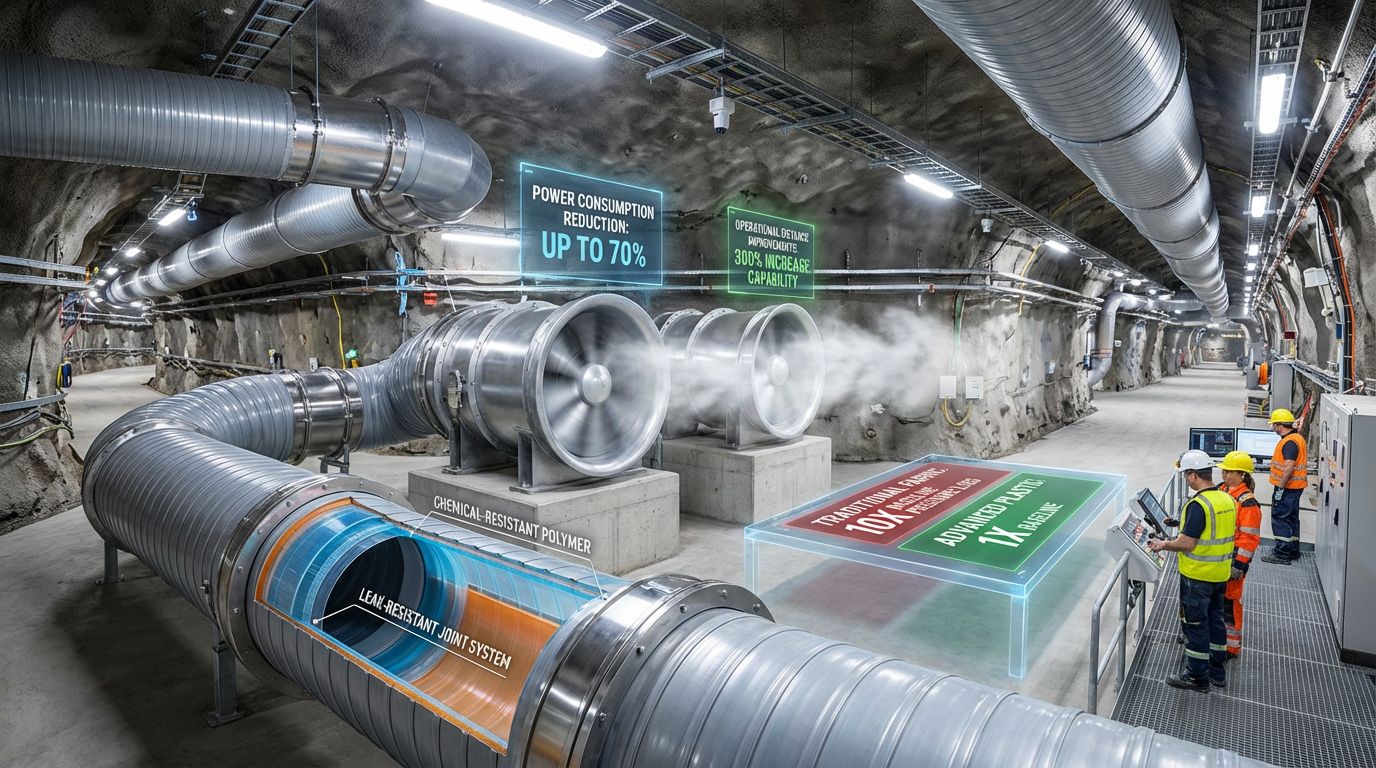
Advanced plastic duct systems demonstrate substantial performance advantages over traditional fabric alternatives. Testing data indicates that high-performance plastic ducts achieve pressure loss reductions of up to 90% compared to conventional fabric systems, enabling operations to extend ventilation distances by up to 300% or reduce operating costs by as much as 70%.
| Duct Type | Pressure Loss Factor | Operational Distance | Durability (Years) |
|---|---|---|---|
| Traditional Fabric | 10x baseline | Limited range | 2-3 |
| Advanced Plastic | 1x baseline | 3x extended reach | 10+ |
The durability differential between advanced plastic and traditional fabric systems creates significant total cost of ownership advantages. While fabric ducts typically require replacement every 2-3 years due to material degradation and damage, advanced plastic systems can maintain operational integrity for over 10 years under comparable conditions.
This technological advancement aligns with broader mining industry innovation trends that prioritise efficiency and sustainability in mining operations.
Energy Efficiency Metrics and Performance Indicators
Power consumption reduction potential reaches up to 70% in optimised implementations of advanced ventilation systems. This efficiency gain results from reduced air leakage through superior sealing technologies and lower pressure loss characteristics that enable fan systems to operate at reduced power levels while maintaining target airflow rates.
Airflow optimisation through leak-resistant materials addresses one of the primary inefficiencies in traditional ventilation systems. Conventional fabric ducts experience significant air losses through seam failures and material permeability, requiring oversized fan systems to compensate for these losses.
Total cost of ownership analysis over operational lifecycles demonstrates that initial capital investments in advanced systems typically achieve payback periods of 18-24 months through reduced energy consumption and maintenance requirements. This economic advantage becomes even more significant when considering renewable energy integration strategies in modern mining operations.
How Do Smart Ventilation Systems Transform Underground Operations?
Automated Control Integration Technologies
Real-time monitoring systems incorporate sensor networks that provide continuous feedback on air quality parameters, pressure differentials, and flow rates throughout the ventilation network. These systems enable dynamic adjustments to maintain optimal conditions while minimising energy consumption.
Variable speed drive implementation allows for responsive airflow adjustment based on real-time operational requirements. This technology enables fan systems to operate at optimal efficiency levels rather than fixed-speed operation that often results in energy waste.
Integration with mine management systems creates comprehensive operational optimisation opportunities by coordinating ventilation control with production scheduling, personnel movement, and equipment deployment throughout the underground facility. These smart VOD systems are revolutionising how mines approach air quality management.
Advanced Engineering Design Methodologies
Computational fluid dynamics (CFD) modelling applications enable engineers to optimise ventilation system design before installation, reducing trial-and-error approaches that characterise traditional system design. These modelling tools can predict airflow patterns, identify potential dead air zones, and optimise fan placement for maximum effectiveness.
Specialised software tools like DuctCalculator enable precise system specifications by analysing site-specific parameters including tunnel geometry, elevation changes, and environmental conditions. This approach ensures optimal duct sizing, material selection, and fan configuration for each unique application.
Thermodynamic analysis for temperature and humidity control incorporates heat transfer calculations that account for geothermal effects, equipment heat generation, and human metabolic heat production to maintain acceptable working conditions throughout the ventilation network.
Which Engineering Innovations Drive Ventilation System Performance?
Material Science Breakthroughs in Duct Manufacturing
Polymer engineering advances have produced materials with enhanced durability and flexibility characteristics specifically designed for harsh underground environments. These materials demonstrate superior chemical resistance to the acidic and corrosive conditions commonly encountered in mining operations.
Leak-resistant joint technologies represent a critical innovation in ductwork design, addressing the primary failure point in traditional ventilation systems. Advanced joining methods create sealed connections that maintain integrity under the pressure fluctuations and mechanical stress typical of underground installations.
Chemical resistance specifications ensure long-term performance in environments with elevated concentrations of hydrogen sulphide, methane, and other corrosive gases that can rapidly degrade conventional materials.
Installation and Maintenance Optimisation Techniques
Vertical ventilation system designs enable rapid deployment in mine operations by simplifying installation procedures and reducing the specialised equipment required for system setup. These innovations allow faster and safer installation compared to traditional horizontal ductwork configurations.
Modular component systems reduce installation complexity by standardising connections and eliminating the need for custom fabrication at installation sites. This approach reduces both installation time and the potential for human error during system assembly.
Predictive maintenance protocols extend equipment lifespan by utilising sensor data to identify potential failure points before they result in system downtime. This approach transforms maintenance from reactive to preventive, reducing both costs and operational disruptions whilst contributing to improved mining waste management solutions through more efficient operations.
Where Are Advanced Ventilation Technologies Making the Greatest Impact?
Global Adoption Patterns and Regional Implementation
North American mining operations demonstrate the highest adoption rates for advanced ventilation technologies, with Quebec province showing over 95% utilisation of high-performance plastic duct systems in major mining operations. This adoption reflects both regulatory requirements and economic incentives that favour efficient ventilation solutions.
| Region | Advanced System Adoption | Regulatory Framework | Performance Standards |
|---|---|---|---|
| North America | 95%+ in major operations | Strict enforcement | High precision monitoring |
| Latin America | Emerging adoption | General requirements | Growing specification focus |
| Asia-Pacific | Variable implementation | Mixed standards | Increasing compliance focus |
Latin American markets show emerging adoption patterns with positive initial results. Mexico demonstrates a 100% repurchase rate among mining companies that have implemented advanced ventilation systems, indicating strong satisfaction with performance outcomes.
Regional expertise networks spanning Mexico, Peru, Chile, and Canada provide technical support and system optimisation services that facilitate technology transfer from established markets to emerging adoption regions. These developments are often showcased at events like the global resources innovation expo, where industry leaders share best practices.
Case Study Analysis: Performance Improvements in Deep Mining Operations
Operational distance improvements of up to 300% have been documented in implementations where advanced plastic duct systems replace traditional fabric installations. These improvements enable mining operations to extend ventilation to previously inaccessible working faces without requiring intermediate fan stations.
Energy cost reductions ranging from 40-70% have been achieved in documented implementations across various mining operations. These savings result from improved system efficiency and reduced maintenance requirements that lower total operational costs.
Safety enhancement metrics through improved air quality management demonstrate measurable improvements in worker health indicators and reduced incidents related to air quality deficiencies. Furthermore, mine ventilation innovations continue to evolve, providing even greater safety benefits.
What ROI Can Mining Operations Expect from Ventilation System Upgrades?
Financial Performance Analysis Framework
Initial capital investment versus operational savings calculations typically demonstrate payback periods of 18-24 months for comprehensive ventilation system upgrades. The analysis must account for energy cost reductions, maintenance savings, and productivity improvements through enhanced working conditions.
Energy cost reduction quantification requires detailed analysis of current consumption patterns and projected savings from improved system efficiency. These calculations should incorporate local energy pricing trends and potential future rate increases that may accelerate payback periods.
Maintenance cost comparisons over 10-year periods reveal significant savings potential when comparing traditional fabric systems requiring replacement every 2-3 years against advanced plastic systems with operational lifespans exceeding 10 years.
Productivity improvements through enhanced working conditions include reduced heat stress incidents, improved air quality compliance, and better overall working environment conditions that can positively impact worker performance and retention.
Risk Mitigation and Compliance Value Proposition
Regulatory compliance cost avoidance represents a significant but often undervalued benefit of advanced ventilation systems. Enhanced air quality monitoring and control capabilities reduce the risk of regulatory violations and associated penalties.
Worker safety improvement quantification includes reduced incidents related to poor air quality, heat stress, and respiratory issues that can result in both direct medical costs and indirect productivity losses.
Environmental impact reduction benefits align with growing ESG requirements that affect mining company valuations and access to capital markets. Advanced ventilation systems typically demonstrate lower energy consumption and reduced environmental footprint compared to conventional alternatives.
Insurance and liability considerations may favour operations with advanced ventilation systems through reduced premium rates and lower liability exposure related to worker health and safety incidents.
How Should Mining Engineers Evaluate Ventilation System Specifications?
Technical Assessment Criteria and Performance Benchmarks
Airflow capacity requirements per operational zone must account for the number of workers, equipment heat generation, and specific contaminant removal needs in each area of the underground facility. These calculations should incorporate safety margins to ensure adequate performance under varying operational conditions.
Pressure resistance specifications for varying depths require careful analysis of elevation changes, tunnel geometry, and expected pressure differentials throughout the ventilation network. Systems must maintain adequate performance across the full range of operational conditions.
Environmental durability standards for chemical exposure should specify resistance to the specific chemical conditions expected in each mining environment, including pH levels, corrosive gas concentrations, and temperature extremes.
Integration compatibility with existing infrastructure requires assessment of connection interfaces, control system compatibility, and modification requirements for current ventilation infrastructure.
Implementation Planning and Project Management Considerations
Site-specific engineering assessment protocols should include comprehensive analysis of tunnel geometry, geological conditions, operational requirements, and integration challenges with existing systems. This assessment forms the foundation for optimal system design.
Installation timeline optimisation strategies must balance system performance goals with operational continuity requirements. Phased implementation approaches can minimise disruption to ongoing mining operations while achieving ventilation system improvements.
Personnel training requirements for system operation include both initial training for system startup and ongoing education to maintain optimal performance. Training programs should address both routine operation and troubleshooting procedures.
Post-installation performance verification procedures ensure that installed systems meet design specifications and provide documentation for regulatory compliance and warranty purposes.
What Future Developments Will Shape Underground Ventilation Technology?
Emerging Technologies and Innovation Trends
IoT sensor integration for predictive analytics enables continuous monitoring of system performance parameters and early identification of potential issues before they result in system failures or performance degradation. This technology supports transition from reactive to predictive maintenance approaches.
Machine learning applications in airflow optimisation can analyse historical performance data to identify patterns and optimise system operation for changing conditions. These systems can automatically adjust ventilation parameters to maintain optimal conditions while minimising energy consumption.
Sustainable material development in duct manufacturing focuses on recyclable materials and manufacturing processes that reduce environmental impact. These developments align with growing ESG requirements in the mining industry.
Integration with renewable energy systems creates opportunities to power ventilation systems with solar, wind, or other renewable sources, further reducing operational costs and environmental impact. This approach to transforming underground mining through smarter ventilation systems represents the future of sustainable mining operations.
Industry Standards Evolution and Regulatory Outlook
Enhanced environmental compliance requirements are driving more stringent air quality standards and monitoring requirements across global mining jurisdictions. These requirements favour advanced ventilation systems with superior control and monitoring capabilities.
International best practice standardisation trends suggest convergence toward more stringent and specific ventilation requirements, particularly in emerging mining markets that currently have less developed regulatory frameworks.
Digital monitoring and reporting mandate developments require comprehensive data collection and reporting capabilities that traditional ventilation systems cannot provide. Advanced systems with integrated monitoring capabilities are better positioned to meet these evolving requirements.
Energy efficiency regulation implications may create mandatory efficiency standards that favour advanced ventilation technologies over traditional approaches, potentially accelerating adoption rates across the global mining industry.
Key Takeaways for Mining Operation Optimisation
Strategic Implementation Recommendations
Comprehensive system assessment before technology adoption ensures optimal system selection and design for specific operational requirements. This assessment should include technical, financial, and operational considerations that affect long-term system performance.
Phased implementation approaches for large-scale operations can minimise operational disruption while achieving ventilation improvements in priority areas. This strategy allows for performance validation and refinement before full-scale deployment.
Continuous performance monitoring and optimisation protocols ensure that ventilation systems maintain optimal efficiency throughout their operational lifespan. Regular monitoring enables identification of performance degradation and optimisation opportunities.
Investment in technical training for operational personnel ensures effective system operation and maintenance, maximising return on investment in advanced ventilation technology. Consequently, transforming underground mining through smarter ventilation requires both technological advancement and human expertise development.
Performance Monitoring and Continuous Improvement Framework
Key performance indicators for ventilation system effectiveness should include energy consumption per unit airflow, system pressure differentials, air quality parameters, and maintenance requirements. Regular monitoring of these indicators enables identification of optimisation opportunities.
Regular efficiency auditing procedures provide systematic evaluation of system performance against design specifications and industry benchmarks. These audits should identify both immediate issues and long-term trends that affect system efficiency.
Technology upgrade pathway planning ensures that ventilation systems remain current with evolving technology and regulatory requirements. This planning should include both incremental improvements and major system upgrades over the operational lifespan.
Industry benchmark comparison methodologies enable mining operations to evaluate their ventilation performance against industry best practices and identify opportunities for improvement. Through implementing these comprehensive strategies for transforming underground mining through smarter ventilation, operations can achieve significant improvements in safety, efficiency, and environmental performance.
Disclaimer: The performance claims and cost reduction estimates presented in this article are based on specific case studies and may not be applicable to all mining operations. Actual results will vary based on site-specific conditions, system design, and operational factors. Mining operators should conduct thorough engineering assessments and consider multiple factors when evaluating ventilation system investments.
Looking for Investment Opportunities in Mining Innovation?
Discovery Alert's proprietary Discovery IQ model delivers real-time alerts on significant ASX mineral discoveries, instantly empowering subscribers to identify actionable opportunities as mining companies announce breakthrough technologies and operational improvements. Begin your 30-day free trial today and secure your market-leading advantage in this rapidly evolving sector.