
July 10, 2026
The Geology of Leverage: Why Uranium's Biggest Trade Story Is Still Being Underestimated
The global uranium market operates on a logic that most commodity markets do not: scarcity is not primarily geological, it is political. The world has no shortage of uranium in the ground. What it has historically lacked is the diplomatic architecture to move that uranium from resource-rich nations to energy-hungry ones. When those barriers collapse, the consequences for supply chains, pricing, and investment can be substantial, and often arrive faster than markets anticipate.
That is precisely the context in which the Australia and India uranium export deal demands serious attention. Not simply as a bilateral trade announcement, but as the resolution of a structural blockage that has constrained one of the most consequential potential supply relationships in the nuclear fuel cycle for over a decade.
When big ASX news breaks, our subscribers know first
From Political Intent to Operational Reality: Understanding the 12-Year Gap
The civil nuclear cooperation agreement between Australia and India was first signed in 2014 under the Abbott Government. At the time, it was widely described as a landmark moment in the bilateral relationship. The problem was that landmark moments in diplomacy do not automatically translate into functional trade mechanisms.
The 2014 pact established the political will for uranium exports but left critical operational and administrative questions unresolved. Chief among these was Australia's longstanding export policy, which historically required recipient nations to be signatories to the Nuclear Non-Proliferation Treaty (NPT). India, which conducted its first nuclear weapons test in 1974 and has maintained an independent nuclear deterrent ever since, has never signed the NPT and has no intention of doing so.
The NPT Problem and the IAEA Solution
For decades, India's non-NPT status placed it outside the boundaries of Australia's uranium export policy. The policy was not simply a bureaucratic quirk. It reflected a genuine non-proliferation concern: that supplying uranium to a nuclear-armed state outside the NPT framework could undermine the global arms control architecture.
What changed the calculus was India's ratification of an Additional Protocol to its International Atomic Energy Agency (IAEA) safeguards agreement. This protocol is a significantly more rigorous inspection and verification regime than the baseline safeguards framework. Critically, it requires India to maintain a verifiable and auditable separation between its civilian nuclear energy infrastructure and its military nuclear programme.
Under the Additional Protocol, IAEA inspectors gain broader access rights, shorter notice requirements for inspections, and the ability to use environmental sampling and satellite imagery as verification tools. This was not a trivial concession. The Additional Protocol gave Australian policymakers a defensible non-proliferation rationale for reconsidering the export restriction.
The 2008 NSG Waiver: The Precedent That Made This Possible
A less commonly discussed but critically important piece of the puzzle is the Nuclear Suppliers Group (NSG) waiver granted to India in 2008. The NSG is a 48-nation grouping that controls exports of nuclear materials and technology. Granting India a waiver despite its non-NPT status was a contentious and historically significant decision. It effectively created a new category in international nuclear commerce: the responsible non-NPT nuclear state.
The 2008 NSG waiver did not just open doors for India commercially. It established a normative precedent that India could be treated as a de facto member of the responsible nuclear states club without formally joining the NPT. Australia's decision to activate the 2014 agreement follows the logic established by that waiver, even if it took an additional 12 years to work through the domestic policy and administrative mechanisms required.
What the 2026 Administrative Agreement Actually Did
The administrative arrangement signed in Melbourne between Prime Ministers Anthony Albanese and Narendra Modi in 2026 resolved the outstanding technical, regulatory, and procedural barriers that had previously prevented actual uranium shipments from commencing. As reported by Reuters, the meeting placed uranium and defence cooperation at the centre of the bilateral agenda.
The 2014 agreement was the treaty-level instrument. The 2026 arrangement is the operational enabler — the mechanism that converts a political commitment into a commercially executable supply relationship. This distinction matters enormously for understanding the market implications.
The question for Australia's uranium sector is no longer whether exports to India are legally permissible. They now are. The question is how quickly the commercial infrastructure, including producer offtake agreements, logistics chains, and Indian utility procurement processes, can be built out to translate the agreement into physical uranium flows.
The Safeguards Architecture: How Non-Proliferation Concerns Are Being Managed
Any serious analysis of the Australia and India uranium export deal must engage with the non-proliferation dimension honestly, because it is the most technically complex and geopolitically sensitive aspect of the arrangement.
Civilian-Military Separation and IAEA Verification
All Australian uranium supplied under the deal is restricted exclusively to civilian nuclear energy purposes. This is not simply a contractual representation. It is enforced through the IAEA safeguards framework, which requires India to designate specific facilities as civilian, subject those facilities to ongoing international inspection, and maintain documented material accounting showing where Australian-supplied uranium has been used.
The IAEA's Additional Protocol inspection regime includes provisions for short-notice and complementary access inspections, meaning Indian authorities cannot simply restrict inspector access to pre-approved sites. Environmental sampling techniques can, furthermore, detect undeclared nuclear activities even in locations not formally subject to inspection.
The Fungibility Debate
A legitimate technical concern raised by non-proliferation specialists is the issue of uranium fungibility. The argument runs as follows: uranium is uranium at the point of enrichment. If India receives Australian uranium for its civilian reactors, it frees up domestically mined uranium that might otherwise have been directed to civilian use, effectively creating additional headroom for military programme inputs.
Proponents of the deal counter that this argument, taken to its logical conclusion, would make all uranium exports to any nuclear-armed state inadvisable, including exports to the United States, the United Kingdom, and France. The Additional Protocol's civilian-military separation requirement is designed precisely to address this concern by creating a verified accounting boundary between the two domains.
Whether one finds this framework entirely satisfactory is partly a function of risk tolerance, but it is the same framework that governs Australia's uranium exports to other partners including the UAE. Furthermore, understanding the broader uranium supply and demand picture helps contextualise why these frameworks matter so much to market stability.
India's 100 GW Nuclear Target: The Demand Signal That Changes the Market
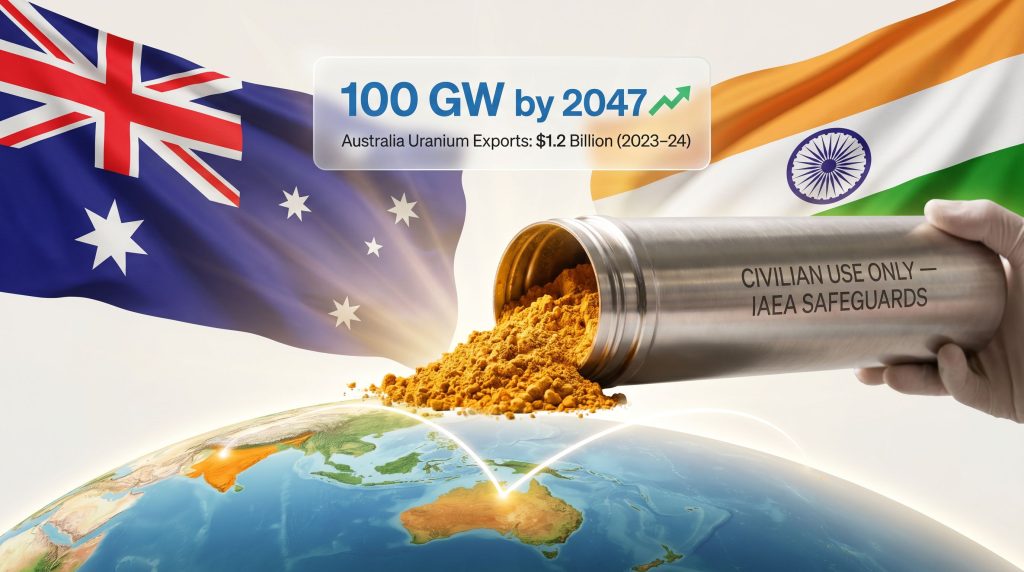
The scale of India's nuclear ambition is not always fully appreciated in Western energy market analysis. India has set a national target of reaching 100 gigawatts of nuclear power capacity by 2047, timed to align with the centenary of Indian independence.
The Scale of the Challenge
| Metric | Detail |
|---|---|
| Current nuclear installed capacity | Approximately 8 GW |
| 2047 target capacity | 100 GW |
| Growth multiple required | Approximately 12.5x current capacity |
| Implied new reactor programme | Among the largest in history |
| Australian uranium's role | Primary fuel supply for civilian fleet |
To put this in perspective, the United States, the world's largest nuclear power generator, has approximately 95 GW of installed nuclear capacity built over roughly six decades. India is proposing to build a programme of equivalent scale in approximately two decades. Even accounting for the likelihood that timelines slip, the directional demand signal is unambiguous and structurally significant.
Why India Is Turning to Nuclear Rather Than Renewables Alone
India faces a specific energy challenge that intermittent renewables cannot fully resolve: the combination of rapidly growing baseload electricity demand, a domestic coal resource base that contributes substantially to air pollution, and grid infrastructure that cannot yet support the frequency and voltage stability requirements of a renewables-dominant system at scale.
Nuclear power provides firm, dispatchable, low-carbon baseload electricity, which is precisely what India's grid needs as a complement to solar and wind. The economics of nuclear in India also differ from Western markets because labour costs are significantly lower, the regulatory approval pathway for state-owned reactor programmes is less litigious, and India has developed proprietary reactor designs.
These include pressurised heavy water reactors and fast breeder reactors that can eventually operate on thorium, of which India holds the world's largest known reserves. This thorium angle is particularly underappreciated. India's long-term nuclear strategy involves a three-stage programme: use imported uranium to fuel conventional reactors, use the plutonium produced as a byproduct to fuel fast breeder reactors, and eventually transition to a thorium fuel cycle.
Australian uranium exports are therefore not just meeting near-term demand. They are providing the foundational fuel input for the first stage of a multi-decade energy strategy.
Economic Dimensions: What the Deal Means for Australia's Uranium Sector
Australia's uranium export earnings totalled approximately $1.2 billion in 2023-24, providing a measurable baseline against which the India deal's incremental value can eventually be assessed. The multi-billion dollar characterisation of the deal's long-term potential is plausible given the scale of India's planned nuclear expansion, though precise contract volumes and pricing have not been publicly disclosed.
Export Diversification as a Strategic Imperative
Australia's resource export revenue has historically been heavily concentrated toward a small number of destination markets, with China representing a dominant share across multiple commodity categories. The India uranium deal is explicitly part of a strategic effort to diversify the destination mix for Australian resource exports.
Australia's existing civil nuclear agreements span a carefully selected group of partners:
| Partner Country | NPT Signatory | Agreement Operational Since | Key Safeguard Conditions |
|---|---|---|---|
| United States | Yes | 1981 | Standard IAEA safeguards |
| South Korea | Yes | 1979 | Standard IAEA safeguards |
| United Arab Emirates | Yes | 2012 | Enhanced non-proliferation conditions |
| India | No | 2026 (pact signed 2014) | IAEA Additional Protocol + civilian-military separation |
India's inclusion in this group is strategically significant beyond the commercial dimension. It aligns uranium trade with the Quad partnership framework, in which Australia, India, the United States, and Japan cooperate on regional stability and supply chain resilience.
Implications for Australia's Uranium Mining Sector
Global uranium reserves are concentrated significantly in Australia, which holds the largest known reserves in the world, primarily in South Australia and the Northern Territory. Key assets in these jurisdictions have operated for decades, but the sector has experienced prolonged investment uncertainty driven by policy ambiguity and price volatility.
The India deal provides something the sector has lacked: a credible, long-duration demand signal from a market with a constitutionally embedded commitment to nuclear expansion. This type of signal is qualitatively different from spot market price movements. It supports the investment case for projects currently in feasibility stage or on care-and-maintenance status, because it demonstrates that a large, creditworthy, sovereign-backed buyer exists and intends to procure uranium at scale for at least two decades.
"Uranium project economics are highly sensitive to long-term contract visibility. A single large offtake agreement can transform a project's bankability overnight. The India deal creates the conditions under which multiple such agreements become possible."
Uranium Price Dynamics and Investor Implications
Spot uranium prices have experienced considerable volatility in recent years, with the U3O8 spot price rising sharply through 2023 before moderating. Long-term contract markets, which is where the majority of utility procurement occurs, have been tightening as utilities recognise that the post-Fukushima oversupply era has ended and new supply development has been insufficient.
A sustained Indian procurement programme operating through long-term contracts would provide structural floor support to contract market pricing. Consequently, for investors in uranium equities and uranium-focused exchange-traded funds, the deal represents a demand-side catalyst that extends the runway for uranium price support well beyond the current cycle. The uranium investment outlook has, in turn, strengthened considerably on the back of this development.
The broader uranium market dynamics at play here also intersect with geopolitical supply risks, including the impact of the Russian uranium import ban on Western utilities' procurement strategies — further underlining why the Australia-India agreement arrives at a particularly opportune moment.
Investors should note that uranium market dynamics involve long lead times between policy announcements and physical supply changes, and commodity price forecasts carry inherent uncertainty. This analysis does not constitute financial advice.
The Broader Strategic Partnership: More Than a Uranium Deal
The uranium agreement was signed alongside a broader bilateral declaration that extends cooperation across defence, critical minerals supply chains, renewable energy, and green hydrogen. This framing is deliberate. It positions uranium trade not as a standalone commodity transaction but as one element of a comprehensive strategic realignment.
For India, securing a reliable uranium supply from a geopolitically aligned, rule-of-law jurisdiction with the world's largest reserves addresses a genuine energy security vulnerability. India's domestic uranium resources are limited relative to its planned reactor programme, making import dependency a structural reality. As reported by the AFR, Australia's uranium miners are well positioned to capitalise on the scale of India's energy ambitions.
Australia is the ideal counterpart: abundant reserves, stable governance, an existing IAEA safeguards framework, and a shared interest in deepening Indo-Pacific partnership. For Australia, the deal delivers a durable new demand market for a commodity in which it holds structural geological advantage, while simultaneously anchoring a bilateral relationship with a nation that will be the world's most populous country and one of its largest economies through the mid-century period.
The next major ASX story will hit our subscribers first
Frequently Asked Questions
Why did it take 12 years to activate the 2014 agreement?
The 2014 pact established the legal and political framework for uranium exports but left the operational mechanisms unresolved. India's non-NPT status required Australia to work through the implications of its own export policy, and the technical conditions around IAEA safeguards implementation took time to negotiate and formalise. The 2026 administrative arrangement resolved these outstanding barriers.
Is Australian uranium being used for India's weapons programme?
The agreement explicitly restricts all Australian-supplied uranium to civilian nuclear energy purposes. IAEA safeguards, including the Additional Protocol's inspection and verification regime, enforce this restriction. Australia retains the right to suspend exports if safeguard conditions are breached.
Which Australian uranium mines will supply India?
Specific supply allocations will be determined through commercial negotiations between producers and Indian counterparties. Australia's primary uranium production comes from operations in South Australia and the Northern Territory, and these regions would logically be the primary source of supply. The deal's activation may also accelerate project development decisions for assets currently in feasibility or care-and-maintenance status.
What is the deal worth financially?
Exact volumes and contract values have not been publicly disclosed. Australia's total uranium export earnings were approximately $1.2 billion in 2023-24, and the Australia and India uranium export deal is broadly characterised as having multi-billion dollar long-term potential, consistent with the scale of India's planned nuclear expansion.
Does this affect Australia's relationship with China?
The deal is structured as an export diversification initiative, reducing concentration risk in Australia's resource export mix. It does not directly alter existing uranium trade relationships. Strategically, it deepens Australia's resource partnerships with Indo-Pacific democratic partners, which is consistent with the direction of Australian foreign policy more broadly.
Want to Know Which ASX Uranium Stocks Could Benefit From India's Nuclear Expansion?
Discovery Alert's proprietary Discovery IQ model delivers real-time alerts on significant ASX mineral discoveries — including uranium — the moment they hit the exchange, turning complex data into actionable opportunities before the broader market reacts. Explore historic discoveries and their returns on Discovery Alert's dedicated discoveries page, then begin your 14-day free trial at Discovery Alert to position yourself ahead of the next major uranium announcement.