July 22, 2026
The Invisible Bottleneck Holding Back America's Nuclear Future
Most discussions about nuclear energy security in the United States centre on uranium mining, enrichment capacity, or reactor construction timelines. Far less attention lands on the chemical step that sits between raw ore and reactor-ready fuel. Yet this intermediate process, uranium conversion, represents one of the most structurally fragile points in the entire domestic nuclear fuel cycle. Understanding why, and what is being done about it, requires a closer look at the uranium conversion technology research agreement now gaining traction, alongside the chemistry, geopolitics, and emerging wave of research investment targeting this gap.
When big ASX news breaks, our subscribers know first
What Uranium Conversion Actually Does, and Why It Cannot Be Skipped
The Chemistry That Connects Mining to Enrichment
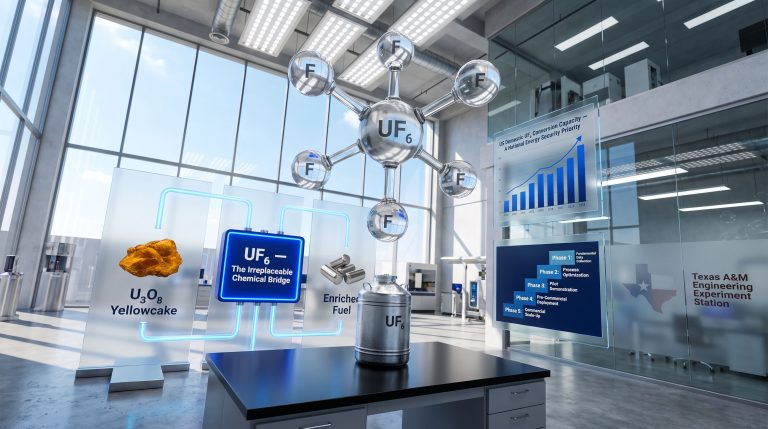
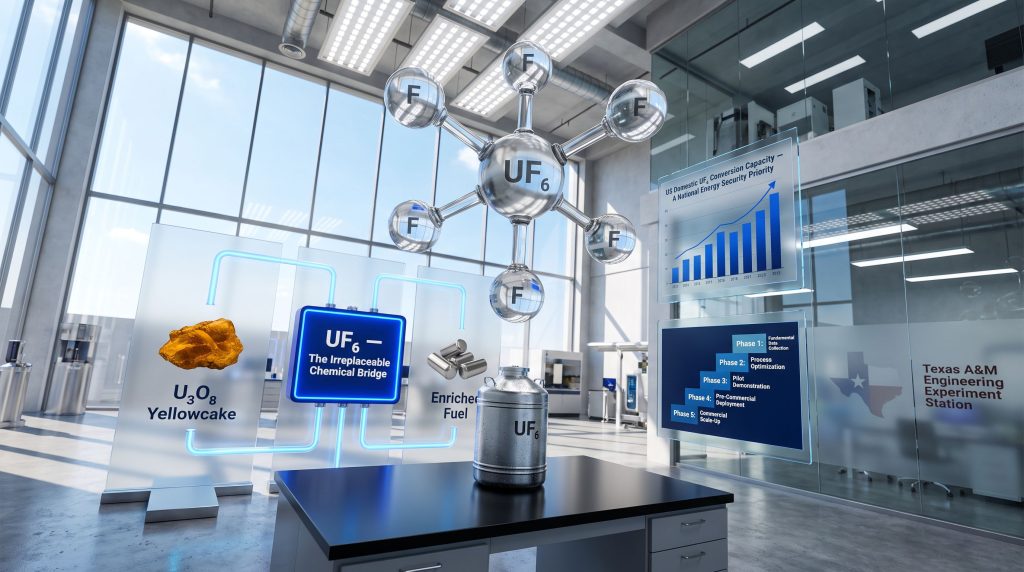
When uranium is extracted from the earth and processed at a mill, the product is a coarse powder called yellowcake, chemically represented as uranium oxide (U₃O₈). This material cannot be fed directly into an enrichment facility. Before the concentration of the fissile uranium-235 isotope can be increased to levels suitable for reactor use, the uranium must first be transformed into a gaseous compound that is chemically compatible with centrifuge enrichment technology.
That compound is uranium hexafluoride, or UF₆. It is produced through a multi-stage fluorination process that subjects uranium oxide to increasingly reactive fluorine-bearing agents under carefully controlled temperature and pressure conditions. The result is a compound that exists as a gas above 56 degrees Celsius, making it uniquely suited to the gaseous centrifuge separation process used in virtually every commercial enrichment facility operating today.
What makes UF₆ indispensable is not arbitrary convention but fundamental physics. The centrifuge separation of U-235 from U-238 depends on the slight mass difference between isotopes. To exploit that mass difference at scale, the uranium must be in gaseous form. According to uranium enrichment experts, UF₆ is the only uranium compound that achieves this at practical industrial temperatures without decomposing or reacting destructively with containment materials at manageable engineering standards.
The Nuclear Fuel Cycle: A Step-by-Step Framework
| Fuel Cycle Stage | Input Material | Output Material | Key Process |
|---|---|---|---|
| Mining and Milling | Uranium ore | Yellowcake (U₃O₈) | Chemical extraction |
| Conversion | Yellowcake (U₃O₈) | Uranium hexafluoride (UF₆) | Fluorination chemistry |
| Enrichment | UF₆ | Enriched UF₆ | Centrifuge separation |
| Fuel Fabrication | Enriched UF₆ | Fuel pellets and assemblies | Reconversion and sintering |
| Reactor Use | Fuel assemblies | Heat and electricity | Fission |
The table above makes clear that conversion is not a peripheral step. It is the chemical gateway through which all upstream uranium production must pass before enrichment becomes possible. Any constraint at this stage propagates directly into enrichment shortfalls and, ultimately, reactor fuel availability.
America's Single-Facility Problem: A Structural Vulnerability
The United States currently operates just one commercial uranium conversion facility serving its entire domestic nuclear fuel supply chain. This is not a temporary transitional state but the product of decades during which imported conversion services from overseas providers, particularly in Europe, were economically competitive enough to discourage domestic investment in new capacity.
That market logic made sense in an era of stable geopolitics and open trade relationships. It has become considerably less defensible as energy security considerations have moved to the centre of national industrial strategy. Furthermore, the US ban on Russian uranium has intensified scrutiny of every dependency point in the domestic fuel cycle. A disruption to the sole domestic conversion facility, whether from operational failure, regulatory action, or physical damage, would leave US nuclear utilities entirely dependent on foreign conversion services to keep reactors fuelled.
The United States imports a substantial portion of its uranium conversion services from foreign providers, including facilities in France, Russia, and Canada. As the nuclear sector's role in decarbonisation planning expands, the strategic case for rebuilding domestic conversion capacity has shifted from a niche concern to a mainstream policy priority.
The asymmetry is striking. The US operates the world's largest fleet of commercial nuclear reactors, generating roughly 18 to 19 percent of national electricity from nuclear sources, yet relies on a single domestic conversion point as its first line of defence against supply disruption in the fuel cycle. The vulnerability is compounded by the fact that UF₆ production requires specialised equipment, trained personnel, and regulatory approvals that cannot be rapidly mobilised in a crisis. Consequently, the uranium supply-demand volatility now evident across global markets makes this structural weakness increasingly difficult to ignore.
The QLE-TEES Research Agreement: Building the Engineering Foundation
Why Fundamental Data Collection Comes Before Plant Construction
Expanding domestic uranium conversion capacity is not simply a matter of political will or capital investment. Before any company can justify the expenditure required to build a new conversion facility, it needs validated process data that confirms reaction kinetics, thermodynamic parameters, material compatibility, and cost modelling at scales approaching commercial production. Without this foundation, regulatory submissions to the Nuclear Regulatory Commission lack the technical credibility required for licensing approval, and investment decisions lack the risk-adjusted returns that capital providers require.
This is precisely the logic underpinning the uranium conversion technology research agreement signed between Quantum Leap Energy (QLE) and the Texas A&M Engineering Experiment Station (TEES). The collaboration is designed to generate fundamental physicochemical data on the reactions involved in converting U₃O₈ into high-purity UF₆, providing the evidentiary basis for process design, engineering modelling, and eventual scale-up decisions.
QLE is a development-stage nuclear fuels company and a subsidiary of ASP Isotopes (ASPI), which is dual-listed on both the JSE and Nasdaq. ASP Isotopes recently announced details of this collaboration, describing it as a significant step forward for domestic nuclear fuel-cycle infrastructure. ASPI was incorporated in 2021 but traces its technological heritage to South Africa's uranium enrichment programme of the 1980s, giving the organisation a lineage in isotope separation science that predates the modern centrifuge enrichment industry in many respects. Beyond its QLE subsidiary, ASPI also holds a majority stake in PET Labs South Africa, a provider of nuclear medicine services operating across sub-Saharan Africa.
TEES, as a State agency within the Texas A&M University System, brings a complementary mandate to the partnership. Its institutional mission encompasses applied research, technology commercialisation, and workforce development, positioning it as an appropriate counterpart for an industry partner seeking to convert laboratory chemistry into commercial engineering solutions.
What the Research Programme Is Designed to Produce
The specific outputs targeted by the QLE-TEES collaboration cover several interconnected technical objectives:
- Characterisation of the reaction kinetics and thermodynamic properties governing the fluorination conversion pathway from U₃O₈ to UF₆
- Identification of process conditions that maximise conversion efficiency while meeting the high-purity UF₆ specifications demanded by commercial enrichment facilities
- Development of process design parameters and engineering models that support scale-up projections from bench-scale experiments to pilot and ultimately commercial production volumes
- Generation of data packages suitable for supporting future regulatory submissions and commercial feasibility assessments
- Exploration of cost reduction pathways that could make domestically produced UF₆ competitive with established international conversion providers
TEES Associate Agency Director and Professor of Nuclear Engineering Dr Lin Shao has noted that the research is expected to strengthen the engineering foundation for QLE's conversion technology commercialisation efforts, contribute to a more resilient US nuclear fuel supply chain, and support the development of a more robust nuclear ecosystem in Texas.
The Scale-Up Pathway: From Laboratory to Commercial Facility
The journey from research agreement to operating conversion plant involves a structured progression through technically and commercially distinct phases:
- Phase 1 – Fundamental data collection: Characterise reaction kinetics, thermodynamics, and physicochemical properties at bench scale under controlled laboratory conditions.
- Phase 2 – Process modelling: Construct engineering models that use laboratory data to predict performance at larger production scales and identify potential failure modes.
- Phase 3 – Pilot-scale validation: Test process configurations at intermediate scale to surface practical engineering challenges before full capital commitment is required.
- Phase 4 – Regulatory engagement: Compile data packages meeting NRC documentation standards to support licensing applications and environmental review processes.
- Phase 5 – Commercial scale-up: Deploy validated and licensed process designs in a commercially viable conversion facility capable of meaningfully contributing to domestic UF₆ supply.
The current QLE-TEES agreement sits at Phase 1, which is exactly where it should be for a development-stage company seeking to de-risk its technology before approaching capital markets for plant-scale investment.
The Technical Challenges That Make UF₆ Production Genuinely Difficult
Why Commercial Conversion Is Not a Simple Chemistry Problem
Uranium hexafluoride production involves some of the most demanding process chemistry in the nuclear fuel cycle. Several engineering challenges make scaling this process commercially non-trivial:
- Fluorination reaction management: The conversion pathway involves highly exothermic reactions with fluorine-bearing compounds. Managing heat generation at industrial scale without compromising product purity or creating runaway reaction conditions requires sophisticated reactor design and real-time process control.
- Materials compatibility: Fluorine chemistry is exceptionally corrosive to most common engineering materials. Identifying and qualifying reactor vessel materials, pipe systems, and containment infrastructure capable of withstanding continuous exposure to fluorine-rich environments across operational lifetimes of decades is a non-trivial materials science challenge.
- Purity specification compliance: Commercial enrichment facilities operate under strict UF₆ purity requirements. Impurities, including trace metals, moisture, or non-fluoride compounds, can damage centrifuge components, contaminate enriched product streams, or trigger regulatory non-compliance events.
- Regulatory licensing complexity: New commercial uranium conversion facilities must navigate a licensing pathway under NRC oversight that includes detailed safety analysis reports, environmental impact assessments, and site-specific engineering reviews. This process is lengthy and data-intensive, reinforcing the value of generating robust technical documentation at the research stage.
The conversion step is frequently underestimated because it sits between two better-understood processes: uranium mining on one side and enrichment on the other. But the fluorination chemistry involved is among the most technically demanding in the entire fuel cycle, and the barriers to entry are substantial.
Signals of a Broader Market Inflection Point
Parallel Developments Confirming Industry-Wide Interest
The QLE-TEES agreement does not exist in isolation. The broader uranium conversion sector is showing signs of renewed commercial interest after decades of consolidation and underinvestment. Indeed, the uranium market dynamics now shaping investment decisions have placed conversion capacity at the centre of strategic planning conversations across the industry.
Hadron Energy has separately entered into a uranium conversion services agreement with ConverDyn for domestic UF₆ supply, representing another data point confirming that multiple commercial actors are now pursuing strategies to diversify and expand domestic conversion access.
US Department of Energy investment programmes targeting domestic uranium fuel-cycle infrastructure have also contributed to an improving commercial environment for conversion-focused companies, though it is important to note that no specific government support has been confirmed for the QLE-TEES programme itself. The US uranium market disruption caused by tariff threats and geopolitical realignment has, however, strengthened the policy case for domestic solutions considerably.
The policy environment is reshaping the economics of domestic nuclear fuel production more broadly, with the Inflation Reduction Act including provisions relevant to nuclear energy deployment that improve the long-run revenue visibility for nuclear fuel suppliers.
Advanced Reactors and the Evolving UF₆ Demand Profile
The nuclear energy landscape is not static. The deployment of small modular reactors (SMRs) and advanced reactor designs, including those requiring high-assay low-enriched uranium (HALEU) as fuel, creates demand profiles for enriched uranium that differ meaningfully from those of conventional light water reactors. Critically, all of these advanced fuel types still require UF₆ as an intermediate feedstock at the enrichment stage, meaning that growth in advanced reactor deployment amplifies rather than alleviates pressure on conversion capacity.
This dynamic gives domestic conversion technology development a longer runway of commercial relevance than might be apparent from near-term reactor fleet considerations alone. Furthermore, the evolving uranium market trends point consistently towards tightening supply conditions that reward early movers in domestic fuel-cycle infrastructure.
The next major ASX story will hit our subscribers first
Texas as an Emerging Nuclear Technology Hub
Why State-Level Research Infrastructure Matters
Texas is positioning itself as a centre of gravity for the next generation of US nuclear fuel-cycle capability. The state already hosts significant nuclear power generation infrastructure, and the presence of TEES within the Texas A&M University System provides an established applied research base with genuine capacity to support nuclear engineering development at industrial relevance.
University-industry partnerships of the type exemplified by the QLE-TEES agreement also serve a workforce development function that extends beyond the immediate research programme. Building a technically skilled workforce capable of designing, constructing, and operating commercial conversion facilities is itself a constraint on the speed at which domestic conversion capacity can be expanded.
Research collaborations that engage graduate students and faculty in applied conversion chemistry problems contribute directly to this human capital pipeline. The multiplier effect of anchoring advanced nuclear research in a state with Texas's energy infrastructure, industrial base, and research university system should not be underestimated in terms of its long-run contribution to domestic nuclear fuel-cycle capability.
Frequently Asked Questions: Uranium Conversion Technology
What is uranium hexafluoride and why is it essential?
UF₆ is the chemical compound used as feedstock in uranium enrichment. It is produced from yellowcake through fluorination reactions and is the only uranium compound compatible with the gas centrifuge enrichment process used to concentrate fissile U-235.
How does conversion differ from enrichment?
Conversion changes the chemical form of uranium from solid oxide to gaseous hexafluoride, making it processable by enrichment equipment. Enrichment then adjusts the isotopic composition of that feedstock. Both steps are mandatory and sequential.
Why does the US have only one commercial conversion facility?
Decades of cost-competitive imported conversion services from international providers reduced the economic incentive for domestic investment. The resulting single-facility dependency has only recently been recognised as a strategic liability as energy security priorities have shifted.
What is the significance of a research-stage agreement?
Research agreements at this stage generate the validated technical data required to de-risk commercial investment decisions, support regulatory submissions, and underpin engineering scale-up models. They are the necessary precursor to plant-scale capital deployment.
How do advanced reactors affect conversion demand?
SMRs and HALEU-fuelled advanced reactors all require enriched uranium derived from UF₆ feedstock. Growth in these reactor types increases demand for conversion services, not reduces it.
Key Takeaways for Industry Observers and Investors
The uranium conversion segment is transitioning from a commercially overlooked infrastructure category into a strategic priority within the domestic nuclear fuel cycle. Several conclusions emerge from examining the QLE-TEES collaboration and its broader context:
- The single-facility dependency in US uranium conversion represents a genuine and underappreciated national energy security risk that is only beginning to receive commensurate attention.
- University-industry research partnerships are emerging as the most practical mechanism for building the technical data foundation needed to de-risk commercial conversion technology before large capital commitments are made.
- The QLE-TEES collaboration represents a uranium conversion technology research agreement of early-stage but structurally significant importance, embodying exactly the type of foundational work that responsible commercialisation of complex nuclear fuel-cycle technology requires.
- Parallel commercial activity from other industry participants confirms that this is a sector-wide inflection rather than an isolated corporate initiative.
- Texas is establishing itself as a meaningful hub for advanced nuclear fuel-cycle research, with state research infrastructure playing a catalytic role in aggregating technical and commercial capabilities.
This article contains forward-looking statements and analysis based on publicly available information. It does not constitute financial advice. Readers should conduct independent due diligence before making investment decisions related to companies or sectors discussed herein.
Want To Position Yourself Ahead Of The Next Major Nuclear Or Mineral Discovery?
Discovery Alert's proprietary Discovery IQ model delivers real-time alerts on significant ASX mineral discoveries, transforming complex data into actionable investment insights for both short-term traders and long-term investors. Explore how historic discoveries have generated substantial returns on Discovery Alert's dedicated discoveries page, and begin your 14-day free trial today to secure a market-leading advantage.