May 7, 2026
Strategic uranium supply chains are undergoing a fundamental transformation as Western nations confront decades of infrastructure neglect and geopolitical dependency. This reconfiguration represents not merely a policy response to recent events, but a comprehensive reimagining of energy security architecture that will reshape nuclear fuel markets for the next quarter-century. Understanding this shift requires examining the technological, economic, and strategic forces driving fuel cycle localization in the uranium industry.
Nuclear Fuel Cycle Architecture and Strategic Vulnerabilities
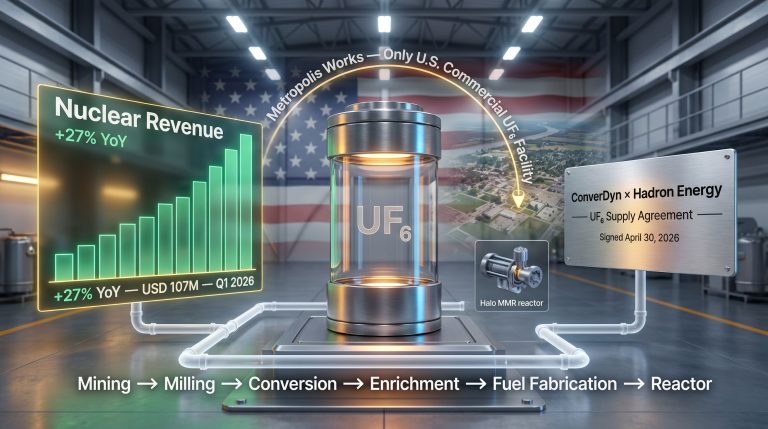
The nuclear fuel cycle encompasses seven distinct stages, each requiring specialised infrastructure and technical expertise. Natural uranium extraction through mining operations yields ore containing approximately 0.1-0.3% U3O8 concentration globally. Milling operations subsequently transform this raw ore into yellowcake, a concentrated uranium oxide powder containing 70-90% uranium after chemical processing.
Yellowcake conversion into uranium hexafluoride (UF6) proceeds at approximately 99.8% efficiency in modern facilities, with typical conversion rates producing 4.8 kilograms of UF6 per kilogram of yellowcake. This UF6 then undergoes enrichment to increase the concentration of fissile U-235 isotopes from natural uranium's 0.71% to the 3-5% required for conventional light water reactor fuel.
Current Western infrastructure reveals critical vulnerabilities across this supply chain. The United States operates only one conventional uranium mill at Energy Fuels' White Mesa facility in Utah, representing a single point of failure for domestic processing. Furthermore, concerning US uranium tariff threats, the U.S. maintains zero commercial uranium enrichment capacity as of 2025, with the most recent domestic facility ceasing operations in 2013.
Russia's Rosatom subsidiary controls approximately 46% of global uranium conversion capacity and 65% of commercial enrichment services, creating structural dependency that extends far beyond simple commodity procurement. This concentration means Western reactor operators rely on Russian infrastructure for fuel cycle continuity, a vulnerability that became strategically untenable following geopolitical tensions that emerged in 2022.
Technical Infrastructure Requirements
Establishing comprehensive fuel cycle capabilities demands substantial capital investment across multiple specialised facilities. Each stage carries distinct technical requirements and development timelines:
| Fuel Cycle Stage | Technical Process | Western Bottleneck | Development Timeline |
|---|---|---|---|
| Mining | Physical uranium ore extraction | Multiple US/Canadian operations | 2-3 years to production |
| Milling | Chemical processing to yellowcake | Single US facility active | 5-10 years for new mill |
| Conversion | Yellowcake to UF6 transformation | 46% Russian control globally | 7-12 years new facility |
| Enrichment | Isotopic U-235 separation | Zero US commercial capacity | 10-15 years new plant |
| Fuel Fabrication | Reactor-ready assembly manufacturing | Limited Western capacity | 3-5 years expansion |
Yellowcake production specifications require 96-99% U3O8 purity in commercial-grade concentrate, stored as powder requiring specialised containment protocols. This material classification as hazardous necessitates licensed transportation carriers and comprehensive security measures throughout the supply chain.
When big ASX news breaks, our subscribers know first
Advanced Reactor Technologies and Fuel Demands
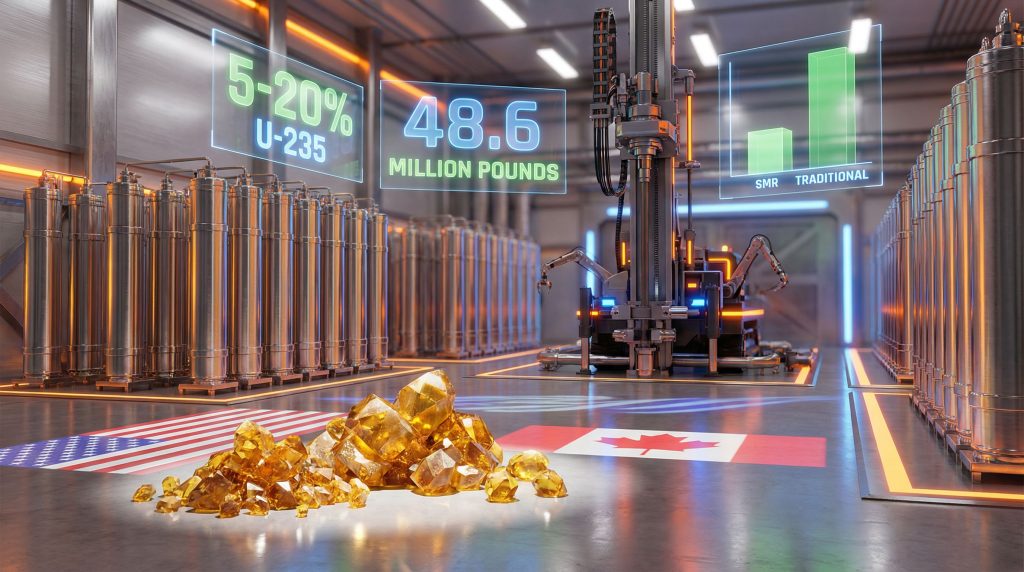
Small Modular Reactors are fundamentally altering uranium demand dynamics through their requirement for High-Assay Low-Enriched Uranium containing 5-20% U-235, compared to conventional reactor fuel at 3-5% enrichment. This elevated enrichment level demands 2-4 times higher feedstock per megawatt-hour generated and more sophisticated enrichment infrastructure.
Current HALEU production remains concentrated in Russia, creating strategic bottlenecks for Western SMR deployment programmes. The U.S. Department of Energy's HALEU Availability Program represents an attempt to establish alternative production capacity through domestic and allied suppliers, though commercial-scale deployment remains years away.
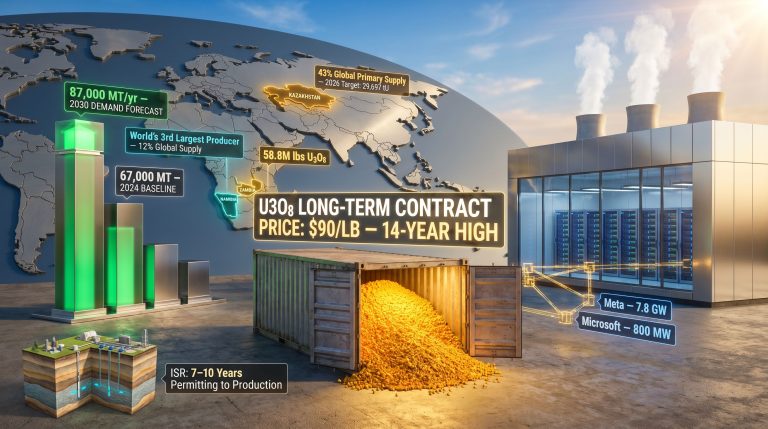
Technology companies including Meta, Amazon, and Microsoft are pursuing direct nuclear energy procurement through dedicated SMR installations. This corporate-anchored demand model bypasses traditional utility procurement cycles, creating predictable long-term demand that accelerates deployment timelines and provides revenue certainty for fuel suppliers.
However, concerns about uranium market volatility continue to affect investment decisions. The World Nuclear Association's Nuclear Fuel Report 2025 projects global uranium requirements reaching 391-532 million pounds annually by 2040, reflecting both traditional reactor buildouts and accelerating SMR deployment.
Western Production Capabilities and Strategic Assets
United States Domestic Infrastructure
U.S. uranium production totaled approximately 820,000 pounds U3O8 in 2024, representing a dramatic decline from Cold War peaks exceeding 20 million pounds annually during the 1980s. This production level satisfies only 8-12% of domestic reactor demand, highlighting the infrastructure gap requiring resolution despite the US uranium production surge.
Energy Fuels' White Mesa Mill operates at 4-5 million pounds annual nameplate capacity, though 2024 actual production reached approximately 1.2 million pounds reflecting feedstock availability constraints. The facility accepts domestic ore, imported concentrate, and legacy stockpiles through a flexible operational model that maintains processing capability during market fluctuations.
EnCore Energy focuses on In-Situ Recovery operations across Texas and New Mexico, developing assets with projected capacity of 3-5 million pounds U3O8 upon full development between 2026-2028. In addition, ISR technology dissolves uranium underground using chemical solutions, eliminating traditional mining infrastructure while reducing environmental impact and capital requirements.
Total identified U.S. uranium resources encompass approximately 2.4 million short tons of reasonably assured resources under current economic conditions. This represents roughly 1.9 billion pounds U3O8 in-ground inventory, though converting these resources into production requires substantial investment in extraction and processing infrastructure.
Canadian Strategic Positioning
Canada produced approximately 15.3 million pounds U3O8 in 2024, representing 11% of global production despite operating only four producing mines. This efficiency reflects the extraordinary deposit grades found in the Athabasca Basin, where operations achieve 1.5-15% U3O8 grades compared to global averages of 0.3-0.5%.
IsoEnergy's Hurricane deposit contains 48.6 million pounds U3O8 at 34.5% average grade, ranking among the world's highest-grade undeveloped uranium resources. This grade represents 6-10 times higher concentration than average producing mines globally, translating to superior processing economics and competitive advantages that cannot be replicated through capital investment alone.
ATHA Energy maintains a land position exceeding 7.1 million acres across Canadian uranium districts, including:
- 3.8 million acres in the Athabasca Basin
- 3.1 million acres in Nunavut territory
- 268,000 acres in the Central Mineral Belt
- 10% carried interest on portions of NexGen and IsoEnergy acreage
This portfolio provides exploration upside and future supply optionality across Canada's premier uranium districts, supporting long-term resource development as existing mines deplete their reserves.
Allied Jurisdiction Resources
Australia maintains approximately 1.7 million tonnes of reasonably assured uranium resources, ranking third globally after Kazakhstan and Canada. Australian production reached approximately 6,200 tonnes U3O8 from three operating mines in 2024, representing 9% of global output despite the country's substantial resource base.
The United Kingdom is pursuing independent fuel cycle capability post-Brexit, with the Springfields Fuel Fabrication facility serving as Europe's primary fuel assembly manufacturing plant. UK government confirmed in 2024 plans to develop domestic enrichment capacity by the 2030s, reducing dependency on international suppliers.
Economic Implications and Investment Requirements
Infrastructure Capital Intensity
The Vogtle nuclear project in Georgia demonstrated both the scale and complexity of nuclear infrastructure development, with cost overruns exceeding $15 billion beyond original estimates. This precedent influences investor risk assessment and financing structures for all nuclear-related infrastructure investments.
Conversion plants require approximately $200-400 million in development capital, while enrichment facilities demand $2-5 billion depending on capacity and technology selection. These substantial upfront investments require government backing or long-term contracted revenues to attract private capital.
Fuel fabrication infrastructure represents a comparatively modest investment of $100-300 million for new facilities, though expansion of existing capacity offers more cost-effective scaling options. The shorter development timeline for fuel fabrication makes it an attractive near-term localisation target.
Jurisdictional Pricing Premiums
Assets aligned with Western fuel cycle localisation policies command measurable pricing premiums over equivalent resources in non-allied jurisdictions. This premium reflects supply security value and policy support mechanisms including:
- Loan guarantees reducing financing costs
- Tax incentives improving project economics
- Procurement preferences ensuring market access
- Streamlined regulatory processes reducing development timelines
Energy security considerations drive sustained government support for domestic uranium production capabilities. The US uranium import ban has strengthened these policy frameworks, while the U.S. Inflation Reduction Act includes provisions supporting domestic critical mineral production.
Technology Innovation and Operational Efficiency
In-Situ Recovery Advantages
ISR technology enables uranium extraction from lower-grade deposits while maintaining operational flexibility and reducing environmental disturbance. This method requires shorter development timelines and lower capital investment compared to conventional mining, supporting rapid production scaling in response to market demand.
ISR operations dissolve uranium underground through chemical solutions, recovering the pregnant liquor through extraction wells. This process eliminates traditional mining infrastructure requirements while enabling selective extraction from permeable rock formations containing uranium minerals.
Modern ISR facilities achieve recovery rates exceeding 85% from suitable geological formations, with operational costs typically 20-40% lower than conventional mining operations. The technology particularly suits uranium deposits in sedimentary formations with appropriate hydrogeology.
Enrichment Technology Evolution
Centrifuge enrichment provides energy-efficient uranium processing with scalable capacity expansion capabilities. Modern centrifuge cascades achieve higher separation efficiency while reducing electricity consumption compared to historical gaseous diffusion methods by 90%.
Advanced centrifuge designs operate at 50,000+ RPM with sophisticated materials engineering enabling higher throughput and improved reliability. This technology supports modular capacity expansion, allowing operators to scale production in response to market demand.
Laser enrichment represents an emerging technology potentially offering superior efficiency and reduced infrastructure requirements. However, commercial deployment remains limited due to technical complexity and regulatory considerations surrounding proliferation resistance.
Recycling and Closed Fuel Cycles
Spent Fuel Reprocessing Impact
Nuclear fuel recycling recovers unused uranium and plutonium from spent reactor fuel, extending resource utilisation by 15-20% while producing mixed oxide fuel containing recycled materials. France and the United Kingdom operate commercial reprocessing facilities, while the United States maintains policy restrictions against civilian reprocessing.
Reprocessing technology separates usable fissile materials from radioactive waste products, enabling their incorporation into new fuel assemblies. This closed fuel cycle approach maximises resource efficiency but requires additional specialised infrastructure and regulatory oversight.
Advanced reactor designs may utilise recycled materials more efficiently than current light water reactor technology. Fast neutron reactors can consume actinides and reduce long-term waste volumes, though commercial deployment remains in development stages.
Waste Management Integration
Comprehensive fuel cycle localisation must address both front-end production and back-end waste management requirements. Countries achieving full fuel cycle independence require integrated systems spanning extraction, processing, utilisation, and permanent disposal.
Interim storage capacity represents a near-term requirement for spent fuel management, with dry cask storage systems providing temporary solutions pending permanent geological disposal. These facilities require specialised engineering and long-term monitoring capabilities.
The integration of recycling and waste management creates additional value streams while reducing long-term environmental liabilities. However, the capital intensity and regulatory complexity of comprehensive fuel cycle infrastructure limits deployment to nations with substantial nuclear programmes.
The next major ASX story will hit our subscribers first
Investment Positioning and Strategic Analysis
Producer Differentiation Matrix
| Company | Strategic Advantage | Capacity Potential | Localisation Alignment |
|---|---|---|---|
| Energy Fuels | Only US conventional mill | 4-5M lbs annual | High domestic processing |
| EnCore Energy | ISR production capability | 3-5M lbs development | High domestic extraction |
| IsoEnergy | Exceptional grade development | 48.6M lbs Hurricane resource | Medium allied jurisdiction |
| ATHA Energy | Large exploration portfolio | 7M+ acres land position | Medium discovery upside |
Value Chain Investment Themes
Fuel cycle localisation creates differentiated investment opportunities across multiple segments. Uranium producers with domestic or allied jurisdiction assets benefit from policy support and sustained pricing premiums reflecting supply security value.
Processing and enrichment infrastructure operators capture margins from supply chain bottlenecks, though these investments require substantial capital commitments and government backing. The specialised nature of these technologies creates competitive moats once operational.
Consequently, understanding uranium investment strategies becomes crucial for navigating this evolving market. Exploration companies with large land positions provide optionality on future discoveries required to sustain long-term reactor deployment commitments.
Regulatory Framework Evolution
Policy Coordination Mechanisms
Government support for fuel cycle localisation operates through coordinated policy channels including procurement preferences, loan guarantees, tax incentives, and regulatory streamlining. These measures collectively reduce investment risk while improving project economics for qualifying operators.
The U.S. Inflation Reduction Act provides tax credits for critical mineral production, while the Infrastructure Investment and Jobs Act allocates funding for nuclear technology development. Similar frameworks in Canada and Australia support allied fuel cycle capability development.
State-level policy coordination complements federal initiatives, with uranium-producing states offering additional incentives and regulatory support. This multi-level alignment creates favourable conditions for domestic fuel cycle investment while maintaining environmental standards.
Permitting Optimisation Initiatives
Regulatory agencies are implementing streamlined permitting processes for strategic fuel cycle projects. These reforms reduce development timelines and regulatory uncertainty while preserving environmental protection and safety requirements.
Arizona enacted legislation prohibiting local governments from blocking Small Modular Reactor construction once federal early site permits are granted, establishing regulatory floors that reduce project-level political risk. Similar initiatives across multiple states signal coordinated policy support.
Over 150 pro-nuclear bills were introduced across U.S. states during the first quarter of 2026, demonstrating legislative momentum supporting nuclear infrastructure development. This policy acceleration extends visibility for long-term project planning and capital allocation.
Market Structure Transformation
Supply Security Partnership Models
Fuel cycle localisation is reshaping uranium markets from commodity trading toward strategic partnership arrangements. Long-term contracts and government-to-government agreements increasingly replace spot market transactions for critical supply security.
This evolution favours producers with policy alignment and technical capabilities over pure cost competitors. Supply security and alliance compatibility premiums are becoming permanent features of uranium market pricing, particularly for Western reactor operators.
Allied fuel cycle networks enable burden-sharing and specialisation while maintaining collective supply security. Countries may focus on specific fuel cycle stages based on resource endowments, technical capabilities, and strategic priorities.
Technology Leadership and Innovation
Domestic fuel cycle capabilities support advanced reactor development and deployment by ensuring fuel supply availability. This technological leadership creates competitive advantages in emerging global nuclear markets while supporting energy transition objectives.
Investment in fuel cycle infrastructure drives innovation across uranium extraction, processing, and recycling technologies. These advances enhance operational efficiency and reduce costs while supporting environmental compliance requirements.
The development of domestic fuel cycle capacity positions Western nations as technology exporters and standard-setters for global nuclear industry development, creating long-term competitive advantages beyond immediate supply security benefits.
Important Investment Disclaimer: This analysis is for informational purposes only and does not constitute investment advice. Uranium and nuclear energy investments carry significant risks including regulatory changes, commodity price volatility, and project development uncertainties. Past performance does not guarantee future results. Readers should conduct their own research and consult qualified financial advisors before making investment decisions. The author may hold positions in securities discussed. Forward-looking statements involve inherent uncertainties and actual results may differ materially from projections.
Looking to Capitalise on Uranium Supply Chain Transformation?
Discovery Alert's proprietary Discovery IQ model delivers real-time alerts on significant uranium and mineral discoveries across the ASX, helping you identify actionable opportunities as Western nations rebuild their nuclear fuel capabilities. Stay ahead of the market by exploring Discovery Alert's dedicated discoveries page to understand how historic mineral discoveries have generated substantial returns, then begin your 14-day free trial to position yourself at the forefront of this strategic transformation.