August 22, 2026
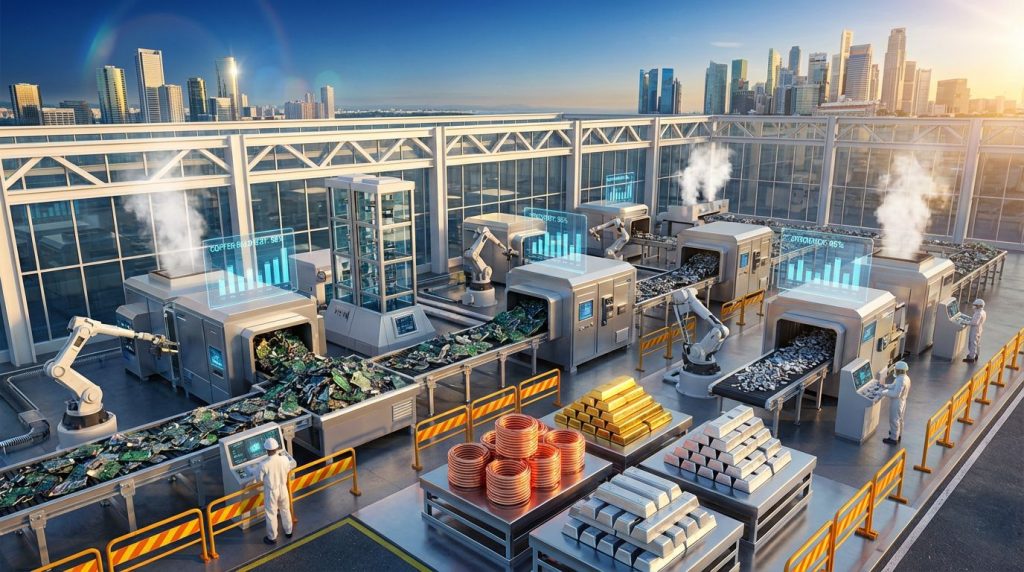
The proliferation of electronic waste has created unprecedented opportunities for materials recovery within established metropolitan areas. Modern consumer electronics contain concentrated deposits of valuable metals, often at grades exceeding those found in traditional geological deposits. However, the technical realities of extracting these materials at commercially viable scales present complex challenges that distinguish urban mining reality from conventional resource extraction.
Understanding Urban Mining: Beyond the Recycling Hype
The fundamental distinction between urban mining and traditional recycling lies in technological sophistication and target materials. While conventional recycling prioritises bulk material recovery like steel and aluminium, urban mining focuses on trace elements requiring advanced separation technologies. The International Resource Panel defines urban mining as the systematic extraction of inorganic materials from obsolete anthropogenic waste streams, emphasising material recovery targeting rather than simple waste diversion.
Defining Urban Mining in the Modern Resource Landscape
Electronic waste typically contains gold at concentrations of 50-200 parts per million (ppm), compared to primary ore grades averaging 1-5 ppm globally. Copper concentrations in e-waste range from 10,000-20,000 ppm, versus primary copper ores at 1,000-3,000 ppm. These concentration differentials create compelling theoretical value propositions for urban mining operations.
Rare earth element concentrations in permanent magnets recovered from e-waste can reach 90,000+ ppm in neodymium-iron-boron magnets, making them among the highest-grade secondary sources available. However, the heterogeneity of e-waste composition creates technical barriers: a single smartphone contains over 60 different elements, distributed across ceramic components, circuit boards, and alloys.
Primary target materials in urban mining operations include:
• High-value targets: Precious metals (gold, silver, platinum group metals), rare earth elements (neodymium, dysprosium, terbium), and speciality metals (lithium, cobalt, nickel)
• Moderate-value targets: Base metals (copper, aluminium, zinc) and tin
• Infrastructure targets: Steel and concrete from demolition waste
The Microgram Challenge: Why Scale Matters in Metal Recovery
Global e-waste generation reached 62 million metric tons in 2022, projected to grow at a compound annual growth rate of 2.7% through 2030. Despite this massive volume, individual devices contain target metals in microgram or milligram quantities, requiring enormous processing volumes to achieve economically viable yields.
The scale threshold challenge becomes apparent when examining processing requirements. A mid-scale urban mining facility processing 10,000 metric tons annually requires approximately 15,000-25,000 square metres of operational space, including pre-sorting, mechanical processing, chemical separation, and environmental containment areas.
Processing efficiency varies significantly by method and material:
• Hydrometallurgical processing achieves 95-99% precious metal recovery under controlled conditions
• Commercial operations typically achieve 60-75% recovery due to contamination and process variability
• Pyrometallurgical smelting operates at 70-85% recovery efficiency for base metals but results in 15-30% rare earth element losses
When big ASX news breaks, our subscribers know first
How Does Urban Mining Actually Work? The Technical Process Breakdown
The technical reality of urban mining involves sophisticated multi-stage processing that differs fundamentally from primary mining operations. Collection networks must aggregate sufficient volumes while maintaining material quality, followed by complex separation processes targeting specific elements across diverse waste streams. Furthermore, these operations must incorporate advanced waste management solutions to ensure environmental compliance.
Collection and Pre-Processing Infrastructure Requirements
Urban mining profitability requires minimum throughput of 5,000-10,000 metric tons annually for single-stream processing, but municipal collection typically operates at 30-40% fill-rate efficiency due to contamination, commingling, and seasonal variation. This logistics aggregation bottleneck represents a critical constraint on operational viability.
Pre-sorting technologies employed in urban mining include:
• Optical sorting: Using spectral analysis to identify material composition
• Density separation: Separating materials based on specific gravity differences
• Magnetic separation: Removing ferrous materials from mixed streams
• Manual sorting: Quality control for high-value or contaminated materials
The Basel Convention Technical Working Group identifies collection efficiency as a fundamental limitation, noting that successful urban mining operations require specialised logistics networks rather than conventional municipal waste management systems.
Advanced Extraction Technologies and Their Limitations
Hydrometallurgical Process Chain:
-
Acid Leaching: E-waste circuit boards dissolved in sulphuric or hydrochloric acid, achieving 90-98% efficiency for target metals
-
Solvent Extraction: Selective precipitation using organic extractants, enabling element separation without additional leaching
-
Electrowinning: Electrodeposition of purified metal onto cathodes, achieving 99%+ purity for refined products
Pyrometallurgical Process Chain:
-
Preprocessing: Mechanical shredding to 2-5mm fragments, removal of non-ferrous materials
-
High-temperature smelting: Heating to 1,200-1,500°C in rotary or blast furnaces
-
Refining: Secondary smelting or electrolytic refining to achieve commercial-grade purity
Energy consumption represents a significant cost factor. Urban mining ranges from 8-15 MWh per ton for pyrometallurgical methods, compared to 5-12 MWh per ton for primary mining operations. Hydrometallurgical approaches consume 5-12 MWh per ton but require sophisticated chemical management and wastewater treatment.
Biotechnology Applications:
Bacterial leaching using Acidithiobacillus ferrooxidans and Acidithiobacillus thiooxidans has demonstrated laboratory-scale feasibility for copper and nickel recovery from e-waste at cost reductions of 20-35% compared to chemical leaching. However, commercial-scale deployment remains limited to pilot operations in Japan, Germany, and Chile.
Rare Earth Element Recovery Challenges:
Rare earth elements in e-waste are dispersed at concentrations of 100-500 ppm, often embedded in ceramic components. Current hydrometallurgical processes achieve only 40-60% recovery rates due to rare earth oxide solubility limitations and lanthanide element similarity, complicating selective precipitation.
Less than 1% of rare earth elements are recycled globally despite their presence in discarded electronics, magnets, and industrial equipment. Japan represents a notable exception, recycling approximately 99% of rare earth metals from permanent magnets through government-backed processing infrastructure.
What Are the Real Economics Behind Urban Mining Operations?
The economic viability of urban mining operations depends critically on commodity price thresholds, processing scale, and material composition of input streams. Unlike primary mining operations with predictable ore grades, urban mining facilities must manage highly variable input quality and contamination levels. In addition, the recent battery recycling breakthrough has demonstrated how technological advances can significantly improve processing economics.
Break-Even Analysis: When Urban Mining Makes Financial Sense
Commodity Price Thresholds:
Gold recovery from e-waste breaks even at commodity prices above $1,200-$1,400 per troy ounce. Current prices (December 2024) range $2,600-$2,800 per troy ounce, providing positive margin for well-managed operations.
Rare earth oxide recovery requires prices above $8-12 per kilogram for dysprosium oxide to achieve profitability. Market prices have ranged $15-35 per kilogram between 2022-2024, though significant volatility creates operational risk.
Copper recovery from e-waste requires commodity prices above $2.50-3.00 per pound to justify processing. London Metals Exchange prices (December 2024) trade at $4.10-4.30 per pound, making base metal recovery profitable under current conditions.
Processing Cost Structure:
• Labour costs: $20-40 per metric ton for mechanical processing, $80-150 per ton for chemical processing
• Energy costs: $400-800 per ton for pyrometallurgical methods, $300-600 per ton for hydrometallurgical methods
• Chemical inputs: $150-300 per ton for hydrometallurgical processing acids and extractants
• Environmental compliance: $200-400 per ton including wastewater treatment and emissions control
Infrastructure Investment Requirements
Capital expenditure requirements scale significantly with processing capacity:
| Facility Scale | Annual Capacity | Capital Investment |
|---|---|---|
| Small-scale | 5,000 metric tons | $5-12 million |
| Mid-scale | 25,000 metric tons | $25-50 million |
| Large-scale | 100,000+ metric tons | $150-300 million |
Return on Investment Analysis:
Facilities focusing on precious metals from high-purity waste streams (data centre equipment, industrial catalysts) achieve ROI within 4-7 years. Facilities processing mixed municipal e-waste achieve ROI within 8-12 years due to lower average metal values and higher contamination rates.
Battery recycling operations show accelerating profitability, with ROI timelines of 3-5 years as battery material prices have increased 40-60% between 2020-2024.
A 20% decline in precious metal prices can reduce facility profitability by 50-70% due to high fixed costs and labour requirements, while primary mining operations achieve greater hedging flexibility through scale and integrated processing.
Why Are Global Recycling Rates Actually Declining?
Despite increasing awareness of resource scarcity and environmental impacts, recycling rates across multiple sectors have stagnated or declined in recent years. This counterintuitive trend reveals structural limitations that constrain urban mining potential, particularly when examining mining industry innovation approaches to address these challenges.
The Infrastructure Paradox: Shrinking Capacity Despite Growing Awareness
Municipal recycling programmes face economic pressures from commodity price volatility. When metal prices decline, collection and processing become unprofitable, leading to programme reductions or cancellations. The United States generated approximately 6.9 million metric tons of e-waste in 2021, with recycling rates estimated at only 32.5%.
Critical factors contributing to declining recycling infrastructure include:
• Commodity price volatility: 20-30% price swings can eliminate programme profitability
• Collection logistics costs: Rising transportation and labour expenses
• Contamination rates: Mixed waste streams requiring expensive sorting and cleaning
• Export restrictions: Reduced overseas processing capacity affecting domestic programmes
Facilities processing fewer than 5,000 metric tons annually typically operate at loss or marginal profit margins due to infrastructure utilisation inefficiency. Facilities achieving 20,000+ metric tons annually benefit from per-unit cost reductions of 30-45% through automation and logistics optimisation.
Technical Barriers to Rare Earth Element Recovery
The physics of rare earth element dispersion in consumer electronics creates fundamental recovery limitations. Rare earth elements are typically dispersed throughout device components rather than concentrated in easily separable forms, requiring energy-intensive separation processes.
Technical Recovery Constraints:
• Element dispersion: Rare earths distributed across multiple component types within devices
• Chemical similarity: Lanthanide elements require sophisticated separation chemistry
• Processing complexity: Multiple processing steps with significant energy requirements
• Economic thresholds: Processing costs often exceed recovered material value
Current hydrometallurgical processes achieve only 40-60% recovery rates for rare earth elements due to oxide solubility limitations. Even advanced facilities struggle to make rare earth recovery economically viable except from high-grade sources like permanent magnets.
OEM-controlled takeback programmes often prioritise data security and brand protection over material recovery. Many programmes employ destructive processing methods that eliminate valuable material recovery opportunities, focusing on secure disposal rather than circular economy objectives.
Where Does Urban Mining Succeed vs. Traditional Mining?
Urban mining demonstrates clear advantages in specific applications where material concentrations, processing requirements, and economic conditions align favourably. Understanding these optimal applications helps distinguish realistic opportunities from overstated potential, particularly as the industry undergoes a sustainability transformation.
Optimal Applications for Urban Mining Technologies
High-Value, Concentrated Waste Streams:
Data centre equipment represents ideal urban mining feedstock, containing 200-500 ppm gold in server components and networking equipment. Industrial catalysts from chemical processing contain 1,000-5,000 ppm platinum group metals, making recovery economically compelling at current commodity prices.
Construction and Demolition Waste:
Steel recovery from building demolition achieves 90-95% material recovery rates through magnetic separation. Aluminium recovery from construction waste operates at 85-90% efficiency with established processing infrastructure. Copper wire and plumbing recovery maintains 95%+ purity through mechanical separation.
End-of-Life Vehicle Processing:
Catalytic converters contain 2,000-7,000 ppm combined platinum, palladium, and rhodium, representing one of the highest-value urban mining targets. Established processing infrastructure and well-developed collection networks support profitable operations.
Apple's Urban Mining Results:
Apple's proprietary e-waste recycling programme recovered 25 tonnes of gold, 2,700 tonnes of copper, and 200 tonnes of tungsten from recycled products between 2015-2022. However, this represents only a fraction of Apple devices in circulation, with approximately 1.5 billion discarded Apple devices globally.
Limitations and Realistic Capacity Projections
Volume Constraints:
Even perfect recycling of all discarded electronics in the United States would supply less than 15% of domestic rare earth demand for clean energy technologies. The International Energy Agency projects 30-fold increases in critical mineral demand by 2040, while secondary recovery is expected to supply only 10-15% of total requirements.
Quality Degradation:
Material properties change through multiple recycling cycles. Aluminium loses strength through repeated melting and recasting. Rare earth magnets lose magnetic properties through thermal processing. Steel accumulates impurities that limit applications in high-grade uses.
Geographic Distribution Challenges:
E-waste generation concentrates in urban areas, while processing facilities require industrial zoning and environmental permits often located in rural areas. Transportation costs and logistics complexity reduce economic viability, particularly for low-value materials.
The maximum theoretical recovery from existing urban waste streams cannot meet projected demand growth for critical minerals required in clean energy technologies, electric vehicles, and advanced manufacturing.
What Infrastructure Changes Could Improve Urban Mining Viability?
Systematic infrastructure improvements could enhance urban mining effectiveness while maintaining realistic expectations about capacity limitations. Policy frameworks, technology development, and operational integration represent key improvement areas. Furthermore, the implementation of direct lithium extraction methods could provide valuable insights for urban mining applications.
Policy Framework Requirements for Scalable Operations
Extended Producer Responsibility Programmes:
Extended producer responsibility (EPR) programmes require manufacturers to assume end-of-life management costs for their products. The EU's Waste Electrical and Electronic Equipment (WEEE) Directive mandates 65-75% material recovery rates by weight, creating standardised collection and processing requirements.
Regulatory Standardisation:
Waste classification and processing permits vary significantly across jurisdictions, creating operational complexity for multi-state urban mining operations. Standardised environmental permits, material handling protocols, and safety requirements could reduce regulatory compliance costs by 20-30%.
Tax Incentives and Subsidies:
Current tax policy favours primary mining through depletion allowances and exploration tax credits. Comparable incentives for urban mining infrastructure could improve investment returns and accelerate facility development.
Technology Development Priorities
Automation and AI Applications:
Machine learning optimisation of processing parameters can improve recovery rates by 10-15% through real-time adjustment of chemical concentrations, temperature profiles, and separation timing. Computer vision systems for waste sorting achieve 95%+ accuracy in material identification.
Mobile Processing Units:
Distributed urban mining operations using mobile processing units could reduce transportation costs and improve collection efficiency. Mobile units processing 100-500 tons monthly could serve regional collection networks more effectively than centralised facilities.
Smart City Infrastructure Integration:
IoT sensors in municipal waste collection systems could optimise routing, predict maintenance requirements, and track material flows. Integration with smart city infrastructure could reduce collection costs by 15-25% through improved logistics efficiency.
The next major ASX story will hit our subscribers first
How Do Different Countries Approach Urban Mining Implementation?
National strategies for urban mining development vary significantly based on resource availability, regulatory frameworks, and industrial capacity. Examining international approaches reveals successful implementation models and common challenges.
Leading National Strategies and Their Results
Japan's Urban Mining Initiatives:
Japan implemented government-backed urban mining operations for Tokyo Olympics 2020, recovering 16 tonnes of gold, 1,600 tonnes of silver, and other metals from discarded electronics to produce official Olympic medals. This programme demonstrated large-scale coordination between government agencies, municipalities, and private processors.
Japan's success factors include:
• Government-industry collaboration: Direct coordination between public policy and private operations
• Standardised collection systems: Unified protocols across municipal boundaries
• Technology investment: Advanced processing facilities with government support
• Public engagement: National awareness campaigns achieving 80%+ participation rates
European Union Circular Economy Regulations:
The EU's WEEE Directive requires member states to achieve specific recovery targets. Companies like Umicore (Belgium) achieve 92-96% material recovery through integrated hydrometallurgical-pyrometallurgical hybrid processing for precious metals, though rare earth recovery remains limited to 20-30%.
China's E-waste Processing Zones:
China operates large-scale e-waste processing zones handling millions of tons annually of both domestic and imported electronic waste. While achieving significant material recovery volumes, environmental protection standards vary significantly across facilities.
Emerging Market Approaches and Challenges
Informal Sector Integration:
In developing economies, informal waste collection networks handle 60-80% of e-waste volumes through manual disassembly and material sorting. Integration of informal sector capacity with formal processing infrastructure could improve recovery rates while providing economic opportunities.
Technology Transfer Requirements:
Emerging market urban mining development requires technology transfer partnerships with advanced processing equipment manufacturers. Local capacity building in chemical processing, environmental management, and quality control represents essential development priorities.
Environmental Protection Standards:
Rapidly industrialising regions face challenges balancing economic development with environmental protection. Urban mining facilities require sophisticated pollution control systems, worker safety protocols, and community impact management.
What Role Can Urban Mining Realistically Play in Supply Chain Security?
Supply chain security analysis requires realistic assessment of urban mining capacity relative to projected demand growth. While valuable as a supplementary source, the urban mining reality demonstrates that it cannot independently address critical mineral supply deficits.
Supplementary vs. Primary Supply Contribution Analysis
Quantitative Supply Contribution:
Maximum theoretical recovery from all discarded electronics in the United States would supply approximately 8-12% of domestic rare earth demand and 15-20% of domestic battery metal requirements. These percentages decline significantly when considering projected demand growth for clean energy technologies.
Timeline Analysis:
Urban mining capacity could scale to meaningful production levels within 5-7 years for established materials like precious metals and base metals. Rare earth element recovery would require 10-15 years to develop commercial-scale processing capability.
Strategic Material Priorities:
Urban mining provides greatest value for materials with high concentration in e-waste and established processing technology:
-
Precious metals (gold, silver, platinum): Immediate viability with existing technology
-
Base metals (copper, aluminium): Large volume recovery with proven infrastructure
-
Battery metals (lithium, cobalt, nickel): Growing importance with expanding capacity
-
Rare earth elements: Limited near-term contribution due to technical constraints
Integration with Traditional Mining and Processing
Hybrid Supply Chain Models:
Successful critical mineral supply chains integrate primary mining, urban mining, and strategic reserves rather than relying on single sources. Hybrid models provide supply diversification while optimising cost and environmental impact.
Processing Facility Sharing:
Economies of scale through integrated operations combining primary and secondary feedstocks can reduce per-unit processing costs by 25-40%. Shared infrastructure utilises expensive equipment more efficiently while reducing capital requirements.
Risk Diversification Strategy:
Urban mining provides supply chain resilience against geopolitical disruption, price volatility, and environmental constraints affecting primary mining operations. However, urban mining itself faces risks from waste generation patterns, commodity prices, and regulatory changes.
Urban mining serves as an essential component of diversified supply strategies rather than a replacement for primary production capacity. Realistic planning requires understanding both contributions and limitations.
Future Outlook: Technology Trends and Market Evolution
Emerging technologies could transform urban mining economics and capability over the next decade. However, fundamental constraints related to material dispersion, processing complexity, and scale requirements will likely persist.
Emerging Technologies That Could Transform Urban Mining
Nanotechnology Applications:
Nanoscale selective extraction membranes could improve rare earth element separation efficiency by 30-50% while reducing chemical consumption and processing time. Research programmes in selective ion extraction show promising laboratory results but require 5-10 years for commercial development.
Machine Learning Optimisation:
AI-driven process optimisation can improve recovery rates by 10-15% through real-time parameter adjustment and predictive maintenance. Machine learning algorithms analysing spectral data can identify optimal processing conditions for specific waste stream compositions.
Blockchain Tracking Systems:
Distributed ledger technology could provide waste stream transparency and quality assurance, reducing contamination and improving material traceability. These systems represent valuable urban mining resources for tracking individual devices from manufacturing through disposal, enabling targeted recovery strategies.
Market Projections and Investment Opportunities
Growth Forecasts by Material Type:
| Material Category | 2024-2030 CAGR | Investment Level |
|---|---|---|
| Precious metals | 8-12% | $500M-1B annually |
| Battery metals | 15-25% | $2-4B annually |
| Rare earth elements | 5-8% | $200-500M annually |
| Base metals | 4-6% | $1-2B annually |
Venture Capital and Government Funding:
Urban mining startups attracted $1.2 billion in venture capital funding during 2023-2024, with government programmes providing additional $800 million in development support. However, commercial deployment timelines typically require 3-7 years from initial investment.
Partnership Opportunities:
Technology companies increasingly partner with waste management firms to develop integrated collection and processing systems. Successful partnerships combine waste stream access, processing technology, and market development capabilities. The recent advances in urban mining developments demonstrate the growing importance of these collaborative approaches.
The urban mining reality involves both significant potential and fundamental limitations. While certain applications demonstrate clear economic viability, the sector cannot independently meet growing critical mineral demand. Realistic development strategies emphasise urban mining as a valuable supplement to diversified supply chains rather than a replacement for primary production capacity.
Disclaimer: This analysis contains forward-looking statements about market conditions, technology development, and supply-demand projections. Actual results may vary significantly due to commodity price volatility, regulatory changes, and technological developments. Investment decisions should consider comprehensive risk assessment and professional consultation.
Ready to Discover the Next Major Mineral Find?
Discovery Alert's proprietary Discovery IQ model delivers real-time alerts on significant ASX mineral discoveries, empowering investors to identify actionable opportunities ahead of the broader market. While urban mining offers supplementary material recovery, the most substantial returns continue to emerge from traditional mineral discoveries – explore Discovery Alert's discoveries page to understand why these finds can generate exceptional market outcomes.