The global supply chain resilience has emerged as the defining industrial challenge of the 2020s, with nations increasingly recognising that economic security depends on diversified sourcing of critical materials. The convergence of technological advancement, geopolitical tensions, and environmental imperatives has created an unprecedented moment where traditional market-driven commodity flows face systematic restructuring. Understanding this backdrop becomes essential for analysing why the U.S.-Australia critical minerals pact represents more than bilateral cooperation.
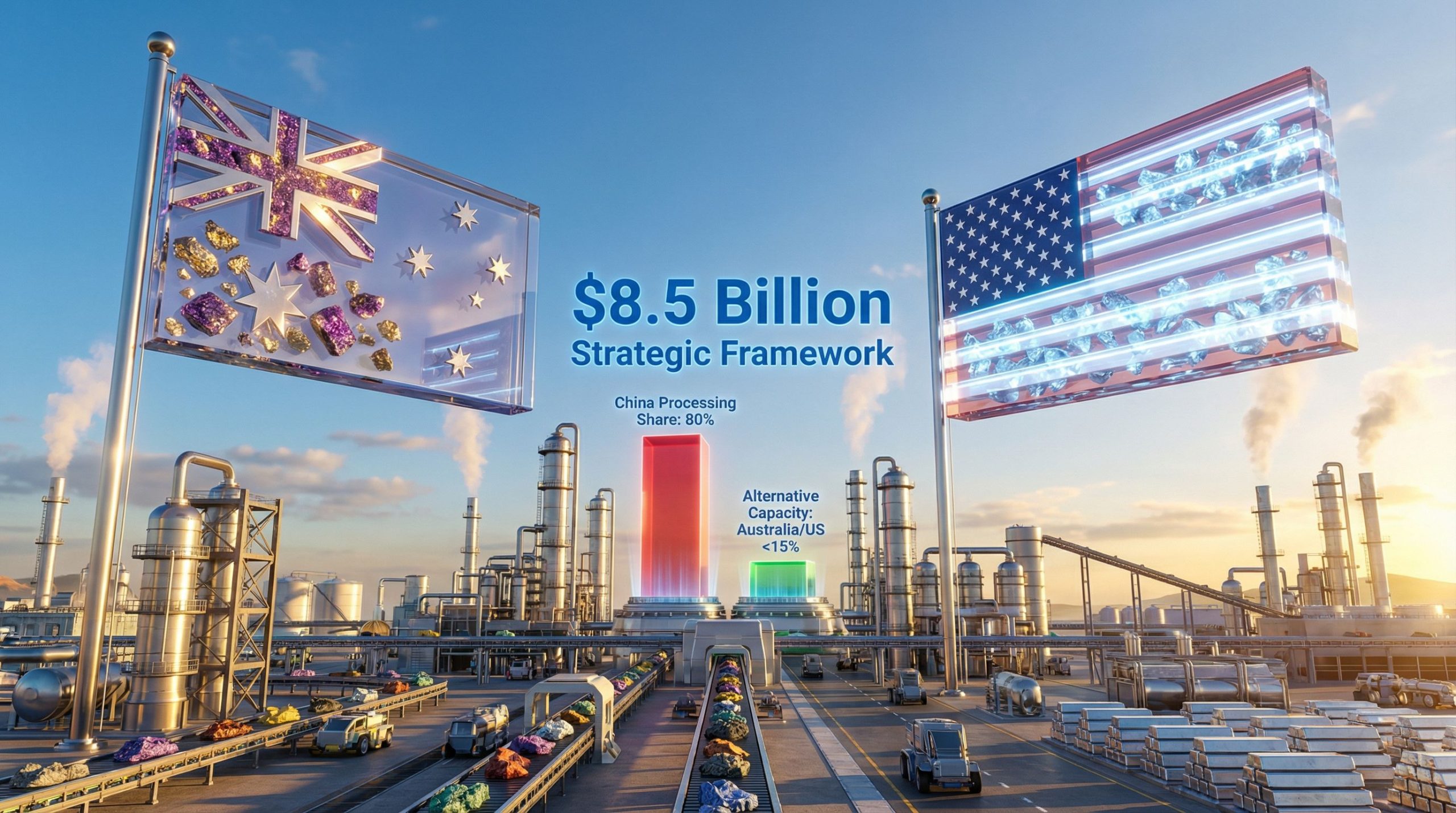
Understanding the $8.5 Billion Strategic Framework
The U.S.-Australia critical minerals pact introduces a fundamentally different approach to resource partnerships, moving beyond conventional export-import relationships toward integrated industrial policy. This $8.5 billion framework combines direct government capital injection with risk-sharing mechanisms designed to build processing infrastructure rather than merely securing raw material access.
What Makes This Partnership Different from Previous Trade Agreements?
Traditional commodity agreements focus on securing supply contracts and favourable pricing terms between buyers and sellers. The U.S.-Australia framework instead emphasises joint equity participation in midstream processing facilities, representing a strategic shift toward what policy experts characterise as quasi-industrial strategy.
The bilateral financing mechanisms mirror methodologies pioneered in the CHIPS and Science Act, which allocated $39 billion toward semiconductor manufacturing incentives. Both frameworks prioritise reshoring critical production capabilities through government-backed capital expenditure support rather than relying solely on market forces, similar to the recent critical minerals order implemented to strengthen domestic supply chains.
Key structural innovations include:
- Direct government equity stakes in processing ventures
- Shared risk allocation between U.S. and Australian treasuries
- Technology transfer provisions linking funding to knowledge sharing
- Supply chain transparency requirements for all funded projects
The timing of the October 2025 signing reflects strategic urgency created by recent supply chain disruptions. China's export controls on gallium and germanium, implemented in July 2023, demonstrated the vulnerability of Western technology manufacturers to coordinated supply restrictions.
Breaking Down the Financial Architecture
The framework's $8.5 billion total commitment divides into distinct funding mechanisms designed to address different aspects of supply chain development:
Joint Mining and Processing Investment: $1 billion allocated for direct equity participation in Australian critical minerals projects, with emphasis on rare earth element processing facilities and lithium refining infrastructure.
EXIM Bank Support Mechanisms: $2.2 billion in Export-Import Bank of the United States financing support, providing loan guarantees and direct lending for critical minerals ventures that meet strategic criteria. Furthermore, this support mechanism mirrors the strategic antimony loan approach recently approved for domestic projects.
Risk-Sharing Model Analysis:
| Funding Component | U.S. Contribution | Australian Contribution | Risk Allocation |
|---|---|---|---|
| Direct Equity Investment | 60% | 40% | Proportional to investment |
| Loan Guarantees | 70% | 30% | Joint liability structure |
| Technology Development | 55% | 45% | Shared IP ownership |
This risk-sharing structure ensures both nations maintain strategic control while distributing financial exposure across multiple projects and development phases.
Why China's 80% Processing Dominance Created This Response
China's control over global critical minerals processing represents one of the most significant supply chain vulnerabilities facing Western economies. This dominance extends far beyond simple market share, encompassing vertical integration from raw material extraction through finished product manufacturing.
The Midstream Bottleneck Crisis
While Australia produces substantial quantities of lithium ore and rare earth concentrates, the critical shortage occurs at the processing stage where raw materials transform into battery-grade chemicals and refined elements suitable for industrial applications.
Global Processing Capacity Distribution:
- Rare Earth Elements: China controls approximately 80% of global processing capacity
- Lithium Refining: China manages 60% of global lithium processing, despite Australia producing nearly 50% of raw lithium
- Cobalt Processing: China refines 70% of global cobalt, primarily from Democratic Republic of Congo ore
The processing bottleneck creates strategic vulnerability because:
- Technical Complexity: Rare earth processing requires specialised chemical separation techniques and significant technical expertise
- Capital Intensity: Processing facilities demand substantial upfront investment with long payback periods
- Environmental Challenges: Refining operations generate significant waste streams requiring careful management
- Workforce Requirements: Processing demands specialised chemistry and engineering talent
China's Vertical Integration Strategy Impact Assessment
China's strategic advantage flows from decades of integrated supply chain development, combining domestic production with overseas resource contracts. This approach creates multiple leverage points throughout the global supply system, highlighting the importance of the broader critical minerals strategy being developed by Western allies.
Export Control Effectiveness Analysis:
When China implemented export licensing requirements for gallium and germanium in July 2023, the immediate impacts included:
- Supply Visibility Reduction: Western manufacturers reported inventory visibility dropping to 30-60 days
- Price Premium Development: Semiconductor-grade materials experienced 15-25% price increases within three months
- Alternative Sourcing Challenges: Limited non-Chinese processing capacity created extended lead times
Similar patterns emerged during 2025 antimony supply disruptions, where delayed shipments at Chinese ports demonstrated real-time vulnerability in Western defence and aerospace supply chains.
Supply Chain Vulnerability Assessment Matrix
| Critical Mineral | China Processing Share | Alternative Capacity | Strategic Risk Level | Key Applications |
|---|---|---|---|---|
| Rare Earth Elements | ~80% | Australia/US <15% | CRITICAL | Permanent magnets, defence systems |
| Lithium Processing | ~60% | Australia 25% | HIGH | Battery cathodes, energy storage |
| Cobalt Refining | ~70% | Limited alternatives | CRITICAL | Battery chemistry, aerospace alloys |
| Tungsten Processing | ~75% | US/Europe ~15% | CRITICAL | Defence applications, cutting tools |
| Silicon (high-purity) | ~65% | Europe/Japan ~25% | HIGH | Semiconductor manufacturing |
This concentration creates systemic risk where supply disruptions in any single material can cascade through multiple technology sectors simultaneously, underscoring the energy transition impact of mineral security challenges.
Strategic Implications for Pacific Region Geopolitics
The U.S.-Australia critical minerals pact represents more than economic cooperation; it signals a fundamental restructuring of Pacific region strategic relationships around resource security and technological sovereignty.
How Does This Align with AUKUS Defence Priorities?
The critical minerals framework directly supports AUKUS Pillar I objectives, particularly the Virginia-class submarine programme and broader defence technology integration between the three allies. Modern naval systems require substantial quantities of rare earth elements for:
- Sonar Systems: Neodymium-based permanent magnets in acoustic arrays
- Propulsion Systems: High-performance electric motors using dysprosium-enhanced magnets
- Navigation Equipment: Precision electronics requiring processed rare earth compounds
- Communication Systems: Fibre optic networks using high-purity germanium and other processed materials
Defence Supply Chain Security Framework:
The integration with existing trilateral security arrangements creates multiple strategic benefits:
- Operational Independence: Reduced dependence on potentially hostile suppliers for critical defence systems
- Technology Sharing: Enhanced collaboration on advanced materials research and development
- Industrial Base Strengthening: Expanded manufacturing capacity within allied territories
- Crisis Resilience: Alternative supply sources during geopolitical tensions
Modelling Three Potential Outcomes
Scenario A: Successful Diversification (Probability: 60%)
In this outcome, the framework achieves meaningful supply chain diversification:
- Chinese processing leverage reduces by 30-40% within five years
- Western processing capacity increases to 25-30% of global market share
- Cost competitiveness achieved through scale economies and technological advancement
- Strategic materials maintain reliable supply during geopolitical tensions
Scenario B: Limited Impact (Probability: 25%)
Execution challenges and cost overruns constrain effectiveness:
- Processing capacity increases achieve only 15-20% non-Chinese market share
- Cost premiums persist at 20-35% above Chinese alternatives
- Environmental permitting delays extend project timelines by 2-3 years
- Political continuity risks across electoral cycles reduce long-term commitment
Scenario C: Accelerated Chinese Counter-Strategies (Probability: 15%)
Beijing responds with aggressive market consolidation and pricing strategies:
- Chinese processors reduce prices by 15-25% to maintain market share
- Increased Chinese investment in overseas processing facilities
- Strategic partnerships with non-aligned nations to expand influence
- Technology export restrictions targeting Western processing development
Strategic Assessment: The framework's success depends critically on execution speed and sustained political commitment across multiple electoral cycles in both countries. Early momentum in project development will be essential for long-term viability.
Which Australian Projects Will Benefit Most?
The U.S.-Australia critical minerals pact creates differentiated opportunities across Australia's mining and processing landscape, with companies possessing operational refining capacity positioned for immediate benefit. Moreover, the development of a minerals strategic reserve complements these private sector opportunities.
Operational Readiness Assessment Framework
Lynas Kalgoorlie Refinery Expansion:
Lynas Rare Earths operates Australia's only significant rare earth processing facility outside of China, positioning the company as a primary beneficiary of the bilateral framework.
- Current Processing Capacity: Approximately 11,000 metric tons rare earth oxide annually
- Planned Expansion: Target capacity of 20,000-25,000 metric tons by 2027-2028
- Funding Integration: U.S. government support mechanisms specifically designed to accelerate expansion timeline
- Market Position: Established customer relationships with Western defence contractors and technology manufacturers
The Kalgoorlie facility's advantage stems from operational experience and existing regulatory approvals, reducing execution risk compared to greenfield projects.
Arafura Nolans Project Development Status:
The Nolans rare earth project in Northern Territory represents a significant development opportunity under the framework:
- Resource Base: Estimated 56 million tons of rare earth ore reserves
- Processing Capability: Planned integrated mining and processing operation
- Development Timeline: Construction targeted for 2026-2027 pending final funding
- Strategic Value: Focuses on neodymium and praseodymium critical for permanent magnet applications
Investment Capital Flow Predictions
Priority Allocation Criteria:
The framework establishes specific criteria for funding allocation, prioritising projects that demonstrate:
- Operational Readiness: Existing permits, infrastructure, and technical capabilities
- Strategic Material Focus: Production of materials identified in bilateral critical minerals lists
- Allied Market Integration: Established customer relationships with U.S. or allied manufacturers
- Environmental Compliance: Demonstrated ESG standards meeting Western regulatory requirements
Expected Investment Flows by Category:
| Project Category | Funding Allocation | Timeline | Expected Capacity |
|---|---|---|---|
| Rare Earth Processing | $400-500 million | 2025-2028 | 15,000-20,000 tons/year |
| Lithium Refining | $300-400 million | 2026-2029 | 25,000-30,000 tons/year |
| Critical Metals Processing | $200-300 million | 2027-2030 | Various specifications |
Infrastructure Readiness Evaluation:
Successful project development requires comprehensive infrastructure assessment:
- Transportation Networks: Port access for raw material imports and finished product exports
- Energy Infrastructure: Reliable electricity supply for energy-intensive processing operations
- Water Resources: Substantial water requirements for chemical processing and waste management
- Workforce Availability: Technical expertise in rare earth chemistry and processing engineering
Investment Insight: Companies with existing operational refining capacity and established allied market access represent the highest probability beneficiaries, rather than early-stage exploration projects with unproven resources or untested processing technologies.
Execution Risk Analysis and Timeline Projections
The U.S.-Australia critical minerals pact faces substantial execution challenges that could significantly impact timeline achievement and cost effectiveness. Understanding these risk factors becomes critical for assessing realistic outcomes.
What Could Derail Implementation?
Environmental Permitting Bottlenecks:
Critical minerals processing involves complex environmental considerations that create potential delay points:
- Waste Management Requirements: Rare earth processing generates 1-2 tons of waste per ton of separated elements
- Water Usage Permitting: Processing facilities require substantial water rights and discharge permits
- Air Quality Standards: Refining operations must meet increasingly stringent emissions requirements
- Community Consultation: Environmental impact assessments require extensive stakeholder engagement
Historical precedents suggest environmental permitting can extend project timelines by 18-36 months beyond initial projections, particularly for greenfield processing facilities.
Technical Workforce Availability Constraints:
The specialised nature of rare earth processing creates significant human capital requirements:
- Chemistry Expertise: Rare earth separation requires advanced knowledge of solvent extraction and crystallisation processes
- Engineering Specialisation: Processing equipment design demands specific metallurgical and chemical engineering backgrounds
- Operational Experience: Plant operations require trained technicians familiar with complex chemical processes
- Safety Management: Handling radioactive thorium-bearing waste streams requires specialised training
Workforce Gap Analysis: Chinese universities graduate approximately 10,000+ rare earth chemistry specialists annually, while Western universities produce significantly fewer qualified professionals.
Success Metrics and Measurement Framework
Processing Capacity Benchmarks:
The framework establishes specific capacity targets for measuring implementation success:
- 2026 Targets: 15,000 metric tons combined rare earth processing capacity
- 2028 Targets: 25,000 metric tons processing capacity with 20% cost reduction versus Chinese alternatives
- 2030 Targets: 35,000 metric tons capacity achieving cost parity with subsidised Chinese operations
Supply Chain Diversification Metrics:
Success measurement includes quantifiable diversification achievements:
- Market Share Redistribution: Reduce Chinese processing dominance from 80% to 65% by 2030
- Supply Security: Establish 90-day strategic material reserves for critical defence applications
- Price Stability: Achieve ±15% price volatility versus historical ±35% volatility in rare earth markets
Cost Competitiveness Thresholds:
| Material Category | Current Cost Premium | 2028 Target | 2030 Target |
|---|---|---|---|
| Light Rare Earths | +25-35% vs China | +15-20% | Cost parity |
| Heavy Rare Earths | +40-50% vs China | +25-30% | +10-15% |
| Processed Lithium | +20-30% vs China | +10-15% | Cost parity |
Political Continuity Risks Assessment
Electoral Cycle Vulnerability:
The framework's five-year implementation timeline spans multiple electoral cycles in both countries, creating political continuity risks:
- U.S. Presidential Elections: Potential policy shifts could alter funding priorities or implementation approaches
- Australian Federal Elections: Changes in government could impact resource allocation and regulatory support
- Congressional/Parliamentary Approval: Ongoing legislative support required for sustained funding commitments
Risk Mitigation Strategies:
Both governments have implemented structural protections against political volatility:
- Bipartisan Legislative Support: Framework enjoys broad political support across party lines
- Treaty-Level Commitments: International agreement status provides additional stability
- Defence Integration: Connection to national security priorities creates continuity incentives
Long-Term Market Structure Transformation
The U.S.-Australia critical minerals pact represents the beginning of fundamental market structure changes that extend far beyond bilateral cooperation, potentially reshaping global commodity flows and pricing dynamics across multiple material categories.
How Will This Change Global Pricing Dynamics?
Subsidy Impact Modelling on Market Pricing:
Government subsidies introduce artificial pricing distortions that could fundamentally alter competitive dynamics in critical minerals markets:
- Short-term Price Suppression: Subsidised Western capacity may initially compete below market-clearing prices
- Chinese Response Pricing: Beijing may reduce prices by 15-25% to maintain market share during Western capacity ramp-up
- Long-term Price Stabilisation: Increased supply diversity should reduce price volatility from current ±35% to target ±15% range
Competition Effects Analysis:
The introduction of subsidised Western processing capacity creates multiple competitive scenarios:
Scenario 1 – Price Competition: Chinese processors reduce margins to maintain volume, benefiting downstream manufacturers through lower input costs.
Scenario 2 – Market Segmentation: Premium markets (defence, aerospace) shift to Western suppliers, whilst commercial markets remain Chinese-dominated.
Scenario 3 – Technology Competition: Focus shifts from price to processing efficiency, purity standards, and supply reliability.
Investment Strategy Implications
Fundamental Shift from Commodity Speculation to Infrastructure Focus:
Traditional rare earth investing emphasised commodity price movements and exploration upside. The framework signals a strategic pivot toward:
- Processing Infrastructure Assets: Companies with operational refining capabilities command valuation premiums
- Government Partnership Benefits: Firms with established allied government relationships gain competitive advantages
- Technology Integration Value: Processing companies that integrate downstream manufacturing capture higher margins
Valuation Premium Analysis:
Companies benefiting from government backing demonstrate measurable valuation premiums:
| Company Category | Traditional Valuation | Government-Backed Premium | Risk-Adjusted Premium |
|---|---|---|---|
| Pure Mining Operations | 0.8-1.2x Revenue | +10-15% | +5-8% |
| Integrated Mining/Processing | 1.5-2.0x Revenue | +25-35% | +15-20% |
| Defence-Integrated Suppliers | 2.0-3.0x Revenue | +40-50% | +25-30% |
Risk-Adjusted Return Projections:
The framework's government backing reduces execution risk whilst potentially limiting upside returns through regulatory oversight and strategic constraints.
Expected Annual Returns by Investment Category:
- Established Processors (Lynas, MP Materials): 12-18% annual returns with reduced volatility
- Development-Stage Projects (Arafura, others): 20-30% potential returns with higher execution risk
- Supporting Infrastructure: 8-12% returns with utility-like stability profiles
Strategic Stockpiling Implications
Government Reserve Programmes Impact:
Both U.S. and Australian governments plan strategic stockpile development, creating additional demand drivers independent of commercial consumption:
- U.S. Strategic National Stockpile: Target 90-day supply reserves for critical defence materials
- Australian Critical Minerals Stockpile: Planned reserves for allied supply security
- Combined Demand Impact: Government stockpiling could increase demand by 15-20% above commercial requirements
Price Volatility Reduction Mechanisms:
Strategic stockpiles serve multiple market stabilisation functions:
- Supply Buffer: Release reserves during supply disruptions to moderate price spikes
- Demand Support: Government purchases provide price floor during market downturns
- Market Signalling: Reserve policies communicate long-term commitment to supply security
Future Bilateral Resource Partnership Framework
Template for Additional Partnerships:
The U.S.-Australia framework establishes precedents for similar arrangements with other allied nations:
- U.S.-Canada Critical Minerals Partnership: Potential focus on nickel, cobalt, and uranium processing
- U.S.-European Union Cooperation: Emphasis on rare earth processing and battery material supply chains
- Trilateral Arrangements: Integration of multiple allied nations in comprehensive supply chain development
Democratic Governance Standards Integration:
Unlike Chinese Belt and Road Initiative debt-financing models, Western partnerships emphasise:
- Environmental Standards: ESG compliance requirements for all funded projects
- Labour Rights: International labour organisation standards enforcement
- Transparency Requirements: Public disclosure of funding allocation and project performance
- Technology Sharing: Mutual benefit arrangements rather than one-way technology transfer
FAQ Section
What specific minerals are prioritised under this pact?
The framework targets rare earth elements, lithium, cobalt, nickel, and other materials essential for battery technology, defence systems, and renewable energy infrastructure. Priority allocation focuses on materials where China currently maintains 70%+ processing market share.
How does this compare to China's Belt and Road mineral investments?
Unlike China's debt-financing model, the U.S.-Australia pact emphasises equity partnerships, technology transfer, and democratic governance standards. The approach prioritises supply chain resilience over pure cost optimisation.
When will the first projects receive funding?
Initial financing commitments are expected within six months of the October 2025 signing, with operational projects likely by 2027-2028. Companies with existing operational capacity may receive funding accelerated timelines.
What are the main execution risks for this framework?
Key risks include environmental permitting delays, technical workforce shortages, political continuity across electoral cycles, and Chinese competitive responses through pricing or supply restrictions.
How will this affect rare earth prices for consumers?
Short-term pricing may remain elevated due to subsidised competition, but long-term diversification should reduce price volatility and supply disruption risks. Government stockpiling may provide additional price stabilisation mechanisms.
Assessing the Strategic Transformation
Why This Represents More Than Trade Policy
The U.S.-Australia critical minerals pact signals fundamental evolution in how democratic nations approach industrial competitiveness and national security integration. This framework transcends traditional trade relationships by combining economic cooperation with strategic alliance objectives. The U.S.-Australia Framework for Securing Supply in the Mining and Processing of Critical Minerals represents a comprehensive approach to addressing supply chain vulnerabilities.
Industrial Policy Evolution in Democratic Nations:
The framework represents a significant departure from decades of market-oriented policy approaches:
- Government Capital Participation: Direct equity investment in critical infrastructure rather than purely regulatory approaches
- Strategic Competition Integration: Economic policy explicitly designed to counter authoritarian supply chain leverage
- Allied Coordination: Multilateral industrial policy coordination among democratic partners
Long-term Competitiveness Framework:
Success requires sustained commitment beyond individual project completion:
- Technology Innovation: Continued investment in processing efficiency and environmental performance
- Workforce Development: Long-term education and training programmes for critical minerals expertise
- Infrastructure Integration: Comprehensive supply chain development from mining through finished products
- Market Development: Cultivation of stable demand sources for processed materials
The framework's ultimate success depends on execution excellence and sustained political commitment across multiple electoral cycles. Consequently, early momentum in project development and operational capacity will determine whether this initiative achieves its strategic diversification objectives or represents merely symbolic cooperation between allied nations. The U.S. and Australia signing of a historic bilateral framework for critical minerals demonstrates the high-level political commitment behind this transformative partnership.
This analysis is based on publicly available information and industry assessments. Investment decisions should consider individual risk tolerance and conduct independent due diligence. Critical minerals markets involve substantial volatility and execution risks that may impact projected returns.
Want to Capitalise on Critical Minerals Investment Opportunities?
Discovery Alert's proprietary Discovery IQ model delivers real-time alerts on significant critical minerals discoveries across the ASX, transforming complex geological data into actionable investment insights. With major supply chain partnerships like the U.S.-Australia framework creating new opportunities in the sector, start your 30-day free trial today to position yourself ahead of market movements and secure your competitive advantage.