
August 25, 2026
The Quiet Erosion: How Sovereign Debt Crises Have Always Ended
Throughout recorded monetary history, there is a pattern that repeats with uncomfortable regularity. Empires and nation-states accumulate debt beyond what their productive economies can service, attempt increasingly creative interventions to suppress the symptoms, and ultimately discover that the market's verdict cannot be indefinitely postponed. The current fiscal trajectory of the United States does not represent a novel problem. It represents the latest iteration of a cycle that has played out across six millennia of monetary systems, from Roman coin clipping to Weimar Germany's printing presses.
What makes the present moment distinctive is not the existence of debt, but its scale, the sophistication of the mechanisms being employed to manage it, and the speed at which institutional confidence appears to be shifting. Furthermore, understanding these dynamics is essential for anyone trying to make sense of the relationship between US debt and gold revaluation in today's market environment. The broader implications of a sovereign debt crisis of this magnitude extend well beyond any single asset class.
When big ASX news breaks, our subscribers know first
Why the U.S. National Debt Has Become a Structural Warning Signal
The Scale of the Problem: When Debt Exceeds 100% of GDP
The United States federal debt has now surpassed $38 to $40 trillion, a figure that exceeds 100% of annual GDP. This is not a temporary cyclical condition. The gap between government expenditure and tax revenue reflects structural imbalances that persist regardless of the prevailing economic cycle, meaning the debt trajectory continues upward even during periods of growth.
Historically, debt-to-GDP ratios above 100% have preceded significant currency debasement events in major economies. The mechanisms differ, but the outcome has been consistent: when sovereign obligations can no longer be met through organic economic growth or taxation, governments turn to monetary intervention.
What makes this particularly consequential for global markets is that the U.S. dollar functions as the world's reserve currency. Erosion of confidence in the dollar is not a localised event. It cascades across every asset class, every trade relationship, and every central bank holding dollar-denominated reserves.
How Bond Market Stress Amplifies Fiscal Fragility
The bond market is the earliest and most sensitive barometer of sovereign fiscal health. When large institutional holders begin reducing their Treasury exposure, it signals a reassessment of long-duration risk that has profound implications for how the government funds itself. Consequently, understanding gold and bond dynamics becomes increasingly relevant for investors navigating these conditions.
One of the most significant recent examples involves a major Dutch pension fund managing approximately $500 billion in assets, which divested roughly $45 billion in U.S. Treasuries. This is not a speculative trade or a tactical rotation. Pension funds with half a trillion under management make structural allocation decisions based on long-term risk frameworks. When they exit sovereign debt at this scale, it reflects a fundamental reassessment of credit quality and currency confidence.
Prominent macro investors including Ray Dalio have publicly flagged deteriorating bond market fundamentals, and a growing cohort of large hedge funds have followed with reduced Treasury positions. The practical consequence for the U.S. government is severe: as organic demand for its debt contracts, the choice becomes either allowing yields to spike to attract buyers, or intervening directly in the market.
When a government begins purchasing its own sovereign debt to suppress yields, it crosses from conventional monetary policy into debt monetisation, a mechanism historically associated with currency erosion and inflation acceleration.
What Is Operation Twist 2.0 and Why Does It Matter for Gold?
Understanding the Mechanics of Yield Curve Intervention
Operation Twist refers to a central bank strategy involving the simultaneous sale of short-duration bonds and purchase of long-duration bonds. The theoretical effect is to flatten the yield curve by reducing long-term rates without technically expanding the total balance sheet. A modern iteration of this approach, being discussed in macro analysis circles as Operation Twist 2.0, is reportedly being applied under current fiscal pressures.
The critical question is whether it is working. Evidence suggests it is not stabilising long-term rates as intended. And the signal this sends to markets is arguably more damaging than the problem it attempts to solve.
Why This Strategy Is Losing Credibility With Markets
| Factor | Traditional QE | Operation Twist 2.0 |
|---|---|---|
| Balance Sheet Impact | Expands significantly | Theoretically neutral |
| Market Signal | Stimulus-oriented | Yield suppression |
| Inflation Risk | High | Moderate to high |
| Confidence Effect | Initially positive | Increasingly negative |
| Gold Price Response | Bullish | Strongly bullish |
When yield suppression fails to stabilise long-term rates, it communicates to markets that organic demand for U.S. Treasuries is insufficient to absorb supply at acceptable yields. This perception gap between government intent and market reality has historically been one of the most reliable precursors to capital rotation into hard assets like gold.
The Gold Revaluation Thought Experiment: What the Numbers Actually Reveal
U.S. Gold Reserves: The Starting Point
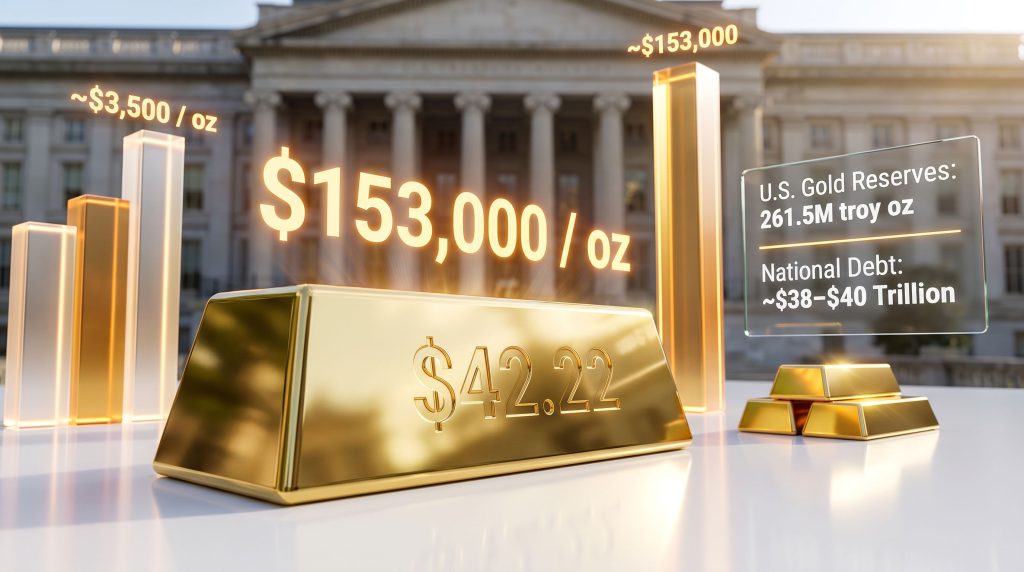
The United States officially holds approximately 261.5 million troy ounces of gold across facilities including Fort Knox and Federal Reserve vaults. The current statutory book value assigned to this gold is $42.22 per ounce, a figure set by Congress and unchanged since the early 1970s.
At that outdated price, the total official value of U.S. gold reserves is approximately $11 billion. Meanwhile, gold has been trading between $3,300 and $3,800+ per ounce in recent market conditions, meaning the government's official gold valuation sits roughly 80 times below current market rates. According to analysis from the Federal Reserve, the international experience of official reserve revaluations offers important context for how this process might unfold.
The Debt-Elimination Thought Experiment
The following is a mathematical illustration intended to contextualise the scale of U.S. fiscal imbalance. It is not a policy proposal or price forecast.
- Total U.S. debt: approximately $38 to $40 trillion
- U.S. gold holdings: approximately 261.5 million troy ounces
- Implied gold price required to fully offset total debt: approximately $153,000 per ounce
| Scenario | Gold Price Per Ounce | Debt Coverage |
|---|---|---|
| Current statutory value | $42.22 | Less than 0.1% |
| Current market price (~$3,500) | $3,500 | ~2.4% |
| Société Générale modelled estimate | ~$5,000 | ~5 to 6% |
| Full debt elimination | ~$153,000 | 100% |
What this arithmetic reveals is not a price target. It is a lens through which to understand the structural impossibility of resolving the national debt through gold revaluation alone. The exercise makes the scale of the imbalance tangible in a way that abstract debt figures cannot.
What a Realistic Revaluation Would Actually Achieve
Revaluing U.S. gold reserves to current market prices of approximately $3,500 per ounce would generate a paper balance sheet gain of roughly $900 billion to $1 trillion. A revaluation to $5,000 per ounce, as modelled by Société Générale analysts, would produce approximately $2.1 trillion in accounting gains.
This represents around 5 to 6% of total federal debt, which is meaningful as a balance sheet adjustment but falls far short of transformative at the fiscal level. Crucially, revaluation does not extinguish debt. It improves the asset side of the Treasury's ledger without reducing the liabilities owed to creditors. The question of US debt and gold revaluation is therefore one of optics as much as economics.
Could the U.S. Government Legally Revalue Its Gold Reserves?
The Legal and Accounting Framework
Under current U.S. law, the Treasury Department holds title to the nation's gold reserves. The statutory price of $42.22 per ounce is set by Congress and can only be changed through legislation. This means revaluation is not within the unilateral authority of the Treasury Secretary or the Federal Reserve. It would require an act of Congress.
The Federal Reserve has acknowledged in policy discussions that reserve revaluation is theoretically possible, but it has not been adopted as formal policy. One reason is political: revaluation would require Congress to confront the true scale of fiscal imbalance in a visible and politically uncomfortable way. However, gold's monetary role in the broader international system adds another layer of complexity to any such legislative action.
What Revaluation Would and Would Not Do
What it could do:
- Increase the Treasury's official net asset position on its balance sheet
- Provide a mechanism for issuing additional gold certificates to the Federal Reserve
- Create limited fiscal headroom for targeted spending or debt reduction programmes
What it cannot do:
- Eliminate or meaningfully reduce the $38 to $40 trillion debt burden
- Restore confidence in the dollar without accompanying structural fiscal reform
- Prevent inflationary consequences if accounting gains are used to fund additional expenditure
A gold revaluation is an accounting reclassification, not a wealth creation event. It reclassifies the same physical asset at a higher number without generating new economic output or reducing actual obligations to creditors.
How Currency Debasement Historically Drives Gold Demand
Six Thousand Years of Monetary Precedent
Gold has functioned as a monetary store of value across virtually every major civilisation for approximately 6,000 years. The consistency of this relationship across cultures, geographies, and centuries is not coincidental. It reflects gold's unique combination of physical properties: scarcity, durability, portability, divisibility, and universal recognisability.
Historical episodes of sovereign debt crises, from Roman currency debasement to the Weimar Republic's hyperinflation, produced a consistent outcome. When official currencies lost credibility, populations and merchants migrated toward gold and silver as transactional mediums and stores of value. This migration was not typically initiated by government policy. It emerged organically from the bottom up, driven by individuals and businesses seeking reliable exchange mechanisms.
The post-1971 fiat monetary era, in which all major currencies are backed exclusively by government promises rather than physical assets, represents a historically brief experiment. In the context of 6,000 years of monetary history, five decades of pure fiat currency is a relatively short trial period.
The Modern Parallel: Dollar Confidence and Capital Rotation
When confidence in a reserve currency erodes, capital seeks the next most liquid and universally recognised store of value. Gold is the primary beneficiary of this rotation because it carries no counterparty risk, cannot be printed, and has functioned as monetary collateral across virtually every economic system in recorded history. Understanding gold in the monetary system helps clarify why this dynamic is recurring now with such force.
Gold's recent price appreciation measured in euros, rising approximately 39 to 40% over a 12-month period from roughly €92,000 per kilogram to approximately €128,000 per kilogram, illustrates this dynamic in real time. The same proportional appreciation has occurred in U.S. dollar terms, confirming that the price move is not a currency-specific effect but a structurally driven revaluation of gold's role as a monetary anchor.
This distinction is important. When gold rises only in one currency's terms, it may reflect that currency's weakness. When it rises proportionally across all major currencies simultaneously, it reflects a broad reassessment of fiat monetary systems collectively.
The next major ASX story will hit our subscribers first
What Happens to Broader Markets If the Bond Market Cracks?
The Interconnected Risk Architecture
Sovereign bonds do not exist in isolation. They function as collateral and pricing benchmarks across virtually every asset class in the global financial system. The risk-free rate implied by U.S. Treasuries is the foundation upon which equity valuations, corporate credit spreads, mortgage rates, and derivative pricing are all built.
A disorderly rise in long-term Treasury yields would trigger a cascade of consequences:
- Equity valuations would compress as higher discount rates reduce the present value of future earnings
- Leveraged portfolios across hedge funds and institutional investors would face margin calls and forced liquidations
- Corporate borrowing costs would rise, compressing margins and reducing capital investment
- Consumer credit costs would increase, suppressing spending and economic activity
- Banks holding large fixed-income portfolios would face mark-to-market losses on their balance sheets
The Slow Wave Dynamic in Macro Risk
One of the most insightful frameworks for understanding the current environment is the concept of the slow wave. Very large systemic risks can appear to move slowly precisely because their scale distorts perception of velocity. A tidal wave that stretches across an entire ocean appears almost stationary from the shore. But when it arrives, it is not slow at all.
The gradual accumulation of fiscal imbalances, institutional bond selling, and currency confidence erosion can persist for years before reaching a non-linear inflection point. Historical analogies suggest the transition from slow accumulation to rapid dislocation can occur within weeks or months rather than years. The extended runway does not reduce severity. It may increase it by allowing further imbalances to accumulate before resolution is forced upon the system.
Is a Return to the Gold Standard Economically Viable?
The Case For: Structural Discipline and Monetary Credibility
A gold-backed monetary system imposes hard constraints on deficit spending because currency issuance must be anchored to a finite physical asset. This structural limitation eliminates the political incentive to inflate away debt obligations. It also removes the mechanism by which governments can silently transfer wealth from savers to debtors through monetary expansion.
Historical gold standard periods, particularly the classical era from approximately 1870 to 1914, were associated with low inflation, stable exchange rates, and sustained international trade growth. The discipline imposed by the gold standard was not always economically convenient, but it prevented the kind of compounding fiscal excess now observable in most major economies.
The Case Against: Operational and Political Constraints
Global gold supply grows at approximately 1 to 2% per year, which many economists argue is insufficient to support the monetary expansion required by modern economies during periods of growth or crisis response. A gold standard would also severely limit a government's ability to respond to economic shocks through monetary policy, a constraint that proved costly during the Great Depression.
The political economy of debt reduction also presents a fundamental obstacle. No government that has accumulated tens of trillions in obligations through decades of deficit spending is likely to voluntarily adopt a monetary framework that makes future deficit spending structurally impossible. The solution is logical. The implementation is politically untenable in the absence of external pressure.
The Organic Adoption Pathway
A more historically grounded pathway is not top-down government implementation but bottom-up adoption driven by the public. Across monetary history, the re-emergence of gold and silver as transactional mediums has typically preceded formal monetary reform. When individuals and businesses begin voluntarily denominating transactions in precious metals because they no longer trust official currencies, the groundwork for systemic monetary change is laid organically. Governments have historically been forced to acknowledge these shifts rather than initiate them.
Gold and Silver Price Outlook: Fundamental Drivers vs. Speculative Momentum
Distinguishing Structural Demand From Market Excitement
Not all gold price rallies are created equal. Earlier speculative spikes, including a vertical move in silver toward $120 per ounce at one point this year, were characterised by momentum-driven buying with limited fundamental anchoring. These moves tend to be sharp and self-correcting.
The current price appreciation cycle is characterised by a different foundation. Multiple structural forces are converging simultaneously, and central bank gold demand is among the most significant of these drivers:
- Major institutional investors are actively reducing Treasury exposure
- Central banks globally are accumulating gold at historically elevated rates
- Real yields remain negative in inflation-adjusted terms across key markets
- Geopolitical risk premiums are compounding safe-haven demand
- Dollar confidence is eroding among both institutional and retail holders
Current Price Reference Points and Year-on-Year Comparison
| Metric | 12 Months Ago | Current Period | Approximate Change |
|---|---|---|---|
| Gold (EUR/kg) | ~€92,000 | ~€128,000 | +~39% |
| Gold (USD/oz) | ~$2,300 to $2,400 | ~$3,300 to $3,800+ | +~40 to 50% |
| Silver (USD/oz) | ~$27 to $29 | ~$70 | +~140 to 160% |
Note: Price figures are approximate and reflect general market levels for illustrative purposes. Precious metals prices are volatile and can change significantly. This is not financial advice.
Geopolitical Risk as a Compounding Variable
Active military conflicts in multiple regions simultaneously serve as both a fiscal drain on participating governments and a safe-haven demand catalyst for precious metals. Sustained conflict requires government borrowing, which compounds the fiscal dynamics already pressuring bond markets. Historically, extended geopolitical instability has prolonged gold bull markets beyond what purely monetary analysis would project.
The monetary dimension of geopolitical conflict is underappreciated by many investors. Wars are, at their root, funded by currency creation. When governments cannot finance military spending through taxation alone, they borrow or print. Both mechanisms accelerate the debasement dynamics that drive gold demand. Notably, commentary from Kitco analysts reinforces that the relationship between US debt and gold revaluation is reshaping fiscal optics in ways that extend well beyond mere accounting adjustments.
FAQ: U.S. Debt, Gold Revaluation, and What It Means for Investors
Could the U.S. Government Revalue Gold to Reduce Its Debt?
Revaluation is legally possible through Congressional action, but it functions as an accounting adjustment rather than genuine debt elimination. At current market prices, revaluing U.S. gold reserves would generate approximately $900 billion to $2.1 trillion in balance sheet gains, representing roughly 2 to 6% of total federal debt.
What Price Would Gold Need to Reach to Theoretically Cover All U.S. Debt?
Based on U.S. gold holdings of approximately 261.5 million troy ounces and a debt load of $38 to $40 trillion, gold would need to be valued at approximately $153,000 per ounce, roughly 40 to 45 times its current market price.
Why Is Gold Rising Now If the Debt Problem Has Existed for Years?
Structural debt accumulation is a slow-moving force. Gold price acceleration tends to occur when market confidence thresholds are visibly breached, such as when major institutions begin actively reducing Treasury exposure or when government bond monetisation becomes apparent. These conditions are currently observable.
Does a Bond Market Crisis Automatically Mean Gold Goes Higher?
Historically, yes. Capital exiting sovereign debt markets seeks liquid, non-counterparty assets, and gold is the most globally recognised of these. However, in acute liquidity crises, gold can temporarily decline as investors sell all assets to meet margin calls before subsequently recovering strongly.
What Is the Difference Between Gold Revaluation and a Gold Standard?
Gold revaluation is a one-time accounting adjustment of the official price assigned to existing reserves. A gold standard is a systemic monetary framework where currency issuance is continuously anchored to gold holdings. They are entirely distinct mechanisms with different implications for monetary policy, fiscal discipline, and long-term currency credibility.
Key Takeaways: Synthesising the Fiscal, Monetary, and Investment Picture
- The U.S. national debt at $38 to $40 trillion represents a structural fiscal challenge that cannot be resolved through gold revaluation alone
- A full revaluation to current market prices would generate a meaningful but insufficient balance sheet improvement of approximately $900 billion to $2.1 trillion
- The gold price required to arithmetically eliminate U.S. debt, approximately $153,000 per ounce, illustrates the scale of fiscal imbalance rather than serving as a realistic near-term price target
- Bond market stress, evidenced by large-scale institutional Treasury selling and government yield curve intervention, is a primary structural driver of current gold demand
- The transition from fiat currency confidence to hard asset preference is a historically recurring pattern with a consistent outcome: gold appreciation measured against the debasing currency
- The current gold price cycle appears more fundamentally anchored than prior speculative spikes, supported by institutional flows, central bank accumulation, and structural monetary concerns rather than momentum alone
- Investors monitoring this environment should maintain a clear distinction between speculative momentum and structurally supported price appreciation, as the risk profile and duration of each are fundamentally different
This article is intended for informational and educational purposes only. It does not constitute financial advice. Precious metals prices are volatile, and past performance is not indicative of future results. Readers should conduct their own research and consult a qualified financial adviser before making investment decisions.
Want to Identify ASX Mineral Discoveries Before the Broader Market Does?
Discovery Alert's proprietary Discovery IQ model delivers real-time alerts on significant ASX mineral discoveries, converting complex geological and market data into actionable insights for both short-term traders and long-term investors — explore historic discoveries and their exceptional returns to understand the opportunity, then begin your 14-day free trial to position yourself ahead of the market.