July 13, 2026
When the Strait Closes, the World Notices
Global energy markets have always had a short list of geographic chokepoints that carry outsized systemic weight. The Strait of Hormuz sits at the top of that list. Stretching just 33 kilometres at its narrowest point between Oman and Iran, this sliver of water channels roughly 20% of the world's traded oil and a significant portion of liquefied natural gas exports destined for Asia. When access to it becomes uncertain, the consequences travel far beyond the Persian Gulf, rippling through commodity futures, currency markets, sovereign bond spreads, and ultimately, equity indices on the other side of the planet.
That dynamic is precisely what confronted Australian investors heading into the US-Iran ceasefire collapse and ASX market open on 13 July 2026. The formalised breakdown, driven by escalating military exchanges and Tehran's decision to close the Strait of Hormuz to commercial navigation, arrived at exactly the wrong moment for a local bourse that had been building momentum across three consecutive winning weeks.
When big ASX news breaks, our subscribers know first
How the Ceasefire Unravelled: A Compressed Timeline
The mid-2026 diplomatic framework between Washington and Tehran had been structured around a Memorandum of Understanding signed in June. Markets interpreted that agreement as a floor of stability, pricing out a significant portion of the Middle East risk premium previously embedded in oil futures. That repricing, however, proved premature.
The sequence of events that destroyed the ceasefire followed a recognisable escalatory pattern:
- Iranian strikes on commercial vessels transiting the Strait of Hormuz triggered immediate US military countermeasures.
- US President Donald Trump, speaking at the NATO summit in Ankara, publicly declared the diplomatic process finished — a statement that functioned as both a political signal and a market catalyst simultaneously.
- Iran's Revolutionary Guard Navy announced the Strait of Hormuz would be closed until further notice, transforming what had been a bilateral diplomatic failure into a global supply chain emergency.
At least one commercial vessel was struck during the initial escalation, according to reports circulating before the ASX opened. The combination of confirmed kinetic activity, a US presidential declaration of intent to use military force, and a formal waterway closure compressed weeks of geopolitical risk into a single weekend trading interval. For more context on how such events shape pricing, the crude oil geopolitical dynamics framework provides essential background.
The Strait of Hormuz: Understanding the Systemic Weight
The Strait's economic significance extends well beyond its crude oil throughput figures. Furthermore, several layers of dependency converge at this single geographic bottleneck:
- India's LPG import supply depends heavily on Persian Gulf production routed through the Strait, making South Asian energy security acutely sensitive to any prolonged closure.
- Asian LNG buyers, particularly in Japan, South Korea, and Taiwan, face contract repricing pressure when Middle East supply lines are disrupted, given the spot market exposure many utilities carry.
- Freight insurance premiums spike immediately upon any credible Strait closure threat, raising the effective landed cost of energy imports across importing nations before a single barrel of oil is withheld from market.
- Refining margins in Asia-Pacific compress when feedstock costs spike rapidly without equivalent product price adjustments, affecting downstream energy economics.
Historical precedents reinforce the severity of this kind of disruption. During the Iran-Iraq War tanker conflict of the 1980s, insurance war-risk premiums on Gulf-transiting vessels rose by multiples within days of each new incident. More recently, the 2019 tanker attacks near the Strait caused Brent crude to jump more than 15% intraday, demonstrating how efficiently oil markets transmit geopolitical risk into price.
"The closure of the Strait of Hormuz does not merely affect oil prices in isolation. It simultaneously elevates freight risk premiums, compresses energy supply chain planning horizons, and forces institutional investors to reprice risk across multiple asset classes within hours, not days."
Pre-Open Macro Dashboard: What the Overnight Session Revealed
Before a single order was matched on the ASX, the overnight global session had already delivered a clear macro verdict. The following asset movements shaped the pre-open framework for Australian equity traders:
| Asset Class | Pre-Open Level / Movement | Key Implication for ASX |
|---|---|---|
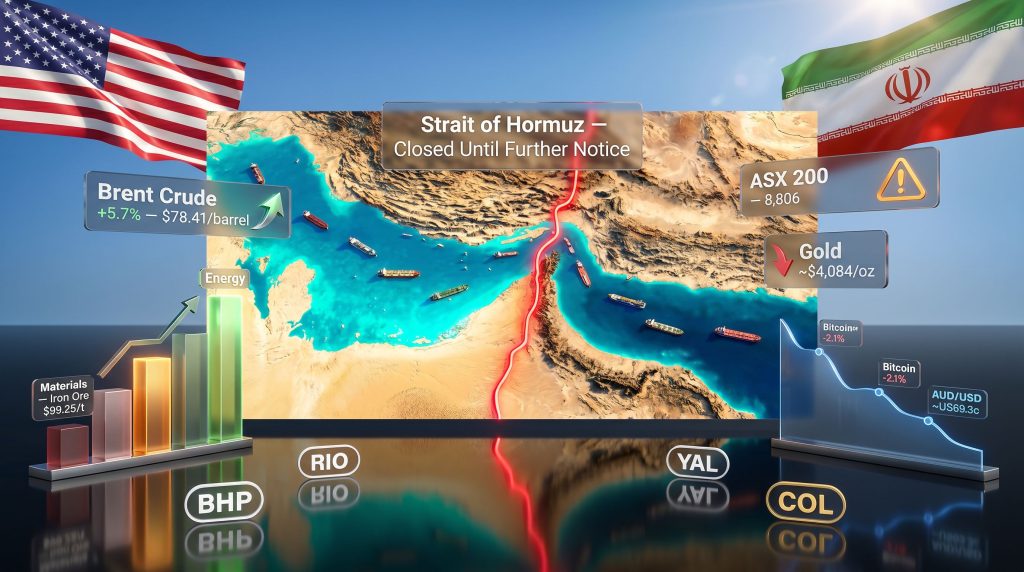
| Brent Crude | +3% to above $78/barrel | Direct energy sector revenue tailwind |
| Iron Ore (Singapore) | ~$99.25/tonne | Hovering below the psychologically significant $100 threshold |
| Gold | Fell to ~$4,084/oz | Safe-haven function disrupted by USD strength |
| US Equities | Closed lower on Middle East concerns | Negative lead amplifying domestic risk-off |
| AUD/USD | ~US69.3c | Mild pressure; import cost exposure elevated |
| US Natural Gas Futures | ~$2.92/gigajoule | Subdued; limited domestic directional signal |
The ASX 200 had closed Friday, 10 July at 8,806, representing a 0.5% gain that reflected investor optimism now directly challenged by weekend developments. ASX futures were pointing to a marginally positive open, but experienced traders understood that futures-implied opens frequently fail to capture geopolitical shock fully. Consequently, the more meaningful price discovery was always going to occur after the 10:00 am AEST bell.
ASX Trading Hours: The ASX opens for normal trading at 10:00 am AEST. Pre-open order entry is accepted from 7:00 am AEST, though no trades execute until the official open. Stock codes begin trading in staggered batches, with A–B codes opening at 10:00:00 and subsequent batches following at two-minute intervals.
Sector-by-Sector Framework: Where the Shock Lands
Energy Stocks: The Unambiguous Near-Term Beneficiary
Brent crude's overnight advance directly lifts the revenue outlook for ASX-listed oil and gas producers. The mechanism is straightforward: higher spot prices improve realised sales margins on unhedged production volumes and support upward contract repricing for LNG export agreements tied to oil price indexation. In addition, the LNG supply outlook adds further context to how Middle East disruptions reshape contract dynamics across Asian markets.
What distinguishes this particular episode from a transient spike is the structural nature of the supply threat. A Strait closure, even if ultimately short-lived, forces buyers to seek alternative supply routes or draw down strategic reserves — each of which carries a cost premium that sustains elevated price floors beyond the initial shock window.
Risks to the energy rally include:
- A rapid diplomatic resolution or partial reopening of the Strait
- US strategic petroleum reserve (SPR) releases, which the Biden administration deployed effectively in 2022 to cap oil prices following the Russia-Ukraine supply shock
- Demand destruction if oil prices spike sufficiently to slow industrial activity in major Asian import markets
Gold and Precious Metals: A Counterintuitive Response
Gold's retreat to approximately $4,084/oz confounded investors who might have expected the metal to surge on classic risk-off logic. The explanation lies in the oil-dollar relationship. When an oil price shock strengthens the US dollar, as it typically does through the terms-of-trade channel for oil-importing nations, gold faces selling pressure because it is priced in USD and becomes more expensive for non-US buyers.
This pattern is not new. During the 2019 Strait of Hormuz tanker incidents, gold initially underperformed relative to crude oil in the first 48 hours of escalation before gradually recovering as broader uncertainty persisted. The same dynamic appears to be playing out in July 2026.
For ASX-listed gold producers, the near-term picture is particularly challenging. Falling spot prices combine with rising operational costs driven by higher diesel and energy inputs, squeezing margins from both directions simultaneously.
Gold typically reasserts its safe-haven premium when:
- The conflict extends beyond two to three weeks without diplomatic resolution
- Inflationary expectations rise sufficiently to reduce real interest rate expectations
- Equity market selling becomes broad and sustained enough to drive genuine capital preservation flows
Materials and Iron Ore: Caught Between Two Forces
Iron ore's position at $99.25/tonne carries particular significance. The $100/tonne level functions as a psychological threshold for major ASX producers, below which investor sentiment toward the sector cools noticeably. The proximity to that line, combined with an oil-driven cost shock that inflates mining operational expenses, creates a margin compression narrative that limits the upside case for BHP (ASX: BHP) and Rio Tinto (ASX: RIO) at the open. The China steel and iron ore outlook provides further context on the demand-side variables shaping this equation.
The secondary variable is China. Iron ore demand is primarily a function of Chinese steel production, and geopolitical uncertainty that elevates global risk aversion can slow Chinese industrial purchasing decisions as planners wait for clarity on the macro trajectory.
Defence and Security Small-Caps: The Contrarian Angle
Geopolitical escalation events have historically triggered rotational flows into defence-adjacent equities, particularly among smaller ASX-listed companies with exposure to communications technology, surveillance systems, or logistics infrastructure. This pattern reflects institutional portfolio hedging rather than pure speculative positioning.
The structural case for defence small-caps during conflict escalation cycles rests on the expectation that prolonged instability generates increased government procurement discussions, even if actual contract awards materialise over much longer timeframes than the initial market rotation implies.
Broader Risk-Off Dynamics: What Retreats When Fear Advances
Beyond commodities, a geopolitical shock of this magnitude exerts pressure across several other ASX sectors:
- Consumer discretionary and retail stocks face the demand destruction narrative as higher fuel prices act as a de facto consumption tax on household spending.
- Financial sector stocks absorb uncertainty through wider credit spread expectations and reduced appetite for growth-related lending activity.
- Technology and growth stocks carry rate-sensitivity risk; if oil-driven inflation resurfaces, the RBA's ability to continue an accommodative stance becomes constrained, which compresses the valuation multiples applied to longer-duration earnings.
For a broader view of how commodity-driven volatility interacts with index performance, the ASX commodity pressure analysis offers useful structural perspective.
ASX Stocks in Focus at Monday's Open
Several company-specific stories were competing for attention alongside the macro backdrop heading into Week 29:
- Telstra (ASX: TLS) remained under pressure following reports identifying decade-old SyncServerS300 infrastructure as a probable cause of the recent network outage. Communications Minister Anika Wells indicated accountability measures were forthcoming, adding regulatory headline risk to an already damaged sentiment picture.
- Yancoal (ASX: YAL) faced a pivotal week with the NSW Independent Planning Commission holding public hearings on the Hunter Valley Operations extension proposal. Glencore and Yancoal are seeking approval to extend operations through to the mid-2040s, a decision that carries long-term revenue implications for the coal producer at a moment when energy market dynamics are acutely in focus.
- Coles (ASX: COL) was on the threshold of completing an approximately $4 billion acquisition of Greencross, the Petbarn operator, from TPG Capital. The deal, which includes the assumption of existing debt, represented a major strategic diversification move that could attract investor attention independent of the macro headwinds surrounding it.
- oOh!media (ASX: OML) saw its acquisition contest narrow to three final bidders: Pacific, I Squared, and Oaktree. M&A processes conducted against a risk-off macro backdrop typically face elevated execution uncertainty, as financing costs move adversely and acquirer confidence weakens.
The next major ASX story will hit our subscribers first
Scenario Analysis: Three Pathways for Week 29
| Scenario | Key Trigger | Expected ASX Impact |
|---|---|---|
| Escalation Deepens | Further strikes; Iranian or Israeli targeting of oil infrastructure | Sharp broad sell-off; energy stocks outperform; gold recovers; index falls 1–2%+ |
| Diplomatic Pause | Back-channel negotiations resume; partial Strait reopening signals | Partial recovery; oil gives back gains; risk assets stabilise |
| Full Re-Escalation | US military action expands; regional powers enter conflict | Significant risk-off; AUD under pressure; flight to cash; broad commodity volatility |
An oil price rally driven by the escalation deepens scenario would likely produce the sharpest divergence between energy sector gains and broad index losses seen in recent years.
Key Monitoring Indicators for the Week Ahead
Investors tracking this situation should watch the following variables closely:
- Whether Brent crude sustains above $80/barrel or retreats, as this level represents the boundary between a manageable supply shock and a structurally inflationary energy event.
- US SPR release announcements, which historically represent Washington's most immediate non-military lever for oil price management.
- Consumer confidence data due Tuesday, which will provide a domestic demand sentiment read that either compounds or partially offsets the international pressure.
- Gulf Cooperation Council nation responses, particularly from Saudi Arabia and the UAE, which have historically played moderating roles during Iran-related escalation cycles.
- Any signals from diplomatic back-channels suggesting ceasefire renegotiation is possible.
According to analysts covering the aftermath of the US-Iran situation, a return to market normalcy is unlikely to be swift even if a new ceasefire is eventually brokered — reinforcing the case for careful position management throughout the week.
"Investors navigating geopolitically driven volatility should maintain a clear distinction between short-term price dislocations, which frequently reverse within days as initial panic subsides, and genuine structural shifts in energy supply that warrant longer-term portfolio repositioning. The historical record on Strait of Hormuz disruptions suggests most episodes resolve within weeks, but the pricing window during the acute phase can be sharp, asymmetric, and unforgiving for poorly positioned portfolios."
Is This a One-Week Shock or Something More Durable?
The three-week winning streak the ASX 200 had accumulated heading into Week 29 carried both technical and psychological weight. Breaking a multi-week positive streak on geopolitical news tends to amplify the initial selling impulse beyond what fundamentals alone would justify, as momentum-following algorithmic strategies exit positions simultaneously with discretionary risk reduction by institutional managers.
Australian equity markets carry a structural characteristic that differentiates their response to oil price shocks from US or European indices: the heavy commodity weighting in the ASX 200 means that energy and materials sector gains partially offset broad market weakness. This internal hedging dynamic has historically produced shallower drawdowns during oil-price-driven geopolitical events than comparable periods on Wall Street.
The US-Iran ceasefire collapse and ASX market open dynamic heading into Week 29 presented investors with an unusually compressed risk-management window. Live ASX market updates tracked the session as it unfolded, providing real-time context for traders navigating the uncertainty. The forward calendar for Week 29 carried several competing narratives: the consumer confidence data, the Hunter Valley Planning Commission hearings, pending corporate M&A outcomes, and the ongoing Telstra regulatory story. Whether any of these storylines could capture sufficient investor attention to redirect focus away from the Middle East remained the central uncertainty as Australia prepared for the 10:00 am AEST open.
This article is intended for informational purposes only and does not constitute financial advice. All market data referenced reflects pre-open levels on 13 July 2026. Readers are encouraged to conduct independent research and consult a licensed financial adviser before making any investment decisions.
Want to Identify the Next Major ASX Discovery Before the Market Moves?
While geopolitical shocks like the Strait of Hormuz closure dominate headlines and reshape commodity pricing across energy, gold, and materials sectors, Discovery Alert's proprietary Discovery IQ model continuously scans ASX announcements in real time — delivering instant alerts on significant mineral discoveries so subscribers can act ahead of the broader market. Explore historic examples of major ASX mineral discoveries and their returns, then begin a 14-day free trial to experience how rapid, actionable intelligence can sharpen your position in volatile commodity markets.