July 24, 2026
The Hidden Fragility of Global Oil Markets Before the First Shot Is Fired
Every major oil supply crisis in modern history has revealed one uncomfortable truth: the market's ability to withstand disruption is rarely as robust as it appears during calm periods. Spare capacity, strategic reserves, and alternative routing options all look reassuring on paper until the moment they are actually needed. Understanding US-Iran conflict oil price scenarios requires moving beyond headline geopolitics and into the physical architecture of global crude flows, refinery economics, and strategic inventory management.
What distinguishes the current conflict from previous geopolitical flashpoints is not simply the scale of the disruption, but the condition of the market's shock-absorbing mechanisms entering the crisis. Buffers that took years to build have already been partially consumed, and the crude quality mismatch created by this particular conflict has no clean historical precedent.
The four US-Iran conflict oil price scenarios that energy analysts have modelled represent meaningfully different futures, each with its own internal logic, probability weighting, and downstream consequences for energy markets worldwide.
When big ASX news breaks, our subscribers know first
Why This Conflict Has Changed How Oil Markets Price Risk
For most of the past two decades, geopolitical tension in the Middle East was treated by oil traders as a sentiment-driven phenomenon. Prices would spike on headlines, then retrace as the situation stabilised without materially affecting physical supply. The implicit assumption was that actual barrels would keep flowing regardless of political temperature.
That assumption has been fundamentally invalidated by the current conflict. Markets are no longer pricing geopolitical sentiment; they are pricing the probability of physical flow disruption. This distinction carries enormous practical importance. Sentiment-driven premiums dissolve when diplomacy resumes. Physical flow disruptions require rerouting infrastructure, alternative crude sourcing, refinery reconfiguration, and time to resolve, none of which respond to a press release.
Rystad Energy's Vice President of Commodity Markets, Janiv Shah, has noted that while oil flows through the Strait of Hormuz have fallen sharply since March, the market has managed to absorb the disruption through a combination of inventory drawdowns, alternative supply routes, and spare production capacity. The critical question is how much longer those three mechanisms can continue to function as effective shock absorbers.
Furthermore, the geopolitical and logistical factors shaping this conflict compound one another in ways that previous crises did not. Three compounding vulnerabilities define the current market structure:
- Global spare production capacity has been materially drawn down since the conflict began
- Strategic Petroleum Reserves in major consuming nations have already been partially deployed during earlier conflict phases, leaving thinner emergency cushions
- Commercial crude and product inventories are running below pre-conflict baselines, amplifying the price impact of each successive disruption event
Key Structural Reality: The oil market's capacity to absorb supply shocks degrades with each drawdown cycle. Entering this conflict phase with depleted buffers means the probability-weighted price impact of any escalation scenario is materially higher than it would have been when the conflict began.
The Four US-Iran Conflict Oil Price Scenarios: A Structured Overview
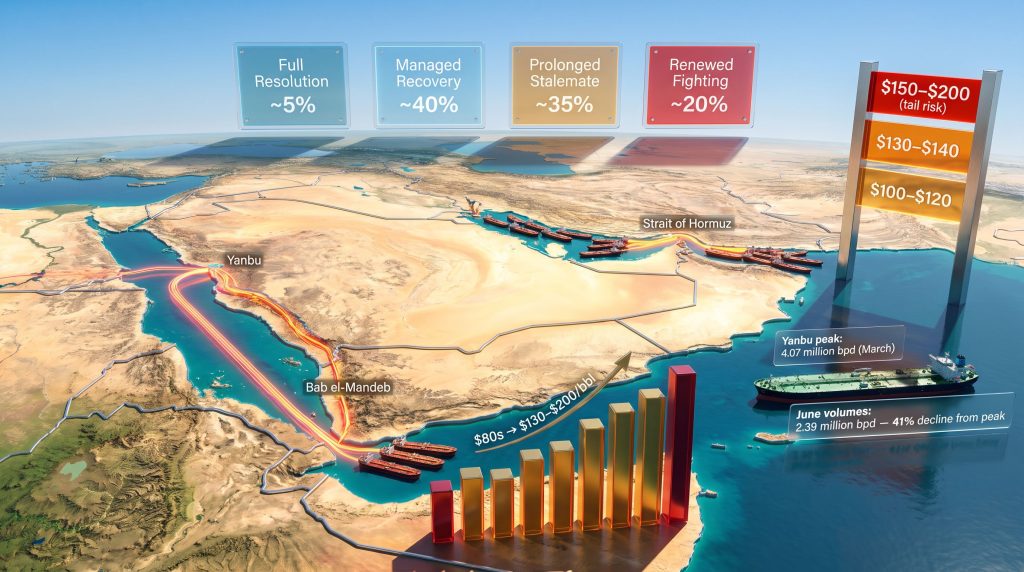
Rystad Energy has modelled four distinct conflict resolution pathways, each assigned a probability and carrying different implications for crude prices, refinery economics, and global trade flows. These are not simply optimistic-to-pessimistic variations on a single theme; they differ in their underlying physical mechanisms and the speed at which market equilibrium could be restored.
| Scenario | Probability | Broad Price Direction |
|---|---|---|
| Full Resolution | ~5% | Brent retreats toward mid-to-high $80s |
| Narrow Deal (Managed Recovery) | ~40% | Elevated with persistent risk premium of $5-$10/bbl |
| Prolonged Stalemate | ~35% | Gradual drift toward $90s-$100+ as deficits deepen |
| Fighting Restarts | ~20% | Sharp spike; $130-$200/bbl tail risk |
Scenario 1: Full Resolution and What Complete De-Escalation Would Actually Require
Why a 5% Probability Is Not Zero
The full resolution scenario demands an unusually rapid and comprehensive sequence of diplomatic outcomes: binding nuclear limitations accepted by all parties, comprehensive sanctions relief restoring Iranian export access, uncontested maritime passage through both the Strait of Hormuz and Bab el-Mandeb, and verifiable implementation milestones. Each condition alone is historically difficult to achieve; achieving all simultaneously in a compressed timeframe is extraordinarily rare.
How Oil Markets Would Respond to Complete Normalisation
Were this scenario to materialise, the price impact would be significant but not instantaneous. Asian refineries, particularly those in South Korea, Japan, and India configured for Persian Gulf sour crude grades, would move aggressively to restore feedstock supply. This initial surge in crude intake would temporarily slow any Brent price decline, as strong demand partially offsets the removal of the geopolitical risk premium.
- Persian Gulf loading programs would take time to rebuild, introducing a lag between diplomatic agreement and physical market relief
- Refinery margins and product crack spreads would normalise gradually as Gulf crude output and export programs are restored
- Estimated price effect: Brent retreats toward the mid-to-high $80s per barrel as the risk premium, currently estimated at $5-$15 per barrel, unwinds over weeks rather than days
Strategic Reserve Dynamics Under Full Normalisation
An often-overlooked dynamic in a resolution scenario involves strategic petroleum reserve behaviour. Governments would have limited immediate incentive to replenish SPR stocks during the initial export wave, as ample supply reduces urgency. However, as markets loosen and prices fall, the economics of strategic buying become attractive, creating a demand floor that moderates further price decline.
This combination of recovering refinery demand and eventual SPR accumulation would provide a meaningful support level, preventing a sharp overshoot to the downside.
Scenario 2: The Narrow Deal and Why Partial Agreement Is Most Likely
The Logic Behind a 40% Probability
A narrow deal resolves the immediate military exchange without addressing the structural disagreements on nuclear capability or maritime leverage that drove the conflict in the first place. This outcome is historically consistent with Middle East conflict resolution patterns: incremental agreements that reduce violence without eliminating the underlying tensions that produced it. Diplomatic channels remain active, but implementation lags create persistent uncertainty that keeps a geopolitical risk premium embedded in prices.
Macquarie strategists have noted that the reintroduction of geopolitical risk premium drove the recent oil price rally, compounded by a short squeeze from historically elevated short interest that had built up prior to the ceasefire's collapse. Their assessment assigns a medium probability to modest further escalation but a low probability for a return to large-scale conflict, absent a serious miscalculation by either party.
In addition, the broader context of oil trade and geopolitics suggests that even partial agreements carry significant ongoing market implications that extend well beyond the immediate conflict zone.
Physical Market Mechanics in a Managed Recovery
Under a narrow deal, attack intensity declines but does not cease. Gulf crude loading programs require time to rebuild as tank clearances, shipping confidence restoration, and insurance market normalisation all introduce lag. Meanwhile:
- Asian buyers compete aggressively for available Persian Gulf sour barrels, keeping sour crude differentials elevated relative to sweet grades
- US refiners increase reliance on Canadian heavy grades and South American crude to compensate for reduced Gulf access
- European refiners absorb additional light sweet crude volumes while competing for middle distillate supply
- Strong crack spreads support crude demand wherever feedstock is accessible
- Estimated price effect: Brent remains elevated with a persistent risk premium of $5-$10 per barrel above pre-conflict levels throughout the transition period
Scenario 3: Prolonged Stalemate and the Yanbu Bottleneck Nobody Saw Coming
Defining the Stalemate Condition
At 35% probability, the stalemate scenario represents a situation where attack intensity declines but no diplomatic breakthrough occurs. Freight rates and insurance costs remain structurally elevated as shipping operators price in ongoing threat exposure. The world, as Rystad Energy characterised it, learns to trade around the threat rather than eliminate it.
The Yanbu Concentration Problem: A False Sense of Diversification
One of the most structurally important and underappreciated dynamics of the current conflict is the degree to which Saudi Arabia's export diversification strategy has created a new concentration risk. Following the closure of the Strait of Hormuz in late February, Saudi Arabia redirected virtually all crude exports through its East-West Petroline to Yanbu on the Red Sea.
Wood Mackenzie's vessel tracking and cargo data reveal the extraordinary scale of this concentration:
| Month | Yanbu Share of Saudi Liftings | Yanbu Volume (approx.) |
|---|---|---|
| March 2026 | 86.7% (77 cargoes, 121.9 million barrels) | ~4.07 million bpd |
| April 2026 | 93.6% | Declining from peak |
| May 2026 | 94.3% | Continuing decline |
| June 2026 | 98.6% | ~2.39 million bpd |
Only a single cargo of approximately one million barrels cleared the Gulf at Ju'aymah during the entire month of June. Measured against Saudi Arabia's January total export level of approximately 7.96 million bpd across both terminals, June's Yanbu volumes represent a 66% decline in total Saudi export capacity.
Ian Solis, Data Analyst, Tech/Maritime-Ops at Wood Mackenzie, described the situation in stark terms: for months the market treated Yanbu as the solution to Hormuz risk, but Yanbu has its own chokepoint. If Bab al-Mandeb comes under sustained disruption from a declared Houthi naval blockade, Asia stands to lose a major crude supply artery. What appeared to be diversification was in reality a shift from one strategic bottleneck to another.
Where Saudi Red Sea Barrels Are Actually Going
The destination profile for Saudi Red Sea crude in June and July reflects a clear prioritisation of South and East Asian markets, with European buyers largely absent from direct cargo flows:
| Destination | Cargo Count (June-July) | Route Type |
|---|---|---|
| Ain Sukhna, Egypt | 11 cargoes | Suez/SUMED pipeline onward |
| Malacca | 5 cargoes | Direct Asia |
| Karachi, Pakistan | 4 cargoes | Direct Asia |
| New Mangalore, India | 3 cargoes | Direct Asia |
| Sikka, India | 3 cargoes | Direct Asia |
| Ulsan, South Korea | 2 cargoes | Direct Asia |
| Yeosu, South Korea | 2 cargoes | Direct Asia |
| Yokkaichi, Japan | 2 cargoes | Direct Asia |
| Direct European deliveries | 0 cargoes | N/A |
Wood Mackenzie also noted that refined product flows from the region have continued at reduced levels, with 171 Middle East Gulf-origin product cargoes recorded in June and July, including jet fuel deliveries to Pembroke in the UK and Le Havre in France, and ULSD movements to Constantza in Romania. Four product cargoes loaded at Jubail on the Saudi Gulf coast in early July, indicating limited commercial passage remains available for smaller vessels.
Oil Price Trajectory in a Stalemate
Rystad Energy's analysis indicates that if current flow disruptions persist or worsen, global crude and liquids balance deficits are likely to push prices higher in the near term. Estimated price effect: Brent drifts into the $90s to $100+ range as deficit conditions accumulate over weeks and months.
A particularly important dynamic involves the crude quality mismatch. SPR releases can cap price spikes but cannot correct the feedstock problem facing Asian refineries. Facilities designed for heavy sour Gulf crude cannot simply substitute light sweet Atlantic Basin barrels without significant operational penalties and run rate reductions. Consequently:
- Diesel and jet fuel crack spreads remain structurally elevated even when light sweet crude is technically available
- Lighter product cracks weaken as the product slate shifts toward middle distillates
- European and complex US refiners compete more aggressively for Atlantic and heavy sour barrels
- Strategic stocks are unlikely to be refilled in this scenario, making each subsequent disruption event progressively more price-sensitive
The next major ASX story will hit our subscribers first
Scenario 4: Fighting Restarts and the Dual Waterway Closure That Markets Cannot Absorb
The Tail Risk Case at 20% Probability
The fighting restarts scenario involves negotiations collapsing entirely, direct US-Iran military exchanges broadening in scope, and regional actors being drawn into the conflict such that Persian Gulf energy infrastructure faces spillover risk. The defining characteristic of this pathway is the simultaneous closure or severe operational restriction of both the Strait of Hormuz and Bab el-Mandeb. According to analysis of oil price scenarios, this dual-waterway closure represents the most severe stress test global oil markets have ever faced.
Why Dual Waterway Closure Creates a Supply Dislocation Markets Cannot Route Around
Rystad Energy's analysis of this scenario identifies a cascading series of physical constraints that no combination of SPR releases, alternative routing, and demand substitution can fully overcome:
- Saudi Yanbu exports moving south from the Red Sea fail to reach Asian buyers if Bab el-Mandeb is closed by Houthi forces
- Rerouting through the Suez Canal and SUMED pipeline is constrained by vessel size: fully laden Very Large Crude Carriers (VLCCs) face draft and dimensional limitations, requiring Suezmax or smaller vessels, partial loading, or additional pipeline handling
- Vessel availability, port capacity, pipeline throughput, and freight costs impose hard volumetric limits on the total barrels that can be redirected from south to north
- European refiners benefit from this flow shift, but Asian buyers, who account for the majority of Gulf sour crude demand, face acute feedstock shortages with no viable near-term substitute
- As crude and product storage fills across the Middle East due to export blockage, back pressure forces progressively deeper upstream production shut-ins
The SPR Problem: Entering the Worst-Case Scenario With Depleted Reserves
Coordinated SPR releases would become likely under this scenario, but their effectiveness is constrained in three critical dimensions:
- Geographic location: Reserves must be physically accessible to the refineries facing shortages
- Crude quality compatibility: SPR stocks may not match the heavy sour grade specifications of the Asian refineries facing the most acute shortages
- Volume limitations: Previous deployments during earlier conflict phases have already drawn down global reserves, in some cases to minimum operational levels
However, the trade war impact on oil markets has further eroded the fiscal headroom that governments previously relied upon to coordinate emergency responses, making joint SPR deployment politically and logistically more complex than in past crises.
Oil Price Range Under a Fighting Restarts Scenario
| Price Level | Conditions Required |
|---|---|
| $100-$120/bbl Brent | Partial Hormuz disruption with Bab el-Mandeb operational |
| $130-$140/bbl | Dual waterway closure with partial SPR offset |
| $150-$200/bbl (tail risk) | Damage to Iranian export infrastructure or prolonged dual closure |
Oxford Economics modelling suggests that a sustained average of $140 per barrel for a two-month period would be sufficient to push parts of the global economy into a mild recession. At $100 per barrel sustained for the same duration, growth would be materially impaired but a recession could likely be avoided in most major economies.
Demand Destruction as the Long-Run Pressure Valve
Severely elevated crude and product costs would eventually destroy demand across road fuels, aviation, petrochemicals, and price-sensitive emerging markets. Combined with non-Gulf supply growth from producers outside the conflict zone, these forces would gradually ease crude markets through 2026 and 2027. This self-correcting mechanism represents the market's ultimate equilibrating force, but the adjustment period carries substantial economic cost that falls disproportionately on import-dependent emerging economies.
How the Current Disruption Compares to Historical Oil Supply Shocks
Structural Parallels and the Quality Dimension That Makes This Crisis Different
| Shock Event | Primary Mechanism | Peak Price Impact | Recovery Timeline |
|---|---|---|---|
| 1973 Arab Oil Embargo | Producer cartel export embargo | ~+300% over 12 months | ~3 years |
| 1979 Iranian Revolution | Production collapse (~4 mbpd lost) | ~+150% over 18 months | ~4 years |
| 1990 Gulf War | Iraqi and Kuwaiti production offline | ~+130% over 6 months | ~8 months |
| 2022 Russia-Ukraine energy sanctions | Supply rerouting and sanctions | ~+60% peak | Ongoing |
| 2026 US-Iran Conflict | Chokepoint closure and grade mismatch | Scenario-dependent | TBD |
Previous supply shocks primarily reduced volume, and refineries could often substitute alternative crude grades with modest operational adjustments and a manageable economic penalty. The current disruption creates a qualitatively different problem. Furthermore, the ongoing sanctions on oil trading established in prior conflicts have already reduced global supply flexibility, narrowing the set of viable substitutes available to buyers now facing Persian Gulf access restrictions.
Asian refineries configured for heavy sour Gulf crude cannot efficiently process the light sweet alternatives available from Atlantic Basin producers. Even when crude volumes are technically available elsewhere, refinery economics prevent a full supply response — a structural constraint with no clean historical precedent at this scale.
The Three Physical Variables That Will Determine Oil Price Direction
Rystad Energy's Janiv Shah has articulated that regardless of which geopolitical pathway materialises, the direction and magnitude of oil price movement will ultimately be determined by three interconnected physical market variables:
- Asian crude flow continuity: Whether sufficient volumes of appropriate grade can reach Asian refineries, which account for the majority of global sour crude demand
- Refinery feedstock adaptability: The speed and extent to which refiners can reconfigure operations to process alternative crude grades when preferred grades are unavailable
- Geopolitical trajectory: Whether the conflict escalates, stabilises, or de-escalates, and the pace at which each transition occurs
OPEC's market influence also plays a critical role here, as any decision by producers to adjust output targets in response to the conflict could either amplify or dampen these physical market dynamics considerably.
The oil market is no longer pricing risk based on geopolitical sentiment alone. The pricing focus has shifted to the resilience of physical oil flows, a fundamentally different and more structurally persistent driver. The probability of higher prices increases with escalation, but the magnitude of that increase depends entirely on how these physical dynamics resolve.
Frequently Asked Questions: US-Iran Conflict Oil Price Scenarios
How high could oil prices go if the Strait of Hormuz is closed?
Analyst estimates range from $100-$120 per barrel (Brent) for a partial or temporary closure, rising to $130-$200 per barrel in scenarios involving prolonged dual waterway closure or damage to major Iranian export infrastructure such as Kharg Island. The upper end of this range represents a tail-risk outcome requiring sustained escalation across multiple fronts simultaneously.
What is the most likely oil price outcome from the US-Iran conflict?
Based on Rystad Energy's current probability weightings, a managed recovery scenario carries the highest likelihood at approximately 40%. Under this pathway, Brent crude would remain elevated above pre-conflict levels with a persistent geopolitical risk premium but would not reach extreme price levels. This is the scenario most consistent with historical Middle East conflict resolution patterns.
Why can Strategic Petroleum Reserves not fully offset a major supply disruption?
SPR effectiveness is constrained by three factors: geographic location relative to affected refineries, crude quality compatibility with the grade specifications of facilities facing shortages, and volume limitations created by previous deployments that have already drawn down global reserves in some cases to minimum operational levels.
What makes Yanbu a strategic vulnerability rather than a solution?
Saudi Arabia rerouted nearly all crude exports through Yanbu following the Hormuz closure, peaking at approximately 4.07 million bpd in March before declining to around 2.39 million bpd by June, a 41% reduction from peak. Yanbu itself is exposed to Bab el-Mandeb disruption risk, meaning the apparent routing diversification has effectively shifted Saudi export dependency from one strategic chokepoint to another, without meaningfully reducing systemic vulnerability.
How are European refiners positioned relative to Asian refiners in this conflict?
European refiners are relatively better positioned because they have greater access to Atlantic Basin light sweet crude and are less dependent on Persian Gulf sour grades. In escalation scenarios where Saudi barrels are rerouted north through Suez rather than south toward Asia, European refiners stand to gain from improved feedstock access. BBC reporting on the conflict's energy implications has similarly highlighted how Asian refiners face the most acute feedstock shortages with the fewest viable substitutes, underscoring the geographic asymmetry of this particular supply disruption.
Want to Know Which ASX Mineral Discoveries Could Outperform in a High-Oil-Price Environment?
Just as physical oil market dynamics determine crude price direction, the timing of entry into significant mineral discoveries can define long-term investment outcomes — Discovery Alert's proprietary Discovery IQ model delivers real-time ASX mineral discovery alerts, turning complex data across 30+ commodities into clear, actionable insights the moment they are announced. Explore historic discoveries and their returns on Discovery Alert's dedicated discoveries page, and begin a 14-day free trial to position yourself ahead of the broader market.