
May 16, 2026
The Hidden Architecture of India's Energy Vulnerability
Few economic relationships are as structurally consequential as the one between a major oil-importing nation and the geopolitical stability of the region supplying that oil. For most of the past decade, India benefited from a relatively benign global energy environment, with crude oil averaging roughly $50 to $60 per barrel between 2014 and 2024. That era of affordable imports quietly masked a structural fragility that the US-Iran war oil price shock in India is now exposing in real time.
The scale of India's dependence on imported crude is difficult to overstate. Approximately 90% of the country's total crude oil consumption comes from overseas, placing India among the most import-dependent major economies on earth. Unlike energy-exporting nations or those with substantial domestic production buffers, India has virtually no structural mechanism to shield its economy from external supply shocks. When Middle East geopolitics deteriorate, India does not merely observe the consequences from a distance. It absorbs them directly and systemically.
When big ASX news breaks, our subscribers know first
Why the Strait of Hormuz Is India's Most Critical Choke Point
The Strait of Hormuz is not simply an important waterway. For India, it functions as the single most critical artery in the entire national energy system. A significant share of India's crude oil imports originates from Persian Gulf producers and transits this narrow passage, which at its narrowest point spans just 21 miles.
Crucially, the threat of a Hormuz disruption does not operate in isolation. Any sustained closure or conflict-driven bottleneck would simultaneously affect:
- Crude oil supply volumes and spot prices, compounding an already volatile oil price rally
- Liquefied natural gas (LNG) imports used for power generation and industry, straining the broader LNG supply outlook
- Fertiliser feedstocks, directly impacting agricultural input costs and worsening existing fertiliser import reliance
- Helium supply chains, affecting industrial and medical sectors already under pressure from a global helium supply crisis
Historical episodes of Hormuz tension have consistently triggered immediate spot price spikes, but the current conflict scenario introduces a more persistent threat than previous incidents. Unlike short-term naval standoffs, a prolonged conflict involving active military operations introduces sustained supply uncertainty that markets price in over months, not days.
India's energy security framework was built for a world where Persian Gulf supply was essentially guaranteed. A structural disruption to the Strait of Hormuz invalidates the foundational assumption beneath that entire architecture.
The $10 Rule: How Oil Price Increases Translate Into Economic Pain
Current Account Deficit Mechanics
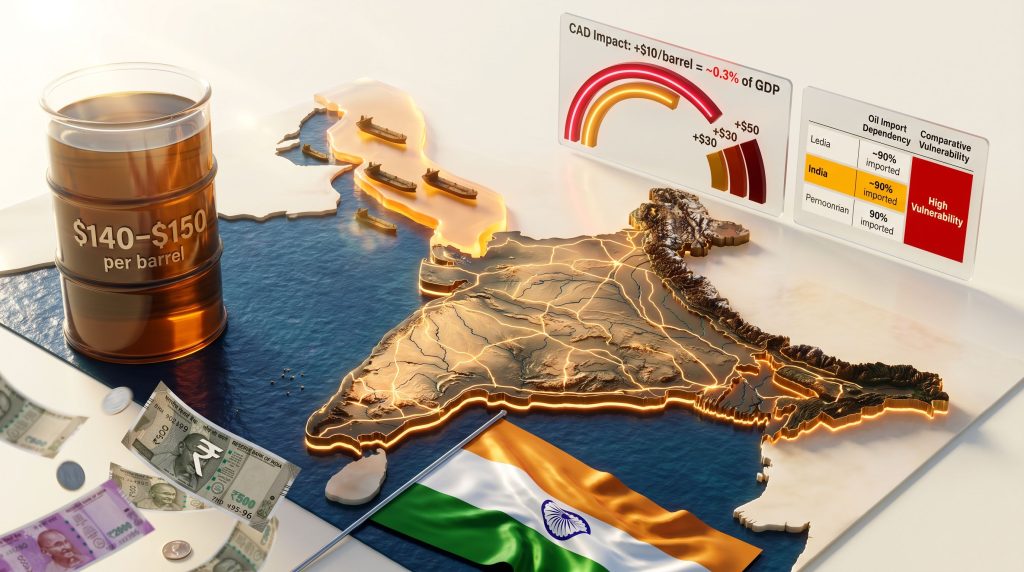
One of the most important analytical tools for understanding India's oil price exposure is the transmission ratio between crude price movements and macroeconomic outcomes. According to Santosh Mehrotra, former Economic Advisor to the United Nations, each $10 increase in the international price of oil widens India's current account deficit by approximately 0.3% of GDP, while simultaneously generating proportionally equivalent pressure on the Consumer Price Index.
This dual-channel impact creates a compounding problem. Rising oil prices simultaneously weaken the external account and push domestic prices higher, leaving policymakers with limited tools that do not worsen one problem while addressing the other.
| Oil Price Scenario | Approximate CAD Impact | CPI Pressure | Macroeconomic Status |
|---|---|---|---|
| +$10/barrel | ~0.3% of GDP | Moderate upward pressure | Manageable but significant |
| +$30/barrel | ~0.9% of GDP | Broad-based price escalation | Elevated fiscal stress |
| +$50/barrel (toward ~$140) | ~1.5%+ of GDP | Severe inflationary conditions | Crisis-risk territory |
| +$60–70/barrel (toward $150) | ~1.8–2.1% of GDP | Potential balance-of-payments stress | Extreme scenario |
Spot prices for Indian crude imports were already reported near $140 per barrel under current conflict conditions as of mid-2026. Furthermore, Mehrotra has indicated that prices could readily touch $150 per barrel if the conflict persists, which would represent territory effectively without modern precedent in terms of sustained pricing.
Why Existing Economic Models Are Already Outdated
A critically underappreciated point is that downward GDP revisions and upward CPI revisions already circulating among analysts are calibrated to current conflict conditions. They do not model a prolonged war scenario. Consequently, the economic projections most widely cited in financial media are likely conservative relative to the actual risk distribution, particularly if the Strait of Hormuz experiences sustained operational disruption.
Inflation Channels That Rarely Make Headlines
Diesel's Role as an Economy-Wide Multiplier
The inflationary mechanism of diesel price increases is frequently simplified to transport costs, but the real transmission is considerably more complex. Diesel is the primary fuel input for:
- Road freight operations moving goods across India's vast logistics network
- Agricultural irrigation systems powered by diesel pump sets
- Industrial generators providing backup power across manufacturing facilities
- Cold chain logistics for perishable food products
Trucking operators initially absorb higher fuel costs at the margin, however, sustained price increases are systematically passed through to end consumers across every goods category. The inflationary signal from a diesel price adjustment does not stay in the transport sector. It propagates through the entire supply chain within weeks.
The LPG Employment Crisis: A Transmission Channel Hidden in Plain Sight
Among the least-discussed consequences of the current energy shock is the employment impact of industrial LPG shortages. Two sectors have been hit with particular severity:
- The ceramics industry, which relies on industrial LPG as a primary process fuel for kiln firing, has faced significant production constraints due to supply unavailability
- The restaurant and food service sector has experienced a measurable decline in employment directly attributable to LPG shortages
Mehrotra specifically highlighted that the number of jobs in the restaurant industry has fallen significantly because LPG supply has been genuinely insufficient. This transmission channel from geopolitical conflict to informal sector employment is rarely captured in headline inflation or unemployment statistics, meaning the social costs of the US-Iran war are likely understated in conventional economic reporting.
When LPG becomes unavailable, restaurants cannot operate. When restaurants cannot operate, informal workers lose income. This is not an energy story at its endpoint. It is a livelihoods story, and the most economically vulnerable people are bearing its weight.
The Policy Response Timing Problem
Government interventions on fuel pricing and gold price pressures have been characterised as reactive rather than anticipatory. The critical problem with reactive policy is the expectation lag: the period between geopolitical escalation and domestic price adjustment during which inflationary expectations become embedded in wage negotiations, contract pricing, and business planning.
Once expectations shift upward, reversing them requires substantially more aggressive monetary intervention than prevention would have required. Mehrotra's framing is pointed: the government accumulated a windfall of roughly 25 to 30 lakh crore rupees (approximately $300 to $360 billion) over the decade when oil prices averaged $50 to $60 per barrel. The failure to channel a meaningful portion of those savings into structural energy security buffers represents a significant policy opportunity cost that is now becoming visible.
Rupee Depreciation: The Shock Amplifier
From ₹90 to ₹96 in Three Months
Currency depreciation functions as an independent inflationary engine in an import-dependent economy. The Indian rupee has depreciated sharply in recent months, moving from below ₹90 to approximately ₹95 to ₹96 per US dollar over a roughly 90-day period. That represents a 6 to 7% depreciation in under three months.
For an economy that imports crude oil, electronics, capital goods, and a wide range of industrial inputs priced in US dollars, this currency movement is not a minor technical adjustment. It is a structural price shock that compounds every other inflationary pressure simultaneously.
The RBI's Shifting Intervention Posture
Historically, the Reserve Bank of India intervened in foreign exchange markets to moderate rupee weakness during periods of external stress, deploying foreign exchange reserves to stabilise the currency. Recent signals indicate the RBI has adopted a more flexible approach, allowing greater exchange rate movement rather than defending specific levels.
While this posture preserves reserve buffers for more extreme scenarios, it also means the depreciation pass-through into domestic prices is now more direct and faster-moving than in previous oil shock episodes. The practical consequence is that currency weakness is now contributing to inflation in real time, rather than being partially absorbed by central bank intervention.
Foreign portfolio investor outflows, driven by elevated geopolitical risk premiums, are adding further downward pressure on the rupee, creating a self-reinforcing cycle where oil price increases drive capital outflows, which drive currency weakness, which amplifies the inflationary impact of the original oil price shock.
Scenario Mapping: What $150 Oil Actually Means for India
| Scenario | Oil Price Range | CAD Impact | Rupee Outlook | Inflation Risk |
|---|---|---|---|---|
| Contained Conflict | $90–$100/barrel | ~0.5% GDP | Moderate depreciation | Elevated but controlled |
| Prolonged Stalemate | $110–$130/barrel | ~0.9–1.2% GDP | Sustained weakness | Broad-based price pressure |
| Full Escalation/Hormuz Closure | $140–$150+/barrel | 1.5–2%+ GDP | Sharp depreciation | Crisis-level inflation risk |
The 1991 Parallel and Why It Still Matters
Economic historians note that India's last true balance-of-payments crisis, in 1991, was partly triggered by the Gulf War oil shock. At that point, India was forced to pledge gold reserves to the International Monetary Fund to manage its external payment obligations. While India today holds substantially larger foreign exchange reserves than it did in 1991, the structural import dependency is broadly comparable.
In addition, the 1991 episode remains the reference scenario for worst-case energy shock modelling among Indian macroeconomists, and the current India-oil shock comparisons are beginning to surface more frequently in mainstream economic commentary.
The next major ASX story will hit our subscribers first
India's Policy Toolkit: What Works and What Doesn't
Strategic Petroleum Reserves
India maintains strategic petroleum reserves designed to provide a short-term supply cushion during disruptions. These facilities are calibrated for temporary interruptions, typically measured in days to weeks, not multi-month conflicts. They can moderate domestic price spikes in the near term but cannot address the underlying price or supply dynamics of a sustained geopolitical confrontation.
Supply Diversification: Progress With Real Limits
India has meaningfully diversified its crude sourcing mix since 2022, with Russian crude representing a growing share of total imports at price-discounted terms relative to benchmark market prices. Imports from the United States and West African producers have also increased. However, diversification has practical ceilings under extreme stress:
- Insurance and maritime liability complications for certain crude origins
- Payment settlement mechanisms that add friction under sanctions environments
- Logistical constraints on vessel routing and port capacity
- Refinery configuration preferences that limit crude grade flexibility
Renewables as a Long-Term Structural Answer
The current crisis is intensifying policy discussions around renewable energy deployment as a long-term energy security strategy. Electric vehicle adoption, solar-powered industrial processes, and green hydrogen development would all structurally reduce India's crude oil import dependency over time. The challenge, however, is timeline: the transition to meaningful renewable energy penetration is measured in decades, not quarters, offering no near-term relief from the present shock.
Sectoral Winners and Losers Inside India's Economy
Sectors facing maximum pressure:
- Transportation and logistics operators absorbing direct diesel cost increases
- Agricultural producers facing simultaneous fertiliser and irrigation cost inflation
- Ceramics manufacturers dealing with industrial LPG supply constraints
- Restaurants and food service businesses losing operational capacity and shedding workers
- Airlines facing jet fuel cost escalation that may translate into higher airfares
Sectors with potential upside exposure:
- Domestic upstream oil and gas producers benefiting from higher price realisations
- Renewable energy developers gaining urgency as an investment destination
- Complex refiners with access to discounted crude grades capturing margin expansion
- Coal sector potentially seeing demand substitution from gas and LPG alternatives
Comparative Vulnerability: How India Stacks Up Globally
| Economy | Oil Import Dependency | Hormuz Exposure | Domestic Buffer | Overall Vulnerability |
|---|---|---|---|---|
| India | ~90% imported | High | Moderate | High |
| China | ~75% imported | High | Larger SPR base | Moderate-High |
| Japan | ~90% imported | High | 90-day SPR coverage | Moderate |
| United States | Net exporter | Low | Surge production capacity | Low |
| Germany | High dependency | Indirect | EU coordination mechanisms | Moderate |
India's vulnerability is compounded by income structure. Because Indian household budgets allocate a higher proportion of income to essential goods relative to advanced economies, oil price shocks consume a disproportionately large share of purchasing power at the consumer level. The social consequences of sustained high oil prices in India are therefore more acute than equivalent price movements would produce in wealthier importing nations.
The US-Iran war oil price shock in India is not simply a macroeconomic event. It is a stress test of the country's energy architecture, its fiscal reserves, its currency management framework, and ultimately its capacity to protect household welfare during an external shock that its fundamental import dependency makes it structurally incapable of insulating against in the short term.
Disclaimer: This article contains forward-looking analysis, economic projections, and scenario modelling based on publicly available expert commentary and established economic frameworks. All forecasts and scenarios involve inherent uncertainty and should not be construed as financial or investment advice. Oil price projections and macroeconomic outcomes are subject to rapid change based on evolving geopolitical conditions.
Want To Position Yourself Ahead of the Next Major Resource Discovery?
As energy security concerns reshape commodity markets and investor attention turns to domestic resource development, Discovery Alert's proprietary Discovery IQ model delivers real-time alerts on significant ASX mineral discoveries — transforming complex data across 30+ commodities into clear, actionable insights. Explore historic discoveries and the returns they generated, then begin your 14-day free trial at Discovery Alert to ensure you're positioned before the broader market moves.