
The global battery industry faces unprecedented disruption as US tariffs and Chinese battery oversupply in Europe reshape traditional supply chains and competitive dynamics. This transformation affects multiple stakeholders across the value chain, from raw material producers to electric vehicle manufacturers, creating new investment opportunities while challenging established market relationships.
Understanding the Global Battery Supply Chain Disruption
The emergence of what economists term "trade diversion effects" in the battery sector represents more than standard market adjustment mechanisms. When major economies implement barriers targeting specific suppliers, the resulting supply redistribution creates cascading impacts across multiple geographic regions and industrial segments simultaneously.
Between late 2024 and mid-2025, Chinese battery manufacturers encountered unprecedented market access restrictions in North American markets through escalating tariff structures. This forced redirection of substantial production volumes toward alternative destinations, with European Union markets emerging as the primary absorption point for this diverted capacity.
Furthermore, this recent Chinese battery recycling breakthrough has added complexity to the competitive landscape. Meanwhile, Australia lithium industry innovations continue to develop alternative supply sources.
Quantifying Supply Chain Redirection Volumes
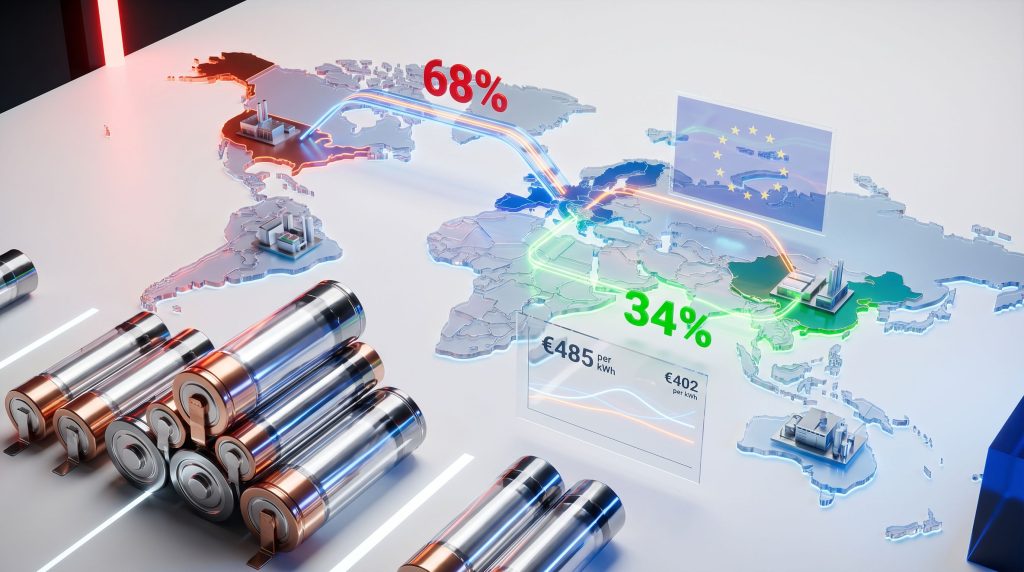
Trade flow analysis reveals the magnitude of this supply redirection phenomenon. Chinese battery exports to the United States contracted approximately 68% during the measured period, while European Union imports from China increased by 34% over the same timeframe. This represents roughly 2.3 million battery units redirected from US-bound shipments into European markets.
The mathematical implications are significant: European manufacturers previously competed primarily against domestic and allied producers now face competition from a substantial volume of Chinese imports that were originally destined for different markets entirely. This creates supply pressure that existing European trade policy frameworks were not designed to accommodate.
In addition, developments in India's battery-grade lithium refinery projects represent alternative processing capacity outside Chinese control.
Economic Theory Behind Forced Market Substitution
Trade diversion theory predicts specific behavioral patterns when artificial barriers block efficient trade routes. Suppliers facing blocked access to preferred markets will systematically seek alternative destinations, even when this requires accepting reduced profit margins to maintain production volumes and market presence.
Chinese manufacturers, confronting 25-60% tariff walls in US markets, have implemented what analysts characterise as margin sacrifice strategies. The documented 17% price compression between December 2024 and August 2025 reflects this approach, where producers prioritise market share retention over short-term profitability maximisation.
However, the broader battery metals investment landscape continues to evolve rapidly. This pricing behaviour creates downstream effects that extend beyond immediate price competition. European battery manufacturers must either match these reduced prices, accept market share losses, or seek protective trade measures to maintain competitive positioning.
When big ASX news breaks, our subscribers know first
European Markets as the Primary Overflow Destination
The European Union's trade policy architecture inadvertently created what economists describe as a "pressure valve" for Chinese battery oversupply. Relatively lower import barriers compared to the United States made European markets the logical destination for redirected Chinese production volumes.
How Trade Barriers Create Opportunities
The asymmetric tariff environment between major Western markets created clear arbitrage opportunities for Chinese manufacturers. US tariffs ranging from 25-60% compared to EU combined duties of approximately 31% (including 20.8% countervailing duties plus 10% battery content tariffs) established a significant differential that made market redirection economically rational.
Economic modelling suggests that even after absorbing EU tariffs and additional transportation costs, Chinese producers maintained 15-20% cost advantages over European manufacturers. This advantage persisted despite the margin compression required to penetrate European markets at scale.
The infrastructure advantages Chinese manufacturers developed during the 2020-2023 European expansion period enabled rapid volume scaling without requiring multi-year relationship building. Existing distribution networks and established logistics partnerships facilitated the swift redirection of substantial volumes into European markets.
Moreover, concerns about critical minerals energy security continue to influence policy decisions across multiple jurisdictions. According to recent analysis from the Centre for European Reform, European policymakers face increasingly difficult choices between industrial competitiveness and trade protectionism.
Market Access Mechanics
Chinese manufacturers leveraged several structural advantages to facilitate rapid European market penetration:
• Established distribution relationships from previous European expansion phases
• Port infrastructure familiarity reducing logistics complexity and costs
• Existing quality certifications meeting European technical standards
• Financial relationships with European importers and distributors
• Inventory management systems capable of handling volume fluctuations
These operational advantages enabled Chinese producers to scale European operations rapidly without the infrastructure development timelines that would be required for alternative markets in Latin America or Southeast Asia.
Measuring Economic Impact on European Battery Manufacturing
The redirection of Chinese battery supply into European markets has created measurable economic consequences across multiple dimensions of European manufacturing competitiveness. These impacts extend beyond simple price competition to encompass structural challenges affecting long-term industry viability.
Manufacturing Performance Metrics
European battery manufacturing has experienced significant performance deterioration across key operational and financial metrics:
| Performance Indicator | Pre-Diversion (Q3 2024) | Post-Diversion (Q3 2025) | Percentage Change |
|---|---|---|---|
| Average EU Battery Price | €485 per kWh | €402 per kWh | -17.1% |
| Chinese Import Volume (EU) | 1.8M units/quarter | 2.4M units/quarter | +33.3% |
| EU Manufacturer Market Share | 67% | 51% | -16 percentage points |
| Average Manufacturing Margin | 23% | 11% | -12 percentage points |
| Capacity Utilisation Rate | 78% | 61% | -17 percentage points |
Production Capacity and Employment Implications
The capacity utilisation decline from 78% to 61% despite growing overall EU battery demand illustrates how trade diversion can undermine industrial policy objectives even in expanding markets. This paradox occurs when rising demand is satisfied through imports rather than domestic production expansion.
European manufacturers report several interconnected challenges:
• Fixed cost absorption difficulties due to lower production volumes
• Workforce optimisation pressures as capacity utilisation declines
• Capital expenditure delays for planned expansion projects
• Supply chain partner impacts affecting upstream component suppliers
• Financial covenant stress for companies with debt tied to production volumes
Consequently, the employment implications extend beyond direct manufacturing positions to encompass engineering, research and development, and administrative functions that support higher production volumes.
Strategic Policy Responses by European Decision Makers
European Union policy makers have implemented increasingly sophisticated approaches to manage Chinese battery import surges whilst maintaining compliance with World Trade Organisation commitments. These responses reflect broader tensions between free trade principles and industrial sovereignty concerns.
Enhanced Anti-Dumping Investigation Methodologies
EU trade authorities have initiated comprehensive anti-dumping investigations targeting Chinese battery imports, employing enhanced methodologies that account for state subsidies in fair value calculations. These investigations examine whether Chinese manufacturers sell batteries below fair market value, potentially justifying additional protective duties beyond existing tariff structures.
The enhanced investigation approach incorporates:
• State subsidy quantification in cost-of-production calculations
• Cross-subsidy analysis examining support across related product lines
• Market economy treatment assessment for Chinese production costs
• Injury analysis measuring impact on EU domestic industry
• Price undertaking negotiations as alternatives to definitive duties
Research from Benchmark Mineral Intelligence indicates that US tariffs and Chinese battery oversupply in Europe have fundamentally altered global trade patterns.
Domestic Production Capacity Development
The European Battery Alliance has accelerated funding for domestic gigafactory construction, targeting 550 GWh of annual production capacity by 2028. This represents sufficient output to meet 85% of projected EU battery demand, supported by a €43 billion public-private investment programme.
Strategic autonomy through domestic production involves multiple policy instruments:
• Direct capital grants for gigafactory construction
• Production-linked subsidies supporting operational phases
• Research and development support for advanced battery technologies
• Critical materials procurement assistance reducing supply chain dependencies
• Workforce development programmes training specialised manufacturing personnel
The timeline acceleration reflects recognition that trade barriers alone cannot provide long-term competitive positioning without corresponding domestic capacity development.
Global Supply Chain Reconfiguration Beyond EU-China Dynamics
The battery trade diversion phenomenon extends beyond bilateral EU-China relationships, creating ripple effects across emerging markets and alternative supplier countries. These secondary impacts demonstrate the interconnected nature of global industrial supply chains and the far-reaching consequences of major market disruptions.
Emerging Market Exploitation Patterns
Chinese manufacturers have systematically expanded into Latin American, Southeast Asian, and African markets where regulatory frameworks lack sophisticated anti-dumping capabilities. Battery exports to these regions increased 127% between 2024 and 2025, creating what trade economists characterise as "regulatory arbitrage" opportunities.
This expansion pattern follows predictable economic logic:
• Lower regulatory barriers in developing markets reduce market entry complexity
• Growing EV adoption in emerging economies creates expanding demand
• Limited domestic production reduces competitive pressure from local manufacturers
• Price sensitivity among emerging market consumers favours cost-competitive imports
• Infrastructure development supports logistics network expansion
Alternative Supplier Market Share Gains
South Korean manufacturers, including LG Energy Solution and Samsung SDI, along with Japanese producers like Panasonic, have captured increased European market share as buyers seek non-Chinese alternatives. Combined Korean-Japanese market share in the EU expanded from 18% to 28% between Q4 2024 and Q3 2025.
This demonstrates how trade diversion can benefit third-country suppliers who offer:
• Supply chain diversification reducing single-supplier dependency
• Technology differentiation through advanced battery chemistries
• Quality assurance meeting or exceeding European technical standards
• Political alignment with Western trade policy objectives
• Financial stability supporting long-term supply agreements
Investment Implications: Winners and Losers in New Trade Architecture
The restructuring of global battery supply chains creates distinct investment opportunities and risks across different segments of the value chain. Traditional risk-return relationships have been altered by policy interventions and trade barriers, requiring updated analytical frameworks for capital allocation decisions.
What Industries Benefit from Supply Chain Shifts?
Critical minerals projects in allied jurisdictions benefit from Western supply chain diversification efforts:
• Lithium projects in Australia, Canada, and Chile command strategic premiums reflecting supply security value
• Nickel operations outside Indonesian and Russian influence gain competitive advantages despite higher production costs
• Graphite projects with non-Chinese processing capabilities benefit from downstream integration requirements
• Rare earth element deposits in Western-aligned jurisdictions attract policy-driven investment support
Midstream Processing and Technology Transfer
European and North American battery manufacturers with domestic processing capabilities gain competitive advantages as buyers prioritise supply chain security over pure cost optimisation. Companies controlling lithium hydroxide conversion, cathode material production, and cell assembly within allied jurisdictions command valuation premiums reflecting their strategic value.
Key competitive advantages include:
• Processing capacity ownership eliminating Chinese midstream dependency
• Technology licensing arrangements with leading battery chemistry developers
• Quality certification achievements meeting automotive industry requirements
• Long-term supply agreements with major OEM customers
• Government partnership arrangements providing policy support and financing access
The next major ASX story will hit our subscribers first
Implications for Global Electric Vehicle Adoption
The battery trade diversion phenomenon creates complex implications for electric vehicle market development. Regional variations in battery costs now affect EV adoption rates and manufacturer competitiveness across different geographic markets in ways that were not anticipated by early electrification forecasts.
Regional EV Price Disparities
European consumers face higher EV prices due to more expensive domestic battery production, whilst markets with continued access to Chinese batteries experience accelerated price declines. This creates a two-tier global EV market where adoption rates correlate with battery trade policy rather than underlying demand fundamentals or charging infrastructure development.
Price impact patterns include:
• EU market price premiums of 8-12% due to higher battery costs
• Southeast Asian price advantages from unrestricted Chinese battery access
• US market stability through domestic production capacity development
• Latin American acceleration benefiting from Chinese export redirection
• African market development supported by competitive Chinese pricing
Automaker Strategic Procurement Responses
European automakers have adopted "portfolio approaches" to battery procurement, sourcing from multiple suppliers across different jurisdictions to manage both cost and supply security risks. This procurement strategy adds complexity and costs but reduces dependency on any single supplier or trade relationship.
Portfolio procurement strategies involve:
• Geographic diversification across multiple supply regions
• Technology diversification incorporating different battery chemistries
• Supplier tier balancing between tier-one and emerging manufacturers
• Contract term optimisation balancing price and supply security
• Financial hedging arrangements managing currency and commodity price risks
What Future Scenarios Could Unfold?
The sustainability of current battery trade patterns depends on political, economic, and technological factors that could shift dramatically over the next 3-5 years. Scenario-based analysis helps understand potential outcomes and their investment implications.
Scenario 1: Escalating Trade Barriers
If the EU implements additional anti-dumping duties matching US levels (40-60%), Chinese manufacturers may redirect supply toward unprotected markets, potentially creating battery shortages in developed economies and accelerating domestic production timelines.
Scenario implications:
• Battery price increases in protected markets driving EV cost inflation
• Accelerated domestic investment in gigafactory construction
• Emerging market supply increases as Chinese production seeks new destinations
• Technology development acceleration to overcome cost disadvantages
• Political pressure intensification from automotive industry stakeholders
Scenario 2: Technology Leapfrogging
Breakthrough developments in solid-state or sodium-ion battery technology could disrupt current supply chain advantages, potentially allowing Western manufacturers to regain competitiveness through superior technology rather than trade protection.
Technology disruption effects:
• Manufacturing advantage shifts to technology leaders regardless of labour costs
• Stranded asset risks for conventional lithium-ion capacity
• Research and development investment acceleration across competing technologies
• Intellectual property landscape changes affecting market positioning
• Supply chain reconfiguration around new material requirements
Scenario 3: Negotiated Market Sharing
Diplomatic resolution could establish voluntary export restraints or market-sharing agreements similar to historical semiconductor trade deals, creating managed competition rather than unrestricted price warfare.
Managed competition outcomes:
• Price stabilisation reducing destructive margin compression
• Market allocation agreements providing predictable competitive frameworks
• Technology sharing arrangements accelerating innovation diffusion
• Investment certainty improvements supporting long-term capacity planning
• Consumer price moderation balancing accessibility and industry viability
Strategic Takeaways for Investors and Policy Makers
The battery trade diversion phenomenon illustrates how rapidly global supply chains can restructure in response to policy changes, creating both opportunities and risks that require sophisticated analysis beyond traditional market fundamentals.
Investment Strategy Implications
Key investment considerations:
• Jurisdictional diversification becomes essential as trade policy increasingly determines market access rather than pure economics
• Upstream raw material assets in allied countries command strategic premiums reflecting supply security value beyond commodity fundamentals
• Technology and processing capabilities matter more than pure cost advantages in the new trade environment
• Company-specific policy alignment affects valuation multiples and financing access
• Long-term supply agreements provide stability in increasingly volatile trade environments
Policy Coordination Requirements
For policy makers, effective response requires:
• Coordination between allied economies to prevent Chinese supply from simply shifting between unprotected markets
• Domestic production incentives scaled appropriately to achieve meaningful import substitution
• Trade enforcement mechanisms updated to address state-subsidised competition effectively
• Consumer price impact consideration balancing industrial policy with affordability objectives
• Innovation support programmes maintaining technological competitiveness alongside trade protection
The durability of current market conditions depends on sustained political consensus supporting industrial policy objectives. Changes in this consensus represent the primary macro risk requiring continuous monitoring by both investors and policy makers.
Investment success factors in this environment include:
• Early identification of assets meeting both cost and strategic criteria before construction decisions
• Policy risk assessment capabilities evaluating likelihood of sustained government support
• Supply chain integration analysis understanding full value chain positioning
• Technology development monitoring tracking potential disruption sources
• Market access verification confirming eligibility under relevant trade agreements
In conclusion, the transformation of battery supply chains from cost-optimised to strategically-aligned structures represents a fundamental shift that extends beyond cyclical market adjustments. The phenomenon of US tariffs and Chinese battery oversupply in Europe exemplifies how geopolitical tensions reshape entire industries, creating new competitive dynamics that require sophisticated understanding for successful navigation.
Understanding and positioning for this new reality becomes essential for successful capital allocation in the battery ecosystem and related industries. As trade patterns continue evolving, market participants must balance traditional economic factors with increasingly important geopolitical and strategic considerations.
Want to Invest in the Next Major Battery Metals Discovery?
Discovery Alert's proprietary Discovery IQ model delivers instant notifications on significant ASX mineral discoveries, including lithium and other critical battery metals that are reshaping global supply chains. With historic discoveries generating exceptional returns and increasing demand for Western-aligned battery metals projects, subscribers gain immediate market insights to identify actionable opportunities ahead of broader market recognition.
