June 10, 2026
Why Mining's Biggest Transition Is Being Measured in EBITDA Percentages
The global mining industry is undergoing a structural recalibration that has not been seen since the commodities supercycle of the early 2000s. This time, however, the driving force is not urbanisation in emerging markets but rather the electrification of the global economy. Copper wiring in EV motors, nickel in high-energy battery cathodes, and gold as a by-product stabiliser are no longer peripheral revenue streams for diversified miners. They are increasingly becoming the core earnings engines around which long-term capital allocation decisions are being made.
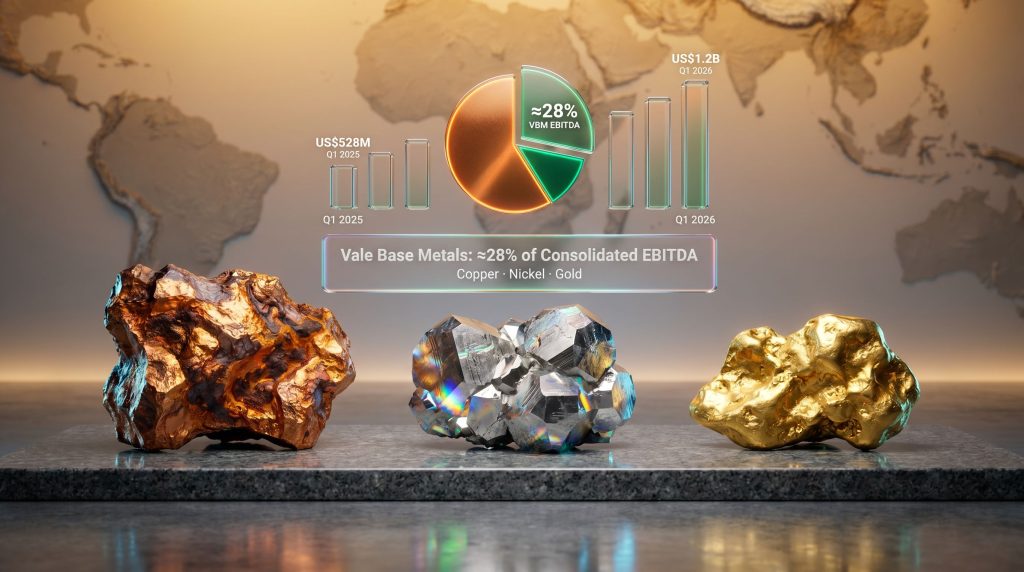
For investors trying to understand how this transition is being quantified at the corporate level, Vale's updated Vale Base Metals EBITDA contribution guidance provides one of the most transparent and regulatory-backed data points currently available in the global mining sector. The formalisation of an approximately 28% long-term EBITDA contribution target for Vale Base Metals Ltd. (VBM) is not simply a headline figure. It is a measurable, price-anchored commitment that tells a layered story about commodity markets, strategic portfolio architecture, and the future of one of the world's largest mining companies.
When big ASX news breaks, our subscribers know first
Understanding Vale's Historical Earnings Concentration Risk
Vale's financial profile has long been dominated by iron ore and iron ore pellets, commodities that built the company's global reputation but also created significant earnings volatility. Iron ore prices are heavily influenced by China steel and iron ore production cycles, and any contraction in Chinese construction activity transmits almost directly into Vale's consolidated EBITDA. This concentration risk was starkly illustrated during the iron ore price collapse of 2015 and again during the demand uncertainty of 2022 and 2023.
Beyond cyclical price risk, iron ore faces a longer-term structural challenge. As global steel producers face pressure to decarbonise blast furnace operations, the demand profile for certain iron ore grades and pellets is entering a period of strategic uncertainty. Vale has been aware of this dynamic for years, and the structural separation of its base metals operations into a distinct legal entity was, in part, a response to this challenge.
The creation of VBM as an independently capitalised subsidiary was itself a sophisticated strategic move. By housing copper, nickel, and gold assets under a separate corporate structure, Vale:
- Created a more transparent valuation framework for energy transition metals, separate from iron ore earnings noise
- Enabled the pursuit of third-party investment and potential future capital market transactions at the subsidiary level
- Positioned VBM to compete for ESG-aligned institutional capital that may be restricted from direct exposure to bulk commodity miners
- Established a cleaner operational reporting structure that allows commodity-specific performance tracking
The 28% Target: Anatomy of a Through-Cycle Benchmark
Vale's updated guidance, disclosed in June 2026, sets VBM's long-term contribution to consolidated group EBITDA at approximately 28%. The figure is constructed using the average of sell-side analyst consensus price estimates for copper, nickel, and gold as of May 2026, and is subject to regulatory disclosure requirements under CVM Resolution No. 80/2022, which governs periodic filings for companies listed on Brazilian capital markets.
| Metric | Detail |
|---|---|
| Updated Long-Term VBM EBITDA Target | ~28% of consolidated Vale EBITDA |
| Commodity Price Basis | 2026 sell-side analyst consensus (copper, nickel, gold) |
| Disclosure Framework | Vale's Formulário de Referência (Reference Form), Item 3 |
| Regulatory Filing Requirement | CVM Resolution No. 80/2022 |
| All Other Prior Estimates | Remain unchanged |
The critical distinction investors must internalise is the difference between a quarterly snapshot and a through-cycle guidance figure. In Q1 2026, VBM generated approximately US$1.2 billion in EBITDA, representing roughly 31% of Vale's pro forma consolidated EBITDA for that quarter. This temporarily exceeded the formal 28% long-term target. By contrast, in Q1 2025, VBM's EBITDA stood at approximately US$528 million, a figure that represented a meaningfully smaller proportional share of group earnings.
The 28% target is calibrated as a normalised, cycle-adjusted benchmark rather than a peak-market projection. The Q1 2026 quarterly outcome of approximately 31% demonstrates operational achievability under favourable conditions, but investors should weight the formal guidance as management's expectation across varying market environments.
The Earlier 30-35% Ambition: Context, Not Contradiction
Market commentary preceding the formal guidance update had referenced an internal framing of VBM contributing 30 to 35% of consolidated EBITDA by 2035. The formalised 28% figure, anchored to current sell-side consensus pricing, may appear to represent a downward revision. In reality, the divergence is most likely a function of price deck assumptions rather than any reduction in operational ambition.
Higher long-run copper and nickel prices would mechanically lift VBM's proportional EBITDA contribution without requiring any change in production volumes or cost structures. If copper trades toward US$5.50 per pound on a sustained basis, the 28% formal guidance would likely be materially exceeded. The 28% figure therefore functions as a conservative, price-disciplined baseline. Furthermore, Vale's estimated EBITDA potential has been widely covered in financial media as a landmark strategic disclosure.
Commodity Price Sensitivity: The Three Variables That Determine the Outcome
Copper: The Highest-Leverage Commodity in VBM's Portfolio
Copper is the single most strategically important commodity within VBM's asset base. Its centrality to EV drivetrains, charging infrastructure, and grid modernisation makes it the primary earnings driver within the subsidiary. The copper supply crunch is forecast by multiple industry bodies to intensify by 2035 under accelerated electrification scenarios, driven by EV penetration rates, renewable energy capacity additions, and the physical expansion of transmission and distribution networks.
Vale's copper operations include the Salobo mine in the Brazilian state of Pará, one of the largest copper-gold mines in the world by reserve base. Salobo benefits from access to hydroelectric power, a structural cost advantage that also supports competitive carbon credentials for offtake arrangements with ESG-sensitive industrial buyers, including automakers imposing supply chain emissions requirements on raw material suppliers.
Nickel: The More Complex and Contested Market
Nickel presents a more nuanced investment case within VBM's portfolio. Vale operates both sulphide nickel assets in Canada and laterite processing operations, two ore types with meaningfully different cost structures, processing methods, and market positioning.
Sulphide nickel, the type mined in Canadian operations such as Sudbury and Voisey's Bay, is generally considered higher quality for battery applications. The processing of sulphide ore produces nickel with lower impurity levels and is associated with lower processing energy intensity compared to high-pressure acid leach (HPAL) processing of laterite ores. This geological distinction matters commercially because battery manufacturers increasingly specify the source and grade profile of nickel inputs as they tighten supply chain quality controls.
However, VBM's nickel portfolio faces two structural headwinds that are not cyclical in nature. In addition, the nickel market recovery remains uncertain against these broader pressures:
- The sustained expansion of Indonesian nickel supply growth, predominantly from laterite-sourced nickel pig iron and more recently from HPAL-processed battery-grade nickel, has exerted sustained downward pressure on global nickel prices
- The shift in battery chemistry preferences toward lithium iron phosphate (LFP) formulations, which contain no nickel, creates demand uncertainty specifically for battery-grade nickel and introduces substitution risk into long-term demand forecasts
These dynamics explain why nickel consensus price estimates embedded in the 28% guidance are likely more conservative than copper assumptions on a relative basis.
Gold: The Stabilising By-Product
Gold functions primarily as a by-product credit within certain VBM operations, most notably at Salobo where copper-gold mineralisation means gold recovery adds directly to EBITDA without proportional cost increases. During periods of base metal price weakness, elevated gold prices provide partial earnings stabilisation, effectively acting as an internal hedge within VBM's revenue mix.
Illustrative Scenario Analysis
| Scenario | Copper Price Assumption | Nickel Price Assumption | Estimated VBM EBITDA Share |
|---|---|---|---|
| Bear Case | US$3.80/lb | US$6,500/t | ~22-24% |
| Base Case (Formal Guidance) | Sell-side consensus May 2026 | Sell-side consensus May 2026 | ~28% |
| Bull Case | US$5.50/lb | US$9,000/t | ~33-35% |
Scenarios are illustrative and for analytical purposes only. Actual outcomes depend on Vale's full cost structure, production volumes, iron ore earnings trajectory, and realised commodity prices.
How VBM Compares to Peer Strategic Pivots in Global Mining
Vale's explicit, quantified EBITDA contribution guidance for VBM distinguishes it from peers who have communicated strategic intent without providing comparable numerical accountability. Consequently, critical minerals demand is reshaping how major miners structure and communicate their long-term earnings profiles.
| Company | Primary Base/Transition Metals | Strategic Direction |
|---|---|---|
| Vale (VBM) | Copper, Nickel, Gold | ~28% long-term EBITDA target formalised under CVM disclosure |
| BHP | Copper, Potash | Suspended Nickel West in 2024; copper-led growth strategy |
| Rio Tinto | Copper, Lithium, Aluminium | Copper and lithium as declared growth vectors |
| Glencore | Copper, Cobalt, Nickel | Broadest diversified base metals exposure among majors |
BHP's suspension of its Nickel West operations in Australia in 2024 is a particularly relevant reference point. It demonstrates that even the world's largest mining companies can find nickel market conditions sufficiently challenging to pause major producing assets. Vale's decision to retain nickel as a core VBM commodity represents a differentiated strategic conviction that long-term battery demand will recover sufficiently to justify the current cost of carrying nickel capacity through a difficult market cycle.
Risk Factors Investors Should Monitor
The 28% guidance is a formal regulatory disclosure, not a guarantee. Several risk factors could cause actual outcomes to diverge materially from the stated target:
- Iron ore earnings outperformance: If Vale's iron ore division generates unexpectedly strong EBITDA, VBM's proportional contribution will remain below 28% even if VBM's absolute earnings grow. The percentage metric is sensitive to both the numerator and denominator.
- Commodity price deterioration: The guidance is explicitly price-dependent. Sustained weakness in copper or nickel would compress both VBM's absolute EBITDA and its proportional share of consolidated earnings.
- Operational execution variables: Ramp-up timelines for expansion projects at Salobo and in Canadian operations, geotechnical conditions, and labour market dynamics in multiple jurisdictions all represent execution risk.
- Battery chemistry substitution: The continued adoption of LFP battery chemistry in consumer EVs and energy storage applications represents a structural, not cyclical, risk to long-run nickel demand forecasts.
- Indonesian supply growth: Continued capital investment in Indonesian nickel processing capacity could keep nickel prices suppressed below levels assumed in current sell-side consensus models.
Investor Caution: Forward-looking guidance anchored to consensus price assumptions should not be treated as a performance commitment. The gap between assumed and realised commodity prices can significantly alter proportional contribution outcomes in either direction. Vale has explicitly noted that actual results may differ materially from stated estimates.
The next major ASX story will hit our subscribers first
VBM's Low-Carbon Positioning as a Commercial Differentiator
One aspect of VBM's strategic value that receives less attention than the EBITDA guidance figures is its emerging role as a low-carbon raw material supplier. Vale has publicly committed to reducing its operational carbon intensity, and VBM's asset geography supports this positioning in concrete ways.
Salobo's access to hydroelectric power in the Amazon basin gives its copper production a significantly lower Scope 1 emissions intensity than comparable open-pit copper operations powered by grid electricity or diesel generation. As automakers and battery manufacturers formalise supply chain carbon requirements, this operational characteristic becomes a commercial differentiator rather than merely an ESG reporting metric.
Canadian nickel operations at Sudbury similarly benefit from the relatively low-carbon electricity grid of Ontario, supporting competitive emissions profiles for battery-grade nickel produced from sulphide ore. The combination of sulphide geology, which favours conventional smelting over energy-intensive HPAL processing, and low-carbon power inputs positions Canadian VBM nickel output favourably in quality-sensitive markets. Furthermore, Vale Base Metals' financial statements provide full audited detail on the subsidiary's cost structure and earnings performance for investors seeking deeper due diligence.
FAQ: Vale Base Metals EBITDA Contribution Guidance
What is Vale's updated long-term EBITDA guidance for Vale Base Metals?
Vale has updated its formal long-term guidance to indicate that VBM is expected to contribute approximately 28% of consolidated group EBITDA over the long term, based on 2026 sell-side analyst consensus pricing for copper, nickel, and gold.
What commodities does Vale Base Metals produce?
VBM's portfolio is centred on copper, nickel, and gold, three commodities with direct structural exposure to electric vehicle manufacturing, battery production, and clean energy infrastructure development.
How does the 28% long-term target compare to recent quarterly results?
In Q1 2026, VBM generated approximately US$1.2 billion in EBITDA, representing roughly 31% of Vale's pro forma consolidated EBITDA for that quarter. This exceeded the formal 28% long-term target, though that quarterly result reflects specific favourable market conditions rather than a normalised through-cycle outcome.
Has Vale changed any other financial guidance alongside this update?
No. Vale has confirmed that all other estimates previously disclosed in Item 3 of its Reference Form remain unchanged. Only the Vale Base Metals EBITDA contribution guidance has been revised.
What regulatory framework governs this disclosure?
The guidance is subject to CVM Resolution No. 80/2022, which governs periodic disclosure obligations for Brazilian capital market issuers. Vale's Formulário de Referência will be formally resubmitted with updated figures within the required regulatory timeframe.
What is the difference between sulphide and laterite nickel, and why does it matter for VBM?
Sulphide nickel ores, which characterise VBM's Canadian operations, are generally processed through conventional smelting at lower energy intensity and produce higher-purity nickel better suited to battery cathode applications. Laterite ores require HPAL processing, which is more energy-intensive and capital-heavy. This geological distinction affects both cost structures and the quality profile of nickel output relevant to battery supply chain specifications.
Key Takeaways for Investors Tracking This Strategic Shift
The formalisation of Vale's approximately 28% long-term Vale Base Metals EBITDA contribution guidance marks a meaningful milestone in the company's multi-year effort to restructure its earnings architecture around energy transition commodities. Several points deserve emphasis as investors assess the implications:
- The 28% figure is a conservative, price-disciplined baseline anchored to current sell-side consensus, not a ceiling. Bullish copper and nickel price scenarios could push VBM's proportional contribution materially higher without any operational change.
- The Q1 2026 quarterly result of approximately US$1.2 billion in VBM EBITDA and roughly 31% of pro forma group earnings confirms that the target is operationally achievable under favourable market conditions.
- The regulatory disclosure framework under CVM Resolution No. 80/2022 provides formal accountability for this guidance, distinguishing it from informal investor communications and strategic aspiration.
- Investors should track the relationship between iron ore price performance and VBM's absolute EBITDA growth simultaneously, since both variables determine where the proportional contribution metric lands in any given period.
- VBM's geological and geographic advantages, including sulphide nickel assets in Canada and hydroelectric-powered copper production in Brazil, provide structural cost and carbon credentials that are increasingly relevant as downstream buyers formalise supply chain sustainability requirements.
Readers seeking ongoing Portuguese-language coverage of Vale and the broader Brazilian mining sector can explore related reporting through Brasil Mineral at brasilmineral.com.br.
Want to Track the Next Major Mineral Discovery Before the Market Does?
Discovery Alert's proprietary Discovery IQ model scans ASX announcements in real time, delivering instant alerts on significant mineral discoveries across copper, nickel, gold, and more than 30 other commodities — turning complex data into actionable investment insights for traders and long-term investors alike. Explore how historic mineral discoveries have generated extraordinary returns and start your 14-day free trial today to position yourself ahead of the broader market.