What Makes the Vale-Glencore Sudbury Partnership a Strategic Copper Play?
The Vale and Glencore copper project Sudbury Basin stands apart as a calculated strategic move, formulated to optimise copper production while minimising risk and capital outlay. At the heart of this partnership lies a 50-50 joint venture structure—Vale Base Metals and Glencore Canada operate as equal partners, distributing financial and operational risk equally across both organisations.
This risk-sharing framework differs from traditional solo project development, as it combines the specialised underground mining innovations knowledge of two globally recognised mining companies. Furthermore, understanding mining permits fundamentals becomes crucial when evaluating such large-scale partnerships.
An essential advantage comes from the brownfield approach that leverages existing infrastructure, specifically the deepening and expansion of Glencore's Nickel Rim South Mine shaft. Instead of launching into the high-cost, high-risk environment of a greenfield build, the collaboration utilises more than four decades of established regional mining systems.
This approach significantly reduces upfront costs, environmental permitting challenges, and project ramp-up timelines. The joint venture consolidation trend reflects broader industry shifts towards shared risk models.
Key strategic elements include:
- Infrastructure Optimisation: The use of established shafts and lateral underground drifts unlocks deeper polymetallic resource zones with reduced construction time.
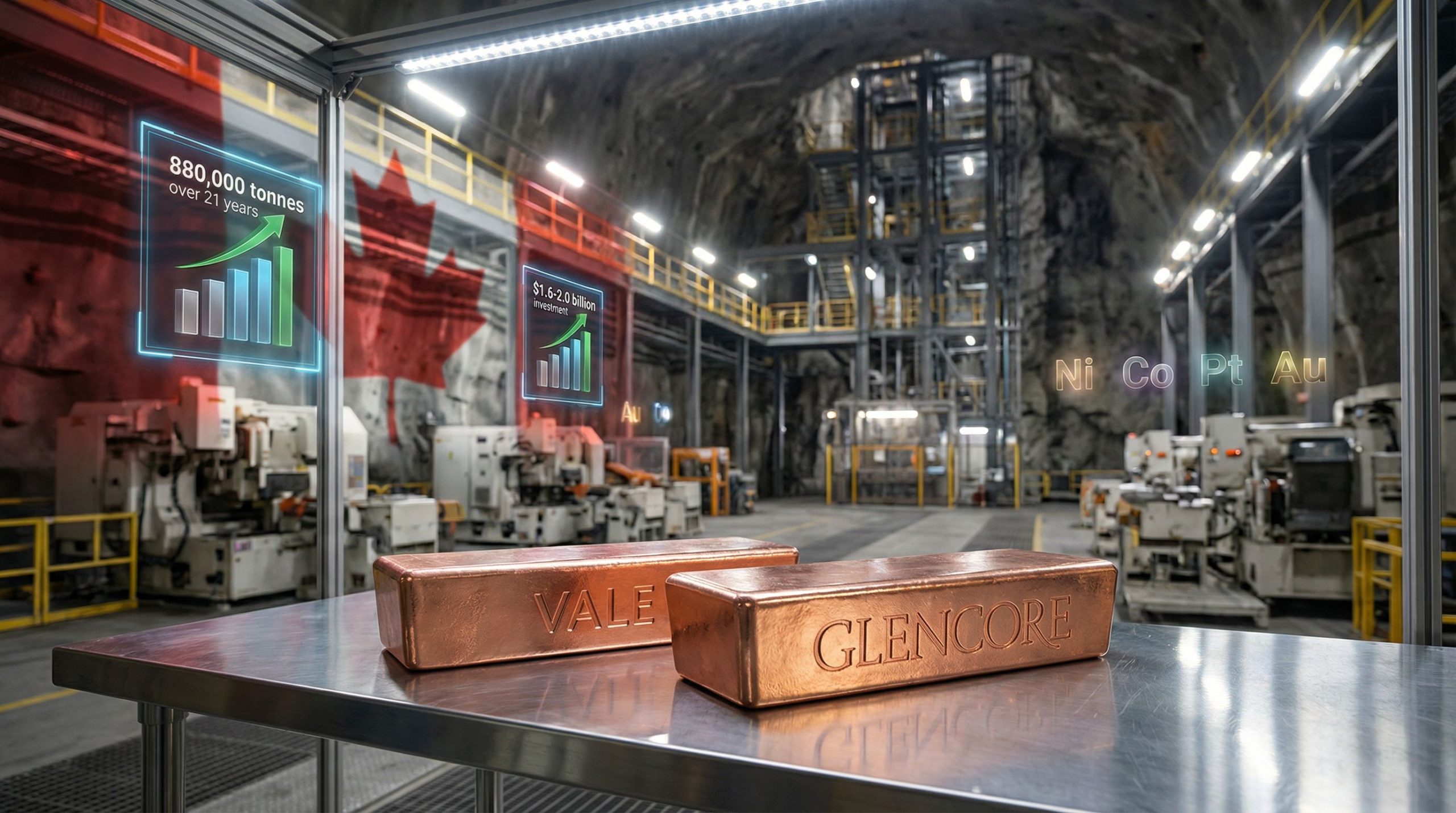
- Shared Capital Deployment: By splitting capital expenditures, projected between $1.6 and $2.0 billion USD, both firms halve their exposure to any overruns or delays.
- Operational Synergies: Joint technical teams blend Vale's expertise in underground base metal mining with Glencore's extensive operational presence in the region.
The Sudbury Basin's mining heritage, with over 130 years of continuous operation, offers a unique foundation of skilled labour, community relationships, and robust supply chains to further solidify the partnership's comparative advantage.
How Does Sudbury Basin Geology Support Multi-Metal Production Economics?
Distinct amongst major ore districts, the Sudbury Basin's geological complexity translates directly into polymetallic production potential and robust project economics. The Vale and Glencore copper project Sudbury Basin is not limited to copper alone; however, it is strategically positioned to extract multiple high-value metals over its projected 21-year life.
Table: Projected Multi-Metal Output Profile
| Metal Category | Production Significance | Market Positioning |
|---|---|---|
| Copper | Primary revenue driver | 880,000 tonnes over 21 years |
| Nickel | Secondary base metal | Leverages existing regional expertise |
| Cobalt | Critical mineral premium | Battery supply chain positioning |
| Platinum Group Metals | High-value byproducts | Industrial applications focus |
| Gold | Precious metal component | Revenue diversification |
Sudbury's mineralisation, dating back 1.85 billion years to a cataclysmic meteor impact, created extensive, disseminated ore deposits. These geological patterns allow for large-scale underground operations, extracting base and precious metals simultaneously.
Sophisticated metallurgical processes are critical for separating copper, nickel, cobalt, PGMs, and gold—ensuring not only maximum recovery but also market flexibility regardless of commodity cycle swings. Additionally, current mining industry innovation trends emphasise such integrated approaches.
Resource Economics Framework:
- Capital Expenditure Range: Estimated between $1.6 billion and $2.0 billion USD, focusing on infrastructure re-use and minimised new construction.
- 21-Year Production Timeline: The longevity of output spreads investment over two decades, reducing annual revenue pressure.
- Revenue Diversification: Recovery of multiple metals insulates the project from copper price volatility, as secondary and byproduct metals cushion any drops in copper profitability.
Such multi-metal capacity is a proven defensive strategy in mining economics, consequently stabilising returns regardless of sector cycles and macro market shocks.
What Investment Timeline Drives the Partnership Decision Framework?
The Vale and Glencore copper project Sudbury Basin partnership unfolds over a carefully sequenced multi-phase timeline, balancing technical certainty with capital discipline.
Development Phase Sequencing
1. Phase 1: Assessment and Planning (2025-2026)
- Completion of joint technical evaluation and initiation of detailed engineering studies.
- Launch of environmental permitting processes and proactive establishment of community and stakeholder consultations.
2. Phase 2: Investment Decision (H1 2027)
- All technical, environmental, and market assessments culminate in a final investment decision anticipated during the first half of 2027.
- Joint venture formalisation and construction planning are finalised, including discussions on long-term customer offtake agreements.
3. Phase 3: Construction and Development (2027–2030)
- Shaft deepening and new drift construction at Nickel Rim South commence.
- Upgrades and integration of onsite processing, transportation, and environmental controls.
- Projected completion allows for copper production start by 2030/2031, supporting a 21-year operational schedule into 2051/2052.
Careful alignment with regulatory timelines under Ontario's mining laws, and proactive engagement with Indigenous communities and local municipalities, underpin this phased approach. This incremental de-risking process helps ensure capital is only exposed once technical and permitting uncertainties have been addressed.
How Do Market Dynamics Influence the Strategic Partnership Timing?
The arrival of the Vale and Glencore copper project Sudbury Basin partnership coincides with pivotal shifts in global copper market dynamics and North American supply reliability. According to Mining Technology, Glencore faces a fourth consecutive year of copper output declines—with a 17% year-over-year slide in its own-sourced copper production through September 2025.
Consequently, Glencore seeks to reverse negative trends and reassure shareholders concerned about the company's lagging share price. Simultaneously, Vale aims to double its base metal production to approximately 700,000 metric tons annually by 2035.
This strategy reduces its risk profile by expanding beyond Brazil and entering the North American critical minerals supply chain. For instance, copper and uranium investment opportunities in Canada have become increasingly attractive.
Copper Market Demand Drivers:
- Increased renewables infrastructure and grid modernisation, both of which require significant quantities of copper for new transmission lines and substations.
- Accelerating electric vehicle adoption, with each EV containing up to four times more copper than combustion vehicles, and a surging network of charging infrastructure amplifying demand further.
- Data centre and AI infrastructure expansion, which are copper-intensive due to power and cooling requirements for high-performance computing.
The partnership's timing also leverages the geographical and political advantages of Canada as a safe jurisdiction. Furthermore, this addresses not just production but also longer-term supply chain security for North American copper customers.
Supply Chain Security Framework
- North American production helps mitigate risks tied to politically or environmentally unstable jurisdictions.
- Existing transportation and power infrastructure enable rapid integration into regional and export supply networks.
Industry observers note that by launching this partnership as existing global producers face ore grade declines and portfolio rationalisations, Vale and Glencore are positioning themselves to respond directly to long-term demand trends rather than chasing short-term market cycles.
What Operational Challenges Could Impact Project Economics?
While the strategic design of the Vale and Glencore copper project Sudbury Basin mitigates many risks, multiple technical and operational factors could influence economic outcomes.
Technical Risk Factors
1. Underground Development Complexities
- Deepening and expanding shaft systems introduce engineering uncertainty, especially in ground stability and rock mechanics in varied ore zones.
- Integration of enhanced water management and ventilation systems is required as mining activities reach greater depths.
2. Processing Technology Integration
- Multimetal separation technology must be meticulously designed to achieve high recovery rates for copper, nickel, cobalt, PGMs, and gold.
- Disposal and water management systems need to maintain environmental compliance, which is under ever-tightening scrutiny from Canadian regulators.
Table: Key Financial Risk Mitigation Strategies
| Risk Category | Mitigation Approach | Partnership Benefit |
|---|---|---|
| Capital cost overruns | Shared investment responsibility | 50% individual exposure reduction |
| Commodity price volatility | Multi-metal revenue streams | Diversified income stability |
| Operational disruptions | Combined technical expertise | Enhanced problem-solving capacity |
| Regulatory changes | Joint compliance resources | Shared regulatory burden |
Other operational factors include the need for robust project management during the 3-year construction ramp-up (typically the highest risk window for cost overruns). In addition, contingency planning for any unforeseen permitting or technical setbacks remains essential.
How Does This Partnership Compare to Alternative Copper Development Strategies?
The Sudbury collaboration illustrates the advantages of brownfield joint venture development strategies over greenfield or single-operator projects.
Brownfield Advantages
- Utilisation of existing mining shafts, power, and processing facilities limits capital outlays and environmental impacts.
- Established permitting relationships and support from experienced labour pools reduce political and operational uncertainty.
Greenfield Disadvantages
- Greenfield projects demand more substantial investment (often 30-50% higher), longer development timelines, and greater regulatory scrutiny.
- Community engagement is more complex without a legacy of operations.
Joint Venture Economics vs. Solo Development
- Shared risk and capital lessen the individual burden if commodity prices underperform or technical surprises emerge.
- Pooling of technical talent improves problem-solving for deep mining challenges.
- Enhanced market strength when negotiating offtake agreements, supply contracts, and customer relationships.
A joint-venture approach increasingly mirrors broader industry trends. As Mining.com reports, declining ore grades worldwide require more sophisticated, capital-intensive recovery strategies that are difficult for single companies to shoulder alone.
What Long-Term Strategic Implications Emerge from This Collaboration?
The Vale and Glencore copper project Sudbury Basin is emblematic of an accelerating shift within the mining industry toward consolidation, shared investment models, and cross-company collaboration on major assets.
Long-Term Sector Impacts
- Establishes a template for similar joint-venture, multi-asset collaborations amongst mining majors, particularly in North America.
- Sustains the Sudbury Basin's economic and technical legacy into the mid-21st century, preserving both specialised labour skills and regional industrial supply chains.
- Supports local economies and supply chains by maintaining high-wage mining jobs, subcontracting opportunities, and infrastructure spend over an extended project life.
Regional Implications
- The partnership prolongs Sudbury's relevance in global mining, ensuring that local expertise and established service networks remain viable well into the future.
- Critical mineral production from a stable Canadian jurisdiction will have strategic implications for North American manufacturers, especially in battery, EV, and clean energy sectors.
How Do Company-Specific Strategies Align with Partnership Objectives?
Both Vale and Glencore demonstrate strong strategic alignment in pursuing the Sudbury Basin copper project.
Vale's Expansion Framework
- Targeting a doubling of annual base metals output to 700,000 tpa by 2035, with a specific focus on diversifying away from Brazilian project and political risk.
- Expanding its presence in the North American battery minerals supply chain via copper, cobalt, and PGM production.
Glencore's Portfolio Strategy
- Seeks to reverse its declining copper production profile—down 17% year-over-year in the first nine months of 2025.
- Monetising and extending the life of existing Canadian mining infrastructure (where copper output in 2025 was forecast 850,000–875,000 tonnes, revised down from 850,000–890,000 tonnes on lower grades).
- Addressing investor pressure for visible, tangible plans to restore growth and asset performance.
Table: Company Strategic Alignment Analysis
| Strategic Objective | Vale Benefit | Glencore Benefit |
|---|---|---|
| Production growth | Copper output expansion | Production decline reversal |
| Geographic diversification | North American presence | Canadian asset optimisation |
| Infrastructure efficiency | Shared development costs | Existing asset monetisation |
| Critical minerals exposure | Multi-metal portfolio | Cobalt and PGM access |
By aligning regional aspirations with global strategy, the two companies maximise their ability to address market, operational, and investor expectations in uncertain commodity cycles.
What Market Positioning Advantages Does the Partnership Create?
The Vale and Glencore copper project Sudbury Basin enhances the competitive standing of both partners on several fronts.
Competitive Positioning Framework
- Ensures long-term security of supply to core North American industrial customers, mitigating risks of future shortages or geopolitical disruptions.
- Offers customers reliability and quality assurance from two of the industry's largest, most technically advanced producers.
- Strengthens negotiating power for supply contracts, pricing, and technical support arrangements.
Customer Relationship Enhancement
- The joint venture structure supports multi-year offtake contracts, critical for automotive, technology, and energy sector clients who prize stability and ESG compliance.
- Proximity to North American markets reduces shipping time and cost, with the added weight of strong operational standards and reliability.
Investment Community Perception
- Visible risk mitigation and partnership structure signal prudent, disciplined capital allocation, reducing concern over megaproject scale.
- Concrete expansion and efficiency plans bolster investor confidence, especially given the multi-metal revenue stability and jurisdictional security.
- The emphasis on multi-metal, environmentally responsible development aligns directly with industry expectations and ESG investor mandates.
Further Exploration:
To deepen understanding of the geological, strategic, and investor context for joint Canadian mining developments, readers may consult resources from the Ontario Geological Survey, Mining Association of Canada, and technical reviews of Sudbury Basin projects by international commodity groups.
Disclaimer: All forward-looking statements reflect current market knowledge as of December 2025. Operational, financial, and commodity outcomes may vary based on regulatory decisions, technological advances, demand shifts, and unforeseen external events.
Ready to Capitalise on the Next Major Mineral Discovery?
Discovery Alert instantly alerts investors to significant ASX mineral discoveries using its proprietary Discovery IQ model, turning complex mineral data into actionable insights just like the strategic partnerships analysed above. Understand why historic discoveries can generate substantial returns by exploring major Australian mineral finds, then begin your 30-day free trial to position yourself ahead of the market.