July 22, 2026
When Boardroom Politics Collide With Commodity Markets
Few dynamics in global finance are as revealing as the moment a major commodity producer's internal governance crisis intersects with its operational performance data. These two forces usually move on separate tracks, but when they converge, they expose the full complexity of how large mining companies are actually controlled, how institutional capital exercises power, and how equity markets price uncertainty.
Vale shareholders elect Oliveira chairman — this event in July 2026 has drawn significant attention not just because of the company's size, but because of what it reveals about the changing nature of shareholder power in resource-heavy emerging markets.
When big ASX news breaks, our subscribers know first
Vale's Position at the Top of the Iron Ore Hierarchy
Vale occupies a rare position in global commodity markets. Alongside BHP and Rio Tinto, it forms an effective oligopoly over seaborne iron ore supply, with its Brazilian operations feeding steel mills primarily across Asia. The Carajas region of the Amazon basin, where Vale operates some of its flagship mines, produces iron ore with exceptionally high iron content, often exceeding 65% Fe, which commands premium pricing relative to lower-grade Australian ores typically in the 58–62% Fe range.
This quality distinction matters more than many outside the sector appreciate. Steel producers, particularly in China, blend iron ore from multiple sources to optimise their blast furnace feed. High-grade Brazilian ore requires less energy to process, generates less slag, and improves furnace productivity. That makes Vale's product strategically valuable in ways that go beyond simple volume metrics. Furthermore, iron ore demand prospects from Asia continue to shape how producers like Vale position themselves for the long term.
The iron content grade of ore is not a minor technical footnote. It directly affects a steel mill's energy consumption, carbon emissions per tonne of steel produced, and ultimately, its competitive cost position. A chairman transition at Vale is not just a governance story; it is a supply chain story for Asian industrial production.
The company's global relevance means that any period of sustained boardroom instability carries consequences beyond its own share price. Long-term capital allocation decisions, including decisions about whether to expand capacity at existing operations or develop new deposits, require a coherent and aligned board. Without that alignment, major projects stall, and downstream steel supply chains feel the effects months or years later.
The Governance Dispute: How It Unfolded
The sequence of events that ultimately led to Vale shareholders elect Oliveira chairman began with a formal move by Previ, Vale's largest single shareholder with approximately a 7% stake. Previ manages retirement assets for employees of Banco do Brasil, a state-linked financial institution, and its fiduciary mandate obliges it to pursue governance improvements as a core investment discipline, not merely a secondary concern.
Previ's formal request for an extraordinary shareholder meeting to address the board chairmanship was the visible trigger, but the underlying tension had been building for some time. The existing board's response was notable: directors voted to recommend that shareholders reject the proposed leadership change. However, three directors abstained from that internal vote, and crucially, one of those abstaining directors was Manuel Lino Oliveira himself, the candidate who would ultimately be elected to the chairmanship.
The governance timeline unfolded as follows:
| Date | Event |
|---|---|
| Approximately June 2026 | Previ formally requests an extraordinary shareholder meeting |
| June 2026 | Vale's full board recommends rejection of Previ's proposal |
| Early July 2026 | Daniel Stieler resigns as chairman before the vote is held |
| July 21, 2026 (evening) | Vale releases strong Q2 iron ore production figures |
| July 22, 2026 | Extraordinary shareholder meeting held; Oliveira elected chairman |
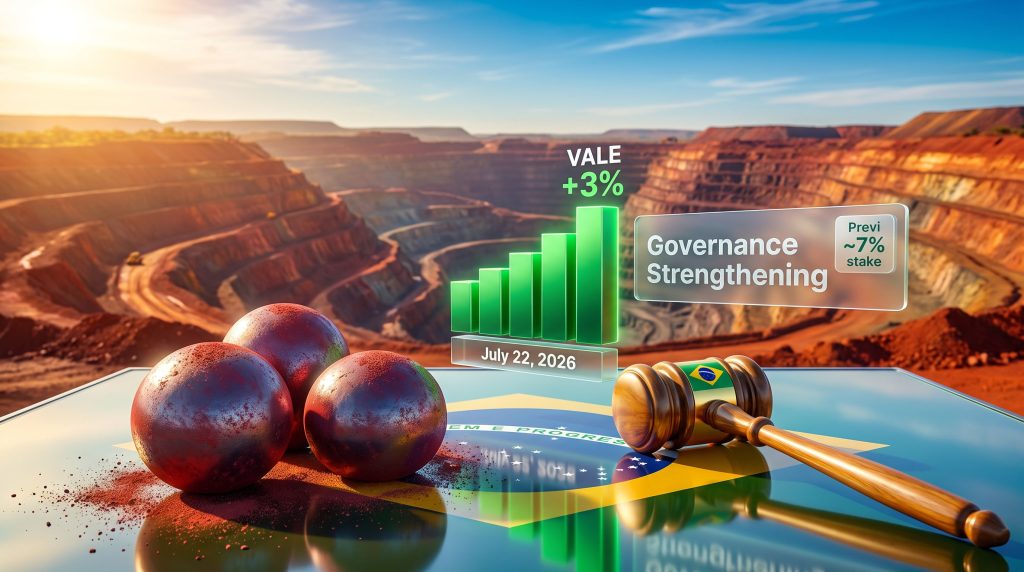
| July 22, 2026 | Vale shares rise more than 3%, outperforming the Bovespa benchmark |
Daniel Stieler had served as a board member since 2021 and as chairman since 2023. His resignation before the shareholder vote was itself a significant signal. When an incumbent chairman steps down ahead of a shareholder-mandated removal vote, it typically indicates that the balance of institutional support has shifted decisively, and that continuing to contest the outcome would further damage both personal and corporate credibility.
Manuel Lino Oliveira: The Significance of an Internal Appointment
The choice to elevate an existing board member rather than install an external candidate deserves careful consideration. Oliveira had served as lead independent director on Vale's board prior to his election as chairman, which meant shareholders were not being asked to accept an unknown quantity. His familiarity with the company's operational structure, its risk framework, and its institutional relationships reduced the transition friction considerably.
This pattern — promoting an existing independent director to the chairmanship rather than recruiting from outside — tends to generate less market disruption than external appointments. The investment community interprets internal promotions as continuity with reform, rather than the more disruptive signal of an outsider mandate.
Why internal promotions are typically preferred by institutional investors in mining:
- Existing board members understand the specific capital intensity and project pipeline of the company
- They have established relationships with senior management, reducing the risk of operational disruption
- Their track record within the boardroom provides a governance baseline for investors to evaluate
- Internal candidates signal that the company's independent oversight function was already functioning to some degree
- The transition carries lower reputational risk than importing an external figure who may pursue an agenda misaligned with long-term strategy
Previ's position that Oliveira would help strengthen governance carried weight precisely because of his existing board credentials. The fund also signalled that it intended to take a hands-off approach to board dynamics following the election — a deliberate move to address concerns that a state-linked pension fund was seeking to exert political influence over a major listed company.
The Proxy Adviser Divide and What It Reveals
One of the more instructive subplots of this governance transition was the divergence between the two major proxy advisory firms in their recommendations to institutional shareholders.
| Proxy Adviser | Supported Candidate | Basis |
|---|---|---|
| Glass Lewis | Manuel Lino Oliveira | Governance strengthening credentials |
| ISS | Marcelo Gasparino | Alternative governance assessment framework |
This split is not merely a curiosity. It highlights a structural reality in global corporate governance: there is no universally agreed framework for evaluating mining company board leadership. The criteria that Glass Lewis applied to favour Oliveira differed sufficiently from ISS's methodology to produce opposing conclusions.
For institutional investors navigating contested board elections, proxy adviser divergence places additional responsibility on internal governance teams to conduct independent analysis. The fact that ADR holders ultimately played a role in determining the outcome adds another layer of complexity, reflecting how Vale's dual-listed structure distributes voting power across different investor classes with potentially different governance priorities.
How the Market Responded and Why the Signal Matters
Vale's share price rising more than 3% on July 22, 2026, and outperforming Brazil's Bovespa benchmark in the process, raises an important analytical question. How much of that movement reflected governance resolution, and how much reflected the strong Q2 iron ore production data released the previous evening?
When two independent positive catalysts arrive within hours of each other, the market's response cannot be cleanly attributed to either one alone. What the combined movement does confirm is that uncertainty had been discounting Vale's share price during the governance dispute, and that its resolution released pent-up institutional demand.
This dual-catalyst effect is a well-documented market psychology phenomenon. In resource companies particularly, governance uncertainty introduces what analysts describe as an uncertainty premium — a downward price adjustment that reflects the market's difficulty in modelling future capital allocation under an unstable board. When governance clarity arrives alongside operational confirmation, the relief rally can overshoot what either factor would have produced independently.
Three dimensions of the market response worth examining separately:
- Governance clarity signal: Reduced uncertainty premium as institutional investors could update their models with a defined board structure
- Operational confirmation signal: Strong Q2 iron ore output data validated production guidance and supported near-term earnings estimates
- Relative outperformance against Bovespa: Indicated that Vale-specific factors, rather than broader Brazilian market sentiment, were driving the day's movement
The next major ASX story will hit our subscribers first
Institutional Shareholder Activism in Emerging Market Mining
Previ's successful challenge to Vale's board composition represents a maturation of institutional shareholder activism in Brazilian corporate markets. Brazilian corporate law permits minority shareholders with meaningful stakes to formally requisition extraordinary general meetings — a mechanism that Previ deployed with strategic precision.
What makes this case particularly instructive is Previ's identity as a quasi-institutional actor. It manages the retirement savings of workers employed by a state-linked bank, which places it in an unusual position: simultaneously a commercial investor with fiduciary obligations, and an entity with indirect connections to government-linked capital. This dual character creates both leverage and complexity in governance disputes.
The distinction between how activist hedge funds and long-term pension funds approach governance interventions is significant and often misunderstood. Hedge fund activism in mining typically focuses on short-to-medium-term value extraction through asset sales, buybacks, or management changes designed to catalyse a rapid re-rating. Pension fund governance activism, by contrast, tends to focus on structural improvements to board composition, independence frameworks, and long-term stewardship because the fund's own investment horizon extends across decades, not quarters.
Oliveira's Chairmanship: Strategic Scenarios and Implications
The restoration of board cohesion under Oliveira's chairmanship opens several strategic pathways for Vale. Each carries distinct implications for different categories of investors.
| Scenario | Key Driver | Investor Implication |
|---|---|---|
| Accelerated ESG alignment | Previ's governance and sustainability mandate | Improved access to ESG-linked financing and index inclusion |
| Dividend policy review | Restored board consensus on capital returns | Positive for income-oriented institutional holders |
| Strategic asset portfolio review | New leadership agenda and capital efficiency focus | Potential non-core asset divestments or partnerships |
| Continued operational focus | Strong Q2 production baseline and existing mine plans | Supports earnings stability and analyst consensus |
Beyond these near-term scenarios, Vale's strategic positioning faces a structural shift driven by the global energy transition. Green steel pricing dynamics are evolving rapidly, as hydrogen-based direct reduction processes require higher-grade iron ore feed to function efficiently. Vale's high-Fe Brazilian ores are considerably better suited to these processes than lower-grade Australian alternatives, positioning the company favourably in a decarbonising steel industry. In addition, a zero-carbon steel partnership model — as demonstrated by other major producers — illustrates how governance-stable mining companies can negotiate supply agreements that align with emerging sustainability frameworks.
This creates an interesting long-term dynamic. The same governance stability that institutional investors demanded in 2026 is also a precondition for Vale to attract the green financing that major capital projects increasingly require, and to manage the complex stakeholder relationships that large-scale mining in the Amazon basin entails.
How Does Vale Compare With Other Major Producers?
It is worth noting that Vale shareholders elect Oliveira chairman at a moment when other major miners are also navigating significant strategic pivots. For instance, BHP iron ore strategy has evolved considerably in response to shifting demand signals, and China steel and iron ore market conditions continue to apply pressure across all major producers. Consequently, the governance clarity that Vale has now achieved may prove to be a competitive advantage as the sector navigates a complex transition period.
Governance Transitions as Reference Cases for the Mining Sector
Vale's experience provides a useful framework for understanding how large-cap mining governance disputes tend to resolve. Several patterns are worth noting for investors monitoring other major producers.
First, operational performance acts as a buffer against prolonged governance instability. A company producing strong output figures retains institutional patience in ways that underperforming operators cannot. Vale's Q2 results arriving the day before the shareholder vote was not coincidental in its market impact — it reminded investors what the underlying asset was worth if board-level distractions were removed.
Second, the internal promotion pathway consistently generates less market disruption than external appointments. When the new chairman is already known to management, staff, and institutional holders, the transition carries lower execution risk. Third, proxy adviser divergence on contested board elections should prompt institutional investors to conduct independent analysis rather than deferring entirely to advisory recommendations. The Glass Lewis and ISS split on Vale's candidates illustrates that different methodological frameworks can generate contradictory conclusions from the same set of governance facts.
Frequently Asked Questions: Vale's Chairman Election
Who is the new chairman of Vale's board of directors?
Manuel Lino Oliveira, widely known as Ollie, was elected chairman of Vale's board on July 22, 2026. Before his election, he held the position of lead independent director on the same board, making him a credible internal candidate with established institutional relationships.
Why did Vale's previous chairman resign?
Daniel Stieler, who had served as Vale's chairman since 2023 and as a board member since 2021, resigned in early July 2026 following a sustained governance challenge initiated by Previ. The pension fund had formally requested an extraordinary shareholder meeting to vote on his removal, and Stieler stepped down before that vote was held.
What is Previ and why does its vote matter?
Previ is a Brazilian pension fund that manages retirement savings for employees of Banco do Brasil, a state-linked financial institution. With approximately a 7% stake in Vale, it holds the largest single shareholder position and therefore carries disproportionate influence over board composition decisions.
Did proxy advisory firms agree on the preferred candidate?
No. Glass Lewis supported Manuel Lino Oliveira's candidacy, while ISS recommended the competing candidate, Marcelo Gasparino. The final outcome reflected the broader shareholder vote, including ADR holders, rather than alignment with either advisory position.
How did Vale's shares perform following the meeting?
Vale's shares rose more than 3% on July 22, 2026, outperforming Brazil's Bovespa benchmark index. The movement reflected both the resolution of governance uncertainty and strong Q2 iron ore production data released the prior evening.
What does governance stability mean for Vale's iron ore business?
Board stability is a precondition for coherent long-term capital allocation in capital-intensive mining. For Vale specifically, it is also relevant to its positioning in the emerging green steel supply chain, where high-grade Brazilian iron ore commands a structural premium over lower-grade alternatives.
Key Takeaways for Investors Monitoring Mining Governance
- Institutional shareholder activism in emerging markets is maturing rapidly, with pension funds increasingly willing to formally challenge incumbent board leadership through legally available mechanisms
- Internal board promotions reduce transition friction and are consistently received more positively by equity markets than external appointments
- Proxy adviser divergence on contested board elections is more common than widely understood, and demands independent institutional analysis
- Dual catalysts (governance resolution plus operational data) amplify market responses beyond what either factor generates independently, complicating clean attribution of share price movements
- High-grade iron ore producers like Vale occupy a structurally advantaged position as green steel production scales globally, making governance stability a strategic asset beyond its immediate market signalling value
- Pension fund governance activism differs fundamentally from hedge fund activism in its objectives, time horizon, and market interpretation, and should be assessed through a different analytical lens
Disclaimer: This article is intended for informational purposes only and does not constitute financial advice or a recommendation to buy or sell any security. Forward-looking statements, scenario analyses, and market interpretations involve inherent uncertainty. Past share price performance is not indicative of future results. Readers should conduct their own due diligence or consult a licensed financial adviser before making investment decisions.
Want To Identify the Next Major Mineral Discovery Before the Broader Market Does?
Discovery Alert's proprietary Discovery IQ model delivers real-time alerts on significant ASX mineral discoveries, transforming complex geological and market data into actionable investment insights — whether you're a short-term trader or a long-term investor seeking transformative opportunities. Explore why historic discoveries have generated extraordinary returns on Discovery Alert's dedicated discoveries page, and begin your 14-day free trial today to position yourself ahead of the market.