
July 7, 2026
The Hidden Cost of Political Interference in Global Mining Governance
Resource nationalism has never been subtle. From the copper nationalisation campaigns of 1970s Chile to the nickel export bans imposed by Indonesia in the 2020s, governments have consistently found ways to reassert control over strategic mineral assets. The more sophisticated playbook, now increasingly visible in Brazil, involves something quieter: the use of state-aligned institutional shareholders to reshape corporate governance from within. The chairman of Vale's board resigns amid political pressure is not merely a headline about one executive's departure — it is a case study in how sovereign interests can erode the independence of even the world's most globally integrated mining companies.
When big ASX news breaks, our subscribers know first
Vale's Ownership Structure and the Governance Paradox
Vale occupies a peculiar position in the global mining landscape. Privatised in 1997, it has spent nearly three decades operating as a publicly listed company with shareholders on both the New York Stock Exchange and Brazil's B3 exchange. Yet its ownership architecture has never been cleanly separated from the Brazilian state. The most consequential link runs through Previ, the pension fund of Banco do Brasil, a state-owned financial institution. Previ holds a substantial voting stake in Vale, and when its governance priorities align with those of the federal government, it functions as a powerful instrument of political influence within a nominally private company.
This creates a structural contradiction that international capital markets have long struggled to price. Global institutional investors demand governance independence, transparent succession processes, and commercially driven capital allocation. State-affiliated domestic shareholders, however, may pursue objectives that serve political constituencies rather than shareholder returns. The result is a permanent tension baked into Vale's ownership architecture — one that periodically erupts into visible crisis.
| Stakeholder Type | Entity | Nature of Influence |
|---|---|---|
| State-linked pension fund | Previ (Banco do Brasil) | Major shareholder; governance voting bloc |
| Federal government | Brazilian executive branch | Indirect political pressure via affiliated institutions |
| Private institutional investors | Global asset managers | Commercially-oriented board expectations |
| International markets | NYSE / B3 listings | ESG and governance compliance benchmarks |
Key Insight: Vale's dual listing and global investor base creates a structural tension. International capital markets demand governance independence, while state-aligned domestic shareholders pursue political objectives that may conflict with commercial logic.
A Two-Stage Governance Crisis: From Warning Sign to Breaking Point
The 2024 Departure That Signalled Deeper Problems
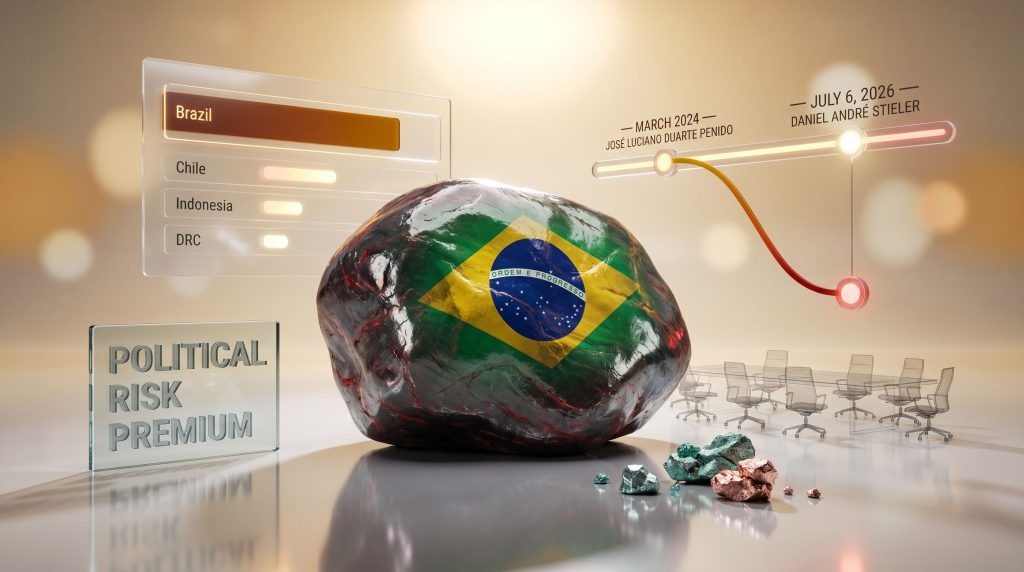
The governance deterioration at Vale did not arrive without warning. In March 2024, board member José Luciano Duarte Penido resigned from his position, publicly stating that Vale's CEO succession process had been compromised by political interference. His resignation letter, addressed to then-chairman Daniel André Stieler, characterised the appointment process as manipulated in a way that actively undermined the company's long-term commercial interests. According to Reuters, Penido's willingness to make his objections public was itself unusual, reflecting a level of institutional dysfunction that insiders rarely acknowledge openly.
What made this departure particularly significant was its specificity. Penido was not resigning over a strategic disagreement or a difference in vision for the company's future. He was alleging that the fundamental process by which Vale selects its most senior executive had been corrupted by external political pressure. That is a governance indictment of the highest order.
The 2026 Culmination: Stieler's Pre-emptive Exit
By July 2026, the governance crisis had reached its structural conclusion. Chairman Daniel André Stieler resigned ahead of a formal shareholder vote that was widely anticipated to remove him from his position. The vote had been driven by Previ, whose alignment with government priorities had placed it in direct opposition to the board's independent governance posture throughout the preceding period.
The manner of the exit matters as much as the exit itself. Stieler's decision to resign rather than contest the shareholder vote signals that the political pressure had become structurally irresistible. As reported by Valor Internacional, when a board chairman calculates that fighting for his position through legitimate corporate governance channels is futile, the implication is that those channels have already been compromised.
Timeline: Vale's Governance Deterioration at a Glance
| Date | Event | Key Figure | Significance |
|---|---|---|---|
| March 2024 | Board member resignation | José Luciano Duarte Penido | First documented public allegation of political interference in CEO succession |
| 2024–2026 | Sustained shareholder-government alignment | Previ / Federal Government | Escalating pressure on independent board members |
| July 6, 2026 | Chairman resignation | Daniel André Stieler | Pre-emptive exit ahead of anticipated shareholder removal vote |
Why Vale's Governance Matters Beyond Brazil's Borders
Vale's Systemic Weight in Global Commodity Markets
Vale is not simply a large company facing an internal governance dispute. It is one of the world's most systemically important commodity producers, and disruptions to its governance carry implications that extend into iron ore pricing benchmarks, energy transition supply chains, and global steel manufacturing economics.
Consider the scale of its operations across three critical commodity categories:
-
Iron ore: Vale consistently ranks among the world's two or three largest producers, with the Carajas mining complex in Para state representing one of the highest-grade iron ore deposits on the planet. With iron ore grades at Carajas averaging around 67% Fe content, the deposit sits at the premium end of the global quality spectrum, commanding price premiums over lower-grade Australian supply in Asian markets. Furthermore, the global iron ore outlook depends significantly on Vale's production stability.
-
Nickel: Vale's nickel operations, spanning Canada, Indonesia, and Brazil, feed directly into the battery supply chain for electric vehicles. The class-one nickel required for lithium-ion battery cathode production is a segment where Vale has significant production exposure. In addition, shifts in nickel market trends globally are closely tied to Vale's output decisions.
-
Copper: Vale's copper assets, including the Sossego and Salobo deposits in Brazil, position it as a meaningful participant in the copper supply chain at a time when copper demand projections tied to electrification infrastructure are rising sharply.
Leadership instability introduced through political channels can delay capital allocation decisions, defer mine development timelines, and create uncertainty around production targets across all three of these commodity categories.
The Political Risk Premium in Mining Equity Valuation
Analysts covering resource equities in politically active jurisdictions routinely apply a discount to valuation multiples to account for the probability of non-commercial decision-making. This sovereign interference discount is not merely theoretical. Historical precedents across Latin America, Africa, and Southeast Asia demonstrate that political interference in mining governance consistently precedes operational underperformance and capital misallocation.
Investor Framing: When a board chairman exits under political duress rather than completing a scheduled term, the market signal extends well beyond one individual. It functions as a referendum on whether the company's governance architecture can withstand sustained sovereign pressure.
Resource Nationalism in Comparative Context
Brazil's Soft Capture Model Versus Harder Interventions Elsewhere
Brazil's approach to reasserting influence over Vale represents what can be described as a soft governance capture model. Rather than pursuing outright renationalisation or direct regulatory seizure, the government leverages state-affiliated institutional shareholders to influence board composition and executive appointments from within the existing corporate structure. This model is legally defensible, politically deniable, and operationally effective.
Comparing this to other major mining jurisdictions illustrates how governance risk manifests differently across national contexts. For instance, resource nationalism in cobalt markets takes a far more direct regulatory form than Brazil's approach.
| Country | Primary Resource | Government Influence Mechanism | Governance Risk Level |
|---|---|---|---|
| Brazil | Iron ore, nickel, copper | State pension fund shareholding via Previ | High |
| Chile | Copper | Codelco state ownership; royalty legislation | Medium-High |
| Indonesia | Nickel | Export ban mandates; downstream processing rules | High |
| DRC | Cobalt | Royalty renegotiation; state equity demands | Very High |
| Australia | Iron ore, lithium | Regulatory frameworks; relatively independent boards | Low-Medium |
What distinguishes Brazil's model is its sophistication. The government does not need to pass legislation or amend mining codes. It achieves its governance objectives through shareholder meeting votes — a mechanism that is structurally indistinguishable from ordinary institutional investor activism but operates with entirely different motivations.
Strategic Decisions Now Exposed to Political Distortion
Capital Expenditure and the Risk of Misallocated Investment
Vale operates one of the most capital-intensive business models in global mining. Major infrastructure decisions — including expansions at iron ore production hubs, investments in nickel processing technology, and copper development projects — require governance continuity and commercially grounded leadership to execute effectively.
Leadership installed through politically motivated processes faces a credibility deficit with international institutional investors, ESG-focused funds, and credit rating agencies. Consequently, this matters for several interconnected reasons:
-
Capital expenditure priorities may shift toward projects that serve regional employment or political agendas rather than those with the strongest risk-adjusted returns.
-
Asset divestment decisions, including Vale's ongoing base metals portfolio discussions, could be influenced by government preferences over maximising shareholder value.
-
ESG and dam safety commitments require governance continuity. Following the Brumadinho disaster in 2019, which killed 270 people, and the earlier Mariana catastrophe in 2015, Vale carries outstanding environmental and remediation liabilities that demand sustained, independent board oversight.
Risk Callout: Governance instability is particularly consequential for companies with unresolved environmental liabilities. Vale's remediation obligations require sustained, independent oversight. Politically motivated leadership cycles introduce execution risk into processes that demand long-term institutional commitment.
What Investors Should Monitor in Coming Quarters
The signals worth tracking as Vale navigates this governance transition include:
- The independence credentials of newly appointed board members and whether their professional backgrounds reflect commercial or political appointment logic
- Whether the incoming chairman's profile aligns with international governance standards or reflects government-aligned priorities
- Vale's quarterly capital allocation disclosures for signs of politically motivated spending patterns diverging from stated strategic priorities
- Commentary from Fitch, Moody's, and S&P on governance risk in upcoming Vale debt reviews, where board composition changes may trigger rating watch notifications
- Previ's ongoing voting behaviour at shareholder meetings as the most direct observable proxy for government influence intensity
The next major ASX story will hit our subscribers first
The Deeper Structural Question: Reform or Repetition?
The circumstances that produced this governance crisis — in which the chairman of Vale's board resigns amid political pressure — are not unique to a particular political administration or electoral cycle. They are structural features of Brazil's post-privatisation resource ownership model. As long as state-affiliated pension funds hold significant voting stakes in nominally private resource companies, the conditions for this kind of interference will persist regardless of which political party holds power.
Meaningful structural reform would require one or more of the following:
- Strengthened statutory requirements governing board independence at companies where state-affiliated shareholders exceed defined ownership thresholds
- Clearer regulatory boundaries distinguishing the fiduciary duties of institutional pension fund shareholders from the policy objectives of the governments that oversee the underlying state institutions
- Coordinated governance advocacy from international institutional investors, who collectively hold substantial stakes in Vale and have legitimate standing to demand enforceable independence standards as a condition of ongoing capital allocation
Brazil's electoral calendar creates recurring incentives for federal administrations to leverage state-affiliated institutional assets for governance outcomes. The precedent established by both Penido's 2024 departure and Stieler's 2026 resignation may embolden future interference unless a coordinated investor response changes the cost-benefit calculus for political actors.
Vale's trajectory over the next 12 to 24 months will serve as a critical data point for the broader question of whether soft governance capture in Brazilian resource companies is a cyclical disruption or a durable structural feature that global investors must permanently price into their models. Moreover, the ongoing situation — where the chairman of Vale's board resigns amid political pressure — serves as a stark reminder that governance risk in resource companies rarely resolves itself without structural intervention.
Disclaimer: This article contains forward-looking analysis and investor perspectives that involve inherent uncertainty. Nothing contained herein constitutes financial advice. Readers should conduct independent research and consult qualified financial advisers before making investment decisions.
Want to Stay Ahead of Significant Mineral Discoveries Before the Broader Market Does?
While governance risks in major global miners like Vale can erode investor confidence, the real opportunity often lies in identifying transformative ASX mineral discoveries the moment they are announced — Discovery Alert's proprietary Discovery IQ model scans daily ASX announcements in real time, delivering actionable alerts across more than 30 commodities, and you can explore the historic returns that major discoveries have generated before starting your 14-day free trial at Discovery Alert.