July 27, 2026
Venezuela's Energy Sector Is Attracting Global Attention Again — and Domestic Operators Are Taking Centre Stage
Across the global energy landscape, the question of which frontier hydrocarbon markets are genuinely re-opening for international capital has become one of the most closely watched debates among institutional investors and energy executives alike. Venezuela, long considered too structurally complex and geopolitically fraught to attract serious attention, is quietly re-entering that conversation. Understanding this shift requires examining the broader geopolitical resource landscape in which Venezuela now operates. The mechanics of how that re-entry unfolds will be shaped not just by international operators, but by the domestic service companies already embedded in the country's producing basins.
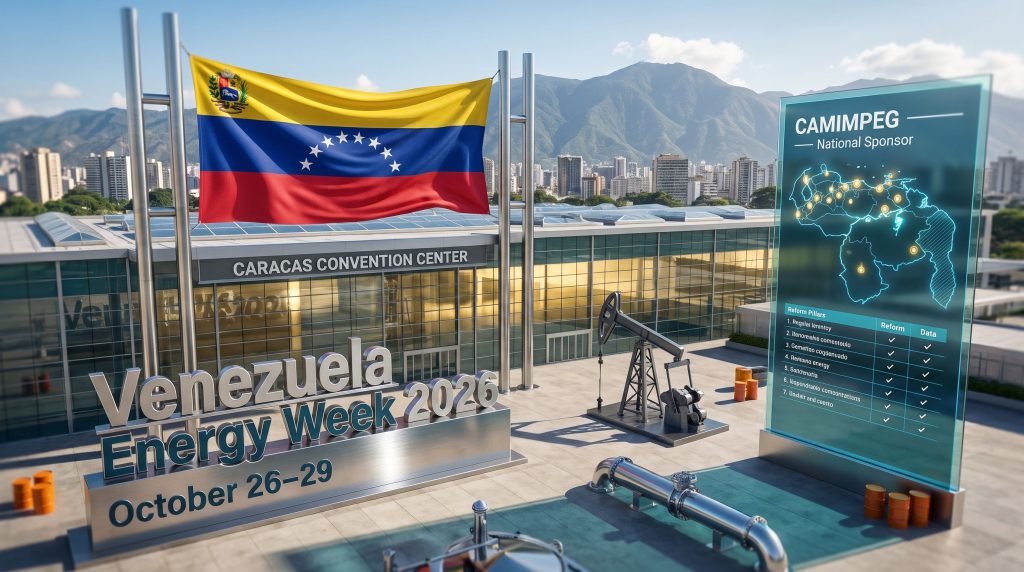
The confirmation of CAMIMPEG as national sponsor of Venezuela Energy Week 2026 offers a precise lens through which to examine this dynamic. It is a development that tells us something meaningful about the current confidence level among established Venezuelan energy service firms, and about how domestic operators are repositioning themselves ahead of what many in the sector expect to be a significant uptick in project activity.
When big ASX news breaks, our subscribers know first
Venezuela Energy Week 2026: More Than a Conference
Venezuela Energy Week 2026 is scheduled to run from October 26 to 29, 2026, in Caracas, making it the country's largest international energy investment forum to date. The event is designed to bring together a cross-section of the global energy ecosystem, including government ministers, upstream operators, institutional investors, energy service companies, and contractors.
What distinguishes this particular edition of the forum from prior gatherings is timing. The event comes on the heels of a substantive legislative overhaul that has materially changed the risk-return profile of operating in Venezuela's energy sector. For international stakeholders who have been monitoring the country from a distance, Venezuela Energy Week 2026 represents a structured entry point into a market that, until recently, offered few credible engagement channels.
The forum is expected to address a range of strategic themes, including:
- Upstream investment opportunities across Venezuela's major hydrocarbon basins
- The practical implications of the January 2026 Organic Hydrocarbons Law reforms for joint venture structures with PDVSA
- Strategies for scaling production capacity through domestic and cross-border partnerships
- The expanding role of Venezuela's mining and extractive industries sector
- Infrastructure and logistics requirements to support higher output targets
Who Is Watching Venezuela Energy Week 2026?
The stakeholder map for this event is broader than a standard oil and gas conference. The following table outlines the primary audience segments and their specific interests in the forum:
| Stakeholder Group | Primary Interest |
|---|---|
| International oil and gas operators | Understanding the reformed JV framework and identifying upstream entry points |
| Institutional investors | Assessing Venezuela's post-reform risk profile and capital deployment timelines |
| Energy service and equipment companies | Sourcing partnership and contract opportunities with PDVSA and domestic operators |
| Mining and extractive industry players | Engaging with Venezuela's growing industrial minerals services market |
| Government and policy stakeholders | Communicating reform commitments to global capital markets |
The January 2026 Organic Hydrocarbons Law Reforms: A Structural Shift
Understanding why CAMIMPEG's national sponsorship matters requires understanding the regulatory environment that has made Venezuela's energy sector newly relevant to international capital. In January 2026, Venezuela enacted a series of amendments to its Organic Hydrocarbons Law that represent the most substantive legislative change to the country's upstream framework in years.
These were not cosmetic adjustments. The reforms addressed structural issues that had long deterred international participation, particularly the terms governing joint ventures with PDVSA, Venezuela's state oil company. The Venezuela-PDVSA policy shift has further shaped the environment in which these domestic reforms are being interpreted by international capital. The core reform pillars and their strategic implications are summarised below:
| Reform Element | Strategic Impact |
|---|---|
| Greater contractual flexibility | Enables more diverse and tailored partnership structures with PDVSA |
| More competitive fiscal terms | Improves project economics and internal rate of return for international operators |
| Enhanced minority shareholder protections in PDVSA JVs | Reduces governance risk exposure for foreign capital |
| Regulatory stabilisation mechanisms | Provides longer-term legal certainty for project planning and financing |
The combined effect of these changes is a framework that moves Venezuela closer to the investment terms offered by comparable Latin American hydrocarbon producers. For international operators that had maintained technical and commercial interest in Venezuela's prolific Orinoco Belt and western producing basins without committing capital, these reforms remove several of the most frequently cited structural objections.
It is worth noting, however, that legislative reform and operational reality are not always synchronised. The pace at which international capital actually moves into Venezuela will depend on factors beyond the statute book, including PDVSA's operational capacity, infrastructure constraints, and Venezuela's ability to demonstrate consistent regulatory behaviour over a sustained period.
Analytical note: Experienced frontier market investors typically apply a 12 to 24 month observation window after legislative reform before committing capital, monitoring for signs of implementation consistency and institutional follow-through. Venezuela's reform cycle is still early in that validation process.
Who Is CAMIMPEG and Why Does Its Sponsorship Signal Matter?
CAMIMPEG is a Venezuelan energy and mining services company with operational coverage spanning five of the country's most significant hydrocarbon and mineral-producing states: Zulia, Monagas, Anzoátegui, Bolívar, and Carabobo. This geographic footprint is not incidental. These states collectively account for the vast majority of Venezuela's oil production capacity, and the ability to operate across all of them simultaneously is a capability that relatively few domestic service firms can credibly claim.
CAMIMPEG's Service Portfolio Across the Energy Value Chain
The company's operations span multiple segments of the hydrocarbon and mineral services value chain:
- Well operations and field maintenance — directly supporting upstream production continuity at active PDVSA fields
- Industrial blasting and mining services — serving Venezuela's extractive industries, particularly in Bolívar state where the country's mineral endowment is concentrated
- Maritime shipping and port agency services — enabling the logistics of hydrocarbon export and equipment importation
- Cargo and heavy transport — facilitating the movement of drilling equipment, production machinery, and bulk commodities
- Critical infrastructure security and protection — safeguarding energy assets, a function of growing importance given the condition of Venezuela's upstream infrastructure
CAMIMPEG's operational track record includes field-level engagements at some of Venezuela's most strategically important production sites. These include well maintenance and production support at PDVSA's Punta de Mata and El Furrial fields in Monagas state, a services agreement covering the Ambrosio field in western Venezuela, and export logistics support at the Petrocedeño terminal — one of the country's key heavy crude upgrading and export facilities.
Key Insight: The Petrocedeño terminal is associated with Venezuela's extra-heavy Orinoco Belt crude, which requires upgrading before export. Providing logistics support at this facility positions CAMIMPEG at a critical node in the country's hydrocarbon export chain, not merely in upstream production.
Why the Breadth of Operations Matters in Venezuela's Market Context
One of the structural realities of operating in Venezuela's energy sector is the degree to which field-level execution depends on integrated service capability. International operators entering or re-entering the market through PDVSA joint ventures cannot simply import a full-service package from abroad. Sanctions-related constraints, logistical complexity, and the practical demands of operating in Venezuela's producing regions create a strong preference for domestic partners with existing infrastructure, established relationships with state entities, and demonstrated execution capacity.
CAMIMPEG's multi-state presence and cross-segment service offering positions it as one of the few domestic firms capable of supporting both upstream field operations and downstream export logistics concurrently. Furthermore, effective risk management in extractives environments like Venezuela demands precisely this kind of integrated capability. In markets where operational integration is a competitive advantage, that capability set is genuinely differentiated.
What National Sponsorship Communicates to the Investment Community
The decision by a domestic energy service firm to commit resources to national sponsorship of Venezuela's largest international investment forum is not a trivial commercial decision. It reflects a calculated assessment that the sector is approaching an inflection point at which visibility among international operators, investors, and contractors will translate into tangible commercial opportunity.
Sponsorship at this level serves several strategic functions simultaneously:
- Market positioning — placing CAMIMPEG's brand and capabilities directly in front of decision-makers who are actively evaluating Venezuela entry strategies
- Credibility signalling — aligning the company with a high-profile institutional event demonstrates organisational stability and sector confidence
- Relationship infrastructure — concentrated industry events generate commercial conversations that distributed outreach cannot replicate
- Partnership facilitation — international operators entering Venezuela through PDVSA joint ventures will need domestic service partners with proven track records
From an investor psychology standpoint, the willingness of established local operators to make visible, public commitments to sector promotion is itself a form of market signal. Companies with genuine concern about operational viability in the near term do not typically invest in high-profile sponsorships of forward-looking investment forums.
Venezuela's Producing Basins: The Geological Context Underpinning the Opportunity
Any serious analysis of Venezuela's energy investment landscape requires engaging with the geological reality that underpins it. Venezuela holds the world's largest proven oil reserves, estimated at over 300 billion barrels, the overwhelming majority of which are located in the Orinoco Heavy Oil Belt. These reserves are composed predominantly of extra-heavy crude with API gravity typically ranging between 8 and 12 degrees, requiring upgrading or blending before they can be processed in most international refineries.
This geological characteristic has significant implications for the service sector:
- Extra-heavy crude production is more technically demanding than conventional oil extraction, requiring specialised well maintenance regimes
- Upgrading infrastructure at facilities such as Petrocedeño is critical to converting raw production into exportable product
- The transport and logistics requirements for heavy crude are distinct from those of lighter grades, demanding specialised equipment and port handling capabilities
Venezuela's western producing states, particularly Zulia and the Lake Maracaibo basin, produce lighter, more conventional crude that has historically been more straightforward to monetise. CAMIMPEG's presence in both the western basins and the Orinoco-adjacent states of Monagas and Anzoátegui gives it exposure to both ends of Venezuela's crude quality spectrum. Comparing these conditions with those across global resource jurisdictions highlights how Venezuela's reformed framework is beginning to compete more credibly for international capital.
The next major ASX story will hit our subscribers first
Challenges That Remain in Venezuela's Energy Sector
A balanced assessment of Venezuela's energy investment landscape requires acknowledging the structural challenges that persist alongside the reform momentum.
Infrastructure degradation represents perhaps the most acute operational constraint. Years of underinvestment in Venezuela's upstream, midstream, and export infrastructure have left significant deferred maintenance requirements across the sector. Restoring production capacity to levels that justify large-scale international capital deployment will require sustained investment in physical infrastructure, not just contractual reform.
PDVSA's operational complexity remains a structural consideration for any international partner. The joint venture framework, even with enhanced minority shareholder protections, requires navigating a state entity that has faced substantial financial and organisational pressures over the past decade.
Geopolitical and sanctions considerations continue to shape the appetite of certain categories of international investor. While the regulatory framework has improved at the domestic level, external considerations remain a factor in how quickly and from which sources international capital can be mobilised. This dynamic is closely connected to the broader patterns of resource security diplomacy now reshaping energy relationships globally.
Speculative perspective: Some industry analysts have observed that the first wave of meaningful capital re-entry into Venezuela is likely to come from operators and investors already active in comparable heavy oil environments, such as Canada's oil sands or certain Latin American heavy crude basins, given the technical familiarity required to work effectively with Venezuela's resource base.
Frequently Asked Questions: CAMIMPEG and Venezuela Energy Week 2026
What is Venezuela Energy Week 2026?
Venezuela Energy Week 2026 is the country's largest international energy investment forum, scheduled to take place in Caracas from October 26 to 29, 2026. It brings together government officials, international operators, institutional investors, contractors, and energy service companies to explore regulatory developments and investment opportunities across Venezuela's energy and mining sectors.
What does CAMIMPEG do?
CAMIMPEG is a Venezuelan energy and mining services firm operating across the hydrocarbon and mineral value chains. Its services include well operations and field maintenance, industrial blasting, maritime shipping and port agency services, cargo and heavy transport, and the security and protection of critical energy infrastructure.
What are the key January 2026 reforms to Venezuela's Organic Hydrocarbons Law?
The reforms introduced greater contractual flexibility for PDVSA partnerships, more competitive fiscal terms for operators, enhanced minority shareholder protections within joint ventures, and regulatory stabilisation mechanisms designed to improve long-term investor confidence.
Which Venezuelan states does CAMIMPEG operate in?
CAMIMPEG maintains an operational presence across Zulia, Monagas, Anzoátegui, Bolívar, and Carabobo, five of Venezuela's most significant hydrocarbon and mineral-producing states.
Why is CAMIMPEG's national sponsorship commercially significant?
It signals active confidence in Venezuela's near-term investment trajectory and positions the company as a preferred domestic service partner for international operators entering or expanding their presence in the country. According to Venezuela Analysis, domestic operator confidence is one of the more reliable leading indicators of genuine sector momentum in emerging hydrocarbon markets.
Reading CAMIMPEG's Sponsorship as a Forward Indicator
The significance of CAMIMPEG being confirmed as national sponsor of Venezuela Energy Week 2026 extends beyond corporate marketing. It reflects a concrete commercial bet, made by an operator with deep field-level knowledge of Venezuela's energy sector, that the conditions are in place for a meaningful expansion of activity across the country's producing basins.
Domestic service firms are often among the most accurate barometers of near-term sector conditions precisely because their revenue is directly tied to operational activity rather than investment announcements. When established local operators make visible commitments to sector promotion at this scale, it typically indicates that the pipeline of commercial conversations is already building below the surface.
Between now and October 2026, the metrics worth tracking include the pace of new PDVSA joint venture announcements, the rate at which international operators are engaging with Venezuela's reformed regulatory framework, and whether infrastructure investment commitments begin to materialise in the country's key producing states. Each of these data points will shape the environment in which CAMIMPEG as national sponsor of Venezuela Energy Week delivers maximum value to attending stakeholders.
For stakeholders seeking to understand Venezuela's energy sector trajectory, the actions of domestic operators like CAMIMPEG offer a ground-level signal that macroeconomic and policy analysis alone cannot provide.
Want to Stay Ahead of the Next Major Resource Discovery?
Discovery Alert's proprietary Discovery IQ model scans ASX announcements in real time, instantly identifying significant mineral discoveries and turning complex resource data into actionable investment insights — explore historic discoveries that have delivered exceptional returns and begin your 14-day free trial today to position yourself ahead of the broader market.