
June 12, 2026
Understanding Venezuela's Oil Infrastructure Crisis and Strategic Value
Global energy markets stand at a transformative crossroads as Venezuela's vast petroleum reserves face unprecedented development opportunities. The US Venezuela oil infrastructure redevelopment represents one of the world's most significant untapped energy assets, yet decades of operational decline have created both immense challenges and extraordinary potential for infrastructure redevelopment. Furthermore, this situation presents considerable implications for investment strategy 2025 across multiple sectors.
Quantifying the Infrastructure Decay
Venezuela's petroleum production capacity has experienced a catastrophic decline from its historical peak performance. The country once produced 3.5 million barrels per day during the 1970s, establishing itself as a major global energy supplier. Today, production has collapsed to less than 1 million barrels per day, representing a decline of over 70% from peak capacity levels.
The state-run oil company Petróleos de Venezuela, S.A. (PDVSA) currently operates with significantly reduced capabilities, maintaining only basic operational functions across its five domestic refineries. Critical infrastructure components including pipelines, drilling equipment, and processing facilities have deteriorated substantially due to budgetary constraints and lack of qualified technical personnel.
Venezuela's steel industry collapse exemplifies the broader infrastructure crisis. The nation produced merely 29,000 tonnes of steel in 2024 according to World Steel Association data, maintaining this minimal output level since 2020. The formerly significant Sidor steel mill, once comparable to Brazil's Usiminas in scale, now operates at drastically reduced volumes with poor-quality output following nationalisation.
Global Strategic Importance of Venezuelan Reserves
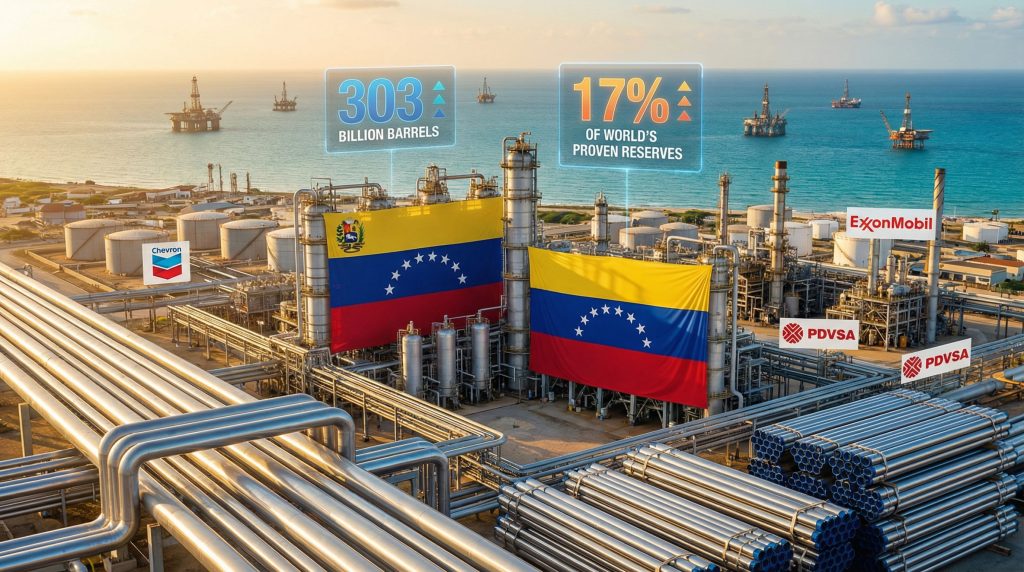
Venezuela possesses 303 billion barrels of proven oil reserves, representing 17% of global reserves according to US Energy Information Administration data. These reserves consist primarily of heavy-sour crude oil from the Orinoco Belt, which requires specialised processing infrastructure and presents unique technical challenges for extraction and refinement.
The heavy crude characteristics demand sophisticated refining capabilities, making development economically, environmentally, and technologically costly. Transportation requires mixing with diluents, while processing necessitates specialised refineries designed for heavy-sour crude specifications. Despite these complexities, Venezuela's geographic positioning offers significant advantages for US Gulf Coast refineries already equipped for heavy crude processing.
The petroleum sector's historical evolution reflects broader economic challenges. The oil industry underwent mostly nationalisation in 1976, with remaining privately operated fields nationalised in 2007. This transition eliminated foreign direct investment and contributed to technical workforce degradation, creating the current infrastructure crisis. In addition, these developments have had significant effects on the global iron ore market through reduced industrial demand.
When big ASX news breaks, our subscribers know first
What Investment Models Could Drive Venezuela's Oil Sector Revival?
Contemporary energy sector redevelopment requires unprecedented capital deployment across multiple phases, with private companies shouldering primary financial responsibilities. The investment framework must address immediate field rehabilitation while establishing long-term infrastructure capabilities for sustainable production growth.
Phased Capital Deployment Strategy
Initial rehabilitation efforts demand $10-20 billion over a two-year timeline, focusing on immediate field restoration and basic production capacity recovery. This phase emphasises restoring existing wells, repairing critical pipeline connections, and implementing emergency infrastructure repairs to stabilise current output levels.
Comprehensive infrastructure overhaul requires $100+ billion over a 10-year horizon, encompassing complete system modernisation. This extensive investment covers new drilling equipment, pipeline networks, refinery upgrades, and supporting infrastructure necessary for achieving historical production levels.
Private oil companies will directly finance infrastructure reconstruction, eliminating government funding requirements. This approach ensures rapid capital deployment while maintaining operational control over critical energy assets. Risk-adjusted return calculations indicate substantial profit potential despite significant upfront investment requirements. However, this strategy must consider potential US-China trade war impact on global investment flows.
Corporate Participation Framework
US petroleum companies possess strategic advantages for Venezuelan operations, particularly those with existing heavy crude processing capabilities. Companies with Gulf Coast refinery operations can efficiently process Venezuelan heavy-sour crude, creating integrated supply chain benefits.
Service companies including Halliburton and Baker Hughes will provide specialised infrastructure services essential for field development and production optimisation. Their technical expertise in complex petroleum operations proves crucial for overcoming Venezuela's unique geological and infrastructure challenges. For instance, recent studies by the Council on Foreign Relations suggest that "increasing Venezuela's oil output will take several years and billions of dollars" to achieve meaningful production levels.
Current crude oil transfers involve 30-50 million barrels from existing Venezuelan stockpiles, representing immediate energy supply opportunities. These initial transfers demonstrate system capabilities while larger infrastructure projects commence across multiple development phases.
How Will Steel Demand Transform Across Regional Markets?
US Venezuela oil infrastructure redevelopment will generate substantial steel demand across specialised product categories, particularly Oil Country Tubular Goods and pipeline infrastructure. Regional steel markets must adapt to accommodate increased production requirements while managing existing supply chain constraints.
Oil Country Tubular Goods Market Dynamics
OCTG casing and tubing demand will increase by an estimated 300,000-500,000 tonnes over 2-3 years as companies rebuild deteriorated well infrastructure. Current US pricing for OCTG API 5CT casing remains stable at $1,375-1,425 per short ton, unchanged since September 2025 despite ongoing market oversupply conditions.
Line pipe infrastructure requirements will grow by 200,000-350,000 tonnes over 3-5 years for pipeline reconstruction and expansion. ERW line pipe pricing maintains $1,400-1,450 per short ton, reflecting stable market conditions since October 2025.
| Steel Product Category | Estimated Demand Increase | Primary Suppliers | Timeline |
|---|---|---|---|
| OCTG Casing & Tubing | 300,000-500,000 tonnes | US Mills, Imports | 2-3 years |
| Line Pipe Infrastructure | 200,000-350,000 tonnes | North American Producers | 3-5 years |
| Structural Steel | 150,000-250,000 tonnes | Regional Suppliers | 1-2 years |
Structural steel demand will increase by 150,000-250,000 tonnes over 1-2 years for supporting infrastructure including processing facilities, storage systems, and transportation networks. This category encompasses broader construction requirements beyond petroleum-specific applications.
Regional Steel Market Repositioning
Venezuelan infrastructure rebuilding requires substantial steel imports since domestic production capacity remains insufficient. Market sources indicate that rebuilding the oil industry necessitates sourcing steel from US, European, or Chinese suppliers due to local manufacturing limitations.
US domestic OCTG markets may experience price stabilisation as Venezuelan demand absorbs chronic oversupply conditions that have persisted for four months. Persistently weak oil prices previously dampened OCTG and line pipe demand, but Venezuelan development could provide long-term demand catalysts, similar to what analysts have observed in the oil price rally analysis regarding market responses to geopolitical developments.
Brazil's steel export opportunities include slab pricing at $480-490 per tonne, remaining stable since December 2025. Brazilian producers may benefit from US-funded Venezuelan construction projects, creating indirect demand for Brazilian steel products in regional infrastructure development.
Mexican steel markets maintain stability with hot-rolled coil pricing at 13,638 pesos per tonne in Monterrey and 14,094 pesos per tonne in Bajio regions. While direct Venezuelan impact remains minimal due to limited trade relationships, broader regional demand growth may influence Mexican steel positioning.
What Are the Geopolitical Risk Scenarios for Energy Infrastructure Investment?
Political stability assessment frameworks must evaluate multiple risk factors affecting long-term investment security in Venezuelan energy infrastructure. Historical precedents of asset nationalisation create significant concerns for private investors considering substantial capital commitments.
Political Stability Assessment Framework
Current interim government structure under acting leadership requires careful evaluation regarding investment protection mechanisms. Long-term governance stability depends on establishing sustainable political frameworks beyond current administrative transitions.
Historical nationalisation events in 1976 and 2007 eliminated private sector participation, creating precedents for potential asset seizure. These expropriations represent the largest property transfers in regional history, demonstrating significant political risk factors for current investment considerations.
Investment Risk Warning: Venezuelan oil sector investments carry substantial political risks based on historical asset nationalisations. Investors should carefully evaluate protection mechanisms and potential loss scenarios before committing capital to infrastructure projects.
Sanctions Relief and Legal Framework Evolution
Current US sanctions modification requirements create complex legal environments for investment authorisation. Investment protection mechanisms must extend beyond current administrative policies to ensure long-term asset security across potential political transitions. Consequently, understanding the OPEC production impact on global pricing becomes essential for risk assessment.
Hydrocarbon law reforms prove essential for sustainable foreign investment frameworks. Legal structures must provide investor protections while establishing clear operational guidelines for petroleum sector participation. Moreover, analysts at S&P Global note that "Venezuela's oil industry is operating after US seizes Maduro", highlighting the complex nature of current operational realities.
Which Market Scenarios Offer the Highest Strategic Value?
Strategic scenario modelling reveals three primary pathways for Venezuelan oil infrastructure redevelopment, each presenting distinct risk-return profiles and market implications. Investment decisions must consider multiple development scenarios while maintaining flexibility for changing conditions.
Optimistic Scenario: Full Infrastructure Revival
Full infrastructure revival could achieve 2.5-3.0 million barrels per day production capacity by 2035, requiring $150+ billion total private investment over 15 years. This scenario assumes stable political conditions, consistent regulatory frameworks, and sustained international investment commitment.
Regional energy security enhancement for the Western Hemisphere represents strategic value beyond financial returns. Combined US-Venezuela reserves would constitute 55% of global petroleum reserves, substantially reducing dependence on Middle Eastern and other international suppliers.
Conservative Scenario: Limited Rehabilitation
Limited rehabilitation approach targets 1.5-1.8 million barrels per day production plateau by 2030, requiring $50-75 billion investment with selective field development. This scenario emphasises existing infrastructure optimisation rather than comprehensive system reconstruction.
Focused development on proven reserves minimises technical risks while providing reasonable return opportunities. Conservative investment levels reduce exposure to political instability while maintaining meaningful production increases.
Risk Scenario: Political Instability Impact
Political instability scenarios encompass investment delays due to governance uncertainties, partial asset nationalisation risks, and regional energy supply disruption potential. These outcomes would significantly impact return calculations and regional energy security planning.
Investor protection mechanisms prove critical for mitigating political risks across all scenarios. Legal frameworks must provide adequate safeguards for substantial capital commitments required for meaningful infrastructure development.
How Will This Reshape Latin American Steel Trade Patterns?
Brazilian steel industry participants identify potential opportunities as US investment programmes expand across Latin America. The largest regional economy could benefit from increased demand for construction steel in US-funded Venezuelan infrastructure projects.
Brazil's Strategic Positioning
Construction steel demand for Venezuelan projects may create new export opportunities for Brazilian producers currently facing domestic market headwinds. Import pressures in 2025 created pricing challenges, but Venezuelan development could provide alternative demand sources.
Brazilian distributors anticipate potential political implications affecting investment climates. Market participants suggest that Venezuelan developments might influence Brazilian political landscapes, potentially affecting both domestic and foreign investment patterns in the steel sector.
Credit line mobilisation for Venezuelan projects indicates early financing mechanisms are being structured. Brazilian steel producers may benefit from these development programmes through direct construction material supply contracts.
Mexico's Competitive Landscape Evolution
Mexican steel markets face minimal direct impact from Venezuelan developments due to limited historical trade relationships. However, broader regional demand growth could influence Mexico's strategic positioning as overall steel consumption increases across Latin America.
USMCA renegotiation scheduled for 2026 creates additional uncertainties for Mexican steel trade patterns. Recent Mexican tariff implementations on Asian steel goods represent attempts to counter transshipment while improving positioning for trade agreement discussions.
Steel transshipment countermeasures demonstrate Mexican efforts to align with US trade preferences. These policy adjustments may strengthen Mexico's negotiating position during upcoming USMCA discussions while addressing US concerns about unfair trade practices.
The next major ASX story will hit our subscribers first
What Timeline Should Investors Expect for Market Impact?
Infrastructure redevelopment timelines span multiple phases, each presenting distinct investment opportunities and market implications. Understanding development sequences proves essential for strategic planning across steel supply chains and energy market positioning.
Short-Term Developments (6-18 months)
Initial crude oil transfers from existing stockpiles provide immediate supply opportunities while longer-term infrastructure projects commence. Emergency infrastructure repairs focus on stabilising current production levels and preventing further deterioration.
Steel procurement contracts for immediate rehabilitation needs will commence within months, creating early demand for OCTG, line pipe, and structural steel products. These contracts represent initial market opportunities before larger infrastructure projects begin.
Medium-Term Transformation (2-5 years)
Major pipeline and refinery reconstruction projects will commence during this period, generating sustained steel demand growth for energy infrastructure. Production capacity expansion targeting 1.5+ million barrels per day requires substantial infrastructure investments.
Sustained steel demand growth will benefit multiple product categories as comprehensive reconstruction proceeds. Regional supply chains must adapt to accommodate increased production requirements while maintaining quality standards for petroleum industry applications.
Long-Term Strategic Outcomes (5-15 years)
Full-scale oil sector modernisation and expansion could transform regional energy markets through comprehensive supply chain integration with North American markets. Production levels approaching historical peaks require complete infrastructure reconstruction. In this context, the US Venezuela oil infrastructure redevelopment becomes pivotal for achieving regional energy independence goals.
Regional energy market rebalancing will affect global petroleum pricing and supply security. Western Hemisphere energy independence becomes achievable through combined US-Venezuela production capabilities, reducing reliance on other international suppliers.
Frequently Asked Questions About Venezuela Oil Infrastructure Redevelopment
How much will US companies invest in Venezuelan oil infrastructure?
Private US oil companies plan to invest at least $100 billion over the next decade, with initial phases focusing on $10-20 billion for immediate field rehabilitation and basic infrastructure repairs. These investments will be funded directly by oil companies rather than government financing.
Which steel products will see the highest demand increase?
Oil Country Tubular Goods, including casing and tubing, along with line pipe for pipeline infrastructure, are expected to experience the most significant demand growth. OCTG requirements may increase by 300,000-500,000 tonnes over 2-3 years as companies rebuild Venezuela's deteriorated oil transportation and production systems.
What risks do investors face in Venezuelan oil projects?
Key risks include political instability beyond current administrative periods, potential asset nationalisation based on historical precedents from 1976 and 2007, ongoing sanctions complications, and the need for specialised heavy crude oil refining capabilities. Investment protection mechanisms prove essential for managing these substantial risks.
Strategic Implications for Global Energy Security
Western Hemisphere energy independence represents the most significant strategic outcome from Venezuelan oil infrastructure redevelopment. Combined US-Venezuela petroleum reserves could fundamentally alter global energy balance while enhancing regional supply security.
Western Hemisphere Energy Independence
Combined reserves representing 55% of global petroleum would substantially reduce North American dependence on Middle Eastern and other international suppliers. This concentration of reserves within allied territories provides unprecedented energy security opportunities. Furthermore, the US Venezuela oil infrastructure redevelopment could serve as a catalyst for broader regional energy cooperation.
Strategic petroleum reserve diversification opportunities emerge through Venezuelan production capacity restoration. Regional refining infrastructure optimisation for heavy crude processing creates integrated supply chains reducing transportation costs and supply disruption risks.
Long-Term Market Stabilisation Potential
Global oil price stabilisation through increased Western Hemisphere production could moderate energy cost volatility affecting multiple economic sectors. Enhanced regional production capacity provides buffer against international supply disruptions.
Energy infrastructure redevelopment in Venezuela represents transformative opportunities across multiple sectors, particularly steel manufacturing and petroleum production. Success depends on managing substantial political risks while maintaining long-term investment commitments necessary for comprehensive infrastructure restoration. Additionally, the US Venezuela oil infrastructure redevelopment must be considered within the broader context of evolving global trade relationships and regional security concerns.
Disclaimer: This analysis contains forward-looking projections and investment scenarios that involve substantial uncertainties. Political developments, regulatory changes, and market conditions may significantly affect actual outcomes. Investors should conduct thorough due diligence and consider professional advice before making investment decisions related to Venezuelan energy infrastructure projects.
Ready to Capitalise on Venezuela's Energy Infrastructure Transformation?
Discovery Alert's proprietary Discovery IQ model delivers real-time alerts on significant ASX mineral discoveries, instantly empowering subscribers to identify actionable opportunities ahead of the broader market as global energy dynamics reshape commodity demand. Begin your 30-day free trial today and secure your market-leading advantage in identifying the next major discovery that could benefit from Venezuela's infrastructure developments.