June 3, 2026
The Engineering Ambition Behind One of the Andes' Largest Copper-Gold Expansions
Porphyry copper-gold systems have long defined the economic backbone of Andean mining, but converting their full geological potential into sustained production output is rarely straightforward. The transition from near-surface oxide mineralisation to deeper, more complex sulphide zones represents one of the most capital-intensive and technically demanding inflection points in any large-scale copper district's development arc. It is at precisely this juncture that the Vicuña Stage 3 Filo del Sol Deposit Sulphides project becomes strategically significant, not just for its operators, but for those watching the broader trajectory of the copper supply crunch in Latin America.
When big ASX news breaks, our subscribers know first
Understanding the Three-Stage Development Architecture of the Vicuña District
The Vicuña copper-gold district, straddling the high-altitude border zone between Argentina and Chile, is being developed through a structured, sequenced framework. Vicuña Corp., the joint venture entity responsible for coordinating district-scale development, has organised this progression into three distinct phases, each building on the infrastructure and knowledge base of the previous one.
Stages 1 and 2 are anchored by the Josemaría deposit, which forms the processing and infrastructure nucleus of the district. These earlier phases establish concentrator capacity, water supply systems, power connectivity, and transport corridors. Stage 3, by contrast, introduces a fundamentally different mineralogical challenge: the treatment of sulphide ore from the Filo del Sol deposit, which sits adjacent to the Josemaría system but requires a materially different processing pathway to extract its copper, gold, and silver content.
The distinction matters enormously from an investment and engineering perspective. Oxide copper mineralisation can often be processed through relatively lower-capital heap leach and solvent extraction-electrowinning (SX-EW) circuits, similar to modern copper leaching processes, to produce copper cathode. Sulphide mineralisation, however, demands flotation-based concentrator infrastructure to produce a mixed copper-gold-silver concentrate for smelting. This metallurgical distinction drives the majority of the capital and engineering complexity associated with the Vicuña Stage 3 Filo del Sol Deposit Sulphides expansion.
How Does the Stage 3 Concentrator Expansion Work?
From Three Lines to Five: The Engineering Logic Behind the Plant Upgrade
The existing Josemaría concentrator, established through Stages 1 and 2, operates across three processing lines. Stage 3 adds two additional lines, expanding the facility's total capacity and reconfiguring it to accept blended feed from both the Josemaría orebody and the Filo del Sol sulphide zone simultaneously.
The unit operations incorporated into the expanded plant span the full flotation processing chain:
- Primary and secondary stockpiling for ore blending and feed management
- Grinding circuits including SAG and ball mill configurations
- Rougher and cleaner flotation for initial copper-gold-silver mineral liberation
- Regrinding of flotation middlings to improve mineral liberation at finer particle sizes
- Thickening of concentrate and tailings streams for water recovery
- Tailings management infrastructure including deposition facilities designed for high-altitude conditions
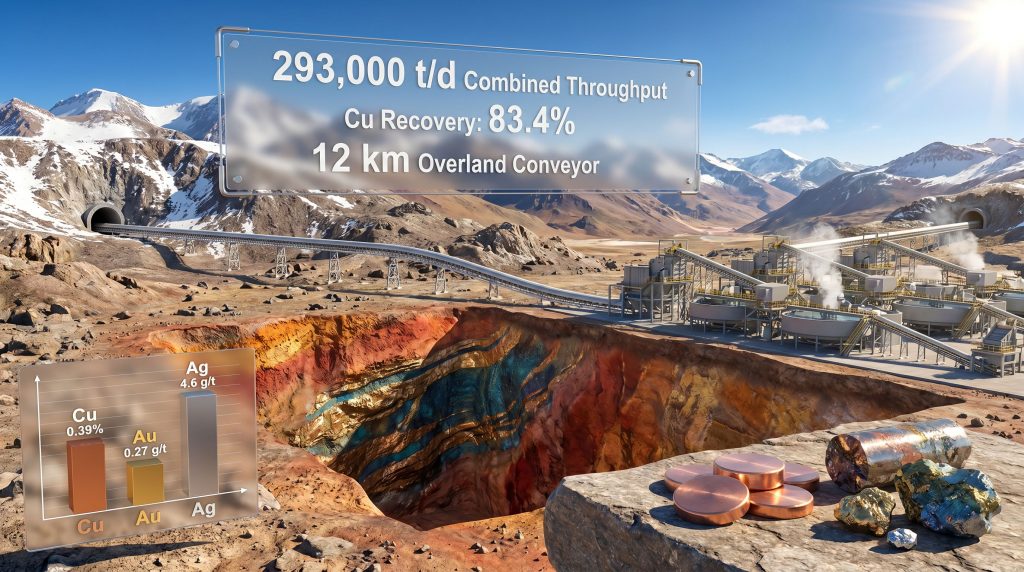
The combined throughput target across the integrated system is 293,000 tonnes per day, a figure that positions the Vicuña district among the highest-capacity copper processing operations in the Andean region when fully ramped up.
Stage 3 Infrastructure: The 12 km Overland Conveyor System
One of the most technically distinctive elements of the Vicuña Stage 3 Filo del Sol Deposit Sulphides project is its ore transport solution. Rather than constructing an extensive haul road network across the rugged high-altitude terrain separating the Filo del Sol mining zone from the concentrator, the project design incorporates a 12-kilometre overland conveyor system.
This conveyor passes through two tunnels bored through the Andean rock: one measuring 3.8 kilometres and the second 2.5 kilometres in length. Upstream of the conveyor, a crushing facility at or near the mine reduces ore to a conveyable size fraction before transfer.
Key Infrastructure Insight: The dual-tunnel conveyor configuration is a defining engineering feature of Stage 3, enabling ore movement across challenging Andean topography without the cost and environmental footprint of a haul road alternative. Long-distance covered conveyors also reduce dust emissions and weather-related operational disruptions at high elevation, where wind and precipitation conditions can be extreme.
From a geotechnical standpoint, tunnelling through high-altitude Andean geology introduces risks related to rock mass quality variability, groundwater ingress, and seismic activity. These factors require careful ground support design and monitoring throughout both construction and operation phases.
What Are the Filo del Sol Sulphide Resource Grades and Metallurgical Recoveries?
Life-of-Mine Head Grade Profile: Copper, Gold, and Silver
The Filo del Sol sulphide deposit carries a polymetallic grade profile that distinguishes it from many single-metal porphyry systems in the Andes. The initial Mineral Resource estimate, confirmed as part of Vicuña Corp.'s May 2025 resource announcement, underpins the following life-of-mine head grades:
| Metal | Life-of-Mine Head Grade |
|---|---|
| Copper | 0.39% Cu |
| Gold | 0.27 g/t Au |
| Silver | 4.6 g/t Ag |
A copper head grade of 0.39% is broadly consistent with large-scale porphyry deposits currently in development across the Andes, though it sits at the lower end of what smaller, higher-grade operations target. What differentiates Filo del Sol is the meaningful gold and silver co-product contribution. A gold grade of 0.27 grams per tonne alongside 4.6 g/t silver creates a genuine polymetallic revenue stream, which significantly improves the project's effective copper equivalent grade and provides natural revenue diversification across commodity price cycles.
For context, many Andean porphyry copper operations report gold credits that can offset 15–25% of total production costs when gold prices are elevated. At current gold price levels above USD 3,000 per ounce, the gold contribution at Filo del Sol takes on heightened economic significance. Furthermore, the Chile copper price outlook adds another layer of relevance for those assessing the broader district economics.
Metallurgical Recovery Performance: What the Technical Study Reports
The metallurgical test work programme supporting Stage 3 has produced the following life-of-mine average recovery estimates through the flotation concentrator circuit:
| Metal | Life-of-Mine Recovery Rate |
|---|---|
| Copper | 83.4% |
| Gold | 59.5% |
| Silver | 55.8% |
A copper flotation recovery of 83.4% is technically robust for a porphyry sulphide system of this scale. Well-optimised large-scale Andean concentrators operating on comparable ore types, such as those at Escondida and Collahuasi in Chile, typically report copper recoveries in the 80–88% range depending on ore hardness, grind size, and mineralogical complexity. Filo del Sol's recovery estimate sits comfortably within this benchmark range.
Gold and silver recoveries of 59.5% and 55.8% respectively are characteristic of bulk sulphide flotation circuits where precious metals are liberated alongside copper sulphides rather than recovered through cyanide leaching. In circuits that do not include a dedicated gold recovery stage, recoveries in the 55–65% range for gold are typical and should not be interpreted as a technical deficiency.
Technical Note: Investors assessing the economics of sulphide flotation projects should understand that gold and silver recovery rates in bulk flotation are structurally lower than those achievable in dedicated gold heap leach or carbon-in-pulp operations. The trade-off is that flotation circuits handle far higher throughput volumes, making total precious metal production volumes meaningful even at moderate recovery rates.
How Does Stage 3 Fit Into the Vicuña District's Long-Term Production Trajectory?
Peak Production Enablement and Feed Blending Strategy
Stage 3 is not a standalone operation but rather the mechanism through which the Vicuña district achieves and sustains its peak production capacity. As the Josemaría orebody matures and its oxide feed diminishes over the mine life, the sulphide feed from Filo del Sol progressively takes on greater importance as the dominant material stream entering the expanded concentrator.
The blending of Josemaría and Filo del Sol sulphide material through the five-line processing facility creates operational flexibility. Mine schedulers can adjust the proportional feed from each source to optimise head grade, manage metallurgical variability, and maintain consistent concentrate quality for offtake partners and smelters.
This transition from oxide-dominant to sulphide-dominant feed is a well-understood phenomenon in long-life copper district operations, but it requires careful capital phasing. Stage 3's capital intensity is expected to be materially higher than the earlier stages given the concentrator expansion, dual-tunnel conveyor system, and associated supporting infrastructure requirements.
Supporting Infrastructure Requirements Beyond the Concentrator
Sustaining a 293,000 tonne per day processing operation at high altitude in a water-scarce Andean environment requires infrastructure well beyond the processing plant itself. Key requirements identified for the broader Vicuña system include:
- Desalination plant capacity: Fresh water sourced from coastal desalination facilities, with a long-distance pipeline system transporting process water to the high-altitude site
- Port and maritime logistics: Copper-gold-silver concentrate will require export through a dedicated or shared port facility on the Chilean coast, with all the associated maritime logistics and storage infrastructure
- Dry port and inland transport corridors: Reagents, consumables, equipment, and personnel require reliable inland supply chains, likely utilising a combination of dry port facilities and road transport networks
- Power supply: A concentrator of this scale operating at high altitude, where air density affects both equipment performance and worker conditions, requires substantial and reliable power supply, likely drawing from grid connections or potentially dedicated power generation assets
What Makes the Vicuña District One of the Most Significant Copper-Gold Projects in Latin America?
Scale, Polymetallic Endowment, and Global Context
The Vicuña district's development ambition places it among a small cohort of genuinely district-scale copper-gold projects in the Andean copper belt. Very few projects globally are designed to process nearly 300,000 tonnes of ore per day. At this throughput, even modest head grades generate substantial annual metal production, and the polymetallic nature of the Filo del Sol deposit adds further dimension to the value proposition.
When ranked against major Latin American copper development projects currently in various stages of study or construction, Vicuña competes for attention alongside projects like Los Azules, the Reko Diq copper-gold project (though Pakistan-based), and the expanded phases of existing Chilean operations. What sets the Vicuña district apart is the combination of scale, geographic concentration of resources, and the structured three-stage development sequence that de-risks each successive phase by building on established infrastructure.
Regulatory and Permitting Landscape for a Binational Project
The cross-border nature of the Vicuña district introduces a layer of regulatory complexity not present in single-jurisdiction mining projects. Operations span the Argentina-Chile border zone, meaning the project must navigate two distinct environmental assessment regimes, two sets of water rights frameworks, separate royalty and fiscal structures, and Indigenous consultation requirements under both Chilean and Argentine law.
Indeed, the broader mining geopolitical landscape continues to shape how multinational projects of this nature are assessed by investors and regulators alike. Key regulatory considerations include:
- Environmental Impact Assessments (EIA) under Chile's Sistema de Evaluación de Impacto Ambiental (SEIA) for Chilean-side infrastructure, and Argentina's provincial environmental approval processes for the mining zone
- Water rights allocation in a water-scarce high Andean environment, where glacial and snowpack water sources are subject to strict protection regulations in both countries
- Indigenous consultation obligations under ILO Convention 169, which both Argentina and Chile have ratified, requiring formal engagement with communities whose territories may be affected by infrastructure development
- Cross-border infrastructure approvals for the overland conveyor and tunnel systems, which may require bilateral agreements or treaty-level coordination between the two governments
These regulatory pathways are complex and time-consuming, and represent genuine timeline risk for the Stage 3 development schedule.
The next major ASX story will hit our subscribers first
Frequently Asked Questions: Vicuña Stage 3 and Filo del Sol Sulphides
What is the Vicuña Stage 3 project?
The Vicuña Stage 3 Filo del Sol Deposit Sulphides project is the third and most advanced development phase of the Vicuña copper-gold district. It is designed to process sulphide mineralisation from the Filo del Sol deposit through an expanded five-line flotation concentrator, targeting a combined throughput of 293,000 tonnes per day across the integrated Josemaría and Filo del Sol processing system.
What metals does the Filo del Sol sulphide deposit contain?
The deposit contains copper, gold, and silver, with life-of-mine head grades of 0.39% Cu, 0.27 g/t Au, and 4.6 g/t Ag.
How is ore transported from Filo del Sol to the concentrator?
Ore is transported via a 12-kilometre overland conveyor that passes through two tunnels measuring 3.8 km and 2.5 km respectively, navigating the challenging high-altitude Andean terrain between the mine and processing facility.
What copper recovery rate is expected for the Filo del Sol sulphide processing?
The technical study results report a life-of-mine copper recovery of 83.4% through the flotation concentrator circuit, which is consistent with industry benchmarks for well-optimised large-scale porphyry sulphide operations.
Who is developing the Vicuña Stage 3 project?
Vicuña Corp. is the joint venture entity responsible for district-scale development across the Vicuña copper-gold system, including the Stage 3 Filo del Sol sulphide expansion.
Key Takeaways: Vicuña Stage 3 Filo del Sol Sulphides at a Glance
| Parameter | Detail |
|---|---|
| Project Stage | Stage 3 – Sulphide Processing Expansion |
| Target Throughput | 293,000 tonnes per day (combined) |
| Concentrator Lines | Expanded from 3 to 5 lines |
| Ore Transport | 12 km overland conveyor with dual tunnels (3.8 km + 2.5 km) |
| Cu Head Grade (LOM) | 0.39% |
| Au Head Grade (LOM) | 0.27 g/t |
| Ag Head Grade (LOM) | 4.6 g/t |
| Cu Recovery (LOM) | 83.4% |
| Au Recovery (LOM) | 59.5% |
| Ag Recovery (LOM) | 55.8% |
| Resource Estimate | Initial Mineral Resource estimate completed May 2025 |
The Vicuña Stage 3 Filo del Sol Deposit Sulphides project is best understood not as an isolated mining expansion, but as the long-duration production engine that completes the district's development logic. By unlocking the sulphide zones that underlie and extend beyond the oxide-dominant Josemaría operation, Stage 3 transforms what might otherwise be a finite oxide mining project into a multi-decade, high-throughput copper-gold district with genuine tier-one scale ambitions.
The combination of a technically sound flotation recovery profile, a meaningful polymetallic grade contribution from gold and silver, and an innovative dual-tunnel conveyor solution for ore transport positions the project as one of the more thoughtfully engineered large-scale copper developments currently advancing in the Andean copper belt. The path to production, however, runs through a complex regulatory landscape spanning two national jurisdictions, significant capital requirements, and the inherent challenges of high-altitude infrastructure construction. Investors and industry observers would do well to track both the technical milestones and the permitting timelines with equal attention.
This article contains forward-looking statements and technical estimates derived from publicly available project study information. Mineral resource estimates, metallurgical recovery projections, and production targets are subject to change as additional technical work is completed. Readers should not rely on this content as the basis for investment decisions and should consult qualified professionals and primary project disclosure documents before drawing conclusions about project economics or development timelines.
Want to Stay Ahead of the Next Major Copper-Gold Discovery on the ASX?
While district-scale projects like Vicuña capture attention at the development stage, the most significant investor returns in copper-gold have historically been captured at the moment of discovery — and Discovery Alert's proprietary Discovery IQ model delivers real-time ASX alerts the instant those announcements hit the market, turning complex mineralisation data into clear, actionable insights. Explore historic discovery returns to understand what early positioning in major copper-gold finds has meant for investors, and begin your 14-day free trial today to ensure you never miss the next one.