Viridis Mining and Minerals Ltd
- ASX Code: VMM
- Market Cap: $403,699,664
Viridis Demonstration Plant Exceeds PFS Recovery Assumptions
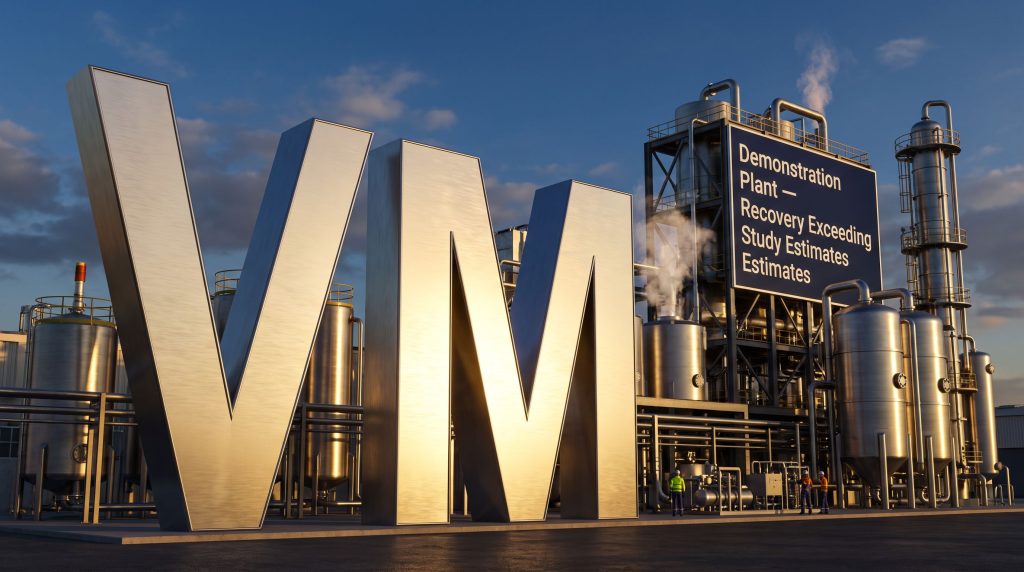
Viridis Mining and Minerals (ASX: VMM) has reported that its Colossus Demonstration Plant has achieved rare earth recoveries above the assumptions built into its Pre-Feasibility Study (PFS), a result the company says supports the case for improved project economics as it finalises its Definitive Feasibility Study (DFS). The Viridis Mining and Minerals Colossus demonstration plant recovery results, published via ASX release on 23 July 2026, show average Magnetic Rare Earth Oxide (MREO) recoveries for the month reaching 79%, with Total Rare Earth Oxide (TREO) recoveries averaging 64%.
These figures compare with PFS assumptions of 76% MREO and 57% TREO. Peak MREO recovery during July reached 80.9%. The DFS is due for completion in August 2026.
When big ASX news breaks, our subscribers know first
Recovery Results Measured Against PFS Assumptions
The difference between what a PFS assumes and what a demonstration plant actually delivers is closely watched in project development, as it provides an early indication of whether a proposed operation is likely to perform in line with, above, or below its feasibility study economics.
| Metric | PFS Assumption | July 2026 Demo Plant Average | July 2026 Peak |
|---|---|---|---|
| MREO Recovery | 76% | 78.8% | 80.9% |
| TREO Recovery | 57% | 64.0% | 68.9% |
The average MREO outperformance of approximately 3 percentage points, with peak results more than 4 points above the PFS assumption, is considered notable given that MREO comprises neodymium, praseodymium, dysprosium and terbium. These elements are used in permanent magnets for electric vehicle motors and wind turbines and represent the higher-value component of the rare earth suite produced from the Colossus flowsheet.
"Every percentage point improvement in recovery translates directly into higher rare earth production from the same ore feed, creating the potential for meaningful improvements in project economics as we progress towards the DFS." — Managing Director Rafael Moreno
Conservative Test Conditions Using Early-Stage Mine Feed
A detail relevant to interpreting these results is the source of the ore used in testing. Rather than using the highest-grade material available, Viridis sourced run-of-mine (ROM) feed from trenches CW-01 and CW-02 in the Northern Concessions — the pits expected to supply feedstock during the first 18 to 24 months of commercial operations.
| Feed Source | Ore Tonnes | TREO (ppm) | MREO (ppm) |
|---|---|---|---|
| Trench CW-01, Northern Concessions | 557t | 2,794 | 803 |
| Trench CW-02, Northern Concessions | 569t | 2,933 | 802 |
| PFS Life of Mine Average (9 July 2025) | 98.5Mt | 3,380 | 936 |
The grades from the Northern Concessions sit below the PFS life-of-mine average. Consequently, Viridis states that achieving MREO recoveries above PFS assumptions on this comparatively lower-grade feed adds a layer of conservatism to the data being carried into the DFS financial model.
How the Demonstration Plant Works
What Is a Demonstration Plant and Why Does It Matter?
A demonstration plant is a scaled-down version of a proposed commercial facility, built to test a process flowsheet under continuous, real-world operating conditions before a company commits capital to a full-scale build. This differs from laboratory test work, which is typically conducted in batches on prepared samples rather than through sustained, round-the-clock operation on ROM ore.
The Colossus Demonstration Plant processes 100 kilograms per hour of clay feed and is described by the company as one of the largest of its kind operating outside China on a continuous, semi-industrial basis. According to the announcement, the facility includes:
- Automated Programmable Logic Controller (PLC) systems supporting unattended 24-hour operation
- Integrated water and reagent recycle circuits supporting zero liquid discharge
- An on-site laboratory used to test feed blends, pH ranges and ore types
- Independent verification through the SGS laboratory in Belo Horizonte
- Power BI data visualisation tools used to support engineering decisions
Why Does Continuous Operation Matter?
Batch test work can obscure variability that only becomes apparent under sustained operating conditions. Maintaining steady-state production over an extended period, while recording recoveries above PFS assumptions, is considered by the company to be a more rigorous test of the flowsheet than laboratory-scale work alone. The Viridis Mining and Minerals Colossus demonstration plant recovery results are, in this regard, particularly meaningful precisely because they reflect continuous operation rather than controlled batch conditions.
Process Improvements Implemented and Further Work Planned
Viridis reports that the recovery gains recorded in July 2026 followed a series of process refinements made over the two months since the plant's start-up. According to the announcement, these included the following areas.
MREC Precipitation
Adjustments to shear, pH control and recycle rates are reported to have improved particle size distribution and filter cake quality in the Mixed Rare Earth Carbonate (MREC) precipitation circuit.
MREC Filtration
A better understanding of cycle times and cake discharge has, according to the company, produced more consistent moisture content and colour in filter cakes.
Residue Filtration
Optimisation of cycle times, feed pressure and drying stages has generated filter cakes described as suitable for mine backfilling, which the company states supports its sustainability approach and simplifies residue management design for the commercial plant.
Counter Current Decantation (CCD) Circuit
Improvements to flocculation, feed mixing and feed dilution are reported to have improved both underflow solids content and overflow clarity, which in turn is said to reduce clay carryover into the MREC product.
Furthermore, the company has stated that several additional optimisation initiatives have not yet been implemented, indicating that the recovery figures reported for July 2026 may not represent the final performance ceiling ahead of DFS completion.
Glossary of Key Terms
| Term | Definition |
|---|---|
| MREO | Magnetic Rare Earth Oxides, comprising Nd₂O₃ + Pr₆O₁₁ + Dy₂O₃ + Tb₄O₇. Used in permanent magnets. |
| TREO | Total Rare Earth Oxides, the full suite of rare earth elements expressed as oxide equivalents. |
| MREC | Mixed Rare Earth Carbonate, the saleable product produced from the Colossus process flowsheet. |
| PFS | Pre-Feasibility Study, an intermediate engineering and economic study assessing project viability. |
| DFS | Definitive Feasibility Study, the detailed study underpinning a Final Investment Decision. |
| CCD | Counter Current Decantation, thickeners used to wash and separate leached solids from rare earth-bearing solution. |
| ROM | Run-of-Mine, ore taken directly from the mine without selective grade control. |
| PLC | Programmable Logic Controller, an industrial computer used to automate plant operations. |
| Amsul | Ammonium Sulphate, a reagent used in leaching that is recovered and recycled in the flowsheet. |
Product Qualification Progressing With Solvay
Alongside metallurgical testing, the Demonstration Plant is being used to generate product samples for qualification with Solvay, described in the announcement as Viridis's strategic offtake partner under a Letter of Intent signed in June 2026. High-grade MREC samples produced to specification have been shipped to Solvay's La Rochelle facility in France.
Solvay is one of the world's established rare earth separation companies, and its La Rochelle facility is a significant rare earth processing site in Europe. Product qualification with a counterparty of this profile is intended to provide independent validation that MREC produced by the Colossus flowsheet meets specifications required by downstream processors.
CPTR Facility Hosts Technical Due Diligence
The Rare Earth Research and Processing Centre (CPTR) facility in Brazil, which houses the Demonstration Plant, has according to the announcement hosted:
- Technical due diligence by independent lenders' engineers supporting the Project Financing scope of the banking consortium
- Government and institutional delegations, including EU Commissioner Jozef Síkela
The presence of lenders' engineers conducting technical due diligence at the facility relates directly to the project financing process, as banking consortia typically require independent technical validation before committing to project finance for developments of this scale.
Next Steps Toward DFS and Final Investment Decision
Multiple workstreams are reported to be advancing in parallel as Viridis works toward completing its DFS and progressing toward a Final Investment Decision (FID).
| Activity | Status / Timeline |
|---|---|
| DFS financial modelling incorporating demo plant recoveries | Due for completion August 2026 |
| Further Demonstration Plant optimisation initiatives | Ongoing |
| MREC product qualification with Solvay | Samples shipped to La Rochelle, ongoing |
| Vendor and EPCM access to Demo Plant post-LNTP | Planned following long lead item orders |
| Project financing (banking consortium) | Technical due diligence underway |
| Final Investment Decision (FID) | Targeted in coming months |
The DFS financial model is expected to incorporate the recovery rates recorded at the Demonstration Plant. As these rates currently exceed PFS assumptions, the DFS economics may, subject to further study, reflect a different outcome to the PFS baseline.
The next major ASX story will hit our subscribers first
Why the Update Is Relevant to Investors
Viridis has outlined several elements it considers relevant to the Colossus Project's progress toward a Final Investment Decision. In summary, the key factors are as follows:
- Metallurgical performance ahead of study assumptions, with recoveries exceeding PFS figures at demonstration scale and further optimisation still to be implemented
- Conservative test conditions, with results achieved on feed grades below the PFS life-of-mine average
- Product qualification progressing with Solvay, a recognised rare earth separation company
- Financing activity underway, with independent lenders' engineers conducting technical due diligence on-site
- DFS completion targeted for August 2026, incorporating actual Demonstration Plant data
- Scale of the facility, described by the company as one of the largest continuous semi-industrial rare earth demonstration plants outside China
The Viridis Mining and Minerals Colossus demonstration plant recovery results represent a meaningful milestone, achieved under continuous 24-hour operation on comparatively lower-grade feed from early production pits. With the DFS due for completion in August 2026 and a Final Investment Decision targeted in the coming months, the company describes the current period as a significant phase in the Colossus Project's development.
Want to Know More About Viridis Mining and the Colossus Project?
With demonstration plant recoveries already exceeding PFS assumptions, a DFS due in August 2026, and a Final Investment Decision targeted in the coming months, Viridis Mining and Minerals (ASX: VMM) is advancing the Colossus Project through one of its most significant phases to date. Investors looking to understand what these results could mean for project economics and the path toward development should read the full ASX announcement. Click here to access the release directly.