Viridis Mining and Minerals Ltd
- ASX Code: VMM
- Market Cap: $426,600,146
Viridis Mining Produces First Rare Earth Carbonate at Colossus — A Milestone That Changes the Development Narrative
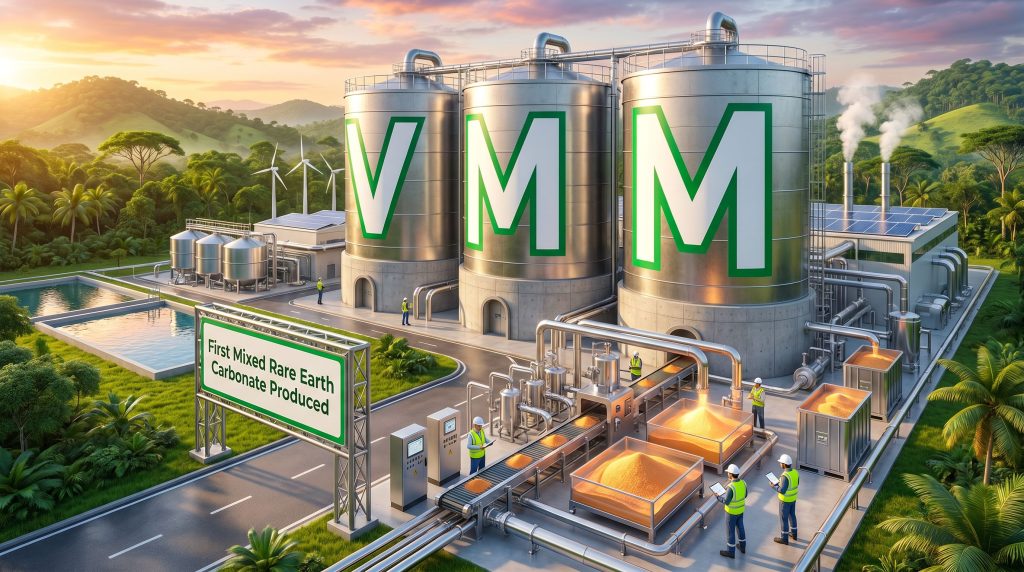
Viridis Mining and Minerals (ASX: VMM) has announced the production of its first batch of Mixed Rare Earth Carbonate (MREC) from its newly commissioned Demonstration Plant at the Rare Earth Research and Processing Centre (CPTR) in Poços de Caldas, Brazil. Viridis Mining and Minerals first rare earth carbonate production at Colossus Project Brazil, announced on 26 May 2026, marks a significant proof-of-concept milestone and represents a meaningful step forward in the company's journey toward commercial rare earth production targeted for 2028.
What makes this moment stand out is not just the production of MREC itself, but what it signals. Viridis has moved from a development-stage company with promising geology into one that can physically demonstrate its processing capability at scale, continuously, and from its own permanent facility.
When big ASX news breaks, our subscribers know first
What Was Produced — and Why It Matters
The MREC produced at the Demonstration Plant is enriched in some of the most commercially valuable rare earth elements in the world:
| Rare Earth Element | Symbol | Key Application |
|---|---|---|
| Neodymium | Nd | Permanent magnets (EV motors, wind turbines) |
| Praseodymium | Pr | Permanent magnets, high-strength alloys |
| Dysprosium | Dy | High-temperature permanent magnets |
| Terbium | Tb | High-efficiency magnets, green phosphors |
| Samarium | Sm | Samarium-cobalt magnets |
| Yttrium | Y | Electronics, phosphors, alloys |
| Gadolinium | Gd | MRI contrast agents, neutron capture |
This is not a generic rare earth product. The Colossus MREC is enriched specifically in heavy and light magnetic rare earth elements — the inputs at the heart of permanent magnet supply chains that underpin electric vehicles, wind turbines, and advanced defence technologies.
At nameplate capacity, the Demonstration Plant produces approximately 8 kilograms of MREC per day — enough to supply product samples to potential offtake partners while simultaneously supporting internal laboratory verification and process optimisation.
The Demonstration Plant — Scale, Sophistication, and Strategic Intent
The CPTR facility is not a modest pilot setup. Viridis designed and built what it believes to be one of the largest known semi-industrial, continuous operation ionic clay rare earth processing plants outside China, operating at a throughput of 100 kilograms of clay feed per hour.
That deliberate choice of scale matters considerably. In collaboration with engineering firm Hatch, prospective offtake partners, and key equipment suppliers, Viridis elected to bypass a smaller pilot plant in favour of a larger-scale Demonstration Plant — a strategy explicitly aimed at minimising scale-up risk and accelerating commercial readiness.
Key Technical Features of the Plant
- Feed capacity: 100 kg/hr of run-of-mine ore from the Colossus Northern Concessions
- Process flow: Ore preparation → leaching and desorption → solid-liquid separation → impurity removal → rare earth precipitation
- Automation: Fully integrated Programmable Logic Controller (PLC) system enabling continuous operation and real-time data capture
- Zero Liquid Discharge (ZLD): Complete recycling of process water and reagent regeneration (Ammonium Bicarbonate into Ammonium Sulphate), minimising environmental impact
- Residue management: Dewatered and washed filter cake suitable for mine backfilling — aligned with best-practice sustainability standards
- Equipment sourcing: All major equipment packages sourced from the same large-scale industrial suppliers currently being assessed for the future commercial Colossus facility
That last point is particularly significant. By using Demonstration Plant equipment from the same vendors shortlisted for the commercial plant, Viridis is simultaneously validating its process and evaluating its Long Lead Item (LLI) suppliers — two critical de-risking activities running in parallel.
Understanding Ionic Clay Rare Earth Deposits — Why Colossus Is Different
What Is an Ionic Clay Rare Earth Deposit?
Unlike hard rock rare earth deposits that require energy-intensive crushing, grinding, and complex chemical separation, ionic clay deposits host rare earth elements adsorbed (attached) onto clay mineral surfaces. This means the rare earth elements can be extracted using a simple leaching process — essentially washing them off the clay using a mild reagent solution.
Why Does This Matter to Investors?
The processing simplicity translates directly into economics. Ionic clay flowsheets typically require fewer processing steps, less energy, and lower capital intensity compared to hard rock peers. This is precisely the characteristic that underpins the Colossus Project's positioning as a potentially low-cost rare earth producer.
The Demonstration Plant's rapid transition from commissioning to first MREC production — described by Managing Director Rafael Moreno as highlighting "the simplicity, scalability and robustness of the Colossus processing flowsheet" — provides real-world validation of that thesis, not just modelled projections.
Glossary of Key Terms
- MREC (Mixed Rare Earth Carbonate): A precipitated rare earth product that can be sold to refiners or separation facilities for further processing into individual rare earth oxides.
- Ionic Clay: A clay-hosted rare earth deposit where REEs are loosely bound to clay particles and recoverable via simple leaching.
- DFS (Definitive Feasibility Study): The highest-level technical and economic study before a final investment decision, incorporating validated engineering, cost, and process data.
- LLI (Long Lead Items): Equipment with extended manufacturing and delivery timeframes that must be ordered well in advance of construction commencement.
- ZLD (Zero Liquid Discharge): A water management approach where all process water is recycled, with no liquid waste discharged to the environment.
- PLC (Programmable Logic Controller): An industrial computer system that automates and controls plant operations.
What Comes Next — Milestones on the Path to 2028
With first MREC product now in hand, Viridis has a clear and near-term pipeline of catalysts ahead. Furthermore, the Demonstration Plant is not an end in itself — it is the engine driving several concurrent workstreams toward commercial production.
| Milestone | Target Timing |
|---|---|
| MREC sample supply to offtake partners (advanced discussions) | Underway / Near-term |
| DFS completion and final process parameter validation | End of June 2026 |
| Initial Long Lead Item (LLI) equipment orders placed | Q3 2026 |
| Viridion Recycling Demonstration Facility commissioning | Second half of 2027 |
| Commercial-scale first production at Colossus | 2028 (targeted) |
Several of these timelines are compressing simultaneously. The DFS — the definitive technical and economic blueprint for the commercial project — is targeted for completion by end of June 2026, less than five weeks away. Consequently, the Demonstration Plant is providing the final real-world operating data needed to validate those parameters with confidence.
Meanwhile, the Company states it remains on schedule for initial LLI orders in Q3 2026 — a procurement step that, once executed, begins converting the Colossus Project from a study into a construction-ready asset.
The Offtake Opportunity — Samples in Hand for Partners in Advanced Discussions
One of the most commercially consequential near-term outcomes of the Demonstration Plant's operation is the ability to supply physical MREC product samples to potential offtake partners. Viridis has confirmed it is currently in advanced discussions with potential offtake partners, and can now supplement earlier ANSTO-produced qualification samples with material generated from its own continuous-operation facility.
This material better reflects the characteristics and consistency of future commercial production. Offtake agreements are pivotal in rare earth project development. They provide revenue visibility for financing discussions, validate product quality and market acceptance, and significantly de-risk a project from the perspective of lenders and strategic investors.
The Demonstration Plant operationalises this process in a way that desktop studies simply cannot. In addition, Viridis Mining and Minerals first rare earth carbonate production at Colossus Project Brazil now positions the company to accelerate those commercial conversations with physical proof in hand.
"Viridis is now producing high-grade, heavy rare earth enriched MREC from its own permanent processing facility, enabling the Company to finalise offtake discussions, validate DFS operating parameters and further de-risk the pathway toward commercial production through the successful completion of this key proof-of-concept milestone."
— Managing Director Rafael Moreno
A Rare Capability in the Western Rare Earth Landscape
Context is important here. Viridis is not merely ticking a development box — it is demonstrating a capability that very few Western rare earth developers possess.
The ability to continuously process ionic clay material at semi-industrial scale into a saleable MREC product, from a company-owned permanent facility, outside China, is genuinely uncommon. Global rare earth supply chains remain heavily concentrated in China across mining, processing, and separation. Western developers with the technical infrastructure to process ionic clay at this scale represent a small and strategically relevant group.
The Demonstration Plant also lays the groundwork for a second future capability at the CPTR facility: the Viridion Recycling Demonstration Facility, designed to accommodate rare earth recycling operations and targeted to commence in the second half of 2027. This adds a future optionality dimension to the CPTR's strategic value.
The next major ASX story will hit our subscribers first
Why Investors Should Keep Viridis on Their Radar
Viridis Mining and Minerals first rare earth carbonate production at Colossus Project Brazil is the kind of milestone that can shift market perception of a rare earth developer. It transitions Viridis from a company with promising geology and compelling economics on paper into one that has physically demonstrated its processing pathway — continuously, at scale, from its own facility, using ore from its own project.
The investment case rests on several reinforcing pillars:
- Processing validation achieved: First MREC product from a continuous-operation plant confirms the Colossus flowsheet works as designed.
- DFS completion imminent: Final process parameter validation through the Demonstration Plant feeds directly into DFS completion targeted for end of June 2026.
- Offtake momentum: Physical product samples now available to partners in advanced discussions — a material step toward binding commercial agreements.
- LLI procurement on track: Initial equipment orders scheduled for Q3 2026 keep the construction timeline intact.
- 2028 production target: The sequencing of milestones — DFS → LLI orders → financing and offtake → construction → production — remains intact and moving.
- Sustainability embedded: ZLD water treatment, reagent recycling, and backfill-ready residue management reflect an operational design built for long-term community and regulatory acceptance.
- Rare earth element profile: MREC enriched in Dy, Tb, Nd, and Pr targets the most commercially critical elements for permanent magnet supply chains.
Key Takeaway:
"Viridis Mining and Minerals has crossed a critical threshold — from developer to demonstrated producer — with the delivery of its first MREC product at the Colossus Demonstration Plant. With the DFS targeted for June 2026, LLI orders expected in Q3 2026, and offtake discussions already advanced, the coming months represent a period of material de-risking and milestone delivery. For investors watching the Western rare earth development space, Viridis has established itself as one of a very small number of companies with the technical infrastructure to back up its project economics with real-world operating proof."
Ready to Dig Deeper Into Viridis Mining's Colossus Project?
Viridis Mining and Minerals (ASX: VMM) has just demonstrated it can produce high-grade, heavy rare earth enriched MREC from its own permanent processing facility in Brazil — a milestone that meaningfully de-risks the path to commercial production targeted for 2028. With the DFS due by end of June 2026, Long Lead Item orders scheduled for Q3 2026, and offtake discussions already advanced, the company is entering one of its most significant periods of milestone delivery. Investors seeking to understand the full technical and commercial detail behind the Colossus Demonstration Plant and what it means for VMM's development trajectory can access the original ASX announcement directly here.