
July 21, 2026
The Infrastructure Race Beneath Argentina's Shale Boom
Unconventional oil development operates on a fundamentally different economic logic than conventional drilling. In shale plays, the subsurface resource is rarely the limiting factor — it is the surface infrastructure, fiscal stability, and capital deployment certainty that determine whether a formation gets developed at scale or sits dormant for decades. This distinction sits at the heart of why Vista RIGI Vaca Muerta Bandurria Norte deserves analysis beyond the headline investment figure.
When a leading independent operator deliberately steps outside its established production hub to pursue a genuinely undeveloped 26,500-acre block with zero producing wells, the decision encodes a specific set of assumptions about risk, returns, and the durability of the regulatory environment. Understanding those assumptions reveals as much about Argentina's evolving investment landscape as it does about the company itself. Indeed, the broader geopolitical mining landscape across South America adds further context to why operators are scrutinising fiscal frameworks so carefully.
When big ASX news breaks, our subscribers know first
What Bandurria Norte Actually Represents: Project Snapshot
Before dissecting the strategic rationale, the scale of the Bandurria Norte project warrants clear framing. This is not an incremental bolt-on acquisition — it is a multi-year, greenfield shale development programme of a size that would reshape Vista's production profile entirely.
| Project Parameter | Detail |
|---|---|
| Block area | 26,500 acres |
| Vista ownership | 100% (operator) |
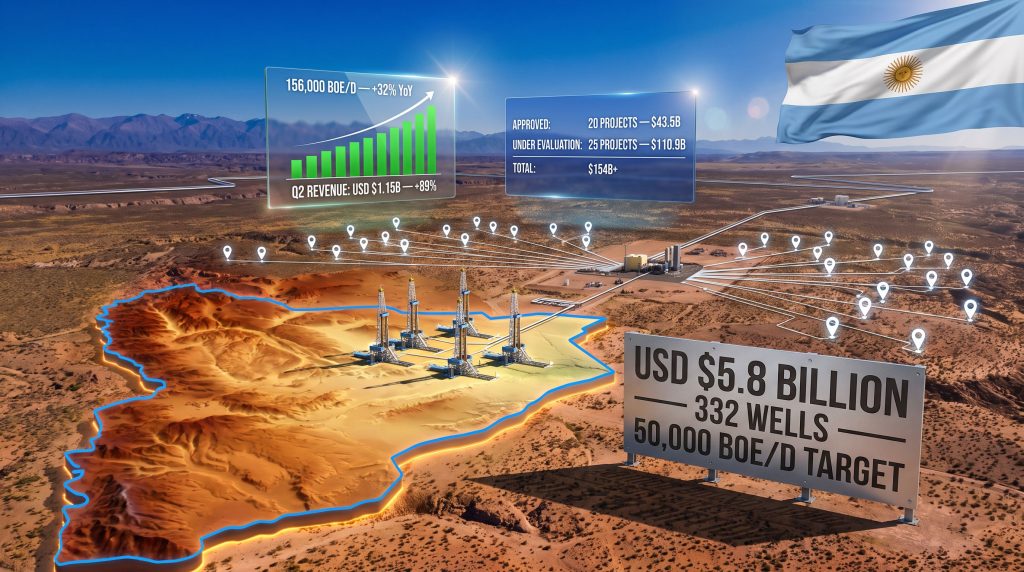
| Planned wells | 332 (drill and complete) |
| Target production | ~50,000 boe/d |
| Total capital commitment | USD $5.8 billion |
| Processing battery capacity | ~40,000 barrels/day |
| Additional infrastructure | Compression station, oil pipelines, gas pipelines |
| Current production status | No producing wells at time of application |
| Regime sought | RIGI (Large Investment Incentive Regime) |
Vista originally secured a 50% interest in Bandurria Norte from Wintershall DEA in 2022 before consolidating to full ownership and operatorship. This block sits within the volatile oil window of Vaca Muerta in Neuquén Province — the geological sweet spot that has driven Argentina's shale productivity gains over the past decade.
The volatile oil window is significant because it produces a liquids-rich hydrocarbon mix that commands premium export pricing relative to dry gas or heavy oil, making capital recovery timelines more predictable at current global crude prices.
Crucially, Bandurria Norte marks Vista's first development project outside its primary operational hub within the formation. That geographic and strategic leap is precisely why the fiscal architecture of RIGI matters so profoundly to this application.
How Argentina's RIGI Framework Changes the Greenfield Risk Equation
The Three Pillars That Make RIGI Relevant for Long-Cycle Projects
Argentina's Régimen de Incentivo para Grandes Inversiones (RIGI) was designed to address a specific market failure: the reluctance of capital-intensive industries to commit multi-billion-dollar investments in a jurisdiction with a history of policy reversals, currency restrictions, and shifting tax regimes. The regime's architecture targets these deterrents directly through three structural mechanisms:
- Fiscal stability for 30 years — protection against adverse changes to tax rates, royalty structures, or export duties for the duration of the project
- Foreign exchange flexibility — graduated rights allowing operators to retain and repatriate export revenues, reducing the currency risk that has historically been the single largest deterrent to energy investment in Argentina
- Regulatory certainty — streamlined approval pathways and explicit protection against retroactive policy shifts that could alter project economics after capital has been committed
For a greenfield block like Bandurria Norte — where the full 332-well drilling programme will span multiple budget cycles and the processing infrastructure must be built before peak production is achievable — a 30-year fiscal stability horizon is not a luxury. It is a structural precondition for the investment to generate risk-adjusted returns that compete with other global shale opportunities.
According to reporting from ADN Sur, Vista is accelerating investment plans across Vaca Muerta and preparing two projects for RIGI submission simultaneously, underscoring the strategic importance of the regime to the company's broader growth ambitions.
The RIGI Pipeline: Where Bandurria Norte Fits Among Peers
The RIGI approval pipeline as of mid-2026 reflects genuine large-scale capital interest across Argentina's resource sectors, concentrated overwhelmingly in hydrocarbons and critical minerals.
| RIGI Pipeline Category | Number of Projects | Estimated Investment (USD) |
|---|---|---|
| Approved projects | 20 | $43.5 billion |
| Under evaluation | 25 | $110.9 billion |
| Total pipeline | 45+ | $154+ billion |
Among the 25 projects under evaluation, oil and gas accounts for 12 initiatives and mining for 10, with energy, infrastructure, and technology comprising the remainder. Approved projects span 10 Argentine provinces: Neuquén, Río Negro, San Juan, Mendoza, Salta, Buenos Aires, La Pampa, Catamarca, Jujuy, and Santa Fe — indicating that the regime's geographic reach extends well beyond Vaca Muerta.
A useful benchmark for calibrating Bandurria Norte's scale within this pipeline is Pampa Energía's Rincón de Aranda project, approved as an upstream petroleum RIGI project in Neuquén with a committed investment of USD $4.5 billion. At USD $5.8 billion, Vista's application for Bandurria Norte positions it as one of the largest single upstream petroleum projects to enter the RIGI evaluation process. Furthermore, the commodity price impact on long-cycle energy projects reinforces why fiscal certainty through RIGI has become non-negotiable for operators of this scale.
Scenario Analysis: RIGI Approval vs. Delay
Base Case — Approval Granted: Vista accelerates capital deployment into Bandurria Norte, potentially compressing the drilling timeline for investments originally scheduled beyond 2030. The Águila Mora block — being simultaneously prepared for RIGI documentation — could enter the approval queue in parallel, creating a coordinated multi-asset expansion under the regime's protective framework.
Downside Case — Approval Delayed or Rejected: Bandurria Norte reverts to Vista's standard capital allocation cycle, likely deprioritised until Vaca Muerta infrastructure constraints ease and the project can meet internal return thresholds without fiscal incentives. The 332-well programme would be phased across a significantly longer timeline, potentially deferring peak production well into the mid-2030s.
Vista's Financial and Operational Capacity to Execute a $5.8 Billion Programme
Q2 2026 Performance Metrics: The Balance Sheet Behind the Bid
Any assessment of Bandurria Norte's credibility as an investment must be anchored in Vista's demonstrated operational and financial capacity. The company's Q2 2026 results provide the most current baseline.
| Performance Metric | Q2 2026 Result | Year-on-Year Change |
|---|---|---|
| Total production | 156,000 boe/d | +32% |
| Oil production | 135,000 barrels/day | +33% |
| Crude oil exports (Q2) | 8.6 million barrels | +54% |
| Export share of oil sales | 72% | — |
| Total revenue (Q2) | USD $1.15 billion | +89% |
| Adjusted EBITDA (Q2) | USD $805 million | +99% |
| Quarterly capital expenditure | USD $467 million | — |
| New wells connected (Q2) | 27 wells | — |
| Cumulative Argentina investment | ~USD $7 billion | — |
Vista's position as Argentina's largest independent oil producer and leading crude exporter was cemented following the acquisition of Petronas assets in April 2025. The subsequent acquisition of Equinor's Vaca Muerta assets in Q2 2026 further expanded its resource base and production capacity, confirming a pattern of aggressive inorganic growth layered on top of organic drilling activity.
The export-heavy revenue model — with 72% of oil sold internationally — is directly relevant to RIGI's foreign exchange retention provisions. For a company that generates the majority of its revenue in US dollars through international crude sales, the ability to retain and repatriate those earnings without being subject to Argentina's historically restrictive currency controls represents a meaningful reduction in effective project risk. However, challenges related to resource export infrastructure in comparable resource-rich jurisdictions demonstrate that physical evacuation bottlenecks can constrain even the most financially capable operators.
Capital Phasing Reality: How Does $5.8 Billion Get Deployed Against Quarterly EBITDA?
At an EBITDA run-rate of approximately USD $805 million per quarter, or roughly USD $3.2 billion annually, Bandurria Norte's total investment of USD $5.8 billion represents slightly under two years of current EBITDA generation. However, the capital deployment mechanics of a 332-well unconventional programme are more nuanced than a simple ratio suggests.
Shale development does not require front-loading the entire capital commitment. Wells are drilled, completed, and connected in tranches — typically organised around pad drilling programmes that optimise rig utilisation and completion efficiency. This means Bandurria Norte's USD $5.8 billion will be distributed across multiple annual capital budgets, with each tranche subject to oil price conditions, infrastructure availability, and balance sheet management priorities.
The infrastructure components add a sequencing constraint that is often underappreciated by observers focused on well count alone:
- The processing battery (designed for ~40,000 barrels of oil per day) must be operational before production from the initial well pads can be commercially evacuated
- The compression station is required to handle associated gas volumes as oil production ramps — without it, gas flaring or curtailment becomes a regulatory and commercial problem
- Oil and gas pipeline connections to existing Vaca Muerta trunk systems must be established to link Bandurria Norte's isolated acreage to evacuation and export infrastructure
This sequencing — build the evacuation and processing infrastructure first, then accelerate drilling — is characteristic of how greenfield unconventional blocks are developed globally. It also means the earliest years of the programme will be disproportionately weighted toward infrastructure capital rather than well-by-well production growth.
Vaca Muerta's Production Context and the Infrastructure Ceiling Risk
Argentina's Record Output and Its Implications for New Entrants
Argentina reached a record national oil output of 893,200 barrels per day in May 2026, driven predominantly by Vaca Muerta's shale growth trajectory. This figure contextualises Bandurria Norte's 50,000 boe/d production target: at full capacity, the block would contribute approximately 5.6% of Argentina's total current national oil production — a material addition from a single development.
For Vista specifically, the numbers are even more striking. Full Bandurria Norte production would increase the company's total output by roughly 32% above its Q2 2026 baseline of 156,000 boe/d, representing a transformational re-rating of its production profile. Consequently, the Vista RIGI Vaca Muerta Bandurria Norte project is arguably the most consequential single-block development currently in Argentina's upstream pipeline.
However, a significant structural risk sits beneath this growth trajectory. Reports circulating among Argentine provincial governors have flagged pipeline and processing capacity constraints as a potential ceiling on how quickly Vaca Muerta's new blocks can ramp to full production. This infrastructure bottleneck risk is not unique to Bandurria Norte — it affects the entire formation's development ambition — but it is particularly acute for greenfield blocks that lack existing evacuation connections.
The distinction between what Vaca Muerta can physically produce and what Argentina can currently evacuate and monetise on international markets is emerging as a critical constraint for the next wave of development. RIGI's incentive structure does not resolve this physical bottleneck — it accelerates the capital commitment that makes building the necessary infrastructure commercially viable.
The Águila Mora Parallel Track: A Coordinated Multi-Block Strategy
Vista's concurrent preparation of RIGI documentation for its Águila Mora block adds an important strategic dimension to the Bandurria Norte application. Rather than treating RIGI as a single-project regulatory exercise, Vista appears to be executing a coordinated multi-asset expansion strategy — seeking long-term fiscal protection across multiple undeveloped blocks simultaneously.
The strategic logic of this approach includes:
- Shared infrastructure potential between adjacent undeveloped blocks, reducing per-barrel capital costs for processing and evacuation
- Combined negotiating leverage across a larger investment portfolio during the RIGI evaluation process
- Timeline compression for investments originally planned post-2030, pulling future production forward under the regime's protective framework
If both Bandurria Norte and Águila Mora successfully enter the RIGI framework, Vista would control two of the most significant greenfield development programmes in Vaca Muerta simultaneously — a positioning that would materially differentiate its growth profile from peers operating primarily within already-developed acreage. This mirrors patterns observed across other Argentine resource sectors, where Argentina copper potential and critical mineral development are similarly benefiting from long-horizon fiscal frameworks.
Key Risks and Constraints Investors Should Monitor
Understanding the opportunity requires equal clarity on the variables that could alter Bandurria Norte's timeline or economics:
- Infrastructure evacuation capacity: The provincial-level bottleneck warnings are real and could delay production ramp regardless of how quickly drilling progresses
- RIGI evaluation timing: Formal government review introduces an approval timeline that remains uncertain and outside Vista's direct control
- Global oil price sensitivity: A 332-well programme spanning multiple years is inherently exposed to commodity price cycles that affect the economics of each drilling tranche
- Águila Mora interdependency: If both blocks share infrastructure planning assumptions, delays in one could cascade into the development sequencing of the other
- Balance sheet management: Sustaining USD $467 million in quarterly capital expenditure while simultaneously funding Bandurria Norte's infrastructure phase requires disciplined capital allocation across competing priorities
The next major ASX story will hit our subscribers first
What the RIGI Pipeline Signals About Argentina's Investment Trajectory
A USD $5.8 billion investment application functions as more than a corporate growth decision. It operates as a revealed preference signal from one of Vaca Muerta's most operationally sophisticated participants about confidence in Argentina's regulatory trajectory over a multi-decade horizon.
The broader RIGI pipeline — USD $154 billion in approved and pending projects across hydrocarbons, critical minerals, infrastructure, and ports — reflects Argentina's structural comparative advantage in global resource capital markets. The 25 projects under evaluation project 145,615 direct and indirect jobs, a multiplier effect that gives the regime political durability that transcends individual policy cycles.
Oil, gas, and mining collectively dominate the pipeline because these are sectors where Argentina possesses geological endowments that are genuinely competitive on a global basis. Vaca Muerta's volatile oil window, Catamarca's lithium brine resources, San Juan's copper and gold deposits — these assets do not depreciate when policy changes. In addition, Argentina's lithium brine market demonstrates the same pattern of long-horizon capital attraction that RIGI is now channelling into upstream petroleum. This is precisely why operators with long-cycle investment horizons are willing to commit capital under a framework designed to protect those horizons.
Econojournal reports that Vista is simultaneously elevating its 2026 production targets alongside the RIGI submissions, signalling that the company views regulatory approval and operational acceleration as complementary rather than sequential processes.
For Vista, the Vista RIGI Vaca Muerta Bandurria Norte programme represents the next logical chapter in a growth narrative that has seen cumulative Argentine investment reach approximately USD $7 billion. Whether the RIGI application translates into approved status — and at what pace the 332-well programme ultimately advances — will be determined by the evaluation process ahead. What is already clear is that the application itself marks a meaningful commitment to Vaca Muerta's next frontier of development, and that Vista's track record positions it as one of the few independents with the balance sheet and operational depth to execute a project of this scale.
This article is intended for informational purposes only and does not constitute financial or investment advice. Forward-looking statements regarding production targets, capital deployment, and project timelines involve assumptions and risks that may cause actual outcomes to differ materially from those described. Readers should conduct their own due diligence before making investment decisions.
Want to Stay Ahead of Major Resource Discoveries Before the Market Catches On?
While Vista's $5.8 billion Bandurria Norte programme illustrates the transformative scale of long-cycle resource investments, Discovery Alert's proprietary Discovery IQ model delivers real-time alerts the moment significant mineral discoveries are announced on the ASX — converting complex geological data into actionable opportunities for investors at every level. Explore historic discoveries and their exceptional market returns, then begin your 14-day free trial to ensure you're positioned ahead of the market when the next major find is announced.