Understanding the Market's Valuation Gap for Vulcan Energy ASX Stock
The Vulcan Energy ASX stock discount has created a striking disconnect between market pricing and fundamental asset values across developmental mining projects. This phenomenon becomes particularly pronounced when examining pre-revenue companies with substantial resource assets and integrated renewable energy components, where investment red flags often influence market sentiment.
Current Trading Mechanics Versus Theoretical Values
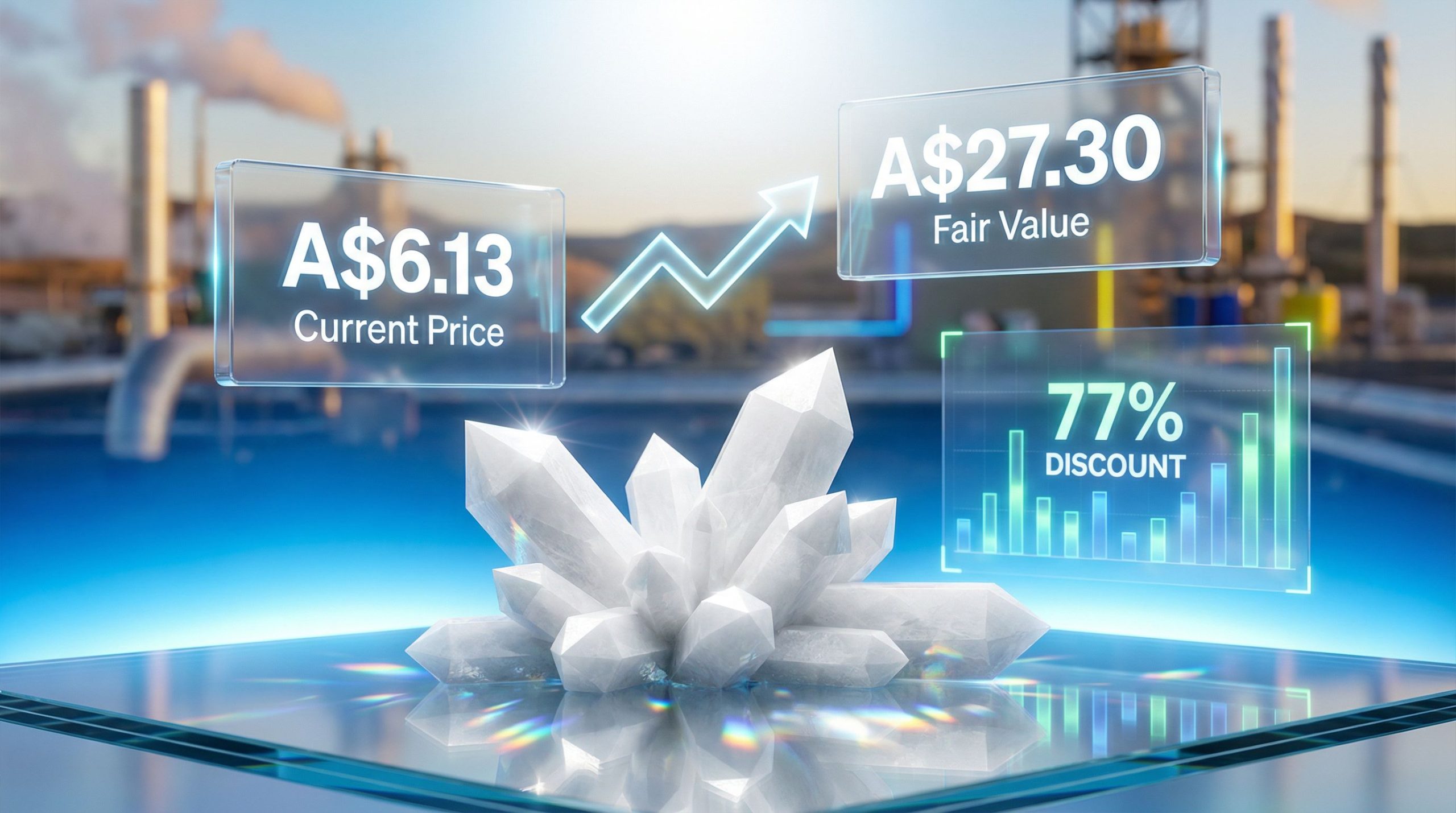
Vulcan Energy's recent institutional placement at A$4.00 per share represents a significant 34% discount to the previous trading price of A$6.31. The theoretical ex-rights price calculation suggests A$5.06 as the mathematical equilibrium following the capital raise structure.
This substantial discount reflects market dynamics beyond simple supply and demand mechanics. Furthermore, the institutional component successfully raised A$710 million, with an additional retail component targeting A$366 million to achieve approximately A$1 billion in total new equity.
The scale of this capital injection introduces 268 million new shares into the market structure, creating immediate dilution concerns. Market participants often observe sentiment-driven selling pressure following large institutional placements, particularly when the Vulcan Energy ASX stock discount exceeds 30% of the pre-announcement trading price.
Historical patterns suggest share prices frequently drift toward offer prices during post-placement absorption periods. This creates additional volatility for existing shareholders who may encounter various ASX capital raising methods throughout their investment journey.
The Discount Phenomenon in Pre-Revenue Mining Ventures
Developmental mining projects typically trade at substantial discounts to discounted cash flow (DCF) valuations due to execution risk premiums. The 21% discount to theoretical ex-rights pricing demonstrates market recognition of project completion uncertainties inherent in large-scale industrial developments.
Risk-adjusted valuation methodologies for pre-revenue mining companies incorporate multiple uncertainty factors:
- Technology validation risks associated with novel extraction methodologies
- Regulatory approval timelines affecting project commencement schedules
- Capital cost overrun potential during construction and commissioning phases
- Commodity price volatility impacting long-term revenue projections
The discount structure serves strategic purposes beyond immediate capital raising objectives. It maximises institutional participation rates, ensures funding certainty for multi-year project execution, and attracts European strategic partners seeking battery materials supply chain exposure.
Consequently, junior mining investments require careful analysis to distinguish between genuine value opportunities and potential value traps.
What Drives the Massive Valuation Disconnect in Vulcan's Stock?
Capital Structure Impact and Dilution Mathematics
The A$1 billion capital raise fundamentally alters Vulcan Energy's capital structure through the introduction of 268 million new shares at the A$4.00 placement price. This dilution mechanism, while necessary for project advancement, creates immediate per-share value compression that markets must absorb over extended periods.
Traditional dilution calculations demonstrate the mathematical impact on existing shareholders. Assuming pre-raise share count approximated 800 million shares, the new issuance represents approximately 25% dilution to existing holdings.
However, the funding certainty provided by this capital injection enables progression from development to construction phase. This represents material de-risking for long-term value creation, particularly for investors who understand the complexities of the broader lithium industry innovations currently emerging.
Execution Risk Premium in Current Market Pricing
Pre-revenue mining projects command higher risk premiums than cash-generating operations due to inherent completion uncertainties. Vulcan's geothermal-lithium extraction methodology represents novel technology requiring demonstrated commercial success before widespread investor confidence develops.
European permitting frameworks add regulatory complexity affecting project timelines. Unlike established mining jurisdictions with streamlined approval processes, integrated lithium-renewable energy facilities must navigate multiple regulatory authorities.
Construction and commissioning risks for the €2.2 billion Phase One financing package introduce potential cost overrun scenarios. Historical precedent for large-scale mining project development suggests budget overruns averaging 20-40% beyond initial estimates, creating additional uncertainty for investor returns.
Sector-Wide Valuation Compression Effects
Lithium price volatility has created investor fatigue across the entire battery materials sector, affecting both established producers and developmental projects. This has led to a notable contraction in Vulcan Energy's share price, reflecting broader market concerns about the sector.
Market preference has shifted toward cash-generating assets with demonstrated operational track records. This creates headwinds for pre-revenue ventures regardless of resource quality, affecting the overall Vulcan Energy ASX stock discount calculation.
Comparative analysis reveals that developmental mining projects across multiple commodities trade at substantial discounts to net present value calculations. This sector-wide phenomenon reflects:
- Investor scepticism toward long-term commodity price projections
- Capital allocation preferences for immediate cash returns over future potential
- Risk management frameworks favouring operational certainty over development upside
- Liquidity considerations affecting institutional investment mandates
How Do Vulcan's Financial Metrics Compare to Industry Standards?
Alternative Valuation Frameworks for Pre-Revenue Companies
Traditional price-to-sales ratios provide limited analytical value for pre-revenue companies like Vulcan Energy. This necessitates resource-based and project-specific valuation methodologies as part of broader investment strategy components.
Industry participants typically employ multiple valuation approaches to capture the full spectrum of value creation potential:
Resource-Based Valuation Metrics:
- Dollars per tonne of lithium equivalent in measured and indicated resources
- Comparative project basis using annual production capacity multiples
- NPV per tonne of planned lithium production capability
- Integrated renewable energy asset valuation components
The A$1 billion capital raise provides substantial cash runway for project advancement, addressing a critical risk factor. Post-raise financial position eliminates near-term financing concerns, allowing management focus on operational milestones rather than capital market activities.
Cash Position and Operational Runway Analysis
Following the institutional placement completion, Vulcan's cash position strengthens significantly with A$710 million confirmed funding. The company's massive capital raise provides operational runway through multiple project development phases.
| Financial Metric | Current Status | Strategic Implication |
|---|---|---|
| Cash Position | A$710M+ raised | Multi-year operational runway |
| Total Raise Target | ~A$1 billion | Phase One funding certainty |
| Phase One Requirements | €2.2 billion | Additional financing needed |
| Funding Gap | ~A$2.9 billion | Future capital requirements |
The €2.2 billion total Phase One requirement indicates future financing rounds will be necessary. However, the current capital raise positions the company to advance through critical development milestones that reduce overall project risk profile.
Monthly operational burn rate calculations become crucial for determining when additional capital may be required. In addition, development-phase mining companies typically experience accelerating cash consumption as projects advance toward construction commencement.
What Makes the Lionheart Project Worth A$3.9 Billion?
Production Scale and Strategic Positioning
The Lionheart Project's 24,000 tonnes per annum lithium hydroxide monohydrate capacity positions it as a significant supplier within European battery manufacturing supply chains. This production volume equates to approximately 500,000 electric vehicle batteries annually, based on standard lithium content assumptions.
Project Specifications and Timeline:
- Annual lithium hydroxide output: 24,000 tonnes per annum
- Electric vehicle supply equivalent: 500,000 batteries per year
- Operational timeline: 30-year mine life
- Geographic advantage: Located in Germany within EU regulatory framework
The 30-year operational horizon provides long-term cash flow visibility that underpins net present value calculations. Extended mine life economics reduce unit capital costs and enhance return on investment metrics compared to shorter-duration projects.
Integrated Renewable Energy Value Creation
Beyond lithium production economics, the Lionheart Project incorporates substantial renewable energy generation capabilities. These create additional revenue streams and differentiate it from conventional mining operations.
Annual Energy Generation Capacity:
- Renewable electricity: 275 gigawatt hours (GWh) annually
- Renewable heat: 560 gigawatt hours (GWh) annually for surrounding communities
- Carbon footprint: Zero-carbon lithium production methodology
- Market positioning: Europe's first fully integrated zero-carbon lithium development
The renewable energy component addresses European Union decarbonisation mandates while creating diversified revenue opportunities. Heat generation for surrounding communities establishes potential long-term offtake agreements that provide additional cash flow stability.
Strategic Value Proposition and Market Positioning
European market positioning provides strategic advantages beyond production economics. The project addresses EU battery supply chain security concerns while aligning with government policy objectives for domestic critical mineral production capabilities.
Strategic Value Drivers:
- First-mover advantage in European lithium production sector
- Sovereign supply security addressing geopolitical supply chain risks
- ESG investment appeal through zero-carbon production methodology
- Government and institutional backing supporting project development
Zero-carbon production methodology may command premium pricing relative to conventional lithium extraction processes. This pricing premium potential enhances long-term revenue projections supporting current project valuations, particularly among ESG-focused battery manufacturers seeking supply chain decarbonisation.
When Might Vulcan's Share Price Converge with Fair Value?
Critical Operational Milestones and Timeline
Share price convergence toward theoretical fair value typically correlates with operational milestone achievement that reduces project execution risks. The progression from development through construction to commercial production represents sequential de-risking events.
Key Development Milestones:
- Construction commencement following regulatory approval completion
- Technology demonstration validation for geothermal-lithium extraction methodology
- First lithium production marking transition to revenue-generating operations
- Renewable energy facility commissioning and grid connection
- Long-term offtake agreements with European battery manufacturers
Each milestone achievement reduces specific risk categories that markets currently price into the Vulcan Energy ASX stock discount. Construction commencement, in particular, demonstrates regulatory approval completion and financing adequacy, addressing two primary uncertainty factors.
Market Catalysts for Valuation Re-rating
External market factors beyond company-specific milestones may trigger valuation convergence toward fundamental values. Lithium market dynamics, European battery supply chain development, and ESG investment flows create multiple potential catalysts.
Potential Revaluation Catalysts:
- Lithium price recovery improving sector-wide investment sentiment
- European battery supply chain partnerships validating strategic positioning
- Government policy support for domestic critical mineral production
- ESG investment acceleration into zero-carbon production technologies
- Technology validation success reducing execution risk perceptions
Timing remains uncertain, but historical precedent suggests 12-24 month periods for major milestone achievement and market recognition. The current capital raising provides operational runway through multiple catalyst opportunities.
Should Investors View This Discount as an Opportunity or Warning?
Bull Case Scenario Analysis
The substantial discount presents potential opportunity for investors willing to accept development-phase execution risks. European lithium production scarcity creates strategic value that current market pricing may inadequately reflect.
Opportunity Factors:
- Early-mover positioning in European lithium production sector
- Integrated renewable energy revenue diversification beyond mining economics
- Government support for strategic mineral supply security
- Premium pricing potential for zero-carbon lithium products
- Long-term European battery demand growth trajectory
The A$1 billion capital raise provides funding certainty through critical development phases, reducing near-term financing risks. Strategic institutional participation suggests professional investor confidence in project fundamentals.
Bear Case Risk Assessment
Conversely, the discount may signal legitimate market concerns regarding execution risks and capital requirements. Multiple risk factors warrant careful consideration before investment decisions, particularly given the volatile nature of the Vulcan Energy ASX stock discount.
Risk Considerations:
- Technology execution uncertainty for novel geothermal-lithium extraction
- Capital cost overrun potential affecting project economics
- Regulatory approval delays extending development timelines
- Lithium market oversupply scenarios pressuring long-term pricing
- Additional financing requirements creating further dilution risk
The €2.2 billion total Phase One requirement substantially exceeds current capital raising. This indicates future financing rounds that may occur at unfavourable market conditions, creating ongoing uncertainty for existing shareholders.
Risk Management Strategies for Investors
Professional investors typically employ multiple risk management approaches when considering developmental mining investments with substantial execution risks and capital requirements.
Investment Approaches:
- Position sizing appropriate to risk tolerance and portfolio concentration limits
- Dollar-cost averaging during volatility periods to reduce timing risk
- Milestone-based investment linking additional purchases to de-risking events
- Sector diversification across multiple battery materials companies
- Timeline flexibility accepting 3-5 year investment horizons for value realisation
The current discount creates entry opportunity, but investors should maintain realistic expectations regarding timeline and volatility during project development phases. Furthermore, understanding the broader market context remains essential for informed decision-making.
Frequently Asked Questions About Vulcan's Valuation Discount
Why do DCF models show such high fair values?
Discounted cash flow models for developmental mining projects incorporate long-term production assumptions over 30-year operational horizons. Terminal value calculations significantly impact final valuations, particularly when applied to projects with extended operational timelines.
DCF Model Components:
- Long-term lithium price assumptions affecting revenue projections
- Discount rate applications reflecting project risk profiles
- Terminal value calculations based on operational continuity
- Integrated renewable energy cash flows beyond mining economics
Sensitivity analysis demonstrates substantial valuation ranges depending on commodity price assumptions and discount rate applications. Conservative investors may apply higher discount rates that reduce DCF valuations closer to current market pricing.
How does the recent capital raise affect valuation?
The A$4.00 placement price creates immediate dilution effects while providing funding certainty that reduces specific risk categories. Net valuation impact depends on execution success and timeline to commercial production.
Capital Raise Implications:
- Immediate dilution from 268 million new shares at discounted pricing
- Funding certainty reducing near-term financing risks
- Strategic investor participation providing validation and potential partnerships
- Share price support potential from institutional investor positions
Long-term valuation impact ultimately depends on successful project execution and achievement of production targets. These must justify current capital investment levels to overcome the existing Vulcan Energy ASX stock discount.
What would trigger a valuation re-rating?
Multiple factors could catalyse share price convergence toward fundamental valuations. Operational milestones represent the most direct catalysts for risk reduction and market confidence building.
Re-rating Catalysts:
- Regulatory approval completion enabling construction commencement
- Technology validation success reducing execution uncertainty
- Strategic partnership announcements with European battery manufacturers
- Construction milestone achievement demonstrating project advancement
- Market sentiment improvement across lithium sector participants
Timeline remains uncertain, but successful progression through development phases historically triggers gradual valuation re-rating. As project risks diminish and commercial production approaches, market recognition of fundamental value typically improves.
Disclaimer: This analysis is based on publicly available information and should not be considered investment advice. Mining investments involve substantial risks, including project execution uncertainty, commodity price volatility, and potential total loss of capital. Investors should conduct independent research and consider professional financial advice before making investment decisions.
Ready to Discover the Next Major Mineral Breakthrough?
Discovery Alert's proprietary Discovery IQ model delivers instant notifications on significant ASX mineral discoveries, empowering subscribers to identify actionable opportunities ahead of the broader market. Understand why major mineral discoveries can generate substantial returns by exploring Discovery Alert's dedicated discoveries page, showcasing historic examples of exceptional outcomes, and begin your 30-day free trial today to position yourself ahead of the market.